
Monday, January 4, 1982
Interview for The Times
Interview for the Times
Interview of Paul McCartney
Last updated on August 10, 2025
Monday, January 4, 1982
Interview of Paul McCartney
Last updated on August 10, 2025
Interview 1982 • Interview with BBC
Interview 1982 • Paul McCartney interview for Jamming!
Interview Jan 04, 1982 • Paul McCartney interview for The Times
Film Jan 13-18, 1982 • Shooting of "The Cooler" promo film
Next interview April/May 1982 • Paul McCartney interview for Music Express
Dec 07, 1985 • From The Times
Fab? If you say so, pop pickers
Apr 25, 1997 • From The Times
Sir Paul McCartney confronts the ghosts of his past
Nov 23, 2008 • From The Times
Paul McCartney: in love and back on the road
Dec 05, 2009 • From The Times
Paul and Mary McCartney on meat-free life, losing Linda and craving normality
Dec 22, 2021 • From The Times
This interview remains the property of the respective copyright owner, and no implication of ownership by us is intended or should be inferred. Any copyright owner who wants something removed should contact us and we will do so immediately.
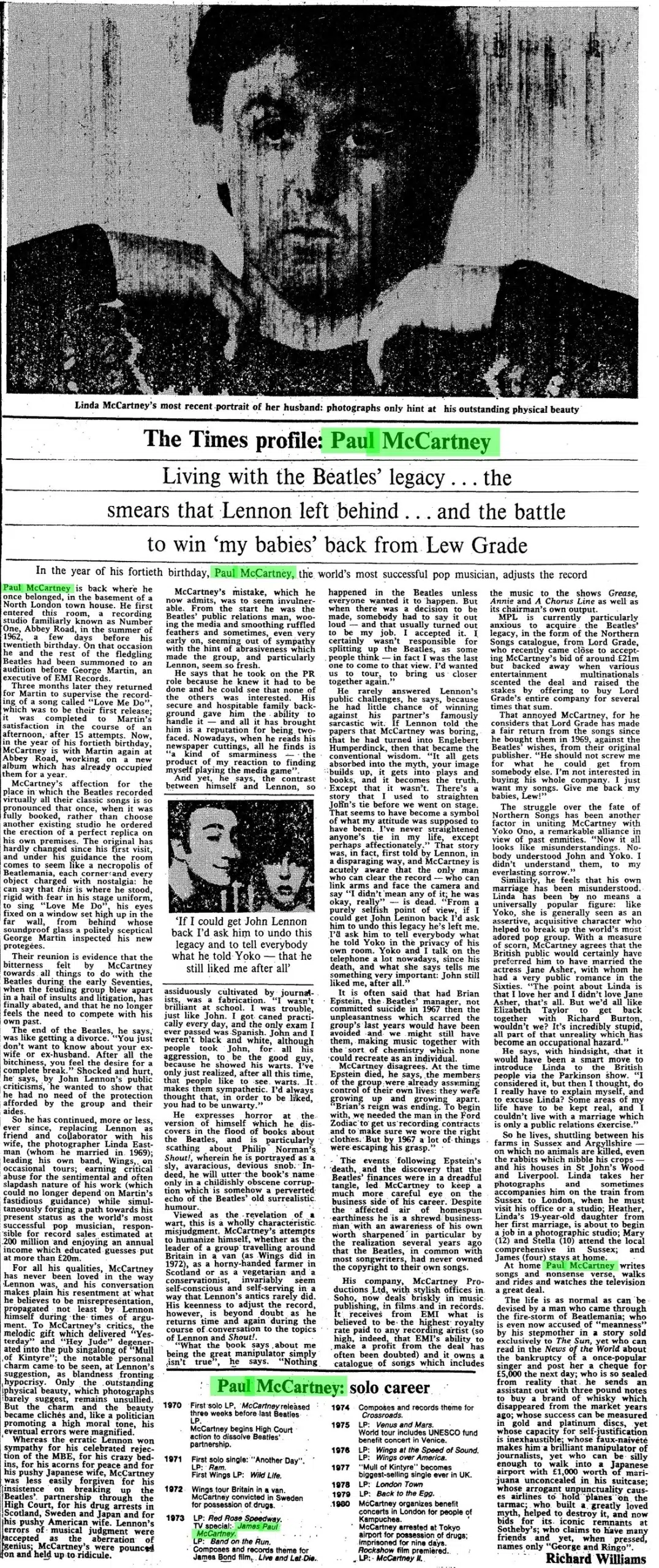
Paul McCartney is back where he once belonged, in the basement of a North London town house. He first entered this room, a recording studio familiarly known as Number One, Abbey Road, in the summer of 1962, a few days before his twentieth birthday. On that occasion he and the rest of the fledgling Beatles had been summoned to an audition before George Martin, an executive of EMI Records.
Three months later they returned for Martin to supervise the recording of a song called “Love Me Do”, which was to be their first release; it was completed to Martin’s satisfaction in the course of an afternoon, after 15 attempts. Now, in the year of his fortieth birthday, McCartney is with Martin again at Abbey Road, working on a new album which has already occupied them for a year.
McCartney’s affection for the place in which the Beatles recorded virtually all their classic songs is so pronounced that once, when it was fully booked, rather than choose another existing studio he ordered the erection of a perfect replica on his own premises. The original has hardly changed since his first visit, and under his guidance the room comes to seem like a necropolis of Beatlemania, each corner and every object charged with nostalgia: he can say that this is where he stood, rigid with fear in his stage uniform, to sing “Love Me Do”, his eyes fixed on a window set high up in the far wall, from behind whose soundproof glass a politely sceptical George Martin inspected his new protégés.
Their reunion is evidence that the bitterness felt by McCartney towards all things to do with the Beatles during the early Seventies, when the feuding group blew apart in a hail of insults and litigation, has finally abated, and that he no longer feels the need to compete with his own past.
The end of the Beatles, he says, was like getting a divorce.
“You just don’t want to know about your ex-wife or ex-husband. After all the bitchiness, you feel the desire for a complete break.”
Shocked and hurt, he says, by John Lennon’s public criticisms, he wanted to show that he had no need of the protection afforded by the group and their aides.
So he has continued, more or less, ever since, replacing Lennon as friend and collaborator with his wife, the photographer Linda Eastman (whom he married in 1969); leading his own band, Wings, on occasional tours; earning critical abuse for the sentimental and often slapdash nature of his work (which could no longer depend on Martin’s fastidious guidance) while simultaneously forging a path towards his present status as the world’s most successful pop musician, responsible for record sales estimated at 200 million and enjoying an annual income which educated guesses put at more than £20m.
For all his qualities, McCartney has never been loved in the way Lennon was, and his conversation makes plain his resentment at what he believes to be misrepresentation, propagated not least by Lennon himself during the times of argument. To McCartney’s critics, the melodic gift which delivered “Yesterday” and “Hey Jude” degenerated into the pub singalong of “Mull of Kintyre”; the notable personal charm came to be seen, at Lennon’s suggestion, as blandness fronting hypocrisy. Only the outstanding physical beauty, which photographs barely suggest, remains unchanged. But the charm and the beauty became clichés and, like a politician promoting a high moral tone, his eventual errors were magnified.
Whereas the erratic Lennon won sympathy for his celebrated rejection of the MBE, for his crazy bed-ins, for his acorns for peace and for his pushy Japanese wife, McCartney was less easily forgiven for his insistence on breaking up the Beatles’ partnership through the High Court, for his drug arrests in Scotland, Sweden and Japan and for his pushy American wife. Lennon’s errors of musical judgment were accepted as the aberration of genius; McCartney’s were pounced on and held up to ridicule.
McCartney’s mistake, which he now admits, was to seem invulnerable. From the start he was the Beatles’ public relations man, wooing the media and smoothing ruffled feathers and sometimes, even very early on, seeming out of sympathy with the hint of abrasiveness which made the group, and particularly Lennon, seem so fresh.
He says that he took on the PR role because he knew it had to be done and he could see that none of the others was interested. His secure and hospitable family background gave him the ability to handle it — and all it has brought him is a reputation for being two-faced. Nowadays, when he reads his newspaper cuttings, all he finds is “a kind of smarminess — the product of my reaction to finding myself playing the media game”.
And yet, he says, the contrast between himself and Lennon, so assiduously cultivated by journalists, was a fabrication.
“I wasn’t brilliant at school. I was trouble, just like John. I got caned practically every day, and the only exam I ever passed was Spanish. John and I weren’t black and white, although people took John, for all his aggression, to be the good guy, because he showed his warts. I’ve only just realized, after all this time, that people like to see warts. It makes them sympathetic. I’d always thought that, in order to be liked, you had to be unwarty.”
He expresses horror at the version of himself which he discovers in the flood of books about the Beatles, and is particularly scathing about Philip Norman’s Shout!, wherein he is portrayed as a sly, avaricious, devious snob. Indeed, he will utter the book’s name only in a childishly obscene corruption which is somehow a perverted echo of the Beatles’ old surrealistic humour.
Viewed as the revelation of a wart, this is a wholly characteristic misjudgment. McCartney’s attempts to humanize himself, whether as the leader of a group travelling around Britain in a van (as Wings did in 1972), as a horny-handed farmer in Scotland or as a vegetarian and a conservationist, invariably seem self-conscious and self-serving in a way that Lennon’s antics rarely did. His keenness to adjust the record, however, is beyond doubt as he returns time and again during the course of conversation to the topics of Lennon and Shout!.
“What the book says, about me being the great manipulator simply isn’t true,” he says. “Nothing happened in the Beatles unless everyone wanted it to happen. But when there was a decision to be made, somebody had to say it out loud — and that usually turned out to be my job. I accepted it. I certainly wasn’t responsible for splitting up the Beatles, as some people think — in fact I was the last one to come to that view. I’d wanted us to tour, to bring us closer together again.”
He rarely answered Lennon’s public challenges, he says, because he had little chance of winning against his partner’s famously sarcastic wit. If Lennon told the papers that McCartney was boring, that he had turned into Englebert Humperdinck, then that became the conventional wisdom.
“It all gets absorbed into the myth, your image builds up, it gets into plays and books; and it becomes the truth. Except that it wasn’t. There’s a story that I used to straighten John’s tie before we went on stage. That seems to have become a symbol of what my attitude was supposed to have been. I’ve never straightened anyone’s tie in my life, except perhaps affectionately.”
That story was, in fact, first told by Lennon, in a disparaging way, and McCartney is acutely aware that the only man who can clear the record — who can link arms and face the camera and say “I didn’t mean any of it; he was okay, really” — is dead.
“From a purely selfish point of view, if I could get John Lennon back I’d ask him to undo this legacy he’s left me. I’d ask him to tell everybody what he told Yoko in the privacy of his own room. Yoko and I talk on the telephone a lot nowadays, since his death, and what she says tells me something very important: John still liked me, after all.”
It is often said that had Brian Epstein, the Beatles’ manager, not committed suicide in 1967 then the unpleasantness which scarred the group’s last years would have been avoided and we might still have them, making music together with the sort of chemistry which none could recreate as an individual.
McCartney disagrees. At the time Epstein died, he says, the members of the group were already assuming control of their own lives; they were growing up and growing apart.
“Brian’s reign was ending. To begin with, we needed the man in the Ford Zodiac to get us recording contracts and to make sure we wore the right clothes. But by 1967 a lot of things were escaping his grasp.”
The events following Epstein’s death, and the discovery that the Beatles’ finances were in a dreadful tangle, led McCartney to keep a much more careful eye on the business side of his career. Despite the affected air of homespun earthiness he is a shrewd businessman with an awareness of his own worth sharpened in particular by the realization several years ago that the Beatles, in common with most songwriters, had never owned the copyright to their own songs.
His company, McCartney Productions Ltd, with stylish offices in Soho, now deals briskly in music publishing, in films and in records. It receives from EMI what is believed to be the highest royalty rate paid to any recording artist (so high, indeed, that EMI’s ability to make a profit from the deal has often been doubted) and it owns a catalogue of songs which includes the music to the shows Grease, Annie and A Chorus Line as well as its chairman’s own output.
MPL is currently particularly anxious to acquire the Beatles’ legacy, in the form of the Northern Songs catalogue, from Lord Grade, who recently came close to accepting McCartney’s bid of around £21m but backed away when various entertainment multinationals scented the deal and raised the stakes by offering to buy Lord Grade’s entire company for several times that sum.
That annoyed McCartney, for he considers that Lord Grade has made a fair return from the songs since he bought them in 1969, against the Beatles’ wishes, from their original publisher.
“He should not screw me for what he could get from somebody else. I’m not interested in buying his whole company. I just want my songs. Give me back my babies, Lew!”
The struggle over the fate of Northern Songs has been another factor in uniting McCartney with Yoko Ono, a remarkable alliance in view of past enmities.
“Now it all looks like misunderstandings. Nobody understood John and Yoko. I didn’t understand them, to my everlasting sorrow.”
Similarly, he feels that his own marriage has been misunderstood. Linda has been by no means a universally popular figure: like Yoko, she is generally seen as an assertive, acquisitive character who helped to break up the world’s most adored pop group. With a measure of scorn, McCartney agrees that the British public would certainly have preferred him to have married the actress Jane Asher, with whom he had a very public romance in the Sixties.
“The point about Linda is that I love her and I didn’t love Jane Asher, that’s all. But we’d all like Elizabeth Taylor to get back together with Richard Burton, wouldn’t we? It’s incredibly stupid, all part of that unreality which has become an occupational hazard.”
He says, with hindsight, that it would have been a smart move to introduce Linda to the British people via the Parkinson show.
“I considered it, but then I thought, do I really have to explain myself, and to excuse Linda? Some areas of my life have to be kept real, and I couldn’t live with a marriage which is only a public relations exercise.”
So he lives, shuttling between his farms in Sussex and Argyllshire — on which no animals are killed, even the rabbits which nibble his crops — and his houses in St John’s Wood and Liverpool. Linda takes her photographs and sometimes accompanies him on the train from Sussex to London, when he must visit his office or a studio; Heather, Linda’s 19-year-old daughter from her first marriage, is about to begin a job in a photographic studio; Mary (12) and Stella (10) attend the local comprehensive in Sussex; and James (four) stays at home.
At home Paul McCartney writes songs and nonsense verse, walks and rides and watches the television a great deal.
The life is as normal as can be devised by a man who came through the fire-storm of Beatlemania; who is even now accused of “meanness” by his stepmother in a story sold exclusively to The Sun, yet who can read in the News of the World about the bankruptcy of a once-popular singer and post her a cheque for £5,000 the next day; who is so sealed from reality that he sends an assistant out with three pound notes to buy a brand of whisky which disappeared from the market years ago; whose success can be measured in gold and platinum discs, yet whose capacity for self-justification is inexhaustible; whose faux-naïveté makes him a brilliant manipulator of journalists, yet who can be silly enough to walk into a Japanese airport with £1,000 worth of marijuana unconcealed in his suitcase; whose arrogant unpunctuality causes airlines to hold planes on the tarmac; who built a greatly loved myth, helped to destroy it, and now bids for its iconic remnants at Sotheby’s; who claims to have many friends, and yet, when pressed, names only “George and Ringo”.
Excerpts of the interview, not published in The Times’ printed version, were published in “The McCartney Legacy: Volume 1: 1969 – 73” published in 2022:
To me that’s precious. As a kid I used to get down on my hands and knees in dandelions and stuff. It’s a huge part of my being all that stuff—smelling soil, and woods—it was a huge part [of my childhood]. When I grew up I thought I’d left it behind. I thought it had all gone. But I started to realize that if I got down on my knees in a field I’d smell it again; because it hadn’t gone, it was just I’d moved away from it.
Paul McCartney – From “The McCartney Legacy: Volume 1: 1969 – 73” by Allan Kozinn and Adrian Sinclair, 2022
[About the “McCartney” Q&A] At the time it just seemed to me that it was answers to questions, and I was being bitchy. That’s for sure. I’ll admit that because we were all being bitchy. And that was my, sort of, weedy way of being bitchy. One of the questions is: What do you think of John and Yoko’s thing? And I said, ‘Well, it doesn’t impress me very much.’ And leave it at that. And it came off very weird.
Paul McCartney – From “The McCartney Legacy: Volume 1: 1969 – 73” by Allan Kozinn and Adrian Sinclair, 2022

Notice any inaccuracies on this page? Have additional insights or ideas for new content? Or just want to share your thoughts? We value your feedback! Please use the form below to get in touch with us.
