Saturday, September 20, 1969
US radio WKBW broadcasts the “Get Back” LP
Last updated on May 16, 2025
Saturday, September 20, 1969
Last updated on May 16, 2025
Session Sep 18, 1969 • Recording "Rock Of All Ages"
Article Sep 19, 1969 • BBC Late Night Line Up previews "Abbey Road"
Article Sep 20, 1969 • US radio WKBW broadcasts the "Get Back" LP
Article Sep 20, 1969 • The Beatles sign the new Capitol / EMI agreement
Interview Sep 20, 1969 • Paul McCartney interview for Evening Standard

By The Beatles • Bootleg

The “Get Back” LP rumours • April to May 1969
April - May 1969
Photo shoot of the “Get Back” LP album
May 13, 1969
The “Get Back” LP rumours • June to July 1969
June - July 1969
The “Get Back” LP rumours • August 1969
August 1969
The “Get Back” LP rumours • September to December 1969
September - December 1969
US radio WBCN broadcasts the “Get Back” LP
Sep 22, 1969
In January 1969, towards the end of the “Get Back” sessions, engineer Glyn Johns began mixing tracks and, on January 30, completed a first version of the “Get Back” LP. He also prepared acetates for The Beatles to review.
Beatles press officer Derek Taylor obtained one of the acetates — or a copy of it — and passed it along to his friend, San Francisco-based DJ Tom Donahue. Donahue, in turn, shared it with DJ Steven Segal, then working at the underground Boston radio station WBCN-FM. It was likely understood by both DJs that the recordings were not intended for broadcast.
From March to May 1969, Glyn Johns resumed more formal work on assembling a “Get Back” album.
On September 12, 1969, John Lennon, along with the Plastic Ono Band, travelled to Canada to perform at the Toronto Rock and Roll Revival. It was rumoured that John gave an acetate or tape copy of the album to Toronto-based journalist Ritchie Yorke. Another version of the story suggests that John handed over the acetate during an interview with Yorke at Apple’s London offices on September 17, shortly after returning from Toronto.
Back in Toronto, Yorke reportedly made a tape copy of the acetate — capturing only the left stereo channel — and sold it to local station CHUM-FM. CHUM then supplied tape dubs to Windsor’s CKLW and Niagara Falls’ CJRN. The three stations began broadcasting the songs. WKBW-AM in Buffalo obtained a copy from a Canadian source and started airing the tracks on this day, September 20.
In its September 20 edition, Rolling Stone magazine published a review of this leak.
Upon hearing that “Get Back” tracks were being aired by WKBW-AM, Steven Segal decided to broadcast his copy of the album. He began doing so on September 22.
The January 1969 version of the “Get Back” LP, broadcast by WKBW-AM, led to the release of the first Beatles bootlegs, titled “Kum Back.”
The Early May version of the “Get Back” LP, as aired by WBCN-FM, was also bootlegged — firstly on the release titled “O.P.D.,” which surfaced on the U.S. market in early 1970.
Source: article “Let It Bootleg” by Scott “Belmo” Belmer, in “The Beatles Finally Let It Be,” by Bruce Spizer, 2020
One of those versions [of the “Get Back” LP] that was put together when it was still Get Back was pretty damn good. It was the one that turned up as a bootleg and I got the blame. People reckon I was responsible for it. Maybe I was. Can’t remember! They said it came from an acetate that I gave to someone who then went and broadcast it as being an advance pressing or something. If that’s true, then I suppose I am responsible. But it’s not as though I was pressing them up and selling them out the back door!
John Lennon – From “Beatles at the Movies” by Ron Carr, 1996
Beatles Get Back, Track by Track
LONDON — The Beatles; Get Back album, now set for a December release in the U.S., is a model of simplicity — in concept, music, philosophy, and politics.
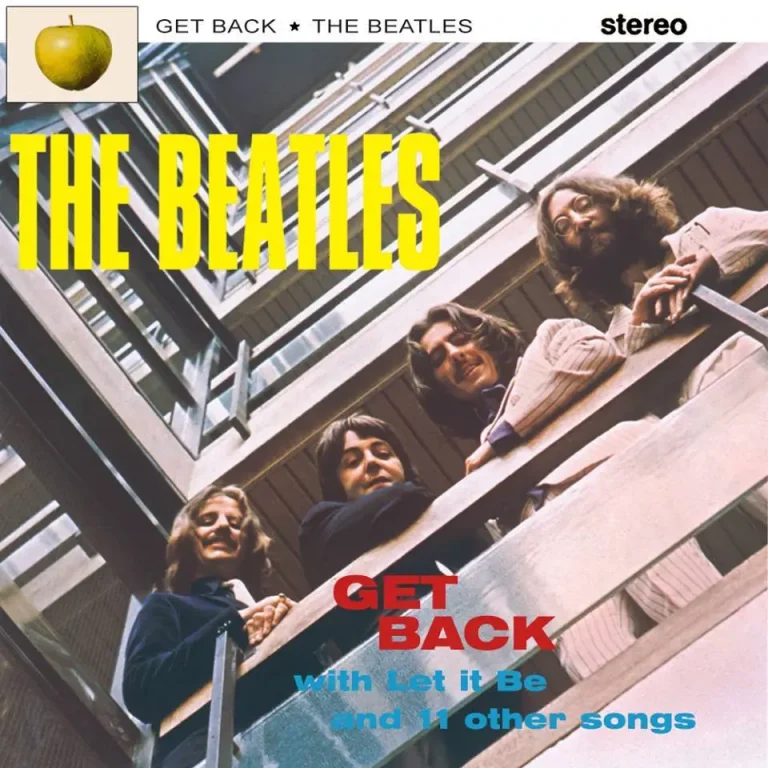
Regression appears to be one main theme for this album, beginning with the cover photo. The Beatles are posed at the offices of EMI Records in Manchester Square, grouped over the staircase, just as they were for their first English album, Please Please Me, in 1963. The photograph is by Angus McBean, who took the original cover photo six years ago. And the first song on the album, “One After 909,” is a 1959 Lennon–McCartney composition, written when the Beatles were still the Quarrymen roaming around Liverpool.
On the technical side of the music, the Beatles for the Get Back package are by themselves: No 40-piece orchestra, no special electronic effects — not even over-dubbing of instruments. There is no Eastern or Indian instrument for George, no vocal for Ringo, no peace-in plug for John. The only non-Beatle on the record is keyboard man Billy Preston. The LP, engineered by Glyn Johns, was recorded in Apple’s new studios in the basement at 3 Saville Row, following rehearsals at Twickenham.
“Beatles; Get Back” is a noticeably informal album, looser than The Beatles; freer, in fact, than any record the group has ever made. In a phrase, they kick out the jams. The reason is in the rehearsals. There, all composing was completed and arrangements worked out for songs, so that at Apple, there were no last-minute patch-up jobs and changes on tunes. At Apple, in fact, the Beatles literally ran through the entire album, so that the results simulate a recorded concert or a bugged rehearsal session. Between songs, the Beatles are heard discussing upcoming numbers, criticizing their work in progress, and shouting comments up to Johns. Other sounds and voices heard between cuts are those of the film crew who made a movie of the Beatles working, both at Twickenham and at Savile Row. The film and the LP, along with an impressive book of session photos and reportage, will be released together in December.
Eleven songs, including “Get Back” and “Don’t Let Me Down,” make up the LP, with a short reprise of the “Get Back” theme at the end of the second side. Mini-jams serve as bridges between several numbers. One is a John and Paul rendition of the Drifters’ “Save the Last Dance for Me”, the other a Mersey Beat hoedown called “Maggie May.”
Track by track, the Beatles “Get Back” this way:
[SIDE ONE]
1. “One After 909” — One of the five numbers recorded on Apple’s rooftop (and the only one included on the album), this ten-year-old composition (“One of the first songs we ever wrote,” says Paul) opens with a piano-run, guitar chorded false start. Then, with Harrison on lead guitar, Lennon and McCartney handling the vocals and with screaming Paul on lead, it is — how you say — a rave-up. The lyrics:
My baby said she’s traveling on the one after 909
Move over honey, I’m traveling on that line
Move over once, move over twice
Come on baby don’t be cold as ice
Said she’s traveling on the one after 909…
Pick up your bag, run to the station
Railman said you’ve got the wrong location
Pick up your bag, run right home
Then you will find you got the number wrong.Light applause — mostly from Ringo’s wife Maureen (for which she gets thanks from Paul) — then into the “Save the Last Dance” bridge. The short John-Paul duet is cut short; they chat, and John says “Give me the courage to come screaming in.” He does, on —
2. “Don’t Let Me Down” — The LP version includes Paul helping on the vocals and the same instrumental lineup as on “909” — Lennon on rhythm, Harrison on lead guitar. Preston is not on tap this time around.
3. “Dig a Pony” — John on lead again, with electric piano from Preston and rim shots from Ringo. The song is tinted by blues but is the first non-romance number on the LP. The theme: You can do anything you want to so long as you put your mind to it. In other words, you can work it out (to the point, even, that you could dig a pony). Random comments follow, and Ringo slams a cymbal, plowing into —
4. “I’ve Got a Feeling” — Another screaming McCartney effort with answer lines from Lennon who does a verse, screws up, and mutters, barely audibly: “I cocked it up trying to get…”
5. “Get Back” — The theme stated. John is on lead; Preston on piano. This is the version released as a single.
[SIDE TWO]
1. “For You Blue” — George wrote it and sings it, playing a soft acoustic guitar and backed by John on steel and Paul on piano. No bass. “For You Blue” is a love song about that one chick you know is out there — the one you think and dream about, the one who haunts you — and the one you never quite got to meet. Some nice bits of music, done the blue jay way.
2. “Teddy Boy” — A weird number, the story being about a mother comforting her boy, saying I’ll see you through. The message: We all need someone to turn to. All you need is people. “Teddy Boy” then moves into an outright hay-kicking square dance tempo, including calls. George’s guitar causes some feedback, and it’s kept in for posterity. John handles acoustic, and Paul sings. Again, no bass.
3. “Two of Us on Our Way Home” — The theme restated. Two of us riding nowhere, lazily, with hazy memories in our heads, heading back home. Lennon and McCartney harmonize on this easy-paced almost waltzy number, with bass affected by George on rhythm guitar.
…On our way back home.
You and I have memories
Longer than the road that stretches out of hand…Paul the MC: “So we leave the little town of London, England…” and the group pours it on, getting back to their Liverpool days for “Maggie May.” This bridge sets the pace for the next cut.
4. “Dig It” — Now Lennon’s on bass for the rest of the side. McCartney is on the piano, with George back to acoustic guitar. A loose number, Paul singing and gospely John shouting encouragement: “I can hardly keep my hands still!” George joins in to chat it up with John. “Dig It” dips into politics but oh so gently: You can’t really knock anything — BBC or Doris Day (or Richard Nixon, cops, or Al Capp), anything — because somebody can “dig it” even if you don’t happen to.
5. “Let It Be” — As pretty and simple as the title makes it sound. Paul, singing like he did yesterday on “Yesterday,” backs himself on piano, with Paul and John harmonizing behind him. George is on a Lesley-amplified guitar, so that his picking comes out like organ-playing. The lyric message: When all the heart-broken people living in the world agree, there’ll be an answer, a final solution: Let it be.
6. “The Long and Winding Road” — McCartney wraps it up with another piano-dominated ballad meshed with the “Get Back” mini-encore. Here, he is singing to a girl who has left him standing, crying. “You’ll never know the ways I’ve tried,” he says, “so don’t leave me stranded; lead me down the long and winding road back to your door.”
There’s more — but not on Get Back. With a 160-page book full of words and color photos on the recording sessions to be packaged with the LP, the Beatles decided against another double-record set. Finished pieces in the can could make up an incredible separate album. Included are old gold pieces like “Shake Rattle and Roll” and “Blue Suede Shoes,” along with a re-make of a Beatles oldie — “Love Me Do.” Ringo has a vocal among the dozen or so other numbers stashed away. His composition — shades of Candy — is called “Octopussy’s Garden.”
All of this will out eventually, but exactly when is uncertain. The Beatles are reportedly working on yet another LP to be released before the film, book, and Get Back package, which was finished at the end of May (with the cutting of “One After 909”).
The Beatles have gotten back and they’re more obviously together than they’ve seemed in a long time.
From Rolling Stone – September 20, 1969

TOO SOON
WKBW prides itself on playing recordings by major pop music performers before they are released. Sometimes, however, they are a bit premature.
For example, the Beatles have a new album, “Get Back,” for release in December. After two days of play the station was slapped with an injunction so it couldn’t play it anymore — at least for a month or so. Record company feels too-early play will hurt sales. Meantime, new Beatles album, “Abbey Road,” is making it big these days.
From The Buffalo News – October 8, 1969

“Get Back” bootlegs would arrive in the UK market in Spring 1970:
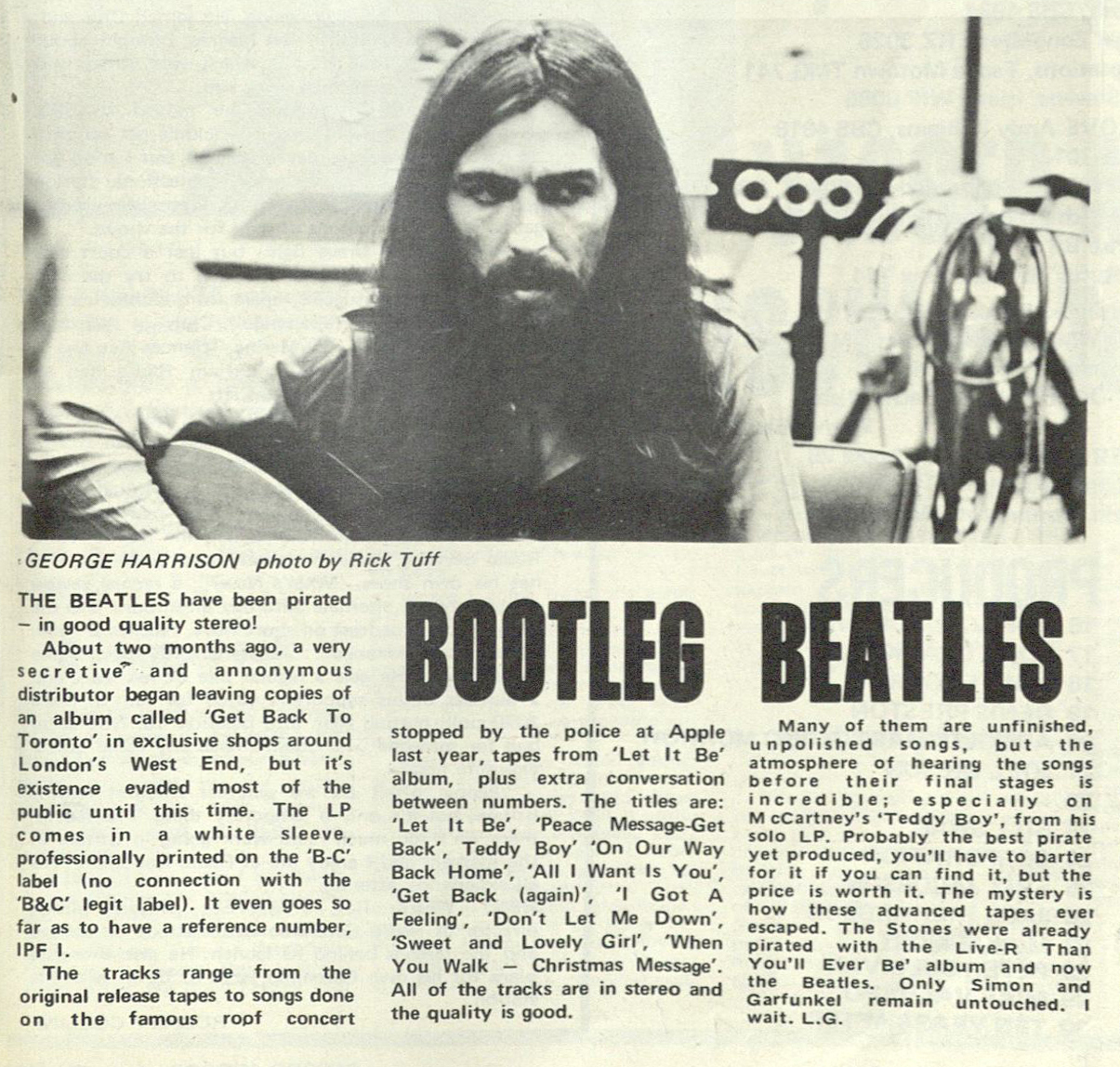
BOOTLEG BEATLES
THE BEATLES have been pirated – in good quality stereo!
About two months ago, a very secretive and anonymous distributor began leaving copies of an album called ‘Get Back To Toronto’ in exclusive shops around London’s West End, but it’s existence evaded most of the public until this time. The LP comes in a white sleeve, professionally printed on the ‘B+C’ label (no connection with the ‘B&C’ legit label). It even goes so far as to have a reference number, IPF 1.
The tracks range from the original release tapes to songs done on the famous rooftop concert stopped by the police at Apple last year, tapes from ‘Let It Be’ album, plus extra conversation between numbers. The titles are: ‘Let It Be’, ‘Peace Message-Get Back’, ‘Teddy Boy’, ‘On Our Way Back Home’, ‘All I Want Is You’, ‘Get Back (again)’, ‘I Got A Feeling’, ‘Don’t Let Me Down’, ‘Sweet and Lovely Girl’, ‘When You Walk – Christmas Message’. All of the tracks are in stereo and the quality is good.
Many of them are unfinished, unpolished songs, but the atmosphere of hearing the songs before their final stages is incredible; especially on McCartney’s ‘Teddy Boy’, from his solo LP. Probably the best pirate yet produced, you’ll have to barter for it if you can find it, but the price goes with it. The mystery is how these advance tapes ever escaped. The Stones were already pirated with the ‘Live-R Than You’ll Ever Be’ album and now the Beatles. Only Simon and Garfunkel remain untouched… I wait. — L.G.
From Record Mirror – June 27, 1970
The Beatles Diary Volume 1: The Beatles Years
With greatly expanded text, this is the most revealing and frank personal 30-year chronicle of the group ever written. Insider Barry Miles covers the Beatles story from childhood to the break-up of the group.

Notice any inaccuracies on this page? Have additional insights or ideas for new content? Or just want to share your thoughts? We value your feedback! Please use the form below to get in touch with us.
