Friday, February 26, 1971
The trial for the dissolution of The Beatles’ contractual partnership – Day 6
Last updated on August 20, 2025
Friday, February 26, 1971
Last updated on August 20, 2025
Article Feb 25, 1971 • "Another Day" broadcast on Top Of The Pops
Article Feb 25, 1971 • The trial for the dissolution of The Beatles’ contractual partnership – Day 5
Article Feb 26, 1971 • The trial for the dissolution of The Beatles’ contractual partnership – Day 6
Article Feb 27, 1971 • Rumours of negotiations between Paul McCartney and Robert Stigwood are denied
Article Mar 01, 1971 • The trial for the dissolution of The Beatles’ contractual partnership – Day 7
Dec 31, 1970 • Paul McCartney files a lawsuit against the other three Beatles
Feb 19, 1971 • The trial for the dissolution of The Beatles' contractual partnership - Day 1
Feb 22, 1971 • The trial for the dissolution of The Beatles’ contractual partnership – Day 2
Feb 23, 1971 • The trial for the dissolution of The Beatles’ contractual partnership - Day 3
Feb 24, 1971 • The trial for the dissolution of The Beatles’ contractual partnership – Day 4
Feb 26, 1971 • The trial for the dissolution of The Beatles’ contractual partnership – Day 6
Mar 12, 1971 • The trial for the dissolution of The Beatles' contractual partnership - Decision
Apr 25, 1971 • John Lennon, George Harrison, Ringo Starr decide not to appeal High Court order

The “McCartney” press kit is sent to UK press
Apr 09, 1970

Dispute over the release of “Let It Be”
April 10 - End of April 1970

Lee Eastman asks for The Beatles to be dissolved
Jun 15, 1970
John Eastman visits Paul and Linda in Scotland
July 11-20, 1970
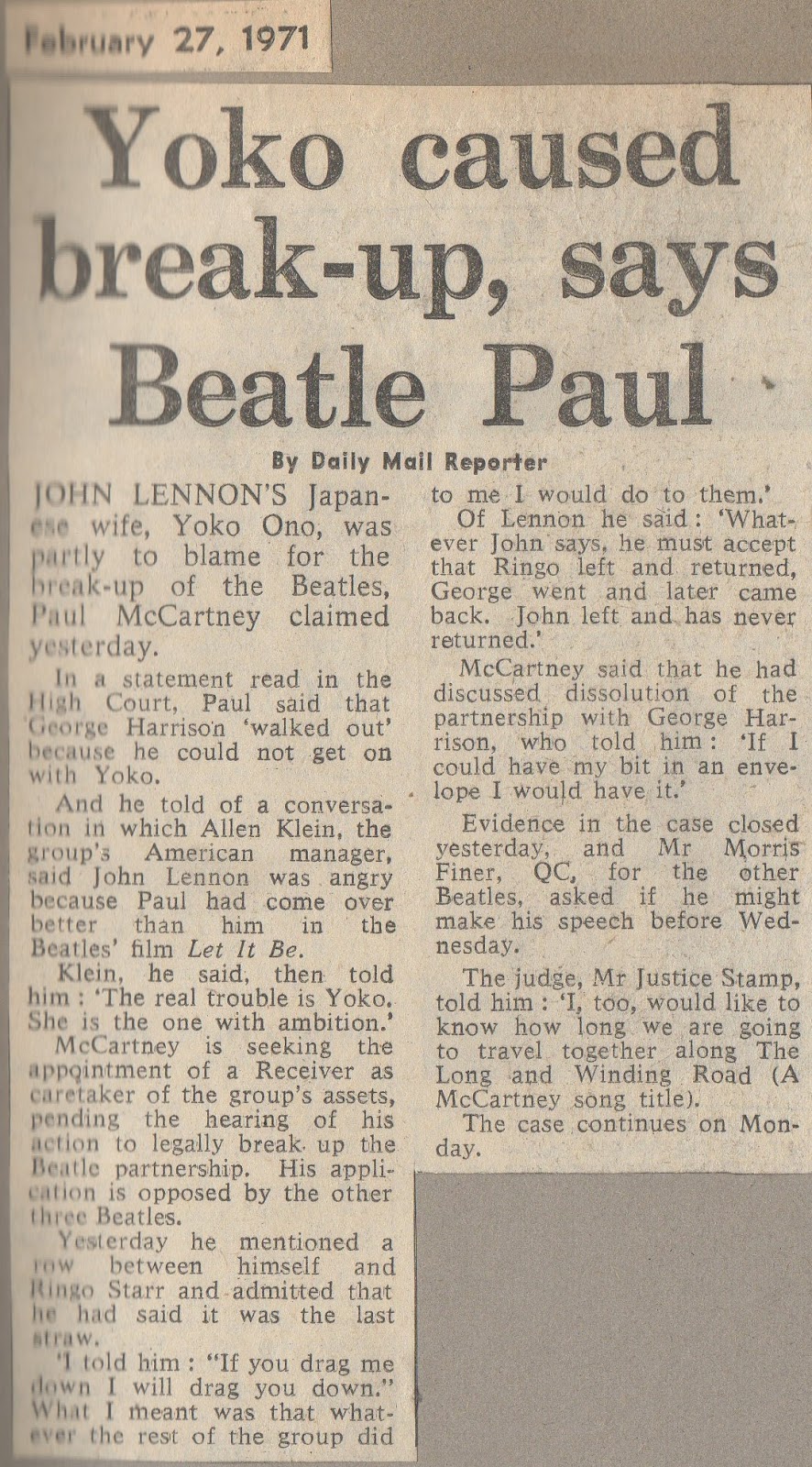
Yoko caused break-up, says Beatle Paul
JOHN LENNON’S Japanese wife, Yoko Ono, was partly to blame for the break-up of the Beatles, Paul McCartney claimed yesterday. In a statement read in the High Court, Paul said that George Harrison “walked out” because he could not get on with Yoko.
And he told of a conversation in which Allen Klein, the group’s American manager, said John Lennon was angry because Paul had come over better than him in the Beatles’ film Let It Be. Klein, he said, then told him: “The real trouble is Yoko. She is the one with ambition.”
McCartney is seeking the appointment of a Receiver as caretaker of the group’s assets, pending the hearing of his action to legally break up the Beatle partnership. His application is opposed by the other three Beatles.
Yesterday he mentioned a row between himself and Ringo Starr and admitted that he had said it was the last straw. “I told him: ‘If you drag me down I will drag you down.’ What I meant was that whatever the rest of the group did to me I would do to them.”
Of Lennon he said: “Whatever John says, he must accept that Ringo left and returned, George went and later came back. John left and has never returned.”
McCartney said that he had discussed dissolution of the partnership with George Harrison, who told him: “If I could have my bit in an envelope I would have it.”
Evidence in the case closed yesterday, and Mr Morris Finer, QC, for the other Beatles, asked if he might make his speech before Wednesday. The judge, Mr Justice Stamp, told him: “I, too, would like to know how long we are going to travel together along The Long and Winding Road (A McCartney song title).”
The case continues on Monday.
From Daily Mail, February 27, 1971
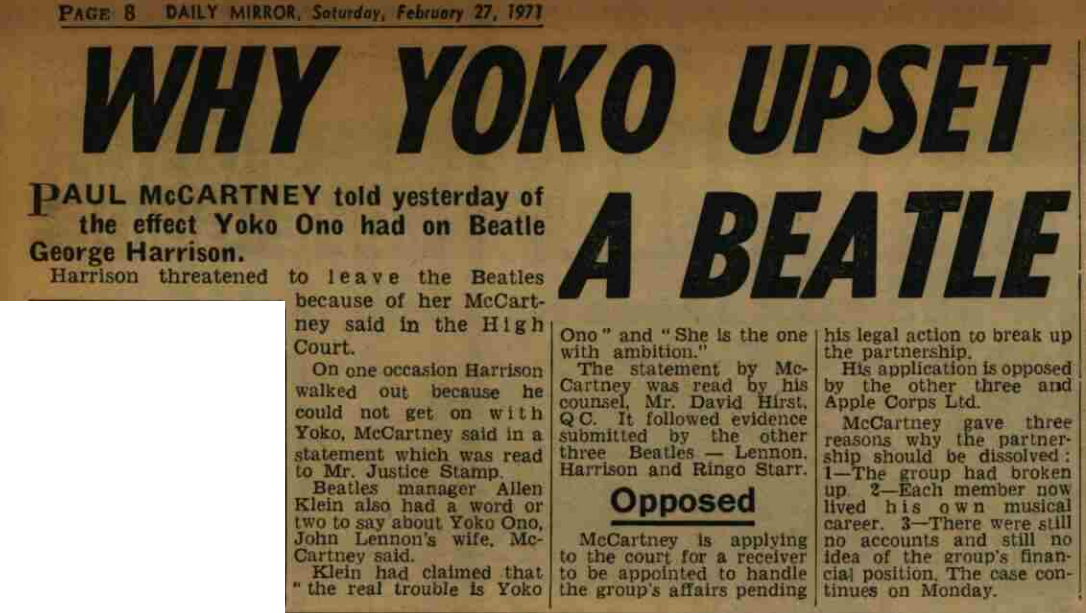
When Beatles forsook title Since the Beatles stopped making group recordings they had stopped thinking of themselves as Beatles, Paul McCartney stated in the High Court yesterday. He was answering evidencu filed by the other three Eeatles in opposition to his claim for the appointment of a receiver of the group’s assets pending trial of his action to have the group legally broken up. John Lennon stated in his evidence : ” We always thought of ourselves as Beatles, whether we recorded singly or in twos or threes.” But Mr McCartney denied this. “One has only to look at recent recordings by John or George to see that neither thinks of himself as a Beatle,” he said. On his recent album John had listed things he did not believe r One was : ” I don’t believe in the Beatles.” Partnership Mr McCartney stated that when the four entered into their partnership agreement in 1967 they did not consider the exact wording or give any thought to the agreement’s legal implications. They had thought that if one of them wanted to leave the group he would only have to say so. On the way in which the four had sorted out thslr differences in the past, Mr McCartney denied that it had been on a three-to-one basis. If one disagreed, they had discussed the problem until they reached agreement, or let the matter drop. “I know of no decision taken on a three-to-one basis,” he said. When the four had talked about breaking up the group, Mr McCartney said that George Harrison had saia : “If I could have my bit in an envelope, I’d love it.” Mr McCartney ended his evidence by stating that none of the other three Beatles seemed to understand vhy he had acted in the way ie had. The short answer w?s that the group had broken up, each now had his own musical career, there were still no audited accounts, and they still did not know what they: tax positions were. None of these points, he said, had been denied by the other Beatles. The hearing continues on Monday, when counsel will make their final submissions.

From Liverpool’s Cavern to London’s High Court – the most spectacular pop story
HIGH COURT, Friday: so this is how it had to end, in the bewigged and cloistered confines of Court No. 16, a stone’s throw from the Strand. Amid the droning of the barristers and the judge’s quizzical raising of eyebrows, the greatest partnership in the history of music is disintegrating.
In the Main Hall Of the High Court, where lawyers and plaintiffs and defendants come and go, and no cameras are allowed, there’s a black white cat dozing on a padding bench. Across the stone floor, beneath the high ceiling, all flying buttresses and stained glass, a large noticeboard bears a small piece of white paper under the legend No. 16: “Mr Justice Stamp: McCartney vs Lennon. Comm. 10.15 am.”
Up the spiral stone staircase, following the signs, a gaggle of office girls giggle and clatter their heels, look-in for the public gallery. They pass the entrances to 12, 13, 14, 15… and then there’s another door, locked, with no markings. Cannily, those in charge have chosen the court with the public gallery which is never open.
Back downstairs and through a door by the barristers’ benches, more girls – only a handful – have found their way in and they stand at the back, craning on tip-toe, whispering.
” Where is he.'”
“Oooh. Look June, there ‘e is…”
“Ummm there’s Linda too.”
There indeed, they were. On the front row, flanked by wigs, Paul in a dark grey suit and white shirt, hair now swept back and full bearded, Linda in brown and yellow. They both look extremely serious, and neither as much as whispers a word for nigh on an hour.
The interesting bits of the hearing come in flashes, briefly, and in between it tends to get bogged down in details of contracts, agreements, and letters between the various parties. One of the most interesting of these is from John and George to Paul, last March or April, stating that they were putting back the release of Paul’s solo album because it would clash with the release of “Let It Be”.
The letter, handwritten, ends with an enigmatic postscript: “Hare Krishna – a mantra a day keeps Mia away”. The barrister pronounced it “Meeya”.
Another letter from which extrcts were read was “From the desk of Phil Spector” to the Beatles, and concerned the remixing of “Let It Be”. It was read out because Paul is apparently alleging that “The Long And Winding Road” was remixed in order to hurt him, and the passage from Spector’s missive concerning this track reads: “This has strings, voices, horns, and Ringo’s drums overdubbed. I like it as a title for the album instead of ‘Let It Be’ but that’s just personal preference”.
It concludes: “If there’s anything you’d like done to the LP, let me know and I’ll be glad to help. Naturally little things are easy to change, big things would be a problem”. A letter from Paul to Klein was then read out, in which McCartney demanded that the strings, horns, and voices be lowered in volume, the harp taken off completely, and the Beatles’ instruments brought back to the forefront. Oh yes… and that it shouldn’t happen again.
But in the main, it was pretty uninteresting, with only the odd flash of dry wit from the judge (in that job, they really need a sense of humour) and every now and then, a gentlemanly disagreement between counsel. Paul wasn’t bored, though; too much depends of it.
From Melody Maker – February 27, 1971

The McCartney Legacy: Volume 1: 1969 – 73

In this first of a groundbreaking multivolume set, THE MCCARTNEY LEGACY, VOL 1: 1969-73 captures the life of Paul McCartney in the years immediately following the dissolution of the Beatles, a period in which McCartney recreated himself as both a man and a musician. Informed by hundreds of interviews, extensive ground up research, and thousands of never-before-seen documents THE MCCARTNEY LEGACY, VOL 1 is an in depth, revealing exploration of McCartney’s creative and personal lives beyond the Beatles.
The Beatles Diary Volume 2: After The Break-Up 1970-2001
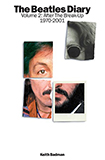
An updated edition of the best-seller. The story of what happened to the band members, their families and friends after the 1970 break-up is brought right up to date. A fascinating and meticulous piece of Beatles scholarship.
Maccazine - Volume 40, Issue 3 - RAM Part 1 - Timeline

This very special RAM special is the first in a series. This is a Timeline for 1970 – 1971 when McCartney started writing and planning RAM in the summer of 1970 and ending with the release of the first Wings album WILD LIFE in December 1971. [...] One thing I noted when exploring the material inside the deluxe RAM remaster is that the book contains many mistakes. A couple of dates are completely inaccurate and the story is far from complete. For this reason, I started to compile a Timeline for the 1970/1971 period filling the gaps and correcting the mistakes. The result is this Maccazine special. As the Timeline was way too long for one special, we decided to do a double issue (issue 3, 2012 and issue 1, 2013).

Notice any inaccuracies on this page? Have additional insights or ideas for new content? Or just want to share your thoughts? We value your feedback! Please use the form below to get in touch with us.


