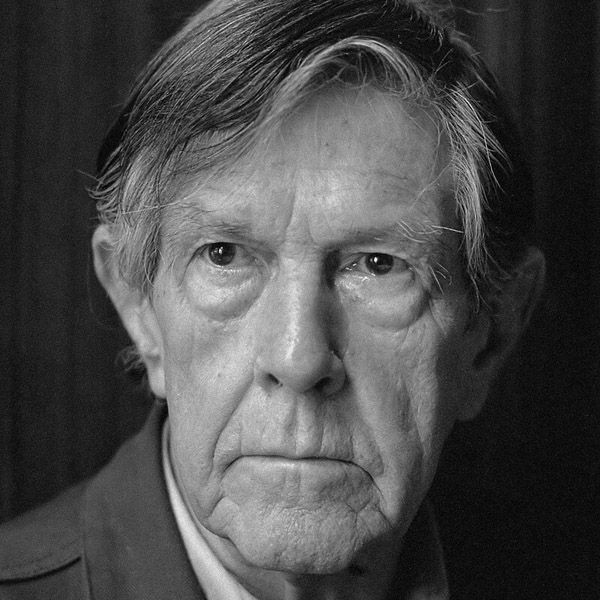
Born Sep 05, 1912 • Died Aug 12, 1992
John Cage
Influencer of Paul McCartney
Photo: John Cage in 1988 - https://en.wikipedia.org/wiki/John_Cage
Last updated on August 22, 2025
Born Sep 05, 1912 • Died Aug 12, 1992
Influencer of Paul McCartney
Photo: John Cage in 1988 - https://en.wikipedia.org/wiki/John_Cage
Last updated on August 22, 2025
From Wikipedia:
John Milton Cage Jr. (September 5, 1912 – August 12, 1992) was an American composer and music theorist. A pioneer of indeterminacy in music, electroacoustic music, and non-standard use of musical instruments, Cage was one of the leading figures of the post-war avant-garde. Critics have lauded him as one of the most influential composers of the 20th century. He was also instrumental in the development of modern dance, mostly through his association with choreographer Merce Cunningham, who was also Cage’s romantic partner for most of their lives.
Cage’s teachers included Henry Cowell (1933) and Arnold Schoenberg (1933–35), both known for their radical innovations in music, but Cage’s major influences lay in various East and South Asian cultures. Through his studies of Indian philosophy and Zen Buddhism in the late 1940s, Cage came to the idea of aleatoric or chance-controlled music, which he started composing in 1951. The I Ching, an ancient Chinese classic text and decision-making tool, became Cage’s standard composition tool for the rest of his life. In a 1957 lecture, “Experimental Music”, he described music as “a purposeless play” which is “an affirmation of life – not an attempt to bring order out of chaos nor to suggest improvements in creation, but simply a way of waking up to the very life we’re living”.
Cage’s best known work is the 1952 composition 4′33″, a piece performed in the absence of deliberate sound; musicians who perform the work do nothing but be present for the duration specified by the title. The content of the composition is intended to be the sounds of the environment heard by the audience during performance. The work’s challenge to assumed definitions about musicianship and musical experience made it a popular and controversial topic both in musicology and the broader aesthetics of art and performance. Cage was also a pioneer of the prepared piano (a piano with its sound altered by objects placed between or on its strings or hammers), for which he wrote numerous dance-related works and a few concert pieces. These include Sonatas and Interludes (1946–48). […]
“A Day In My Life”:
When we took it to the studio I suggested, ‘Let’s put aside twenty-four bars and just have Mal count them.’ They said, ‘Well, what are you going to put there?’ I said, “Nothing. It’s just going to be, One, chunk chunk chunk; two, chunk chunk chunk; three …” And you can hear Mal in the background doing that. He counted down and on bar twenty-four he hit the alarm clock, Brrrrrrr! It was just a period of time, an arbitrary length of bars, which was very Cage thinking. I’m using his name to cover all the sins, but that kind of avant-garde thinking came from the people I had been listening to.
Paul McCartney – From “Paul McCartney: Many Years from Now” by Barry Miles, 1997
Cage had a piece that started at one end of the radio’s range [the 1956 piece Radio Music], and he just turned the knob and went through to the end, scrolling randomly through all the stations. I brought that idea to I Am the Walrus. I said, ‘It’s got to be random.’ We ended up landing on some Shakespeare – King Lear. It was lovely having that spoken word at that moment. And that came from Cage.
From ‘The King Lear in I Am the Walrus? That came from John Cage’: Paul McCartney on the Beatles’ debt to great avant-garde composers | Paul McCartney | The Guardian, August 19, 2025

Notice any inaccuracies on this page? Have additional insights or ideas for new content? Or just want to share your thoughts? We value your feedback! Please use the form below to get in touch with us.


