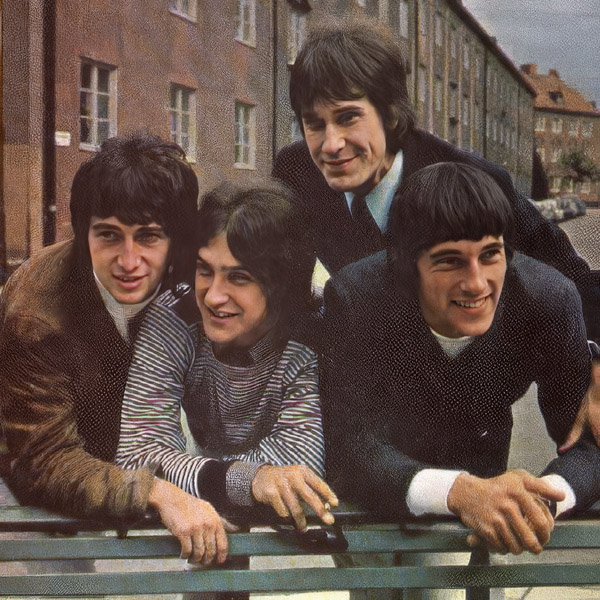
The Kinks
Last updated on May 27, 2026
Last updated on May 27, 2026
From Wikipedia:
The Kinks were an English rock band formed in London in 1962. The band’s original line-up comprised brothers Ray Davies (lead vocals, rhythm guitar) and Dave Davies (lead guitar, vocals), Pete Quaife (bass), and Mick Avory (drums, percussion). Emerging during the height of British rhythm and blues and Merseybeat, their breakthrough third single, the Ray Davies-penned “You Really Got Me” (1964), became an international hit, topping the charts in the United Kingdom and reaching the Top 10 in the United States. Other early hits included “All Day and All of the Night” (1964), “Tired of Waiting for You”, “Set Me Free”, “See My Friends”, and “Till the End of the Day” (all 1965). They were part of the British Invasion of America until several problems during their 1965 American tour led to them being banned from touring there for a number of years.
The Kinks’ music drew from a wide range of influences, including American R&B and rock and roll initially, and later adopting British music hall, folk, and country. Beginning with the late 1965 Kwyet Kinks EP, the band gained a reputation for reflecting English culture and lifestyle, fuelled by Ray Davies’s observational and satirical lyricism, and made apparent in albums such as Face to Face (1966), Something Else by the Kinks (1967), The Kinks Are the Village Green Preservation Society (1968), Arthur (Or the Decline and Fall of the British Empire) (1969), Lola Versus Powerman and the Moneygoround, Part One (1970), and Muswell Hillbillies (1971), along with their hit singles during this period, including “Dedicated Follower of Fashion”, “Sunny Afternoon”, “Dead End Street” (all 1966), “Waterloo Sunset”, “Autumn Almanac” (both 1967), “Days” (1968), and “Lola” (1970). After a fallow period in the mid-1970s, the band experienced a revival with their albums Sleepwalker (1977), Misfits (1978), Low Budget (1979), Give the People What They Want (1981), and State of Confusion (1983), the last of which produced one of the band’s most successful US hits, “Come Dancing”.
The Davies brothers remained with the band throughout its history. Quaife briefly left the band in 1966 and was replaced by John Dalton, though Quaife returned by the end of that year before leaving permanently in 1969, once again being replaced by Dalton. Keyboardist John Gosling was added in 1970, with this line-up remaining in place until 1976. After several changes during the late 1970s, the line-up stabilised in 1979 with the Davies brothers, Avory, bassist Jim Rodford, and keyboardist Ian Gibbons. Avory left in 1984, after which the band underwent a few more personnel changes before giving their last public performance in 1996 and breaking up in 1997 as a result of creative tension between the Davies brothers.
The Kinks are regarded as one of the most influential rock bands of the 1960s. They have had seventeen Top 20 singles and five Top 10 albums in the UK, and five of their singles reached the Top 10 on the US Billboard Hot 100 chart. Additionally, nine of their albums charted in the Top 40 of the US Billboard 200. Four Kinks albums have been certified Gold by the Recording Industry Association of America (RIAA), and the band has sold over 50 million records worldwide. Among numerous honours, they received the Ivor Novello Award for “Outstanding Service to British Music”. In 1990, the original four members of the Kinks were inducted into the Rock and Roll Hall of Fame, as well as the UK Music Hall of Fame in 2005. In addition, groups such as Van Halen, the Jam, the Knack, the Pretenders, Green Day, Queens of the Stone Age and the Romantics covered their songs, helping to boost the Kinks’ record sales. In the 1990s, Britpop acts such as Blur and Oasis cited the band as a major influence. […]
The Kinks were on the same bill as the Beatles on August 2, 1964.
From The Beatles and Bournemouth – Bournemouth Beat Boom (wordpress.com):
The Sunday 2nd August shows were part of a short seven date UK tour coming off the back of their first visits to Australia, New Zealand and Hong Kong and prior to their first full concert tour of America. On the night, they were joined by The Kinks, who were about to release their breakthrough single and first number one, “You Really Got Me”. According to Ray Davies autobiography X-Ray, there was a tense rivalry between Lennon and the author and a spot of one-upmanship. The Kinks front-man alleges they went down so well in the first show in the slot just before The Beatles that they were relegated to closing the first half in the second show. His brother Dave, goes further by stating that they closed the second show going on after The Beatles, but that sounds highly unlikely and has never been substantiated. It sounds more like a case of Dave Davies re-writing history. The remaining acts included The Hearts who had just dropped the Purple from their name due to adverse publicity, the singer cum actress Adrienne Poster before her name change to Posta in 1966, Mike Berry and The Innocents and compere Tony Marsh. They played two shows at 6.15 p.m. and 8.30 p.m. and charged a top price of fifteen shillings to sit in the front stalls.
We’d played with The Beatles in Bournemouth and John Lennon made a remark that we were only there to warm up for them, but we got a great reaction to You Really Got Me,” recalls Davies. “It was an early validation that we had something that stood up for us, like being bullied in school and having something that was bigger than the bully, it was that sort of feeling.
Ray Davies – From The Kinks – Interview with MOJO, 2013
There had been bad blood between the Kinks and the Beatles since they played together on the same bill in 1964. John upset Davies backstage by saying, “We’ve lost our set-list, lads. Can we borrow yours?” implying that the Kinks, who had only released two singles at that point, were mere imitators. Paul was more respectful. When the Kinks released “See My Friends” in 1965, a track now widely regarded as one of the first pop songs to use Eastern scales, Paul played it over and over at the apartment of John Dunbar and Marianne Faithfull, and when he saw Ray’s brother Dave at the Scotch, he reputedly joked, “That ‘See My Friend.’ I really like that. I should have written it,” to which Dave retorted, “Well, you didn’t. You can’t do everything.” Ray Davies later commented, “Paul McCartney was one of the most competitive people I’ve ever met. Lennon wasn’t. He just thought everyone else was shit.“
From “Beatles ’66: The Revolutionary Year” by Steve Turner

Notice any inaccuracies on this page? Have additional insights or ideas for new content? Or just want to share your thoughts? We value your feedback! Please use the form below to get in touch with us.