Saturday, July 25, 1970
Interview for New Musical Express (NME)
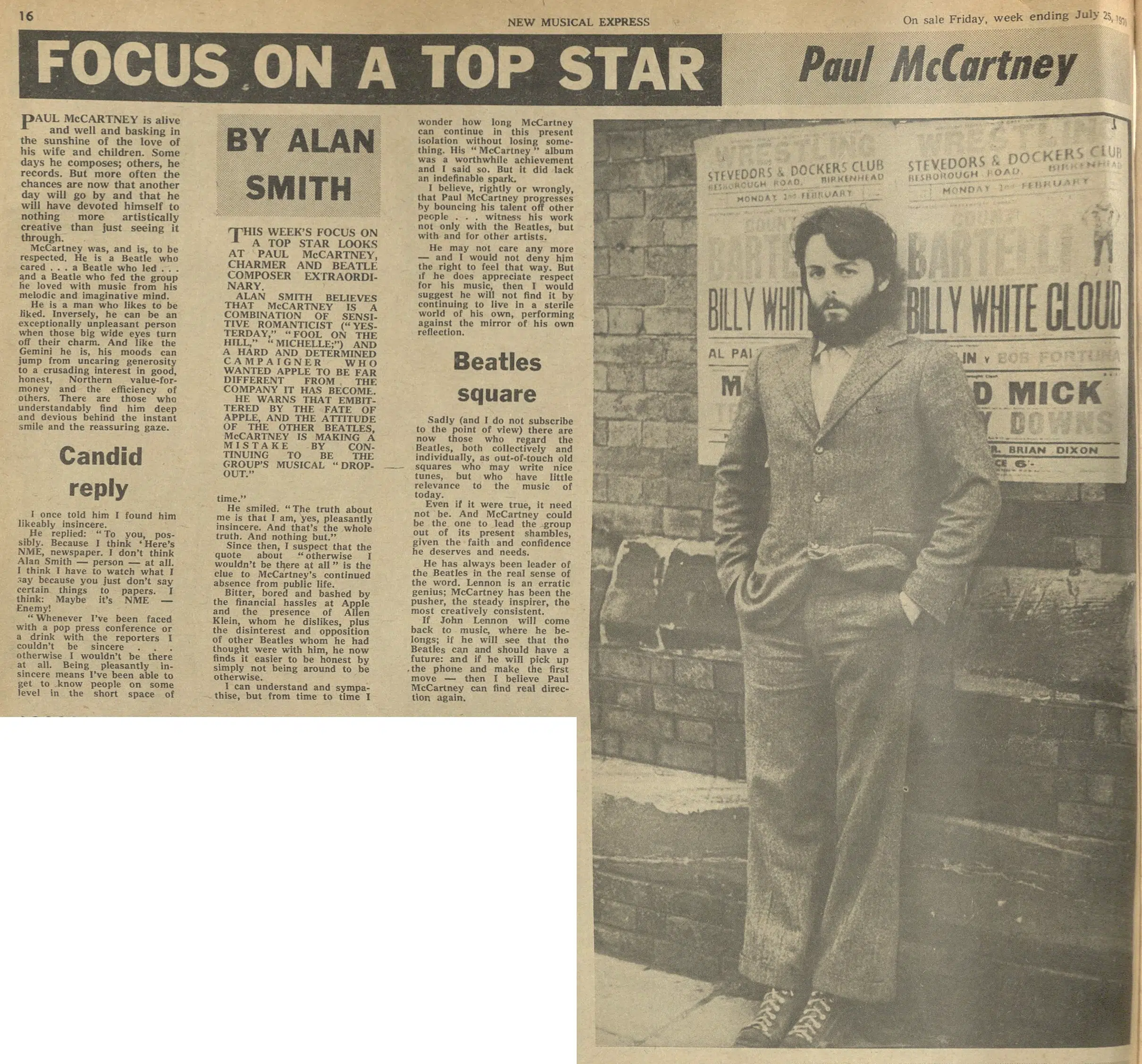
Focus On A Top Star - Paul McCartney
Press article
Last updated on June 25, 2025
Saturday, July 25, 1970
Press article
Last updated on June 25, 2025
This interview remains the property of the respective copyright owner, and no implication of ownership by us is intended or should be inferred. Any copyright owner who wants something removed should contact us and we will do so immediately.
PAUL McCARTNEY is alive and well and basking in the sunshine of the love of his wife and children. Some days he composes; others, he records. But more often the chances are now that another day will go by and that he will have devoted himself to nothing more artistically creative than just seeing it through.
McCartney was, and is, to be respected. He is a Beatle who cared… a Beatle who led… and a Beatle who fed the group he loved with music from his melodic and imaginative mind.
He is a man who likes to be liked. Inversely, he can be an exceptionally unpleasant person when those big wide eyes turn off their charm. And like the Gemini he is, his moods can jump from uncaring generosity to a crusading interest in good, honest, Northern value-for-money and the efficiency of others. There are those who understandably find him deep and devious behind the instant smile and the reassuring gaze.
I once told him I found him likeably insincere. He replied:
“To you, possibly. Because I think ‘Here’s NME, newspaper. I don’t think Alan Smith — person — at all. I think I have to watch what I say because you just don’t say certain things to papers. I think: Maybe it’s NME — Enemy!
“Whenever I’ve been faced with a pop press conference or a drink with the reporters I couldn’t be sincere — otherwise I wouldn’t be there at all. Being pleasantly insincere means I’ve been able to get to know people on some level in the short space of time.”
He smiled.
“The truth about me is that I am, yes, pleasantly insincere. And that’s the whole truth. And nothing but.”
Since then, I suspect that the quote about “otherwise I wouldn’t be there at all” is the clue to McCartney’s continued absence from public life.
Bitter, bored and bashed by the financial hassles at Apple and the presence of Allen Klein, whom he dislikes, plus the disinterest and opposition of other Beatles whom he had thought were with him, he now finds it easier to be honest by simply not being around to be otherwise.
I can understand and sympathise, but from time to time I wonder how long McCartney can continue in this present isolation without losing something. His “McCartney” album was a worthwhile achievement and I said so. But it did lack an indefinable spark.
I believe, rightly or wrongly, that Paul McCartney progresses by bouncing his talent off other people — witness his work not only with the Beatles, but with and for other artists.
He may not care any more — and I would not deny him the right to feel that way. But if he does appreciate respect for his music, then I would suggest he will not find it by continuing to live in a sterile world of his own, performing against the mirror of his own reflection.
Sadly (and I do not subscribe to the point of view) there are now those who regard the Beatles, both collectively and individually, as out-of-touch old squares who may write nice tunes, but who have little relevance to the music of today.
Even if it were true, it need not be. And McCartney could be the one to lead the group out of its present shambles, given the faith and confidence he deserves and needs.
He has always been leader of the Beatles in the real sense of the word. Lennon is an erratic genius; McCartney has been the pusher, the steady inspirer, the most creatively consistent.
If John Lennon will come back to music, where he belongs; if he will see that the Beatles can and should have a future; and if he will pick up the phone and make the first move — then I believe Paul McCartney can find real direction again.

Notice any inaccuracies on this page? Have additional insights or ideas for new content? Or just want to share your thoughts? We value your feedback! Please use the form below to get in touch with us.