
October 10-11, 1970
Paul McCartney holds secret auditions for a guitar player
Last updated on September 17, 2025
October 10-11, 1970
Last updated on September 17, 2025
Location: West 45th Street • New York • USA
Article October 2-7, 1970 • Paul and Linda McCartney travel to New York to record "Ram"
Article Oct 09, 1970 • Paul McCartney holds secret auditions for a drummer
Article October 10-11, 1970 • Paul McCartney holds secret auditions for a guitar player
Interview Oct 10, 1970 • George Martin interview for New Musical Express (NME)
Session Oct 12 to Nov 20, 1970 • "Ram" sessions (CBS Studios, New York City)
Next article Oct 21, 1970 • Paul McCartney meets his legal team to discuss the strategy to break up The Beatles' partnership

Officially appears on Another Day / Oh Woman Oh Why
After discussions in July with his lawyer and brother-in-law John Eastman, Paul McCartney decided to record his second studio album in New York. He envisioned a more sophisticated record than “McCartney,” one that would benefit from the contribution of seasoned session musicians.
Once Paul and Linda had confirmed their dates, John Eastman, based in New York, began the preparations. Through the American Federation of Musicians, he contacted guitarist Barry Kornfeld, who compiled a list of drummers and guitarists for Paul to audition. Eastman also booked rooms for the auditions and reserved six weeks at CBS Studios, beginning on October 12.
On October 9, two days after arriving in New York with his family, Paul held secret auditions for a drummer, and selected 27-year-old Denny Seiwell.
On the following two days, October 10 and 11, Paul auditioned guitaristsat a different location from the drummer auditions. At the end of this process, he chose David Spinozza, hiring him for the next four weeks. During his audition, Spinozza was asked to play chords from “Another Day,” the first track they would record together.
Hugh McCracken had been invited to take part in those auditions but was unavailable, as he was in Florida working with Aretha Franklin. When a replacement was later needed for Spinozza, Denny Seiwell recommended McCracken, who joined the sessions without auditioning.
The following day, David Spinozza and Denny Seiwell joined Paul at CBS Studios for the first recording session of “Ram.”
The British sense of humour, which can be a bit sarcastic, almost got me into trouble. The player was a little bit serious and as he was leaving he said, ‘ok man, see ya. Peace and love’. And I said, ‘Yeah, war and hate’. His face dropped – it was like I was the devil. I had to run after him saying, ‘It’s a joke!’ He forgave me, I think.
Paul McCartney – From “Wingspan – Paul McCartney’s Band On The Run“, 2002
Then a similar kind of process with guitar players [than with drummers]: I had another place for the day and they brought their own guitars this time. We just had an amp they plugged into – nothing special – and I think I might have had an amp, I might have played along, and then we’d just go through the thing. And so out of that we got Dave Spinozza.
Paul McCartney – From “RAM – Archive Collection“, 2012
All I remember is getting a phone call from Linda McCartney addressing herself as ‘Mrs. McCartney’ and I said ‘Who?’ She said ‘My husband would like to meet you’ and I said ‘Did I ever work for your husband before?’ She said: ‘This is Linda McCartney and my husband is Paul McCartney’, like I was supposed to know Paul McCartney was calling my house, that kind of thing. She didn’t make it clear what they wanted me for, I thought it was a meeting or a recording session, but it turned out to be an audition.
So I went to this place on 45th Street, some dirty loft, and they must have been there for three days auditioning people. I’d heard that some of the studio guys had given them a hard time, which I really didn’t want to do because I wanted to work with him. So when I get there, there’s 3 guitar players, but you had to be called, like you couldn’t walk in off the street with your guitar. He introduced himself to me, with a three-day old beard and we’re alone in this gigantic room, and there’s nothing but amplifiers, piano, drums – and Linda. He wanted me to play something. He played a blues, and a solo and some folk and said he wanted me to do that. I played it and then he just said ‘Sorry I couldn’t spend more time but I have a lot of people to see… blah blah’, so I said ‘Fine’. As soon as I got home the phone rang and Linda wanted me to do the sessions the following week.
David Spinozza – Interview with Vicky Wickham – From Hit Parader, November 1971
It seemed weird for him to come to town and audition the heaviest musicians in the business. Cats who had been in music for 15 years and played with just everyone and who, as musicians, the Beatles just couldn’t stand next to as instrumentalists. You don’t have to audition these cats, they can play anything under the sun. We asked him once, and he said he was only in town for two days to check out the musicians and it turned out that he couldn’t go out and buy all the different albums to find out which cats were into what music and so he just called an audition to try to hear everyone. I can understand his point, because people sound good on records and then their attitudes are bad or something, so you have to meet them and get involved personally.
David Spinozza – Interview with Vicky Wickham – From Hit Parader, November 1971
It wasn’t until I got to the loft space where Paul and Linda were holding the auditions that I realised it was an audition. I was a little surprised to see some of my studio musician friends and colleagues in what I would refer to as a waiting room. The actual playing room was up a flight of stairs. It was an unusual situation for us because we’d normally get called for sessions without an audition. Word of mouth was a big way to get hired in the New York session scene. Most of us had played on hit records, commercials, soundtracks and whatnot, so an audition was not the norm at that time. At some point someone came out of the door that led upstairs to the playing room. He or she asked for me by name and asked me to follow them. When we got to the top of the stairs I was introduced to Paul and Linda. It may have been Linda who escorted me upstairs. Anyway, Paul very nicely apologised for having to audition musicians, but he explained that there was no way for him to get a feel for the players just by listening to us on recordings. That made sense to me. I remember there was a drum set, keyboard, amps and some guitars in the room. Paul asked me to play some chords in a straight 8th note feel (G to B7 to E minor. I remember we played it together). I was wondering why he didn’t play the bass, but later I learned that he was looking for the feel that became ‘Another Day’. I think he just wanted to check out my ability to play that feel correctly. It makes sense in hindsight. He had also wanted to know if I played keyboard and drums, which I did, a little. He asked me to play both, so I did. I was hoping he’d play the bass with me, but he didn’t. I found that interesting. I was jamming by myself. The first song I recorded with him was in fact ‘Another Day’ – I guess he knew what he was looking for.
David Spinozza – From “RAM – Archive Collection“, 2012
My answering service got a call asking me if I’d like to audition for Ram, but I was in Florida working on an Aretha Franklin record and didn’t pick up the message until I got back into town. I was disappointed but happy that David [Spinozza] had gotten the job.
Hugh McCracken, from MixOnline, August 1, 2004
The McCartney Legacy: Volume 1: 1969 – 73

In this first of a groundbreaking multivolume set, THE MCCARTNEY LEGACY, VOL 1: 1969-73 captures the life of Paul McCartney in the years immediately following the dissolution of the Beatles, a period in which McCartney recreated himself as both a man and a musician. Informed by hundreds of interviews, extensive ground up research, and thousands of never-before-seen documents THE MCCARTNEY LEGACY, VOL 1 is an in depth, revealing exploration of McCartney’s creative and personal lives beyond the Beatles.
The Beatles Diary Volume 1: The Beatles Years
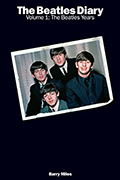
With greatly expanded text, this is the most revealing and frank personal 30-year chronicle of the group ever written. Insider Barry Miles covers the Beatles story from childhood to the break-up of the group.
The Beatles Diary Volume 2: After The Break-Up 1970-2001
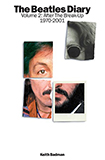
An updated edition of the best-seller. The story of what happened to the band members, their families and friends after the 1970 break-up is brought right up to date. A fascinating and meticulous piece of Beatles scholarship.
Maccazine - Volume 40, Issue 3 - RAM Part 1 - Timeline

This very special RAM special is the first in a series. This is a Timeline for 1970 – 1971 when McCartney started writing and planning RAM in the summer of 1970 and ending with the release of the first Wings album WILD LIFE in December 1971. [...] One thing I noted when exploring the material inside the deluxe RAM remaster is that the book contains many mistakes. A couple of dates are completely inaccurate and the story is far from complete. For this reason, I started to compile a Timeline for the 1970/1971 period filling the gaps and correcting the mistakes. The result is this Maccazine special. As the Timeline was way too long for one special, we decided to do a double issue (issue 3, 2012 and issue 1, 2013).

Notice any inaccuracies on this page? Have additional insights or ideas for new content? Or just want to share your thoughts? We value your feedback! Please use the form below to get in touch with us.
