Monday, October 12, 1970
Recording "Another Day"
For Paul McCartney
Last updated on September 21, 2025
Monday, October 12, 1970
For Paul McCartney
Last updated on September 21, 2025

"Ram" sessions (CBS Studios, New York City)
Oct 12 to Nov 20, 1970 • Songs recorded during this session appear on Ram
Recording studio: CBS Studios • New York City • USA
Interview Oct 10, 1970 • George Martin interview for New Musical Express (NME)
Session Oct 12 to Nov 20, 1970 • "Ram" sessions (CBS Studios, New York City)
Session Oct 12, 1970 • Recording "Another Day"
Session Oct 14, 1970 • Recording "Get On The Right Thing"
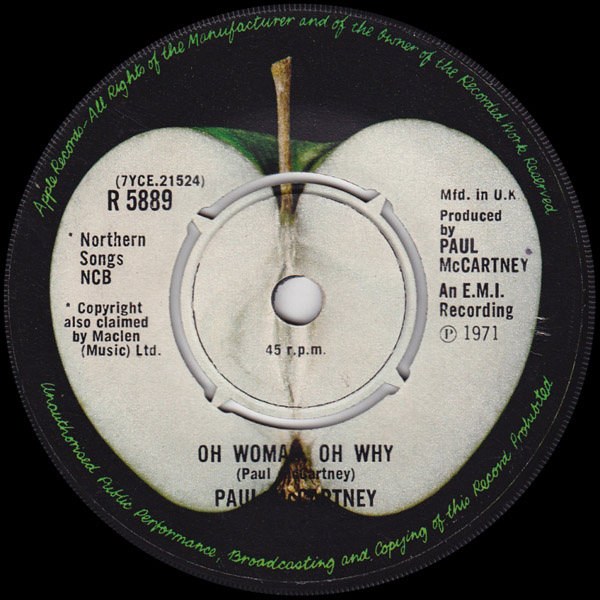
AlbumSome of the songs worked on during this session were first released on the "Another Day / Oh Woman Oh Why" 7" Single
On this day, Paul McCartney began recording sessions for the album “Ram” – as well as the related single “Another Day” – at CBS Studios in New York. A few days earlier, he had held auditions to recruit musicians. For this session, he was joined by drummer Denny Seiwell and guitarist David Spinozza.
Seiwell had recently acquired what he believed to be the drum kit used by Ringo Starr at The Beatles’ 1965 Shea Stadium concert, and decided to bring it along. Its unexpected appearance took Paul by surprise.
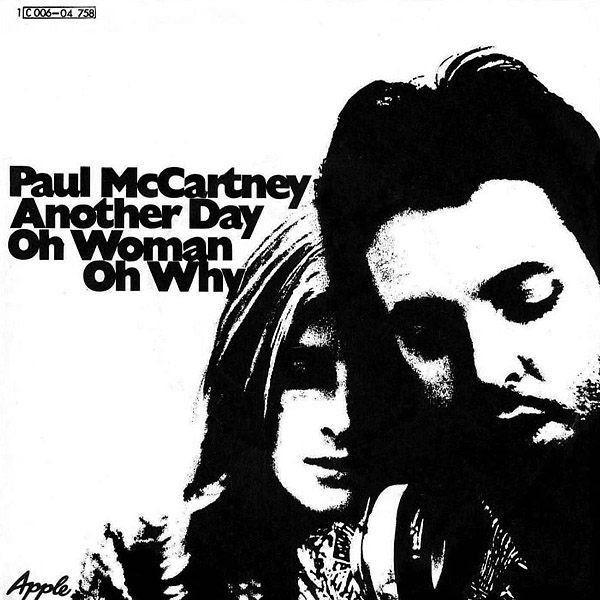
The focus of the day was “Another Day,” which would be released in February 1971 as Paul’s debut solo single. Paul played acoustic guitar and sang guide vocals (his bass parts would be overdubbed later, to the surprise of Seiwell and Spinozza, who had expected him to play his signature instrument). David Spinozza also played acoustic guitar, while Denny Seiwell was on drums. Spinozza recognised the chords he was asked to play, recalling that they were the same ones Paul had asked him to perform during his audition the previous day.
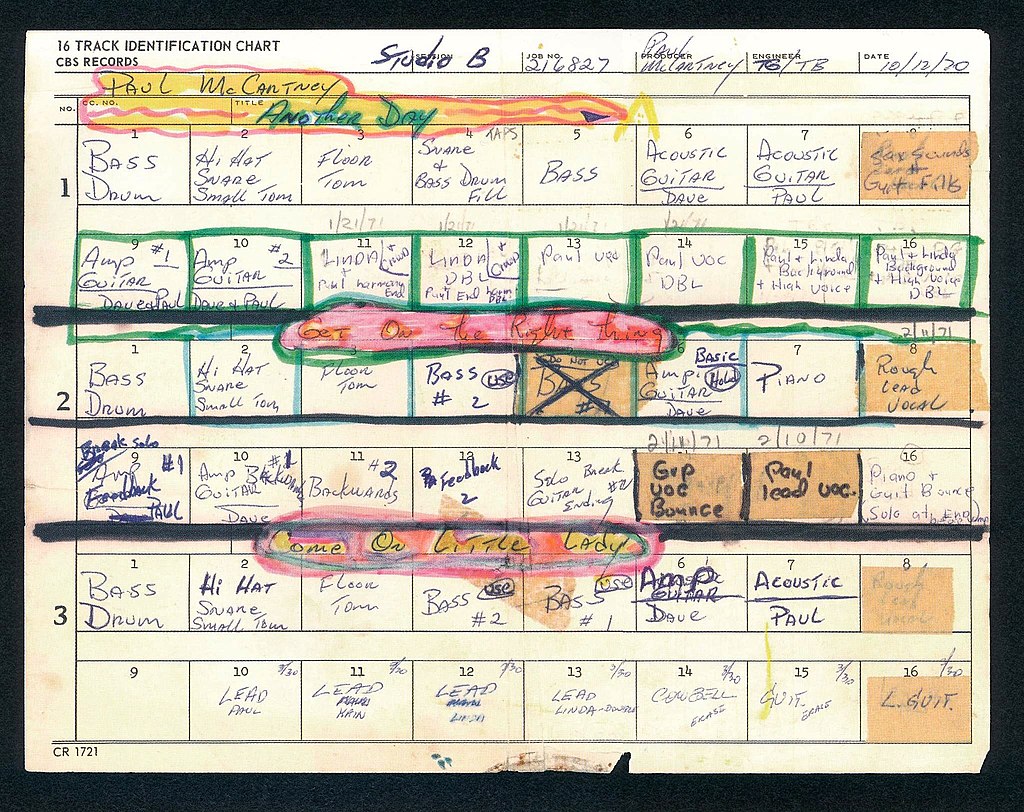
The morning was spent recording the basic track. In the afternoon, Paul and Spinozza overdubbed various electric guitar parts, and Seiwell added extra bass drum, snare and percussions using a telephone directory!
The session, which had begun at 9 a.m., ended at 5 p.m. All the subsequent sessions followed this same schedule – a sharp contrast with Beatles sessions, which typically began in the afternoon and stretched late into the night. The nine-to-five routine suited Paul’s family life, allowing him to spend time with his daughters Heather and Mary. Linda, along with the children, was present at most of the sessions.
The overdub sessions for “Another Day” were not fully documented, and it remains unclear when Paul recorded his bass part and the various vocals. However, some vocal overdubs are known to have been recorded on January 21, 1971.
That evening, Paul and Linda decided to cancel the following day’s session, informing Denny Seiwell and David Spinozza that work would resume on Wednesday.
I had just purchased the Beatles’ drum set, supposedly the one that Ringo used at Shea Stadium. It was purchased through the Museum of Famous People in New York, who were going out of business. My buddy that owned a drum shop picked it up for me. So, Paul comes in and says, ‘Hey Denny, are you ready to go?’ I said, ‘Yeah, ready to go.’ And then he saw the drums and said, ‘Oh shit!’
Denny Seiwell – Interview with Allan Kozinn, 2016 – From “The McCartney Legacy: Volume 1: 1969 – 73” by Allan Kozinn and Adrian Sinclair, 2022
The first song I heard and recorded together was ‘Another Day’. It wasn’t on RAM initially, but was released as a single, prior to the album coming out. The sessions were very organised and business like. I got the feeling that Paul knew exactly what he wanted to hear and we were expected to reproduce it. I wasn’t intimidated by Paul in the studio. I had lots of experience in the studio, but I did and do admire Paul’s natural talent for writing, arranging and producing his music. He seemed to have a clear vision for the outcome of his work. I never thought I was in his band; I was quite comfortable with my studio musician role. He was the singer/songwriter/producer and it was my job to help the songs come to life and assist him with his vision of them. We worked on a song per day. We’d get in at 9am and go to 5pm. It was very efficient.
David Spinozza – From “RAM – Archive Collection“, 2012
Tell me the story about your drum kit – I was blown away by this story of how, you know, the drum kit was a Beatles drum kit. Tell me that story!
I don’t know if it’s [true] Ringo says it isn’t, but I think it is. This place in New York is going out of business and they had a Ringo or a Beatles display I guess, and they had a Ringo Starr drum kit in there, a black Ludwig kit. And they said it was taken from the Shea Stadium concert in New York and that’s how they got it. And so they had this auction and my buddy who runs a drum shop in New York, he called me up, he said “Hey, I’m going to this auction, they have the Beatles drum set from Shea Stadium. I’m going to go get on it, I don’t really want all of the drums, I just want the snare drum, would you be into”? I said “Sure, I’d love to have it, but it’s probably way above my head, financially”. So he goes to the auction, he calls me up, he says “I got it, I got the kit and you can have the two tom toms and the bass drum”. I said, “Okay, how much?” “300 bucks”, I went “Oh my God”. So I ran down there and I gave him 300 bucks.
So Paul calls me, between the audition and the first session, he calls me up and says, “I’d like to hire you for this Ram album”. So I show up on the date and I had my drums in the drum booth. Paul comes in, he goes “Hey man, you ready to go and then he looks and does a double-take on The Beatles drums. I used them, with my dad’s snare drum for the whole album.
That’s pretty amazing. So the bass drum had ‘The Beatles’ written in it?
Of course, yeah. I sold the drums back to the guy because they weren’t great; I could make them sound good but they weren’t an overall great sound, but I kept the head. And then I heard that one of those original seven heads went for $2 million over here. And I started looking for it, I couldn’t find it.
Denny Seiwell – Interview with SuperDeluxeEdition, June 2021
Do you know why Paul wanted to record Another Day as the first track. Was it already ‘the single’ he had in mind?
He had a book of material. He had written 23 or 24 songs and he just started to begin with this. Maybe begin with ‘A’! […]
I remember it set the mood for the whole album. It was not Let It Be, it was not a big, crashing, smashing drum part, it was light, the lyrics had to be heard, the song was all about the lyrics. And when we went through the first part of the song and it goes to the next section, which was actually a three quarter time like a Waltz time, all of sudden you say – of, this is gonna be warm musicianship, we had to make the 3 feel like 4. So it was really a nice chance musically. It was no ordinary rock ‘n’ roll piece, this was quite a piece of music.
And you remember tapping on a Manhattan phone book as a percussion instrument?
Yes, a telephone book, not Manhattan only. I tried to make the sound of horses (imitates the sound). This was done as an overdub.
Denny Seiwell – Interview with Edward Eikelenboom, August 2013 – From Maccazine Volume 40, Issue 3
[Another Day] just blew my mind when I heard him singing and playing it on an acoustic guitar. As a studio man, you sometimes have to do what we call ‘polishing a turd’ — people bring in songs that aren’t really great songs, but obviously, your job is to make them great songs. When he started playing ‘Another Day,’ and it went into the section in three — where it changes time signatures — on the first listen through, you knew you were in for a real treat. This was not another job, this was gonna be really special.
Denny Seiwell – Interview with Allan Kozinn, 2016 – Interview with Allan Kozinn – From “The McCartney Legacy: Volume 1: 1969 – 73” by Allan Kozinn and Adrian Sinclair, 2022
We recorded it with Paul on acoustic and Dave on electric guitar… We started out at about ten in the morning and for lunch we had the right take.
Denny Seiwell – Interview with Luca Perasi, November 2011 – From “Paul McCartney: Recording Sessions (1969-2013). A Journey Through Paul McCartney’s Songs After The Beatles” by Luca Perasi, 2012
I was actually looking forward to playing, with him playing bass. But I never even heard him noodle on the bass the whole time I worked with him. Not one note.
David Spinozza – Interview with Adrian Sinclair, June 2019 – From “The McCartney Legacy: Volume 1: 1969 – 73” by Allan Kozinn and Adrian Sinclair, 2022
Great song. I remember doing many tracks of overdubbed guitar parts. I thought it was a magical song and production.
David Spinozza – Interview with Freddie Rodriguez, August 2012 – Quoted in “Paul McCartney: Music Is Ideas. The Stories Behind the Songs (Vol. 1) 1970-1989” by Luca Perasi, 2022
Written by Paul McCartney, Linda Eastman / McCartney
Recording • Recording of the basic track and first overdubs
Paul McCartney: Music Is Ideas. The Stories Behind the Songs (Vol. 1) 1970-1989
With 25 albums of pop music, 5 of classical – a total of around 500 songs – released over the course of more than half a century, Paul McCartney's career, on his own and with Wings, boasts an incredible catalogue that's always striving to free itself from the shadow of The Beatles. The stories behind the songs, demos and studio recordings, unreleased tracks, recording dates, musicians, live performances and tours, covers, events: Music Is Ideas Volume 1 traces McCartney's post-Beatles output from 1970 to 1989 in the form of 346 song sheets, filled with details of the recordings and stories behind the sessions. Accompanied by photos, and drawing on interviews and contemporary reviews, this reference book draws the portrait of a musical craftsman who has elevated popular song to an art-form.
The McCartney Legacy: Volume 1: 1969 – 73

In this first of a groundbreaking multivolume set, THE MCCARTNEY LEGACY, VOL 1: 1969-73 captures the life of Paul McCartney in the years immediately following the dissolution of the Beatles, a period in which McCartney recreated himself as both a man and a musician. Informed by hundreds of interviews, extensive ground up research, and thousands of never-before-seen documents THE MCCARTNEY LEGACY, VOL 1 is an in depth, revealing exploration of McCartney’s creative and personal lives beyond the Beatles.
Eight Arms to Hold You: The Solo Beatles Compendium
Eight Arms To Hold You: The Solo Beatles Compendium is the ultimate look at the careers of John Lennon, Paul McCartney, George Harrison and Ringo Starr beyond the Beatles. Every aspect of their professional careers as solo artists is explored, from recording sessions, record releases and tours, to television, film and music videos, including everything in between. From their early film soundtrack work to the officially released retrospectives, all solo efforts by the four men are exhaustively examined.
Maccazine - Volume 40, Issue 3 - RAM Part 1 - Timeline

This very special RAM special is the first in a series. This is a Timeline for 1970 – 1971 when McCartney started writing and planning RAM in the summer of 1970 and ending with the release of the first Wings album WILD LIFE in December 1971. [...] One thing I noted when exploring the material inside the deluxe RAM remaster is that the book contains many mistakes. A couple of dates are completely inaccurate and the story is far from complete. For this reason, I started to compile a Timeline for the 1970/1971 period filling the gaps and correcting the mistakes. The result is this Maccazine special. As the Timeline was way too long for one special, we decided to do a double issue (issue 3, 2012 and issue 1, 2013).

Notice any inaccuracies on this page? Have additional insights or ideas for new content? Or just want to share your thoughts? We value your feedback! Please use the form below to get in touch with us.


#/media/File:Record_Sheet_01.jpg)