

Released in 1977
Falling In Love Again (Can't Help It)
Written by Friedrich Hollaender • Sammy Lerner
Last updated on April 9, 2025
Released in 1977
Written by Friedrich Hollaender • Sammy Lerner
Last updated on April 9, 2025
Album This song officially appears on the Live! At The Star-Club In Hamburg, Germany; 1962 Official album.
Timeline This song was officially released in 1977
From Wikipedia:
“Falling in Love Again (Can’t Help It)” is the English language name for a 1930 German song composed by Friedrich Hollaender as “Ich bin von Kopf bis Fuß auf Liebe eingestellt” (literally: “I am, from head to toe, ready for love”). The song was originally performed in the 1930 film Der Blaue Engel (English translation: The Blue Angel) by Marlene Dietrich, who also recorded the most famous English version, which became her anthem. Dietrich is backed by the Friedrich Hollaender Orchestra.[citation needed]
The English lyrics were written by Sammy Lerner, though they do not include a translation of the original version’s most erotic verse; when the English version is sung, the first verse is simply repeated. The song is sometimes co-credited to Reginald Connelly. […]
According to Mark Lewisohn in “The Complete Beatles Chronicle“, The Beatles performed “Falling In Love Again” regularly between 1961 and 1962, with Paul McCartney on lead vocals. A version, recorded in Hamburg in 1962, was released on “Live! at the Star-Club in Hamburg, Germany; 1962.”
It has been reported that The Beatles slightly altered the English lyrics of the song. However, commenter Don Leighty (see comments at the bottom of this page) notes that Paul actually sang the lyrics as recorded by The Temperance Seven in 1961 — a version produced by George Martin.


Star Club - Hamburg, Germany - December 1962
Live bootleg
2:08 • Live • The recording date is a guess - all we now for certain is that the Star-Club tapes were recorded between December 18 and 31, 1962.

Paul McCartney: Music Is Ideas. The Stories Behind the Songs (Vol. 1) 1970-1989
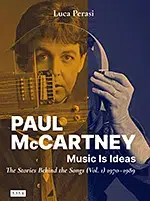
With 25 albums of pop music, 5 of classical – a total of around 500 songs – released over the course of more than half a century, Paul McCartney's career, on his own and with Wings, boasts an incredible catalogue that's always striving to free itself from the shadow of The Beatles. The stories behind the songs, demos and studio recordings, unreleased tracks, recording dates, musicians, live performances and tours, covers, events: Music Is Ideas Volume 1 traces McCartney's post-Beatles output from 1970 to 1989 in the form of 346 song sheets, filled with details of the recordings and stories behind the sessions. Accompanied by photos, and drawing on interviews and contemporary reviews, this reference book draws the portrait of a musical craftsman who has elevated popular song to an art-form.
The McCartney Legacy: Volume 2: 1974 – 80

The follow-up to The McCartney Legacy, Volume 1, the most complete work on the life and work of Paul McCartney ever published. Volume 2 continues to paint the portrait of one of the world’s greatest musicians, his work post-Beatles, and his life from 1974 to 1980.

Notice any inaccuracies on this page? Have additional insights or ideas for new content? Or just want to share your thoughts? We value your feedback! Please use the form below to get in touch with us.

Don Leighty • Apr 08, 2025 • 11 months ago
Paul didn't write his own lyrics to "Falling In Love Again". He's singing the words recorded by The Temperance Seven in 1961 (George Martin produced).
This is a strange song, though. There are three totally different sets of lyrics that I know of. Marlene Dietrich sings both a German version and a (much tamer) English version in The Blue Angel film. That was in 1930. Later the same year, Al Bowlly sang a version of "Falling In Love Again" unrelated to the Dietrich film (or character), but using the same music. This was released on a 78.
I've seen at least six lyricists credited - and all on the Dietrich version! I have no idea whether the same person wrote the Bowlly lyrics. Love to find out, though!
So far, I know of only three people to record the alternate lyrics - Al Bowlly (possibly twice), the Temperance Seven, and The Beatles.
Cheers,
Don Leighty

The PaulMcCartney Project • Apr 08, 2025 • 11 months ago
Thanks a lot, Don, for those insights. I see that Mark Lewisohn, on the Complete Beatles Chronicles, credits the Marlene Dietrich version, written by Hollander, as the inspiration for the Beatles' version. I will revisit this page. Thanks Again.
Don Leighty • Apr 11, 2025 • 11 months ago
Full disclosure here... Although I've been doing what I can to help get to the bottom of this song's origins, the startling discovery that Paul is neither covering the Marlene Dietrich song nor "improvising" his own lyrics should be credited to "Jeri Southern", who has a marvelous thread going at the Steve Hoffman Music Forums site ("Rock and Roll Music: Beatles' Covers Track-by-Track"). She made the connection to the Temperance Seven recording, which is probably the Beatles' source (but without understanding the full history of this weird, alternate version from 1930, it's difficult to be sure).
My guess is that something may have happened along the lines of "A Taste Of Honey". That was originally a jazzy instrumental written for the Broadway run of a British theatrical play. Although not used in the play, songwriter Ric Marlow added lyrics appropriate for its star, Billy Dee Williams, to sing on a record. This version of the lyrics is in character and could have been woven into the Broadway play if so desired. However, when Lenny Welch recorded the song a couple of years later, he wanted a more generic pop song unrelated to the play. Special lyrics were commissioned from someone - most likely Lee Morris (the coauthor of “Blue Velvet”) - but even though these lyrics are better known today, the writer is never identified. Both sets of lyrics are credited to Ric Marlow.
This desire to have a somewhat tamer set of lyrics for "Falling In Love Again" that weren't tied to the film story of Lola may have resulted in the song recorded by Al Bowlly (and others?) in 1930. The songwriter may be the same person who wrote the English lyrics for Dietrich to sing, or it may be someone else entirely. But in any case, it was the movie version that seems to have caught the publics's fancy. The other version seems to have disappeared (at least until the Temperance Seven resurrected it in 1961).
But it's all guesswork.
Don Leighty • Apr 11, 2025 • 11 months ago
Full disclosure here... Although I've been doing what I can to help get to the bottom of this song's origins, the startling discovery that Paul is neither covering the Marlene Dietrich song nor "improvising" his own lyrics should be credited to "Jeri Southern", who has a marvelous thread going at the Steve Hoffman Music Forums site ("Rock and Roll Music: Beatles' Covers Track-by-Track"). She made the connection to the Temperance Seven recording, which is probably the Beatles' source (but without understanding the full history of this weird, alternate version from 1930, it's difficult to be sure).
My guess is that something may have happened along the lines of "A Taste Of Honey". That was originally a jazzy instrumental written for the Broadway run of a British theatrical play. Although not used in the play, songwriter Ric Marlow added lyrics appropriate for its star, Billy Dee Williams, to sing on a record. This version of the lyrics is in character and could have been woven into the Broadway play if so desired. However, when Lenny Welch recorded the song a couple of years later, he wanted a more generic pop song unrelated to the play. Special lyrics were commissioned from someone - most likely Lee Morris (the coauthor of “Blue Velvet”) - but even though these lyrics are better known today, the writer is never identified. Both sets of lyrics are credited to Ric Marlow.
This desire to have a somewhat tamer set of lyrics for "Falling In Love Again" that weren't tied to the film story of Lola may have resulted in the song recorded by Al Bowlly (and others?) in 1930. The songwriter may be the same person who wrote the English lyrics for Dietrich to sing, or it may be someone else entirely. But in any case, it was the movie version that seems to have caught the publics's fancy. The other version seems to have disappeared (at least until the Temperance Seven resurrected it in 1961).
But it's all guesswork.Full disclosure here... Although I've been doing what I can to help get to the bottom of this song's origins, the startling discovery that Paul is neither covering the Marlene Dietrich song nor "improvising" his own lyrics should be credited to "Jeri Southern", who has a marvelous thread going at the Steve Hoffman Music Forums site ("Rock and Roll Music: Beatles' Covers Track-by-Track"). She made the connection to the Temperance Seven recording, which is probably the Beatles' source (but without understanding the full history of this weird, alternate version from 1930, it's difficult to be sure).
My guess is that something may have happened along the lines of "A Taste Of Honey". That was originally a jazzy instrumental written for the Broadway run of a British theatrical play. Although not used in the play, songwriter Ric Marlow added lyrics appropriate for its star, Billy Dee Williams, to sing on a record. This version of the lyrics is in character and could have been woven into the Broadway play if so desired. However, when Lenny Welch recorded the song a couple of years later, he wanted a more generic pop song unrelated to the play. Special lyrics were commissioned from someone - most likely Lee Morris (the coauthor of “Blue Velvet”) - but even though these lyrics are better known today, the writer is never identified. Both sets of lyrics are credited to Ric Marlow.
This desire to have a somewhat tamer set of lyrics for "Falling In Love Again" that weren't tied to the film story of Lola may have resulted in the song recorded by Al Bowlly (and others?) in 1930. The songwriter may be the same person who wrote the English lyrics for Dietrich to sing, or it may be someone else entirely. But in any case, it was the movie version that seems to have caught the publics's fancy. The other version seems to have disappeared (at least until the Temperance Seven resurrected it in 1961).
But it's all guesswork.