
Second half of March 1970
Dispute over the release of “McCartney”
Last updated on August 20, 2025
Second half of March 1970
Last updated on August 20, 2025
Previous article Mar 05, 1970 • "Let It Be" video clip shown on Top Of The Pops
Session Mar 11, 1970 • The "McCartney" track listing is finalised
Single Mar 11, 1970 • "Let It Be / You Know My Name (Look Up The Number)" by The Beatles released in the US
Article Second half of March 1970 • Dispute over the release of "McCartney"
Session Mar 16, 1970 • Playback of the "McCartney" album
Article Mar 17, 1970 • All four Beatles attends Pattie Harrison's birthday party

By Ringo Starr • LP
In March 1970, Paul McCartney contacted Apple to request that his first solo album, “McCartney“ (finalised on March 23, 1970, with its packaging likely conceived in late March), be released on April 17, 1970. According to Paul, this release date was given to him by Neil Aspinall, Apple’s managing director.
The other Beatles and their manager, Allen Klein, were displeased with Paul setting a release date without consulting them, especially since other projects were already in motion. Ringo Starr had completed his first solo record, “Sentimental Journey,” originally scheduled for April. To avoid clashing with Paul’s album, it was rushed forward and released on March 27.
I put my album out two weeks before, which makes me seem like such a good guy but it wasn’t really, because I needed to put it out before, or else it would’ve slayed me, Paul’s album. And it did.
Ringo Starr – Interview with Melody Maker, July 31, 1971
The greater conflict, however, was with the planned release of the “Let It Be” project. While the film was set for May 20, the album was intended for late April (Phil Spector completed its mixing on April 2). Two major Beatles-related releases arriving at the same time was considered commercially unwise.
Klein first attempted to block Paul’s release, citing Apple’s agreement that solo projects required the approval of the other Beatles. He wrote to Sal Iannucci, president of Capitol Records, prompting Paul’s lawyer and brother-in-law, John Eastman, to step in.
[Allen Klein] wrote to the president of Capitol, Sal Iannucci, saying Paul was contracted to the Beatles, so he wasn’t allowed to put out a solo album. I talked to Iannucci and told him, ‘McCartney comes out on Capitol in five weeks or we go straight to Clive Davis at Columbia.’ Iannucci threatened to sue and I said, ‘So sue, it’ll be a great case and terrific publicity for the record.’ ‘You can’t talk to me like that,’ he said, ‘I went to Harvard Law School.’ I said, ‘Well, I went to Stanford, so just go and fuck yourself.’
John Eastman – From “Paul McCartney: The Biography” by Philip Norman, 2016
After discussions, John Lennon, George Harrison, and Klein agreed to postpone “McCartney” to June 4. On March 31, Ken East, managing director of EMI, received the following letter signed by John and George as Apple Records directors, instructing this change:
We have considered very carefully indeed the position concerning the release of Paul McCartney’s album on 17th April. In all circumstances, we have arrived at the conclusion that it would not be in the best interest of this company for the record to be released on that date and we have decided to re-schedule the release for the 4th June, to coincide with the Apple/Capitol Record Convention in Hawaii. The forthcoming Beatles’ album will be released as scheduled on 24th April, to tie in with the film release date in mid-May.
Letter signed John Lennon and George Harrison – From “His Master’s Voice: Sir Joseph Lockwood and Me” by William Cavendish, 2017
The same day, John also drafted a letter to Paul explaining the postponement. It was signed by George, sealed in an envelope marked “From Us, To You.” Ringo was chosen to deliver it — either at John and George’s request (according to John) or because Ringo himself offered to do it, thinking it would soften the blow. (according to Ringo).
Dear Paul,
We thought a lot about yours and the Beatles LP’s — and decided it’s stupid for Apple to put out two big Albums within 7 days of each other (also there’s Ringo’s and Hey Jude) — So we sent a letter to E.M.I. telling them to hold your release date ’til June 4th (there’s a big Apple-Capitol convention in Hawaii then) — We thought you’d come round when you realized that the Beatles album was coming out on April 24th — We’re sorry it turned out like this — it’s nothing personal.
Love
John and George
Hare Krishna A Mantra a Day keeps MAYA Away
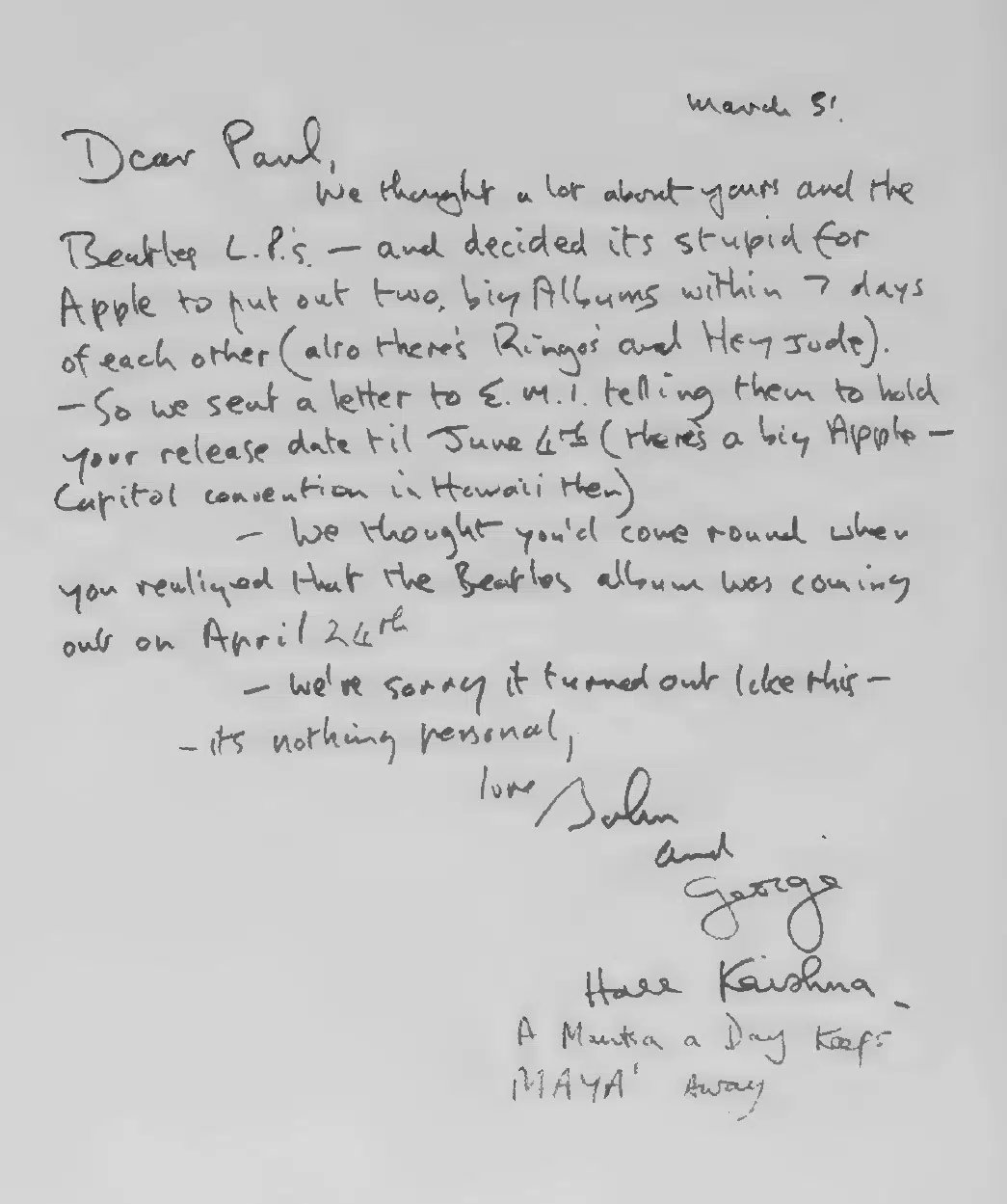
When Ringo brought the letter to Paul’s Cavendish Avenue home on March 31, the meeting quickly soured. Paul, furious, lashed out at Ringo, telling him to leave.
I went to see Paul. To my dismay, he went completely out of control, shouting at me, prodding his fingers towards my face, saying: ‘I’ll finish you now’ and ‘You’ll pay.’ He told me to put my coat on and get out. I did so.
Ringo Starr – From his affidavit for the hearings to end the Beatles’ partnership, 1971
WHAT about the story that John and George sent you round to Paul’s to ask if he’d hold the release of his album so it wouldn’t interfere with sales of “Let It Be”?
They didn’t send me round, it’s a misquote. The letters were ready there. They, as directors of that company — we’re all directors of different companies — wrote a letter to him, and I didn’t think it fair that some office lad should take something like that round. I was in the office at the time and said give it to me… no, I was talking to the office, that’s right, and they were telling me what was going on, and I said, “send it up, I’ll take it round.” I couldn’t fear him then. But he got angry, because we were asking him to hold his album back and the album was very important to him. After I’d left the house — I mean, it’s all been said in court, as it were. He told me to get out of his house. He was crazy, he went crazy, I thought. I got brought down because I couldn’t believe it was happening to me. I’d just brought the letter. I said, I agree with everything that’s in the letter, because we tried to work it like a company then, not as individuals. I put my album out two weeks before, which makes me seem like such a good guy but it wasn’t really, because I needed to put it out before else it would’ve slayed me, Paul’s album. And it did.
IT’S not true that he physically attacked you?
No, he just shouted and pointed at me. It’s funny now. Everything gets funny two years later. But I’m very emotional; things like that really upset me at the time. It’s only like a brother, you know. You mustn’t pretend that brothers don’t fight, ’cause they fight worse than anybody.
Ringo Starr – Interview with Melody Maker, July 31, 1971
Ringo visited me, bringing two letters signed by George and John with which, he said he agreed. These letters confirmed that my record had been stopped. I really got angry when Ringo told me that Klein had told him that my record was not ready and that he had a release date for the Let It Be album. I knew that both of these alleged statements were untrue and I said, in effect, this was the last straw, and, ‘If you drag me down, I’ll drag you down.’ What I meant was, ‘Anything you do to me, I will do to you.’
Paul McCartney – From “The Beatles: Off the Record” by Keith Badman, 2008
I told [Ringo]: ‘If you drag me down I will drag you down.’ What I meant was that whatever the rest of the group did to me I would do to them.
Paul McCartney – From Daily Mail, February 27, 1971
How did it get down to Paul telling Ringo he was going to get him someday?
I don’t know. It happened. It didn’t happen in front of me. I think it happened on the phone. I just knew that…
When Ringo was sent around to say “Look, we don’t want the album out ”…
Oh yeah, that was it. Because we thought it was unfair even though it was Paul’s first new album, that was alright, we weren’t against him puttin’ an album out. I mean I’d done it. And I didn’t think it was any different, except for Paul sang, and mine happened to be Toronto because that happened to happen.[…] There was nothing against Paul having an album out. There was an atmosphere about Eastman and Klein, but it’s alright. It’s business, we all profit from it. But we didn’t want to put it out against Let It Be, it would have killed the sales. It’s like in the old days we used to watch, if the Stones were coming out, we’d ask Brian, “Who’s coming out?” You know? And he’d tell us who’s coming out shortly, and we’d say, “Well, we’ll put it out now.” We could always beat everyone, but what’s the point of losing sales to somebody else? We’d time it! Mick timed it! Wenever came out together. Nobody ever… we’re not that idiot… […] It was just an ego game! It would have killed Let It Be. Let Let It Be breathe!
But Paul didn’t want to.
No!
So…
I can’t remember, he just insisted on putting it out. We asked Ringo to go and talk to him because the real fighting had been going on between me and Paul, and because Eastman and Klein and we were on the opposite ends about that. So Ringo had not taken sides, and he’d always been straight about it, and we thought Ringo would be able to talk fairly. If Ringo agreed that it was unfair, it was unfair, it was like that! Paul wanted — even at one time he wanted a fuckin’ extra vote on our voting trust, but that was the same as like the four of us at a table, but Paul has two votes! Something was going on that Paul thought he was the fuckin’ Beatles! And he never fucking was! Never, never. None of us were the fucking Beatles! Four of us were! […]
So that was it. Ringo went and asked him and he attacked Ringo and threatened him and everything. And that was the kibosh for Ringo. I don’t know what the situation is now.
John Lennon – Interview with Rolling Stone, February 4, 1971
Strictly speaking we all have to ask each other’s permission before any of us does anything without the other three. My own record nearly didn’t come out because Klein and some of the others thought it would be too near to the date of the next Beatles album. I had to get George, who’s a director of Apple, to authorise its release for me.
‘Give us our freedom which we so richly deserve. We’re beginning now to only call each other when we have bad news. The other day Ringo came around to see me with a letter from the others, and I called him everything under the sun. But it’s all business. I don’t want to fall out with Ringo. I like Ringo. I think he’s great. We’re all talking about peace and love, but really we’re not feeling peaceful at all.
‘There’s no one who’s to blame. We were fools to get ourselves into this situation in the first place. But it’s not a comfortable situation for me to work in as an artist.’
Paul McCartney – From interview with Evening Standard, April 1970
They eventually sent Ringo round to my house at Cavendish with a message: ‘We want you to put your release date back, it’s for the good of the group’ and all of this sort of shit, and he was giving me the party line, they just made him come round, so I did something I’d never done before, or since: I told him to get out. I had to do something like that in order to assert myself because I was just sinking. Linda was very helpful, she was saying, ‘Look, you don’t have to take this crap, you’re a grown man, you have every bit as much right…’ I was getting pummelled about the head, in my mind anyway.
Paul McCartney – From “Many Years From Now” by Barry Miles, 1997
Ringo came to see me. He was sent, I believe – being mild mannered, the nice guy – by the others, because of the dispute. So Ringo arrived at the house, and I must say I gave him a bit of verbal. I said: ‘You guys are just messing me around.’ He said: ‘No, well, on behalf of the board and on behalf of The Beatles and so and so, we think you should do this,’ etc. And I was just fed up with that. It was the only time I ever told anyone to GET OUT! It was fairly hostile. But things had got like that by this time. It hadn’t actually come to blows, but it was near enough.
Unfortunately it was Ringo. I mean, he was probably the least to blame of any of them, but he was the fall guy who got sent round to ask me to change the date – and he probably thought: ‘Well, Paul will do it,’ but he met a different character, because now I was definitely boycotting Apple.
Paul McCartney – From the Beatles Anthology book, 2000
After Ringo’s visit, Paul called George Harrison, and George would have the following words to describe the conversation:
[Paul] came on like Attila the Hun. I had to hold the receiver away from my ear.”
George Harrison – From George Harrison,Al Aronowitz,Paul McCartney,Ringo Starr,John Lennon (theblacklistedjournalist.com), 1970
Soon afterwards, Paul wrote to Sir Joseph Lockwood at EMI and Stan Gortikov at Capitol, informing them that the Beatles were effectively finished. Alongside this — or possibly in a separate package — he sent Lockwood a copy of his new LP with a drawing by his daughter Mary of a cherry tree, accompanied by the message: “Dear joe (sic) We hope you like it. Love Heather Mary Paul and Lindea (sic)”
To E.M.I.
Dear Sir Joe and Stan Gortikov,
No matter what anybody tells you, The Beatles are no more (John and I, at least are pursuing our own careers.)
I think that the only thing to do in the circumstances is to dissolve the partnership, and the money and artistic control to go to each of us individually.
I hope you can do something to help, because until this is cleared up, I’m on strike
Paul McCartney.
Letter from Paul McCartney to Sir Joseph Lockwood and Stan Gortikov – From “His Master’s Voice: Sir Joseph Lockwood and Me” by William Cavendish, 2017
Following Paul’s confrontation with Ringo, the decision was reversed: “McCartney” would indeed be released on April 17 as Paul wished, while “Let It Be” was postponed to May 8. One account explains Ringo persuaded Klein to let Paul have his way. On April 2, Ringo phoned Paul to confirm the decision, and EMI was informed as well.
Paul said he was going to ruin Ringo, that he was going to talk with Rolling Stone and really get him. Ringo was really down about it, and he phoned me that night and said, ‘Look Allen, it’s been ten years, Let’s just give him what he wants.’ I said yes.
Allen Klein – Interview with Playboy, November 1971
Ringo, reasonable fellow that he is, told the others that if it meant so much to Paul to have his solo album released in April, they should let him do it, just to show friendship. Ringo’s own solo album was pushed back and the release of Let It Be pushed up. As it turned out, all three albums hit the market within three or four weeks of each other, flooding the record bins with Beatles products. It was a dismal marketing decision.
Peter Brown – From “The Love You Make“, 2002
Five days later, on April 7, John Eastman issued a U.S. press statement announcing the release of McCartney along with Paul’s other personal projects.
On April 9, the album’s press kit was distributed to journalists ahead of the April 17 release. It included the Q&A interview prepared by Peter Brown with Paul’s answers — statements widely read as the official confirmation of the Beatles’ breakup.
This episode later became one of Paul’s formal grievances in the lawsuit he filed against John, George and Ringo on December 31, 1970.
I had now made the “McCartney” record, my first album after The Beatles, and we had a release schedule on it, but then the others started buggering that around, saying, ‘You can’t release the McCartney album when you want to. We’re releasing Let It Be – and Ringo’s solo record.’
I rang Neil who was running Apple and I said, ‘Wait a minute – we’ve decided my release date!’ I had an understanding: I’d marked my release date on the calendar. I’d stuck to it religiously, but they’d moved it anyway.
From my point of view, I was getting done in. All the decisions were now three against one. And that’s not the easiest position if you’re the one: anything I wanted to do they could just say, ‘No.’ And it was just to be awkward, I thought.
Paul McCartney – From the Beatles Anthology book, 2000
I got so fed up with all this I said, ‘OK, I want to get off the label.’ Apple Records was a lovely dream, but I thought, ‘Now this is really trashy and I want to get off.’ I remember George on the phone saying to me, ‘You’ll stay on this fucking label! Hare Krishna!’ and he hung up – and I went, ‘Oh, dear me. This is really getting hairy.’
I didn’t show Apple anything of “McCartney” or the cover or anything until I’d finished it all. I did it all myself, and just gave it to them for release. It was a very difficult position for me.
Paul McCartney – From “The Beatles Anthology” book, 2000
Apple was no longer a happy place: there was a lot of tension in the air. I rang Neil Aspinall – who was and still is the head of Apple – and said, ‘Can I have a release date for this album I’m making?’ He gave me one and I worked towards that. Then, suddenly, a letter came from the other Beatles, who were now with [manager] Allen Klein, which said that they were releasing Let it Be [the film and album] and were going to delay my album. I said, ‘Wait a minute I’ve made all my plans, I’ve got it all worked out…’ We had another argument over that, which increased the tension even more. The word ‘heavy’ was coined during this time. I really did feel physically weighed down by it all, having such a bad time and, worst of all, feeling artistically constricted.
Paul McCartney – From “Wingspan: Paul McCartney’s Band on the Run“, 2002
When the time came to release it I had to deal with Mammon, which was Apple. Ring them up and say, ‘Er, can I have a release date?’ Neil [Aspinall] gave me a date. And suddenly Mammon decided to change my release date for [sarcastically] the massive Let It Be album. And I’m, ‘You bastards! I’ve got a date worked out! How can you do this?’ I certainly shouted loud enough.
It was Rage Against the Machine, me against them, the enemy, the fucking faceless suit out there. That’s why it was a good album.
Paul McCartney – From “Conversations with McCartney” by Paul du Noyer, 2016
I was feeling quite comfortable, the more I went on like this. I could actually do something again. Then I rang up Apple one day and said, “Still okay for the release date?” and they said, “No, we’re changing it. You got put back now. We’re going to release Let It Be first.”’
Paul McCartney – From “Many Years From Now” by Barry Miles, 1997
Paul then informed me and Allen Klein that for personal reasons he wanted his album released on April 10 through Apple. Klein explained that April 10 was out of the question. April was the release date of Let It Be. Phil Spector had done such a good job on John’s “Instant Karma” single that John and Klein had given him all the dusty Let It Be tapes that had been locked in a vault for over a year and had told him to make an album out of it. The album was going to be released in time to back up the finished Let It Be documentary, which was to be released in theaters on May 20. Since it was a United Artists film, the date could not be changed. Also, Ringo had recorded a solo album, an innocent but mawkish album called Sentimental Journey, of classics sung off-key like “Love Is a Many Splendored Thing.” Ringo’s album would have to be released next, after Let It Be.
Paul would just have to wait his place in line.
Paul called Sir Joseph Lockwood at EMI in a rage. “I’m being sabotaged, Sir Joe, that’s what they’re doing to me!” he ranted. Sir Joe said he would see what he could do to help, but in the end it was up to the other Beatles.
Peter Brown – From “The Love You Make“, 2002
The McCartney Legacy: Volume 1: 1969 – 73

In this first of a groundbreaking multivolume set, THE MCCARTNEY LEGACY, VOL 1: 1969-73 captures the life of Paul McCartney in the years immediately following the dissolution of the Beatles, a period in which McCartney recreated himself as both a man and a musician. Informed by hundreds of interviews, extensive ground up research, and thousands of never-before-seen documents THE MCCARTNEY LEGACY, VOL 1 is an in depth, revealing exploration of McCartney’s creative and personal lives beyond the Beatles.
The Beatles Diary Volume 1: The Beatles Years
With greatly expanded text, this is the most revealing and frank personal 30-year chronicle of the group ever written. Insider Barry Miles covers the Beatles story from childhood to the break-up of the group.
The Beatles Diary Volume 2: After The Break-Up 1970-2001
An updated edition of the best-seller. The story of what happened to the band members, their families and friends after the 1970 break-up is brought right up to date. A fascinating and meticulous piece of Beatles scholarship.

Notice any inaccuracies on this page? Have additional insights or ideas for new content? Or just want to share your thoughts? We value your feedback! Please use the form below to get in touch with us.


