Friday, April 10, 1970
“Paul is quitting The Beatles” — UK newspapers break the story
Last updated on October 27, 2025
Friday, April 10, 1970
Last updated on October 27, 2025
Interview Apr 09, 1970 • Paul McCartney interview for Apple Records
Article April 10 - End of April 1970 • Dispute over the release of "Let It Be"
Article Apr 10, 1970 • “Paul is quitting The Beatles” — UK newspapers break the story
Article Apr 14, 1970 • Paul McCartney writes to Allen Klein about "The Long And Winding Road"
Article Late April / early May 1970 • Paul McCartney complains about "McCartney" ads with mentions of ABKCO

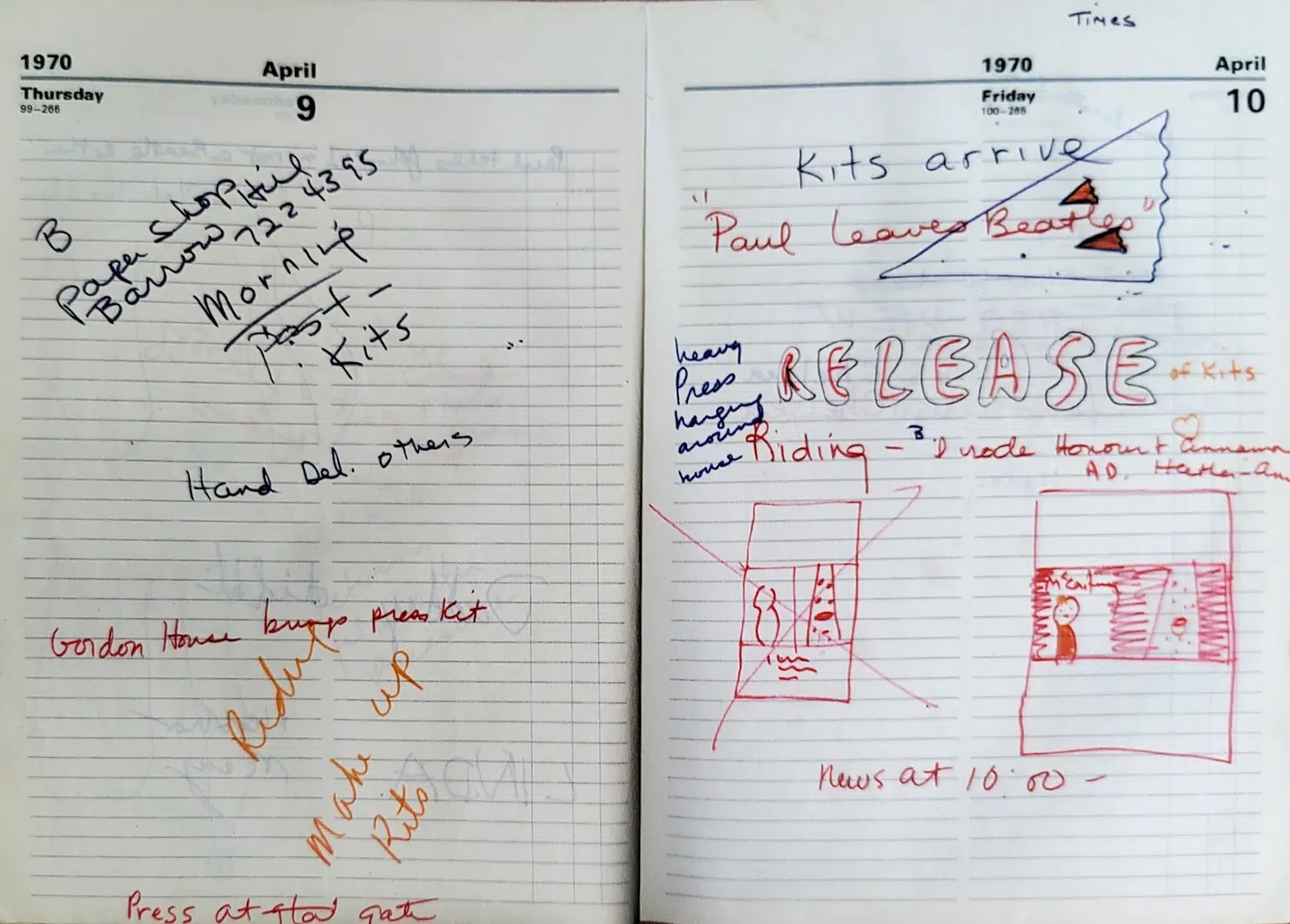
The “McCartney” press kit is sent to UK press
Apr 09, 1970

Dispute over the release of “Let It Be”
April 10 - End of April 1970

Lee Eastman asks for The Beatles to be dissolved
Jun 15, 1970
John Eastman visits Paul and Linda in Scotland
July 11-20, 1970
On April 7, 1970, John Eastman — Paul’s lawyer and brother-in-law — issued a press statement in the United States announcing the imminent release of “McCartney.” The statement also revealed that McCartney Productions Ltd. (established in August 1969 to manage Paul’s business affairs) had acquired the film rights to the cartoon character Rupert the Bear. It further noted that “the private ventures will keep McCartney from directly working with the remainder of the Beatle quartet indefinitely,” prompting many US newspapers to report the end of The Beatles in their April 7 and April 8 editions.
On April 9, advanced copies of “McCartney“ were sent to the UK press, accompanied by a press kit. As Paul was reluctant to hold a press conference or take part in a wide range of interviews, Apple’s Peter Brown had suggested preparing a written Questions & Answers sheet to included in the kit. Paul approved the idea, with Brown drafting the questions and Paul providing brief, dry responses.
When Paul had told Life Magazine in November 1969 that “The Beatle thing is over“, the remark went largely unnoticed. By contrast, the Q&A circulated with the press kit was widely interpreted as the official announcement of The Beatles’ split.
At the end of the day in London, the April 10, 1970, edition of The Daily Mirror began to appear on newsstands, carrying the front-page headline: “Paul is quitting The Beatles.” Don Short, the journalist who wrote the article, had been tipped off by some Apple insiders on April 9. In 2020, he recalled the circumstances, though without revealing the identity of the insiders:
It was the night I was never going to forget. That momentous night April 9, 1970. My world exclusive was splashed on the Daily Mirror’s front page: Paul Quits The Beatles. Unimaginable drama was to unfold, and a world was left asking: “Where will we be without the Beatles?” At the time I was the Mirror’s showbusiness columnist and as evening approached, I had just put on my coat and locked down my attache case when my office phone rang. Instantly, I recognised the voice of one of my Beatles’ contacts. From the quiver in his tone, I knew he had something serious to impart. Finally he stuttered: “Paul is quitting, Don. It’s definite. It’s all over. The Beatles are breaking up”. “Can you believe that?”
I slammed down the phone and called the home of a Beatles aide who was an executive of their Apple company. There was some reluctance on his part to elaborate but, vitally, he confirmed the story.
In a bold typeface normally reserved for earthquakes, plane crashes and other disasters, the Mirror’s front page first edition broke the news.
Don Short, from “The Beatles And Beyond“
At the end of the day, Apple Records issued the following press statement, written by Derek Taylor:
April 10 1970
Spring is here, and Leeds are playing Chelsea tomorrow, and Ringo and John and George and Paul are alive and well and full of hope.
The world is still spinning and so are we and so are you.
When the spinning stops – that’ll be the time to worry. Not before.
Until then, the Beatles are alive and well and the beat goes on. The beat goes on.
Paul McCartney has quit the Beatles. The shock news must mean the end of Britain’s most famous pop group, which has been idolised by millions the world over for nearly ten years.
Today 27-year-old McCartney will announce his decision, and the reasons for it, in a no-holds-barred statement. It follows months of strife over policy in Apple, the Beatles’ controlling organisation and an ever-growing rift between McCartney and his song-writing partner, John Lennon. In his statement, which consists of a series of answers to questions, McCartney says:
I have no future plans to record or appear with the Beatles again. Or to write any more music with John.
Last night the statement was locked up in a safe at Apple headquarters in Savile Row, Mayfair – in the very rooms where the Beatles’ break-up began. The Beatles decided to appoint a “business adviser.” Eventually, they settled for American Allen Klein. His appointment was strongly resisted by Paul who sought the job for his father-in-law, American attorney Lee Eastman. After a meeting in London Paul was out-voted 3-1 by John, and the other Beatles, George Harrison and Ringo Starr. Since the Klein appointment, Paul has refused to go to the Apple offices to work daily. He kept silent and stayed at his St. John’s Wood home with his photographer wife Linda, her daughter Heather and their own baby, Mary. Close friends tried to pacify John and Paul. But August last year was the last time they were to work together – when they collaborated on the “Abbey Road” album.
There were other elements that hastened Paul’s decision to quit. John Lennon, on his marriage to Yoko Ono, set out on projects of his own. Ringo went into films, and George stepped in as a record producer. Today McCartney will reveal his own plans for a solo programme.
Early today an Apple spokesman denied reports that Paul McCartney had left the Beatles. But he said that there were no plans “at the moment” for any more recordings.
Don Short

The world reaction was like ‘The Beatles Have Broken Up – It’s Official’ – we’d known it for months. So that was that, really. I think it was the press who misunderstood. The record had come with this weird explanation on a questionnaire of what I was doing. It was actually only for them. I think a few people thought it was some weird move of me to get publicity, but it was really to avoid having to do the press.
Paul McCartney – From “The Beatles Anthology” book, 2000
I never intended it to mean I’d quit. It was a misunderstanding … We got some people at the office to ask some questions just on paper, you know, and they sent them over to our house and I just filled them out like an essay, like a school thing. When I saw the headlines, I thought, ‘Christ, what have I done? Now we’re in for it.’ I didn’t leave The Beatles – The Beatles have left The Beatles, but no one wants to be the one to say the party’s over.
Paul McCartney – From “The Beatles: Off the Record” by Keith Badman, 2008
The press got it and it looked like I was doing a real number. John then thought, ‘Aha, he’s done the announcement of The Beatles’ split.’ But it was months after. Someone’s got to do it. In actual fact, we signed contracts that were saying that The Beatles were still going and that was one of the terrible things when The Beatles broke up. But I became known as the one who broke The Beatles up.
Paul McCartney – From “The Beatles: Off the Record” by Keith Badman, 2008
Klein was not the exclusive reason why The Beatles broke up. We were starting to do our own things before he arrived, but it certainly helped. There were various reasons why we split. I don’t think even the four of us know all the reasons, but Klein was one of the major ones…
Paul McCartney – From “The Beatles: Off the Record” by Keith Badman, 2008
The inevitable thing after The Beatles, really, was that you were actually facing up to growing up. The thing of finally being on your own. The biggest trouble for me was the break-up of The Beatles. The Beatles’ break-up was shocking. It totally screwed my head. It was not easy being in a top job one day and the next day you haven’t got a job. I asked myself, ‘Am I any use to anyone? I was very useful yesterday playing bass and singing, but now we’ve broken up.’ That was very hard.
Paul McCartney – From “The Beatles: Off the Record” by Keith Badman, 2008
After all we’d been through, I thought that they knew me. I think we were all pretty weird at the time. I’d ring John and he’d say, ‘Don’t bother me.’ I rang George and he came out with some effing and blinding, not at all Hare Krishna. We weren’t normal to each other at the time.
Paul McCartney – From “The Beatles: Off the Record” by Keith Badman, 2008
PAUL: It was going to be an insert in the album. But when it was printed as news, it looked very cold, yes, even crazy. Because it was just me answering a questionnaire. A bit weird. And, yes, John was hurt by that.
LINDA: Let me just say that John had made it clear that he wanted to be the one to announce the split, since it was his idea.
PAUL: He wanted to be first. But I didn’t realize it would hurt him that much or that it mattered who was first.
Interview with Playboy, December 1984
I knew I hadn’t broken up The Beatles. I’d pleaded with them to stay together. It really broke my heart to see Paul so upset that he didn’t have a band anymore, that he felt completely washed up and redundant.
Linda McCartney – From “The Beatles: Off the Record” by Keith Badman, 2008
[You were angry with Paul] when he came out with this “I’m leaving”?
No, I wasn’t angry — shit, he’s a good P.R. man, that’s all. He’s about the best in the world, probably. He really does a job. I wasn’t angry. We were all hurt that he didn’t tell us that was what he was going to do.
I think he claims that he didn’t mean that to happen but that’s bullshit. He called me in the afternoon of that day and said, “I’m doing what you and Yoko were doing last year.” I said good, you know, because that time last year they were all looking at Yoko and me as if we were strange trying to make our life together instead of being fab, fat myths. So he rang me up that day and said I’m doing what you and Yoko are doing, I’m putting out an album, and I’m leaving the group too, he said. I said good. I was feeling a little strange, because he was saying it this time, although it was a year later, and I said “good,” because he was the one that wanted the Beatles most, and then the midnight papers came out.
How did you feel then?
I was cursing, because I hadn’t done it. I wanted to do it, I should have done it. Ah, damn, shit, what a fool I was. But there were many pressures at that time with the Northern Songs fight going on; it would have upset the whole thing, if I would have said that.
John Lennon – From RollingStone, January 21, 1971
Down at Tittenhurst Park, John was fuming. As he had started the Beatles, he had always assumed that he would be the one to finish them. He’d wanted to do it the previous September, but had been talked out of it by Allen Klein. Now Paul had grabbed the glory, as he saw it.
‘Why didn’t you write it when I told you in Canada at Christmas?’ he asked me that day.
‘You asked me not to,’ I replied.
‘You’re the journalist, Connolly, not me,’ he stabbed back.
Ray Connolly – From “Being John Lennon“, 2018
Well, it’s never pleasant when someone appears not to like you. I think his reasons are sad. They are his own personal problems, but unfortunately, he is obligated into Apple for a considerable number of years, so his disassociation with me has really no effect.
Allen Klein – Interview with BBC – From “The Beatles: Off the Record” by Keith Badman, 2008
This is the truth about Paul McCartney. He cannot make that Beatle scene anymore because what we know as The Beatles and love as The Beatles and prized and valued and changed our lives by, is not what it was. It is a hang-up, it’s a drag and it is a prison for four souls screaming for freedom. It was once a garden with tangerine trees and marmalade skies and girls with kaleidoscope eyes and cellophane flowers of yellow and green. Nothing can take that away. As long as all of us are alive we should all be on our knees with our stereo phones on our ears thanking God it happened… It was the only dream I ever had that came true. I love them for it. The Beatles. They have done enough for you and you have done enough for them. For every dollar you spend on them, they give you a dollar’s worth of themselves. I am sick at heart, press, public, Beatles, we seek too much of each other.
Derek Taylor – From “The Beatles: Off the Record” by Keith Badman, 2008
I don’t remember acknowledging it was a break-up. I was interviewed all day, and denied it. I said, ‘It must be temporary. There can be no break-up of these people …
Derek Taylor – From “The Beatles: Off the Record” by Keith Badman, 2008
Reaction to Paul’s statement was worldwide. Hot news. I’m a bit vague as to whether there was an actual announcement: ‘The Beatles have broken up’ at that time. I did put out a statement, one of those very circular statements that actually says nothing: ‘John, Paul, George and Ringo are still John, Paul, George and Ringo, the world keeps spinning and when that stops that will be the time to worry. See you again.’ Something like that. But there was worldwide reaction, and genuine dismay.
I absolutely did believe – as millions of others did – that the friendship The Beatles had for each other was a lifesaver for all of us. I believed that if these people were happy with each other and could get together and could be seen about the place, no matter what else was going on, life was worth living. But we expected too much of them.
Derek Taylor – From “The Beatles Anthology” book, 2000
It’s pretty obvious that without the Beatles I wouldn’t be where I am. I felt a little bit of emptiness, but on the other hand it was almost a relief because I had gained my freedom. I had devoted eight years of my life to them; they were always Number One in my book, and all my other artists had to understand they took second place to the Beatles. After Brian [Epstein] died, I felt some responsibility for their careers, too. I didn’t want to fail them; I wanted them always to be successful. Suddenly, that responsibility was removed.
George Martin – From “Solid State: The Story of Abbey Road and the End of the Beatles” by Kenneth Womack, 2019
The McCartney Legacy: Volume 1: 1969 – 73

In this first of a groundbreaking multivolume set, THE MCCARTNEY LEGACY, VOL 1: 1969-73 captures the life of Paul McCartney in the years immediately following the dissolution of the Beatles, a period in which McCartney recreated himself as both a man and a musician. Informed by hundreds of interviews, extensive ground up research, and thousands of never-before-seen documents THE MCCARTNEY LEGACY, VOL 1 is an in depth, revealing exploration of McCartney’s creative and personal lives beyond the Beatles.
The Beatles Diary Volume 1: The Beatles Years
With greatly expanded text, this is the most revealing and frank personal 30-year chronicle of the group ever written. Insider Barry Miles covers the Beatles story from childhood to the break-up of the group.
The Beatles Diary Volume 2: After The Break-Up 1970-2001
An updated edition of the best-seller. The story of what happened to the band members, their families and friends after the 1970 break-up is brought right up to date. A fascinating and meticulous piece of Beatles scholarship.
Maccazine - Volume 40, Issue 3 - RAM Part 1 - Timeline

This very special RAM special is the first in a series. This is a Timeline for 1970 – 1971 when McCartney started writing and planning RAM in the summer of 1970 and ending with the release of the first Wings album WILD LIFE in December 1971. [...] One thing I noted when exploring the material inside the deluxe RAM remaster is that the book contains many mistakes. A couple of dates are completely inaccurate and the story is far from complete. For this reason, I started to compile a Timeline for the 1970/1971 period filling the gaps and correcting the mistakes. The result is this Maccazine special. As the Timeline was way too long for one special, we decided to do a double issue (issue 3, 2012 and issue 1, 2013).
If we modestly consider the Paul McCartney Project to be the premier online resource for all things Paul McCartney, it is undeniable that The Beatles Bible stands as the definitive online site dedicated to the Beatles. While there is some overlap in content between the two sites, they differ significantly in their approach.

Notice any inaccuracies on this page? Have additional insights or ideas for new content? Or just want to share your thoughts? We value your feedback! Please use the form below to get in touch with us.
Financial Errors to Avoid as a Music Artist • Nov 20, 2021 • 4 years ago
[…] help you avoid some of the most common financial mistakes that musicians make. When you go through the beatles newspaper articles, you realize that Paul McCartney did not want to continue to share the money with John Lennon and […]


