July 11-20, 1970
John Eastman visits Paul and Linda in Scotland
Last updated on September 17, 2025
July 11-20, 1970
Last updated on September 17, 2025
Location: High Park Farm • Campbeltown • UK
Article Jun 15, 1970 • Lee Eastman asks for The Beatles to be dissolved
Article July 11-20, 1970 • John Eastman visits Paul and Linda in Scotland
Article Jul 22, 1970 • Test screening of "The Raging Moon" leads Paul McCartney to withdraw his song
Article Jul 27, 1970 • Holiday in the Orkney and Shetland Islands

The “McCartney” press kit is sent to UK press
Apr 09, 1970

Dispute over the release of “Let It Be”
April 10 - End of April 1970

Lee Eastman asks for The Beatles to be dissolved
Jun 15, 1970
John Eastman, Linda’s brother and Paul’s business lawyer, along with his wife, came to visit Paul and Linda in Scotland, to talk about the options Paul had to get away of the influence of Allen Klein and Apple on his personal projects.
So then we began to talk again about the suit, over and over. I just saw that I was not going to get out of it. From my last phone conversation with John [Lennon], I think he sees it like that. He said, ‘Well, how do you get out?’
My lawyer, John Eastman, he’s a nice guy and he saw the position we were in, and he sympathized. We’d have these meetings on top of hills in Scotland, we’d go for long walks. I remember when we actually decided we had to go and file suit. We were standing on this big hill which overlooked a loch — it was quite a nice day, a bit chilly — and we’d been searching our souls. Was there any other way? And we eventually said, ‘Oh, we’ve got to do it.’ The only alternative was seven years with the partnership — going through those same channels for seven years.
Paul McCartney – Interview with Life Magazine – April 16, 1971
[…] The only way for me to save The Beatles and Apple […] was to sue the band. If I hadn’t done that, it would have all belonged to Allen Klein. The only way I was given to get us out of that was to do what I did. I said, “Well, I’ll sue Allen Klein,” and I was told I couldn’t because he wasn’t party to it. “You’ve got to sue The Beatles.”
Well, as you can imagine, that was horrendous and it gave me some terrible times. I drank way too much and did too much of everything. And it was crazy, but I knew that was the only thing to do, because there was no way I was going to save it for me, because there was no way I was going to work that hard for all my life and see it all vanish in a puff of smoke. I also knew that, if I managed to save it, I would be saving it for them [the rest of The Beatles] too. Because they were about to give it away. They loved this guy Klein. And I was saying, “He’s a fucking idiot.”
“What you talking about? He’s great!”
And John would say this classic thing: “Anyone who’s that bad can’t be all bad.”
And you’d go, “John, he can be… because he’s a fucking idiot.”
But John was very enamoured of him, until he wasn’t.
If you read the history, there comes a point when all the guys turn against [Klein], but I had to do this thing. So to answer your question, because I had to do that, I think I was thought to be the guy who broke The Beatles up and the bastard who sued his mates. And, believe me, I bought into that. That’s the weirdest thing. It was so prevalent that for years I almost blamed myself. I knew that that was stupid and when we eventually got back together I knew it was silly, but I think it spawned a lot of people who thought that of me. “The stupid bastard.”
Paul McCartney – Interview with GQ Magazine, August 2020
In Scotland since May 1970, Paul McCartney spent time composing new songs and reflecting on his next album, following “McCartney,” which he had recorded alone. Some critics had been harsh on “McCartney,” and for his second album Paul wanted to work with other musicians. He may already have been considering forming a new back-to-basics band, an idea he would realise a year later with the creation of Wings in July 1971.
By the time RAM came around I’d had a little chance to kinda settle into my new circumstances with Linda, and now it was kind of a little bit easier to look at future plans, because my personal circumstances were a little more comfortable. So I was able to take some time and start planning the kind of album I wanted next. And having done a homemade ‘front parlour’ album [McCartney], I now wanted to kind of expand a little bit. I was ready to open my horizons, and I think that was the main thing that happened; I felt like I could have a bit more scope to do anything this time.
Paul McCartney – From “RAM – Archive Collection“, 2012
Paul shared his thoughts with John Eastman. John and his father Lee Eastman, both show-business lawyers, had strong connections within the American music scene, particularly in New York and Los Angeles. Among their clients was the fashionable producer Jim Guercio. Eastman suggested that Paul could record in the United States for a change of atmosphere, hire session musicians, and, if he wished to use a producer, be introduced to Guercio.
Paul was receptive to the idea. After some consideration, he decided to record in New York, beginning in October 1970. Recording there offered both distance from London and Abbey Road Studios, where he risked running into John, George or Ringo, and the benefit of a fresh environment.
With John Eastman’s initial help, auditions were arranged to recruit session musicians and secure a studio. For the second phase of the sessions, in January/February 1971, Paul worked with Phil Ramone in New York, before moving to Los Angeles in March/April to collaborate briefly with Jim Guercio.
The McCartney Legacy: Volume 1: 1969 – 73

In this first of a groundbreaking multivolume set, THE MCCARTNEY LEGACY, VOL 1: 1969-73 captures the life of Paul McCartney in the years immediately following the dissolution of the Beatles, a period in which McCartney recreated himself as both a man and a musician. Informed by hundreds of interviews, extensive ground up research, and thousands of never-before-seen documents THE MCCARTNEY LEGACY, VOL 1 is an in depth, revealing exploration of McCartney’s creative and personal lives beyond the Beatles.
The Beatles Diary Volume 1: The Beatles Years
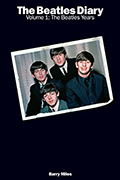
With greatly expanded text, this is the most revealing and frank personal 30-year chronicle of the group ever written. Insider Barry Miles covers the Beatles story from childhood to the break-up of the group.
The Beatles Diary Volume 2: After The Break-Up 1970-2001
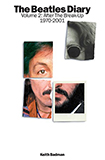
An updated edition of the best-seller. The story of what happened to the band members, their families and friends after the 1970 break-up is brought right up to date. A fascinating and meticulous piece of Beatles scholarship.
Maccazine - Volume 40, Issue 3 - RAM Part 1 - Timeline

This very special RAM special is the first in a series. This is a Timeline for 1970 – 1971 when McCartney started writing and planning RAM in the summer of 1970 and ending with the release of the first Wings album WILD LIFE in December 1971. [...] One thing I noted when exploring the material inside the deluxe RAM remaster is that the book contains many mistakes. A couple of dates are completely inaccurate and the story is far from complete. For this reason, I started to compile a Timeline for the 1970/1971 period filling the gaps and correcting the mistakes. The result is this Maccazine special. As the Timeline was way too long for one special, we decided to do a double issue (issue 3, 2012 and issue 1, 2013).

Notice any inaccuracies on this page? Have additional insights or ideas for new content? Or just want to share your thoughts? We value your feedback! Please use the form below to get in touch with us.


