
Saturday, December 25, 1965
Interview for Record Mirror
Are the Stones more popular than The Beatles? Paul comments...
Press interview • Interview of Paul McCartney
Last updated on December 24, 2025
Saturday, December 25, 1965
Press interview • Interview of Paul McCartney
Last updated on December 24, 2025
Interview location: Capitol Theatre • Cardiff • UK
Previous interview Dec 12, 1965 • Backstage interview in Cardiff
Article Dec 25, 1965 • A Christmas break for The Beatles
Article Dec 25, 1965 • Four Beatles promotional films broadcast on Top Of The Pops
Interview Dec 25, 1965 • Paul McCartney interview for Record Mirror
Interview Dec 25, 1965 • The Beatles interview for BBC Light Programme
Article Dec 26, 1965 • Paul McCartney has a moped accident in Wirral, Liverpool

Cardiff • Capitol Theatre • UK
Dec 12, 1965 • 5:30pm show • UK • Cardiff • Capitol Theatre
Cardiff • Capitol Theatre • UK
Dec 12, 1965 • 8pm show • UK • Cardiff • Capitol Theatre
This interview remains the property of the respective copyright owner, and no implication of ownership by us is intended or should be inferred. Any copyright owner who wants something removed should contact us and we will do so immediately.
On this day, The Beatles performed the last two concerts of their final UK tour, in Cardiff. The first show took place at 5:30 pm and the second at 8 pm. Also appearing on the bill were the Moody Blues, the Paramounts, Beryl Marsden, Steve Aldo, the Koobas, and the Marionettes.
Between the two shows, The Beatles gave interviews to the South Wales Argus and the South Wales Echo. They also recorded a filmed interview — for an unidentified publisher — which resurfaced in 2019. Paul McCartney also gave an interview to Record Mirror.
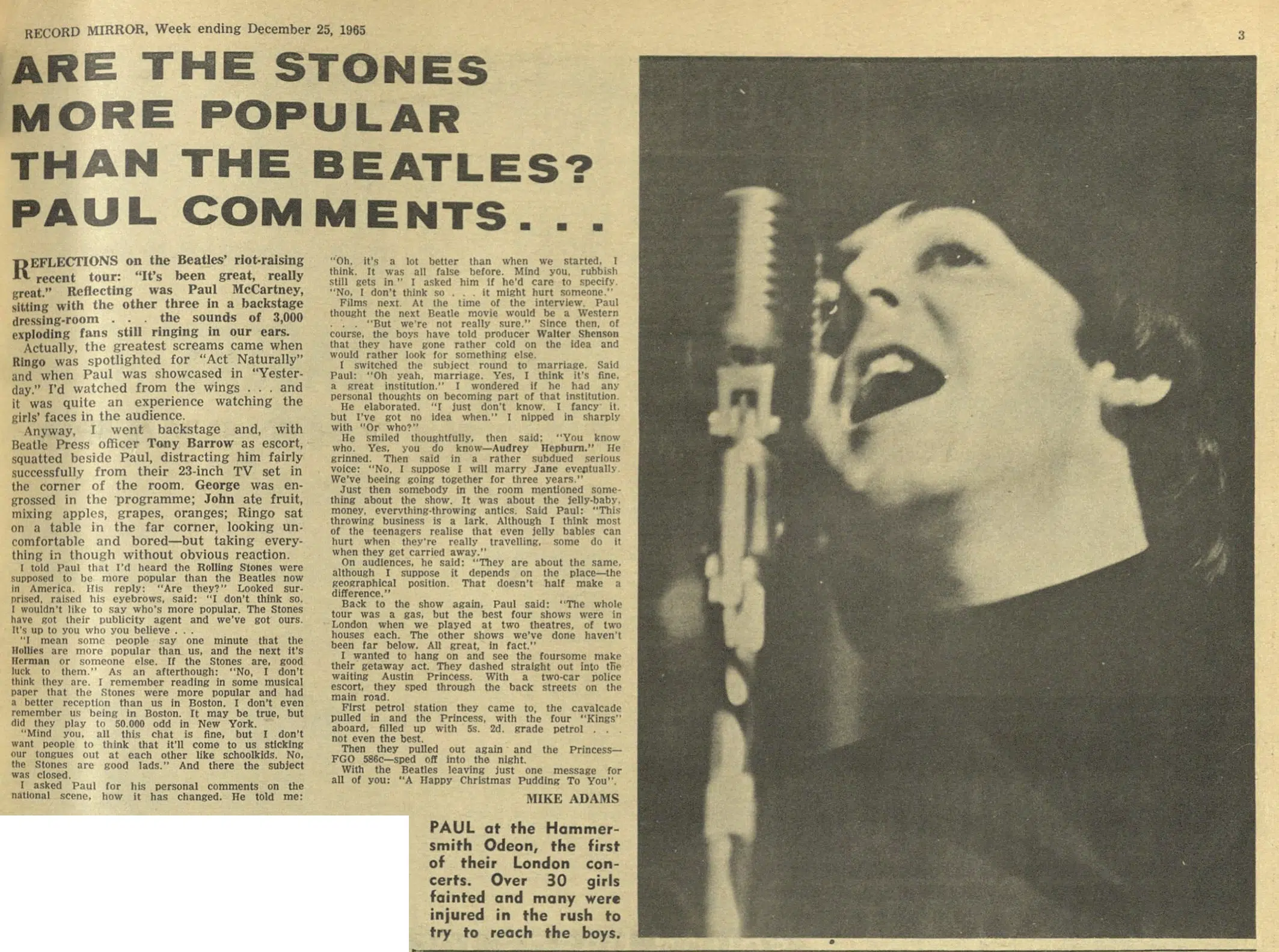
REFLECTIONS on the Beatles’ riot-raising recent tour: “It’s been great, really great.” Reflecting was Paul McCartney, sitting with the other three in a backstage dressing-room — the sounds of 3,000 exploding fans still ringing in our ears. Actually, the greatest screams came when Ringo was spotlighted for “Act Naturally” and when Paul was showcased in “Yesterday.” I’d watched from the wings… and it was quite an experience watching the girls’ faces in the audience.
Anyway, I went backstage and, with Beatle Press officer Tony Barrow as escort, squatted beside Paul, distracting him fairly successfully from their 23-inch TV set in the corner of the room. George was engrossed in the programme; John ate fruit, mixing apples, grapes, oranges; Ringo sat on a table in the far corner, looking uncomfortable and bored — but taking everything in though without obvious reaction.
I told Paul that I’d heard the Rolling Stones were supposed to be more popular than the Beatles now in America. His reply: “Are they?” Looked surprised, raised his eyebrows, said:
“I don’t think so. I wouldn’t like to say who’s more popular. The Stones have got their publicity agent and we’ve got ours. It’s up to you who you believe… I mean some people say one minute that the Hollies are more popular than us, and the next it’s Herman or someone else. If the Stones are, good luck to them.”
As an afterthought:
“No, I don’t think they are. I remember reading in some musical paper that the Stones were more popular and had a better reception than us in Boston. I don’t even remember us being in Boston. It may be true, but did they play to 50,000 odd in New York. Mind you, all this chat is fine, but I don’t want people to think that it’s come to us sticking our tongues out at each other like schoolkids. No, the Stones are good lads.”
And there the subject was closed.
I asked Paul for his personal comments on the national scene, how it has changed. He told me:
“Oh, it’s a lot better than when we started. I think it was all false before. Mind you, rubbish still gets in.”
I asked him if he’d care to specify.
“No, I don’t think so — it might hurt someone.”
Films next. At the time of the interview, Paul thought the next Beatle movie would be a Western. “But we’re not really sure.” Since then, of course, the boys have told producer Walter Shenson that they have gone rather cold on the idea and would rather look for something else.
I switched the subject round to marriage. Said Paul:
“Oh yeah, marriage. Yes, I think it’s fine, a great institution.”
I wondered if he had any personal thoughts on becoming part of that institution. He elaborated:
“I just don’t know. I fancy it, but I’ve got no idea when.”
I nipped in sharply with “Or who?” He smiled thoughtfully, then said:
“You know who. Yes, you do know—Audrey Hepburn.”
He grinned. Then said in a rather subdued serious voice:
“No, I suppose I will marry Jane eventually. We’ve been going together for three years.”
Just then somebody in the room mentioned something about the show. It was about the jelly-baby, money, everything-throwing antics. Said Paul:
“This throwing business is a lark. Although I think most of the teenagers realise that even jelly babies can hurt when they’re really travelling, some do it when they get carried away.”
On audiences, he said:
“They are about the same, although I suppose it depends on the place—the geographical position. That doesn’t half make a difference.”
Back to the show again, Paul said:
“The whole tour was a gas, but the best four shows were in London when we played at two theatres, of two houses each. The other shows we’ve done haven’t been far below. All great, in fact.”
I wanted to hang on and see the foursome make their getaway act. They dashed straight out into the waiting Austin Princess. With a two-car police escort, they sped through the back streets on the main road.
First petrol station they came to, the cavalcade pulled in and the Princess, with the four “Kings” aboard, filled up with 5s. 2d. grade petrol—not even the best.
Then they pulled out again and the Princess—FGO 586c—sped off into the night.
With the Beatles leaving just one message for all of you: “A Happy Christmas Pudding To You”.
MIKE ADAMS

Notice any inaccuracies on this page? Have additional insights or ideas for new content? Or just want to share your thoughts? We value your feedback! Please use the form below to get in touch with us.