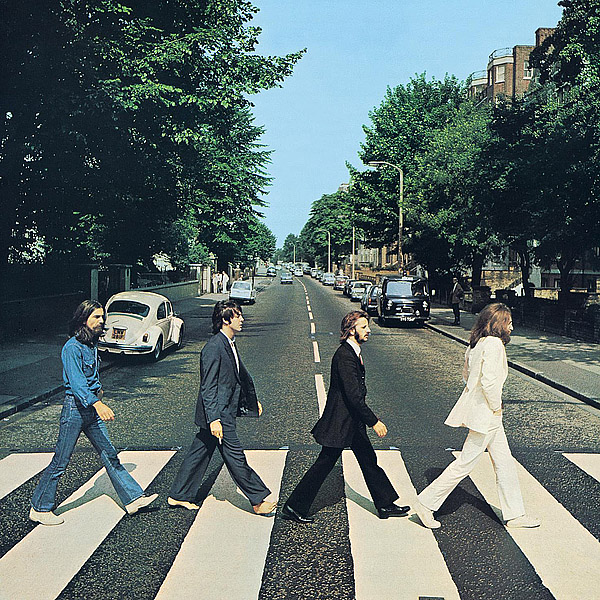

Feb 22 - Aug 25, 1969 • Songs recorded during this session appear on Abbey Road
Recording studio: EMI Studios, Studio Two, Abbey Road • London • UK
Previous session Jul 31, 1969 • Recording "You Never Give Me Your Money", "Golden Slumbers", "Carry That Weight"
Article August 1969 ? • Paul McCartney gives name to band Sounds Nice
Article August 1969 • Designing the packaging for "Abbey Road"
Session Aug 01, 1969 • Recording "Because"
Session Aug 02, 1969 • Recording "Come And Get It"
Article August 3 or 7, 1969 • Test shot for the "Abbey Road" album
AlbumSome of the songs worked on during this session were first released on the "Abbey Road" LP
On this day, from 2:30 pm to 10:30 pm, The Beatles began recording the final song for the “Abbey Road” album, John Lennon’s “Because“.
It was the first time John had introduced the song to the others. The session began with a period of exploration, during which producer George Martin played a significant role in shaping the arrangement.
Everyone agreed that the song was begging for big, lush harmonies — just the kind of thing that was George Martin’s forte. Delighted to be contributing at last, he spent many long hours with John, Paul, and George Harrison gathered around the piano while he worked out their complex parts note by note.
First, though, a backing track had to be recorded, and George Martin was heavily involved in that as well. John had written the song on guitar, gently picking individual notes rather than playing chords, but he felt that something more was needed.
“Why don’t I double your line exactly on harpsichord?” George suggested, and Lennon quickly agreed. “Yeah, great, that will help make it a little more classical-like, too.”
Geoff Emerick – From “Here, There and Everywhere: My Life Recording the Music of The Beatles“, 2006
The Beatles then recorded 23 takes of the basic track, although only takes 1, 16, and 23 were complete. Take 16 was considered the best.
John Lennon played electric guitar (recorded on track two of the eight-track tape), Paul McCartney played bass (on track one), and George Martin played an electric spinet Baldwin harpsichord (on track three). Ringo Starr kept time with handclaps, recorded on track four for guide purposes only.
Take 1, featuring the audible handclaps, was released on the “Abbey Road (50th anniversary boxset)” in 2019.
On Because, for example, very much a John song, it needed the combined singing of the three men. So obviously it became a joint effort…
That particular track started off with John having the idea, the sort of riff on the guitar, which he played to me, and the basic song which he sang to me. And what we did then, we created a backing with him still playing the guitar, that riff, and I duplicated exactly every note that he played on the guitar, on an electric harpsichord, and Paul played bass.
And there was nothing for Ringo to do, because we’d not got drums in. But in fact there was something for him to do. Because it was so slow, and meticulously, the question of ensemble between the guitar and the harpsichord, each note had to be exactly together. And I’m not the world’s greatest player in time, and I would make more mistakes than John did. So we had Ringo beating a hi-hat all the time, to us in headphones, so we had a regular beat. We didn’t have drum machines in those days. So Ringo was our drum machine, and that was the way we did the track.
George Martin – Interview with Richard Buskin, March 3, 1987
Between us, we also created a backing track with John playing a riff on guitar, me duplicating every note on an electronic harpsichord, and Paul playing bass. Each note between the guitar and harpsichord had to be exactly together, and as I’m not the world’s greatest player in terms of timing, I would make more mistakes than John did, so we had Ringo playing a regular beat on hi-hat to us through our headphones.
George Martin – From “Insidetracks: A First-hand History of Popular Music” by Richard Buskin (1999)
So George Martin headed down into the studio, along with John and Ringo, while Paul and George Harrison stayed up in the control room. Ringo’s job was to act as a timekeeper, a human click track; he was merely to tap out a steady tempo on hi-hat, for reference purposes only. Hunched over their instruments, deep in concentration, they labored for a long time on that backing track. It wasn’t really their fault: Paul, who was acting as surrogate producer, was pushing them too hard that night, having them do take after take, playing way past their peak. When the exhausted trio finally came up to the control room to have a listen, they realized that they had laid down a perfectly good take an hour before. John didn’t say anything, but he shot an embarrassed Paul a dirty look. Fortunately, they seemed too tired to make an issue out of it.
Geoff Emerick – From “Here, There and Everywhere: My Life Recording the Music of The Beatles“, 2006 (Geoff Emerick contradicts George Martin by saying Paul didn’t contribute to the basic track but was in the control room)
With the basic track completed, The Beatles began overdubbing the harmony vocals. John, Paul, and George recorded a three-part harmony onto take 16 (on track six). Two additional sets of three-part harmonies would be recorded on the next working day, August 4, 1969.
Having done the backing track, John, Paul and George sang the harmony. Then we overlaid it twice more, making nine-part harmony altogether, three voices recorded three times. I was literally telling them what notes to sing.
George Martin – From “The Complete Beatles Recording Sessions” by Mark Lewisohn, 1988
Recording • Take 1
AlbumOfficially released on Abbey Road (50th anniversary boxset)
Recording • Take 2
Recording • Take 3
Recording • Take 4
Recording • Take 5
Recording • Take 6
Recording • Take 7
Recording • Take 8
Recording • Take 9
Recording • Take 10
Recording • Take 11
Recording • Take 12
Recording • Take 13
Recording • Take 14
Recording • Take 15
Recording • Take 16
Recording • Take 17
Recording • Take 18
Recording • Take 19
Recording • Take 20
Recording • Take 21
Recording • Take 22
Recording • Take 23
Recording • SI onto take 16
The Complete Beatles Recording Sessions • Mark Lewisohn
The definitive guide for every Beatles recording sessions from 1962 to 1970. We owe a lot to Mark Lewisohn for the creation of those session pages, but you really have to buy this book to get all the details - the number of takes for each song, who contributed what, a description of the context and how each session went, various photographies... And an introductory interview with Paul McCartney!
The Beatles Recording Reference Manual: Volume 5: Let It Be through Abbey Road (1969 - 1970)

The fifth and final book of this critically acclaimed series, "The Beatles Recording Reference Manual: Volume 5: Let It Be through Abbey Road (1969 - 1970)" follows The Beatles as they "get back to where they once belonged...". Not once, but twice. With "Let It Be", they attempted to recapture the spontaneity of their early years and recordings, while "Abbey Road" was a different kind of return - to the complexity, finish and polish that they had applied to their work beginning with "Revolver" and through to "The Beatles".
Solid State: The Story of "Abbey Road" and the End of the Beatles
Acclaimed Beatles historian Kenneth Womack offers the most definitive account yet of the writing, recording, mixing, and reception of Abbey Road. In February 1969, the Beatles began working on what became their final album together. Abbey Road introduced a number of new techniques and technologies to the Beatles' sound, and included "Come Together," "Something," and "Here Comes the Sun," which all emerged as classics.
If we modestly consider the Paul McCartney Project to be the premier online resource for all things Paul McCartney, it is undeniable that The Beatles Bible stands as the definitive online site dedicated to the Beatles. While there is some overlap in content between the two sites, they differ significantly in their approach.

Notice any inaccuracies on this page? Have additional insights or ideas for new content? Or just want to share your thoughts? We value your feedback! Please use the form below to get in touch with us.


