Wednesday, March 3, 1965
Filming “Help!” in the Bahamas • Day 9
Last updated on May 20, 2026
Wednesday, March 3, 1965
Last updated on May 20, 2026
Interview March 1965 • Paul McCartney interview for The Beatles Monthly Book
Article Mar 02, 1965 • Filming “Help!” in the Bahamas • Day 8
Article Mar 03, 1965 • Filming “Help!” in the Bahamas • Day 9
Article Mar 04, 1965 • Filming “Help!” in the Bahamas • Day 10
Article Mar 05, 1965 • Filming “Help!” in the Bahamas • Day 11
Feb 22, 1965 • The Beatles fly to the Bahamas to film "'Help!"
Feb 23, 1965 • Filming "Help!" in the Bahamas • Day 1
Feb 24, 1965 • Filming "Help!" in the Bahamas • Day 2
Feb 25, 1965 • Filming “Help!” in the Bahamas • Day 3
Feb 26, 1965 • Filming “Help!” in the Bahamas • Day 4
Feb 27, 1965 • Filming “Help!” in the Bahamas • Day 5
Feb 28, 1965 • Filming “Help!” in the Bahamas • Day 6
Mar 01, 1965 • Filming “Help!” in the Bahamas • Day 7
Mar 02, 1965 • Filming “Help!” in the Bahamas • Day 8
Mar 03, 1965 • Filming “Help!” in the Bahamas • Day 9
Mar 04, 1965 • Filming “Help!” in the Bahamas • Day 10
Mar 05, 1965 • Filming “Help!” in the Bahamas • Day 11
Mar 06, 1965 • Filming “Help!” in the Bahamas • Day 12
Mar 07, 1965 • Filming “Help!” in the Bahamas • Day 13
Mar 08, 1965 • Filming “Help!” in the Bahamas • Day 14
Mar 09, 1965 • Filming “Help!” in the Bahamas • Day 15
March 10-11, 1965 • The Beatles travel from the Bahamas to London

1965 • For The Beatles • Directed by Richard Lester
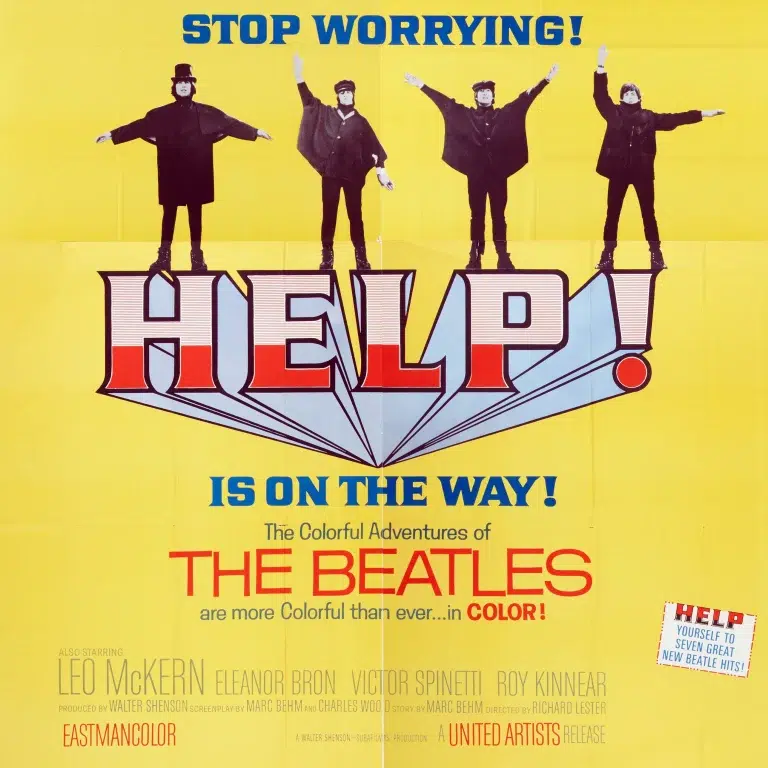
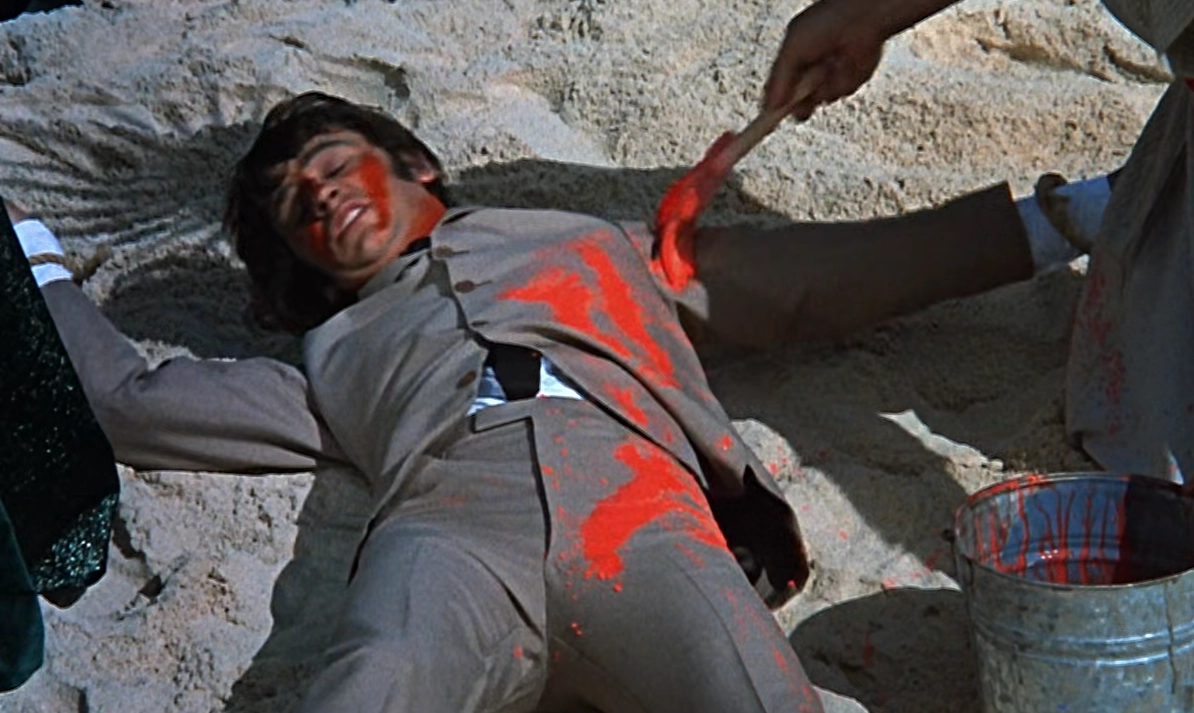
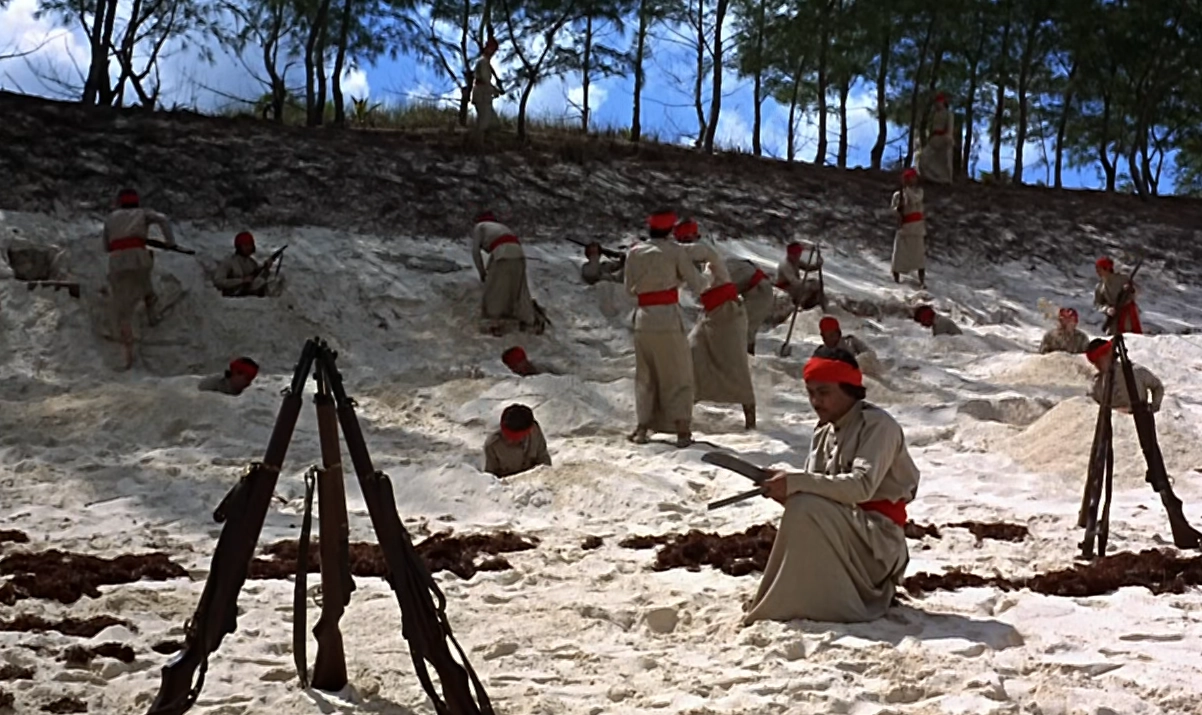
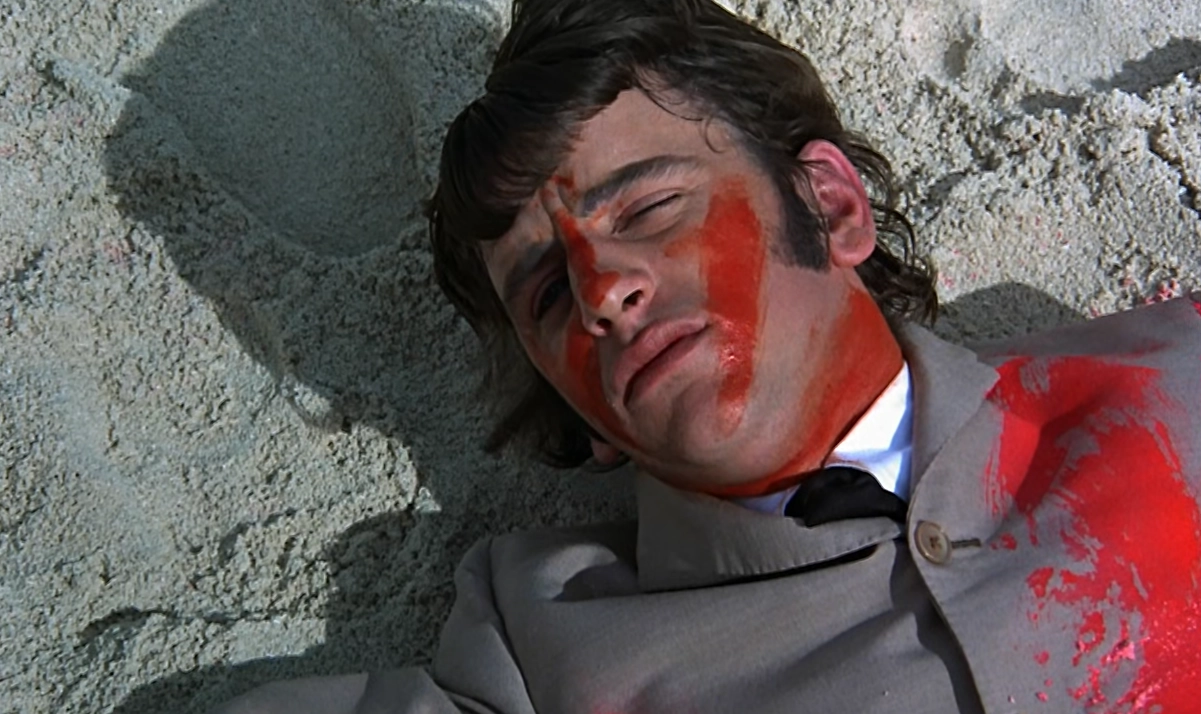
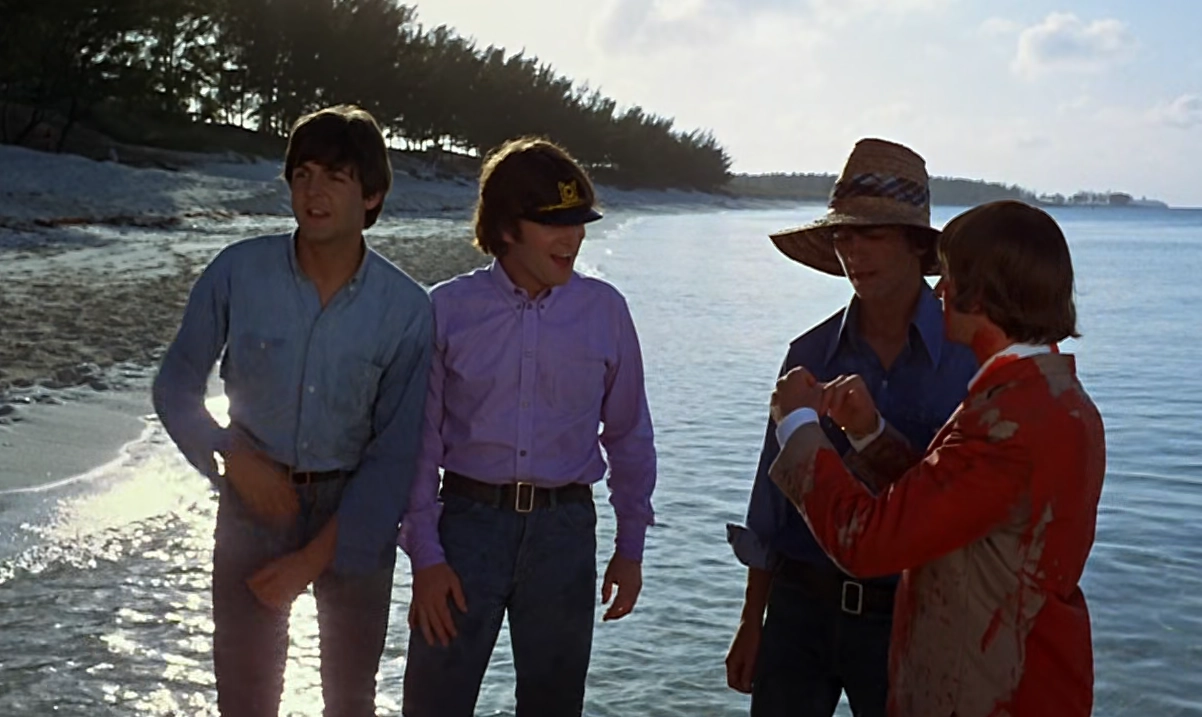
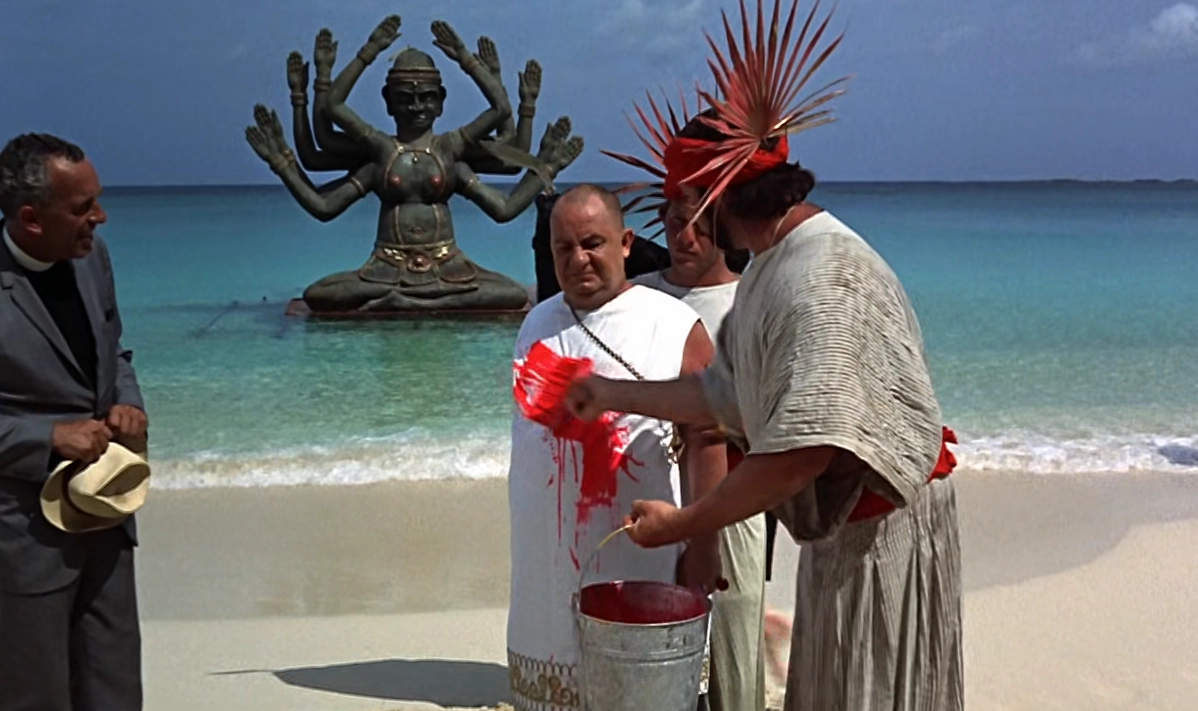
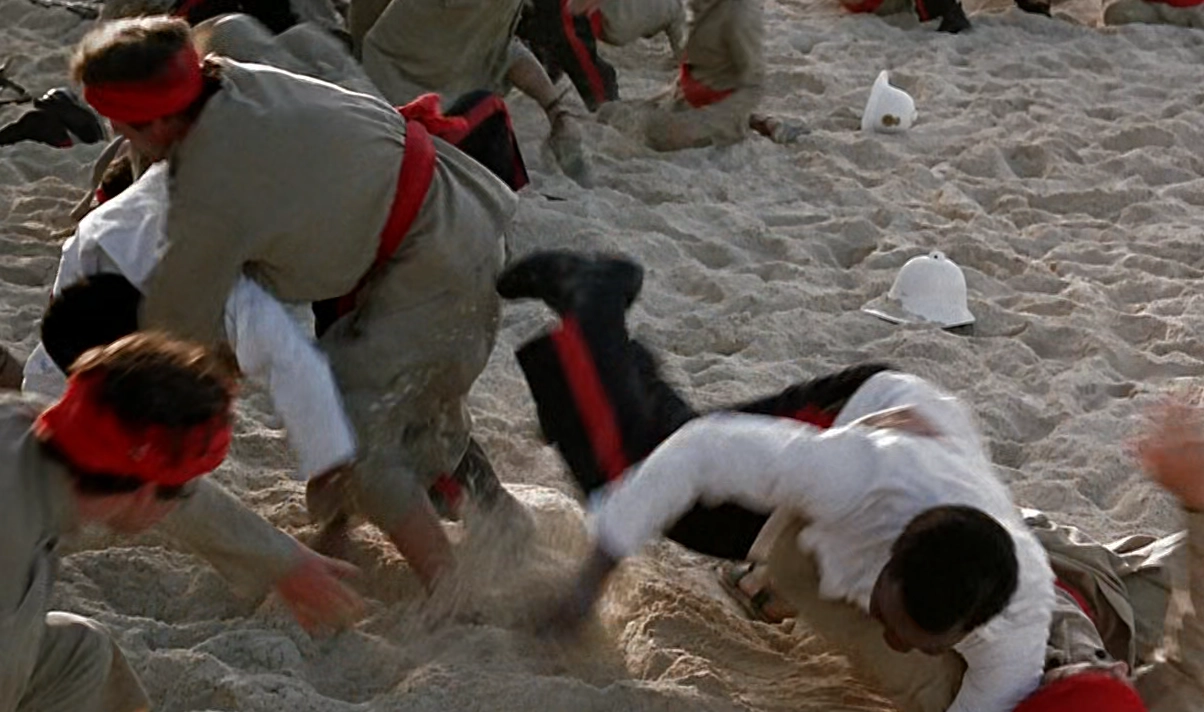
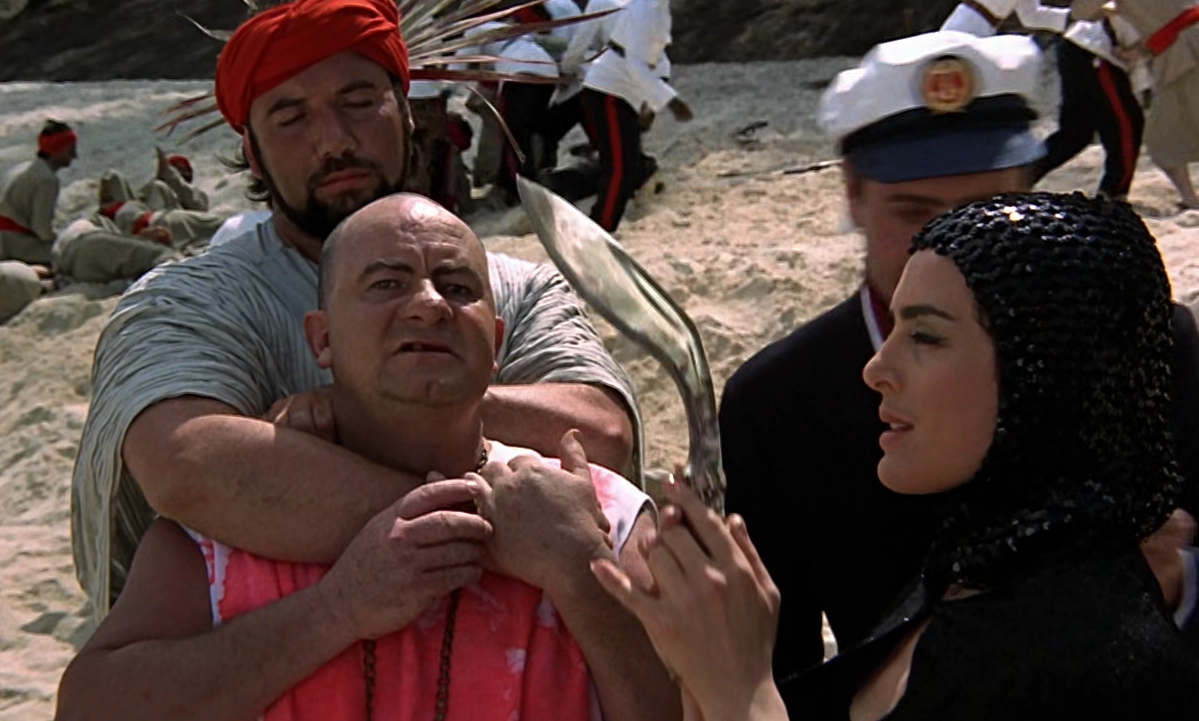
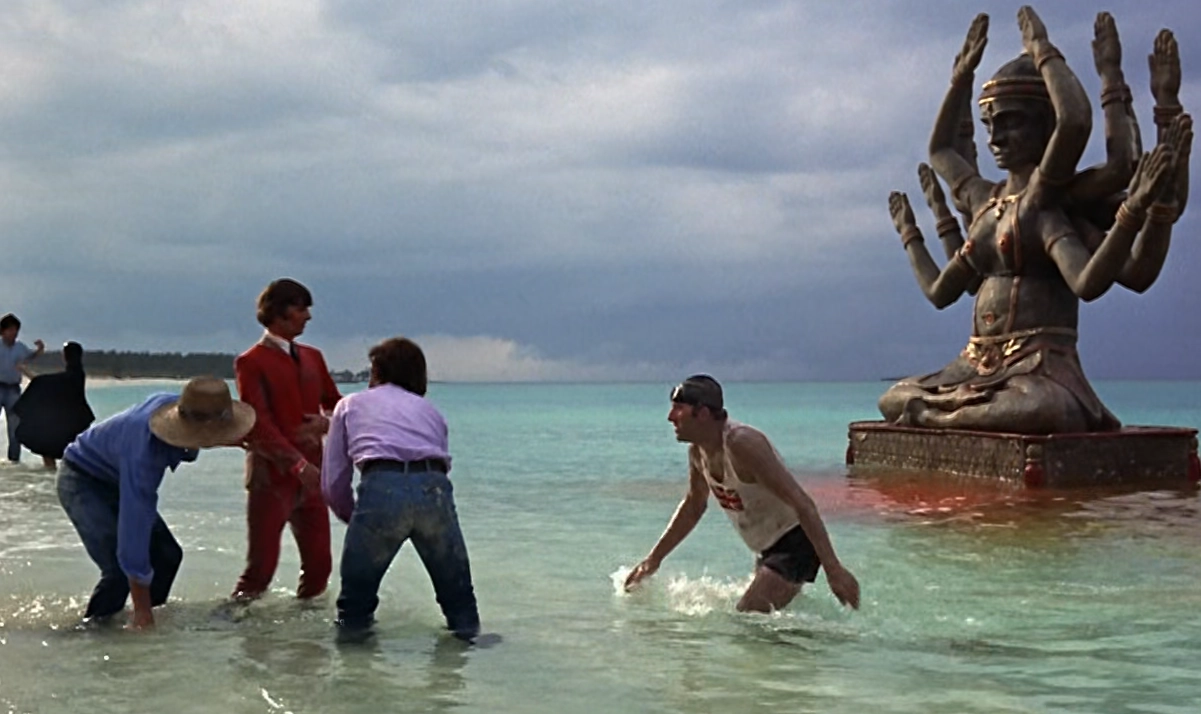
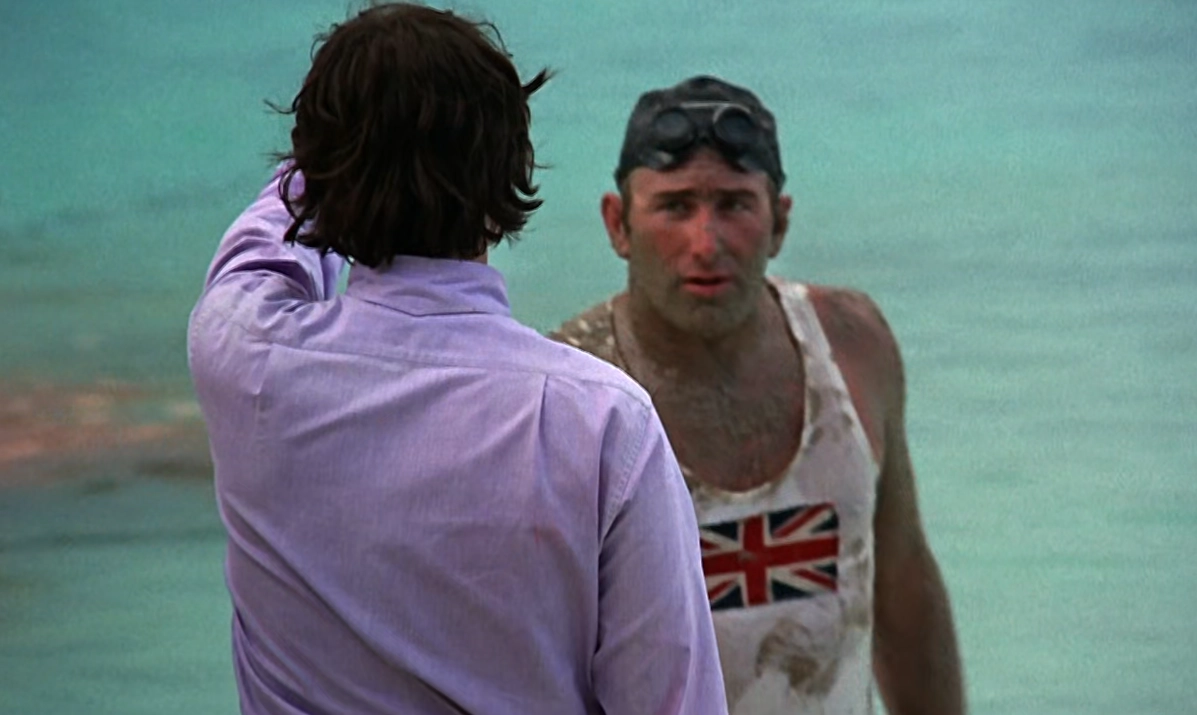
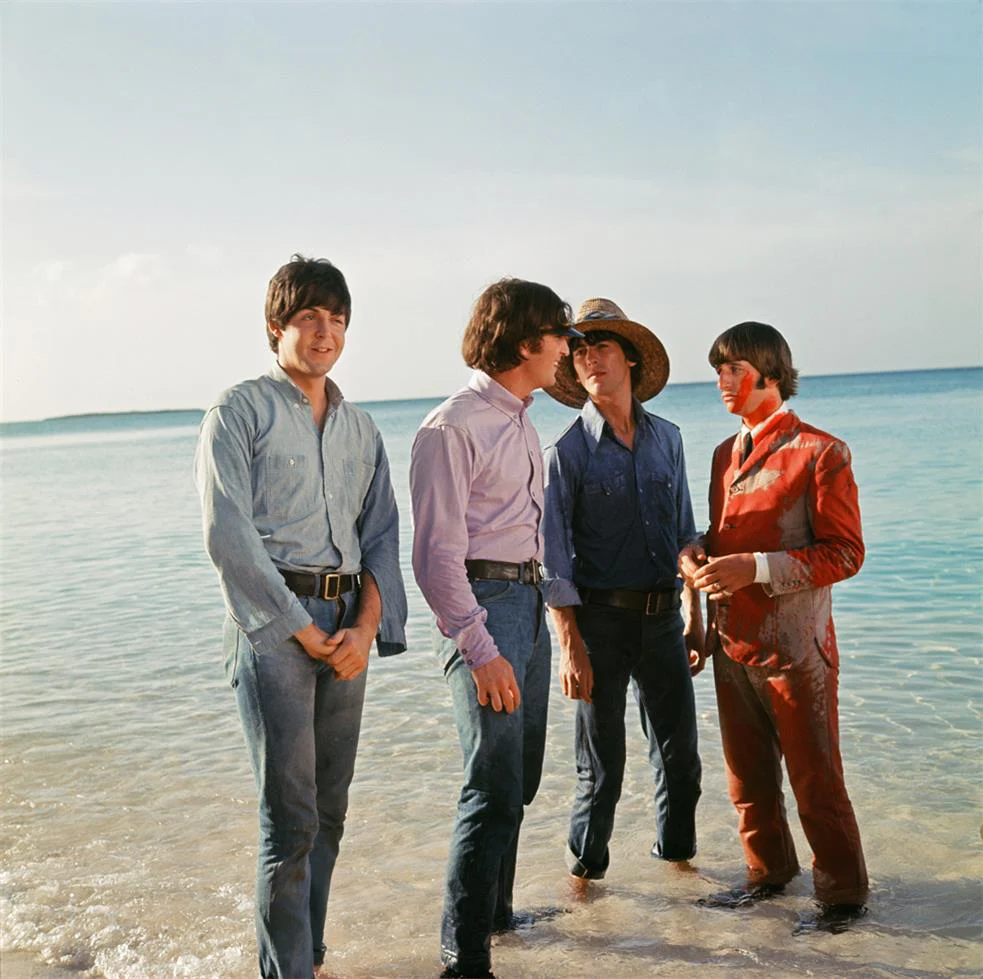
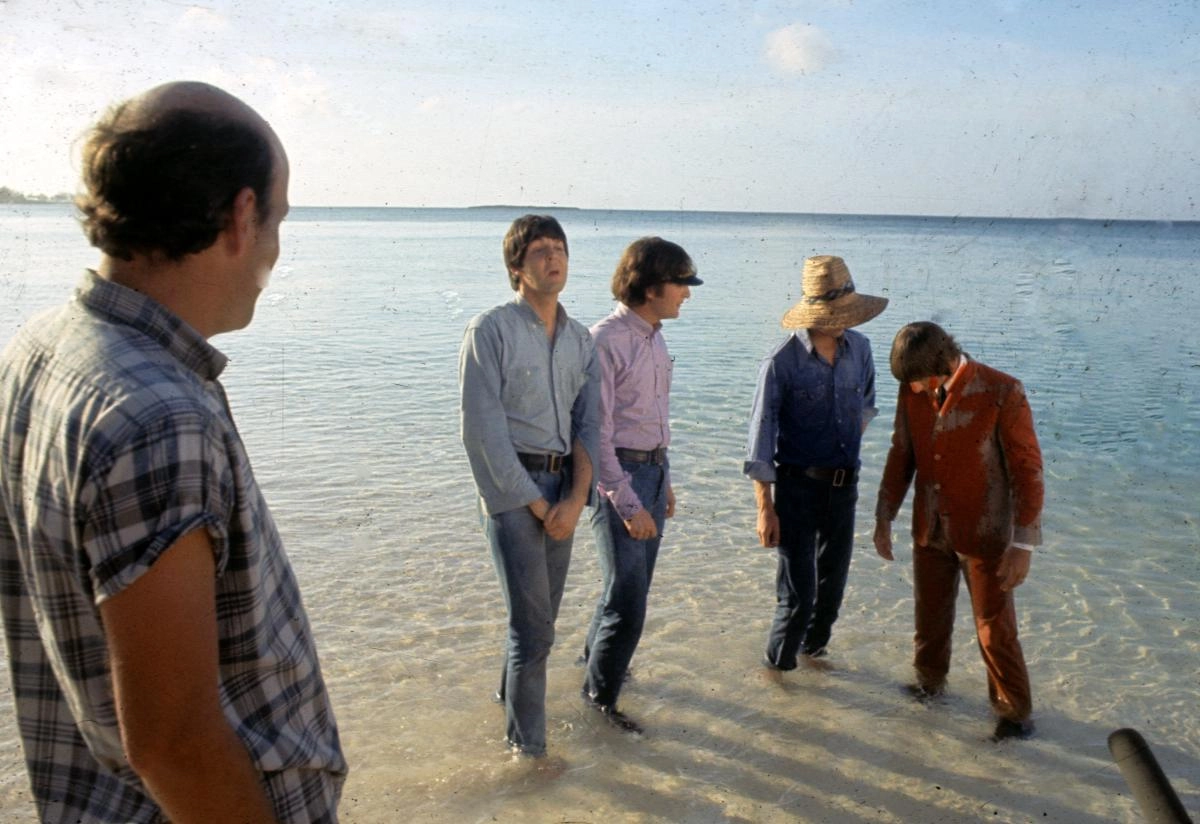
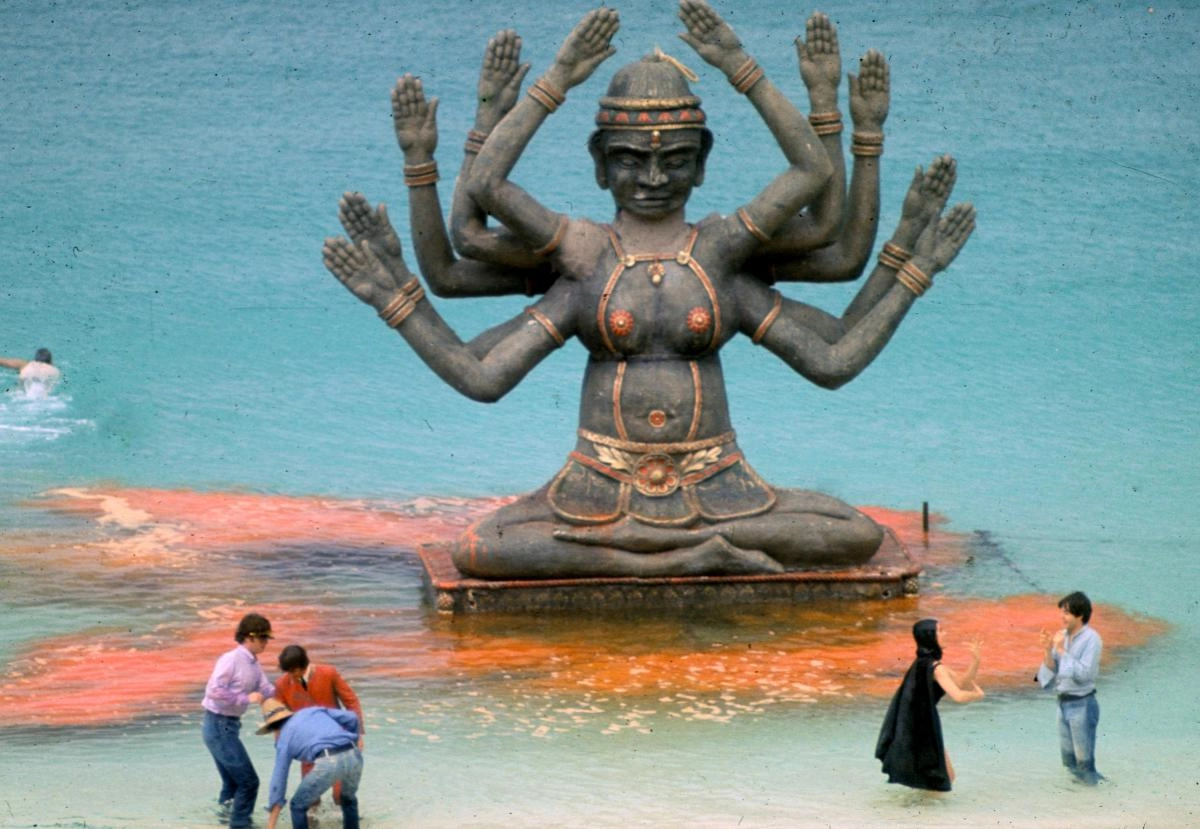
This was the ninth day shooting filming “Help!“ in the Bahamas. On this day, The Beatles returned to Cabbage Beach on Paradise Island and Victoria Beach on Rose Island, to film the final sequence for the film, with Ringo Starr captured in a dramatic scene where his character was staked into the sand.
The day-to-day filming activity in the Bahamas is drawn from “The Complete Beatles Chronicle” by Mark Lewisohn.
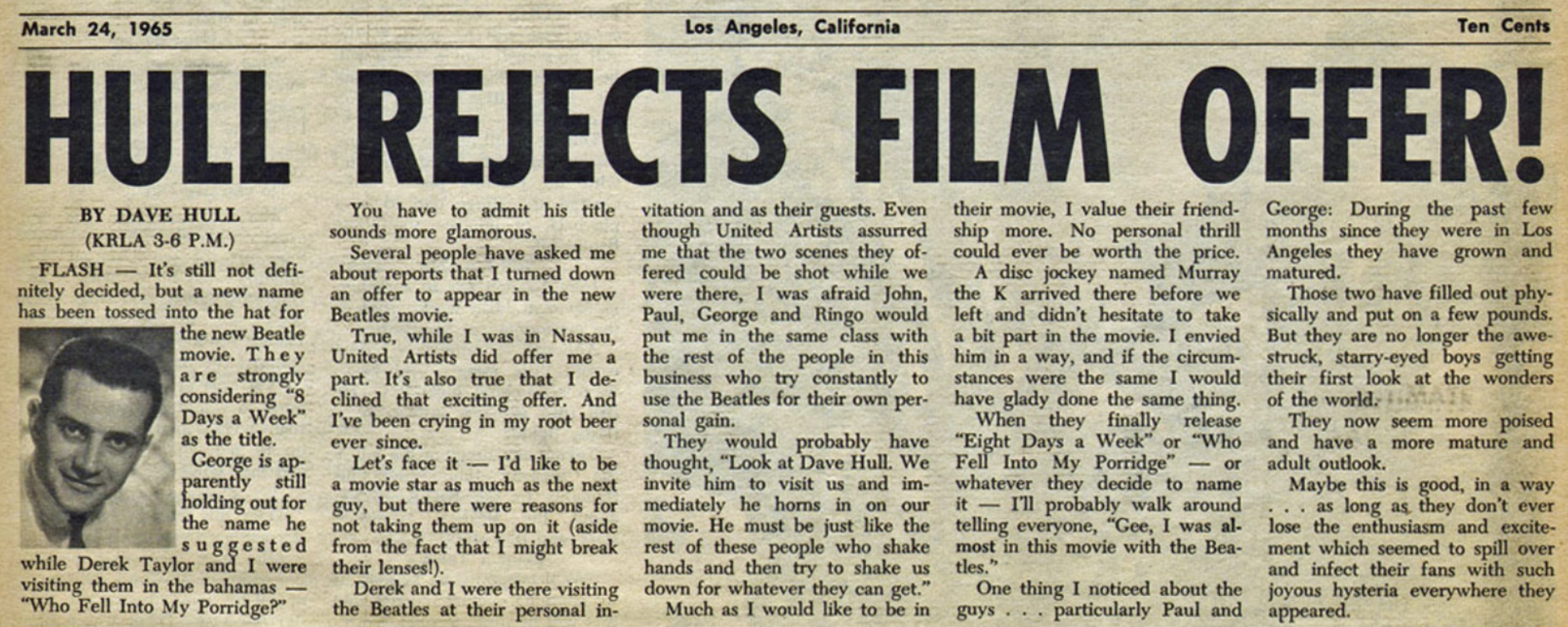
HULL REJECTS FILM OFFER!
FLASH — It’s still not definitely decided, but a new name has been tossed into the hat for the new Beatle movie. They are strongly considering “8 Days a Week” as the title. George is apparently still holding out for the name he suggested while Derek Taylor and I were visiting them in the Bahamas — “Who Fell Into My Porridge?” You have to admit his title sounds more glamorous.
Several people have asked me about reports that I turned down an offer to appear in the new Beatles movie. True, while I was in Nassau, United Artists did offer me a part. It’s also true that I declined that exciting offer. And I’ve been crying in my root beer ever since. Let’s face it — I’d like to be a movie star as much as the next guy, but there were reasons for not taking them up on it (aside from the fact that I might break their lenses!).
Derek and I were there visiting the Beatles at their personal invitation and as their guests. Even though United Artists assured me that the two scenes they offered could be shot while we were there, I was afraid John, Paul, George and Ringo would put me in the same class with the rest of the people in this business who try constantly to use the Beatles for their own personal gain.
They would probably have thought, “Look at Dave Hull. We invite him to visit us and immediately he horns in on our movie. He must be just like the rest of these people who shake hands and then try to shake us down for whatever they can get.”
Much as I would like to be in their movie, I value their friendship more. No personal thrill could ever be worth the price. A disc jockey named Murray the K arrived there before we left and didn’t hesitate to take a bit part in the movie. I envied him in a way, and if the circumstances were the same I would have glady done the same thing.
When they finally release “Eight Days a Week” or “Who Fell Into My Porridge” — or whatever they decide to name it — I’ll probably walk around telling everyone, “Gee, I was almost in this movie with the Beatles.”
One thing I noticed about the guys… particularly Paul and George: During the past few months since they were in Los Angeles they have grown and matured. Those two have filled out physically and put on a few pounds. But they are no longer the awe-struck, starry-eyed boys getting their first look at the wonders of the world. They now seem more poised and have a more mature and adult outlook. Maybe this is good, in a way… as long as they don’t ever lose the enthusiasm and excitement which seemed to spill over and infect their fans with such joyous hysteria everywhere they appeared.
From KRLA BEAT – March 24, 1965
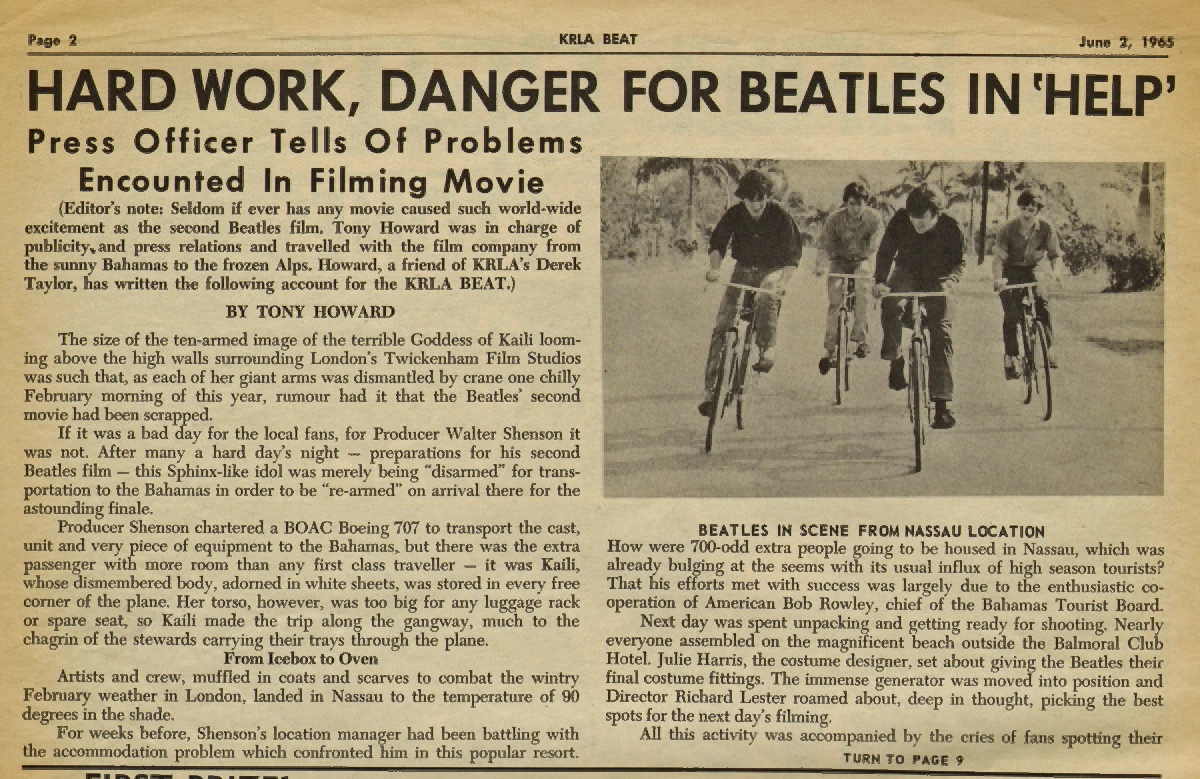
HARD WORK, DANGER FOR BEATLES IN ‘HELP’ – Press Officer Tells Of Problems Encountered In Filming Movie
(Editor’s note: Seldom if ever has any movie caused such world-wide excitement as the second Beatles film. Tony Howard was in charge of publicity, and press relations and travelled with the film company from the sunny Bahamas to the frozen Alps. Howard, a friend of KRLA’s Derek Taylor, has written the following account for the KRLA BEAT.)
BY TONY HOWARD
The size of the ten-armed image of the terrible Goddess of Kaili looming above the high walls surrounding London’s Twickenham Film Studios was such that, as each of her giant arms was dismantled by crane one chilly February morning of this year, rumour had it that the Beatles’ second movie had been scrapped.
If it was a bad day for the local fans, for Producer Walter Shenson it was not. After many a hard day’s night — preparations for his second Beatles film — this Sphinx-like idol was merely being “disarmed” for transportation to the Bahamas in order to be “re-armed” on arrival there for the astounding finale.
Producer Shenson chartered a BOAC Boeing 707 to transport the cast, unit and very piece of equipment to the Bahamas, but there was the extra passenger with more room than any first class traveller — it was Kaili, whose dismembered body, adorned in white sheets, was stored in every free corner of the plane. Her torso, however, was too big for any luggage rack or spare seat, so Kaili made the trip along the gangway, much to the chagrin of the stewards carrying their trays through the plane.
Artists and crew, muffled in coats and scarves to combat the wintry February weather in London, landed in Nassau to the temperature of 90 degrees in the shade.
For weeks before, Shenson’s location manager had been battling with the accommodation problem which confronted him in this popular resort.
How were 700-odd extra people going to be housed in Nassau, which was already bulging at the seems with its usual influx of high season tourists? That his efforts met with success was largely due to the enthusiastic co-operation of American Bob Rowley, chief of the Bahamas Tourist Board.
Next day was spent unpacking and getting ready for shooting. Nearly everyone assembled on the magnificent beach outside the Balmoral Club Hotel. Julie Harris, the costume designer, set about giving the Beatles their final costume fittings. The immense generator was moved into position and Director Richard Lester roamed about, deep in thought, picking the best spots for the next day’s filming.
All this activity was accompanied by the cries of fans spotting their favorite Beatle, tourists taking photographs, a 50-strong group of pressmen and photographers from all over the world, plus a small army of extra policemen. It looked like unbelievable chaos. How could anyone hope to make a film under those conditions? But next day’s shooting commenced without a hitch, although the number of fans and spectators had doubled.
During the days that followed, over 40 sequences were filmed in public places in and around Nassau, and — although most of the Island and tourist population were there at one time or another — there were very few interruptions of any consequence. The most notable incident that held up shooting for a while was when her Majesty the Queen Mother came into shot as she and her entourage of cars and outriders passed by on their way to the airport, homeward bound after her Jamaican tour.
At night, most of the unit took advantage of the delights available in this picturesque spot — the calypsos, the steel bands for moonlight dancing, the exotic menus and the inate gaiety of the native population. Most members of the unit had to take their swims at night since there was never time for bathing in the famous blue waters during the day.
The Beatles would dodge the fans congregating outside their luxurious beach bungalow, and race to the capital in their open sports cars to live it up for awhile after the gruelling day’s work under the burning sun. But most of the time they would stay at home and continue working on the musical score for the picture, music and lyrics by Beatles Paul McCartney and John Lennon — seven new numbers in all.
The last sequences to be shot in the Bahamas were to take place on Paradise Island, by kind permission of Huntington Hartford, who owns the island. While Director Lester supervised the crew on the beach, further activity was going on under the sea a few hundred yards out.
Almost very skindiver in the vicinity, whether they were treasure hunters or underwater guides, were operating from the sea bed, trying to stage the dramatic rising out of the water of the great Image of the Goddess of Kaili — now complete again. Richard Lester was in constant touch by radio with the divers handling the air tanks and pressure bombs needed to make the slow appearance of the 40-foot high idol.
Mr. Huntington Hartford, with his entourage, watched the scene with great interst. His beautiful wife, Diane, was even persuaded to play a small part in the movie.
It took three whole weary days to get Kaili to come out of the water at the right time, at exactly the right place, and by that time the entire unit was glad to see the back of her as she was towed away by a specially hired Navy salvage vessel.
But with the disappearance of the Goddess, an airborne, monster-shaped object became an equally startling sight to the islands. It was the famous Goodyear blimp which was transported from Florida for a spectacular scene in the film.
By now most of the unit was in various stages of sun tan and sun burn, except for the Beatles who had to keep out of the sun throughout the location. Since the Bahamas sequences were actually the last scenes in the completed film, audiences would find it rather odd to watch the boys in varying skin colours without explanation. However, the run on sun tan products and the sale of soft drinks was formidable. It was estimated that some 700 bottles of soft iced drinks were consumed by the unit each day.
When artists and crew finally said goodbye to the Bahamas, unwillingly sweltering in their London clothes, they were given a rousing sendoff by the Bahamanians, for these islands are new ground for film producers and it may well be that Walter Shenson has started up a new profit sideline for them. Indeed, shorter afterwards a 150-strong film unit arrived in Nassau to film exteriors for United Artists’ fourth James Bond film, “Thunderball.”
London was cold but the unit hadn’t much time to notice it because, before two days had passed, they were on their way once again by chartered plane to another extreme of climate — the Austrian Alps!
(In next week’s KRLA BEAT, Tony Howard tells of the complications and dangers of filming in the avalanche-threatened Austrian Alps, of the night the Beatles surprised everyone with a performance and of the assault by Beatle fans upon their return to London.)
From KRLA Beat – June 2, 1965
The Beatles Diary Volume 1: The Beatles Years
With greatly expanded text, this is the most revealing and frank personal 30-year chronicle of the group ever written. Insider Barry Miles covers the Beatles story from childhood to the break-up of the group.
If we modestly consider the Paul McCartney Project to be the premier online resource for all things Paul McCartney, it is undeniable that The Beatles Bible stands as the definitive online site dedicated to the Beatles. While there is some overlap in content between the two sites, they differ significantly in their approach.

Notice any inaccuracies on this page? Have additional insights or ideas for new content? Or just want to share your thoughts? We value your feedback! Please use the form below to get in touch with us.


