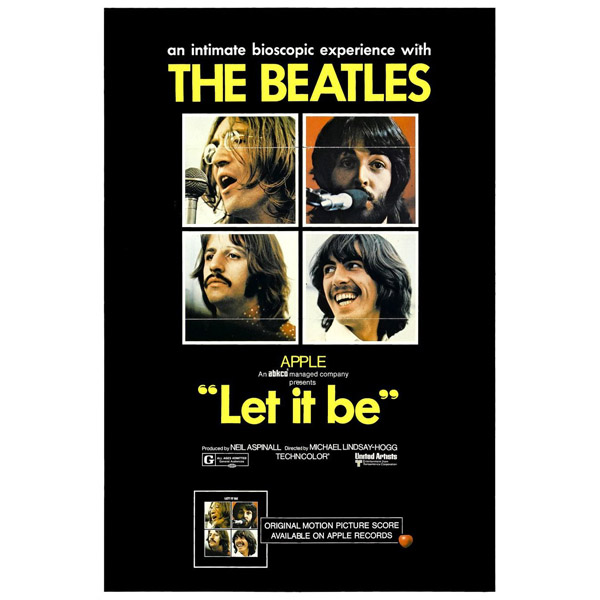
Release date : May 20, 1970
Let It Be (1970 film)
Documentary • For The Beatles • Directed by Michael Lindsay-Hogg
Last updated on October 27, 2025
Release date : May 20, 1970
Documentary • For The Beatles • Directed by Michael Lindsay-Hogg
Last updated on October 27, 2025
Previous film Sep 04, 1968 • Shooting of "Revolution (Versions 1 and 2)" promo film
Session Jan 02, 1969 • The "Get Back / Let It Be" sessions • Day 1
Session January 2-31, 1969 • The "Get Back / Let It Be" sessions
Film January 2-31, 1969 • Shooting of "Let It Be (1970 film)" documentary
Film January-April 1969 • Shooting of "The Ballad Of John And Yoko" promo film
Session Jan 03, 1969 • The "Get Back / Let It Be" sessions • Day 2

Dispute over the release of “Let It Be”
April 10 - End of April 1970
First public screening of the “Let It Be” Film
May 18, 1970
UK premiere of the “Let It Be” film
May 20, 1970
US launch of the “Let It Be” film
May 23, 1970
The Beatles win an Oscar for “Let It Be”
Apr 15, 1971

“The Beatles: Get Back to Let It Be” exhibition at the Rock & Roll Hall of Fame
March 18, 2022 to March 2023

“Let It Be” film reissue announced
Apr 16, 2024
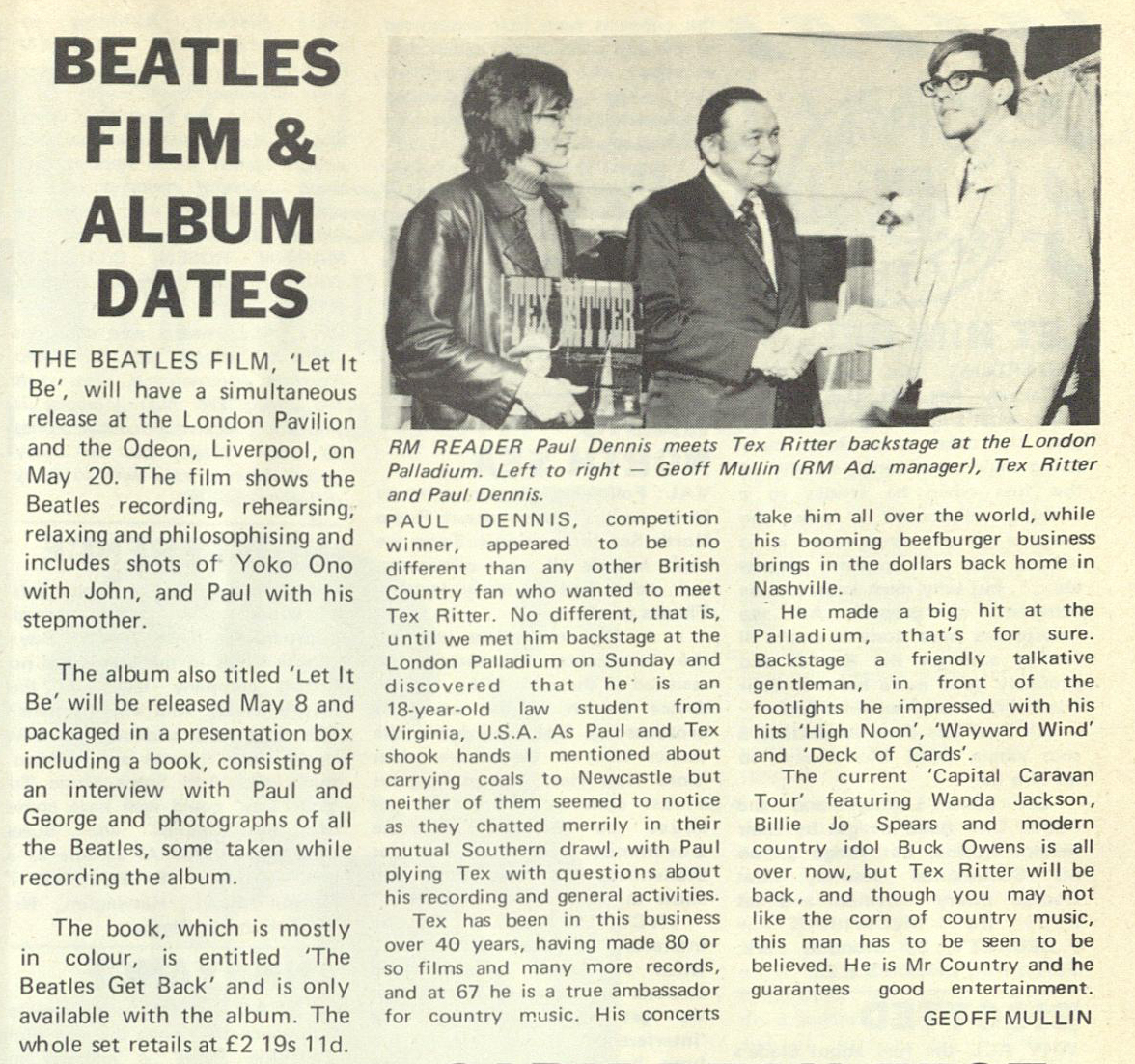
BEATLES FILM & ALBUM DATES
THE BEATLES FILM, ‘Let It Be’, will have a simultaneous release at the London Pavilion and the Odeon, Liverpool, on May 20. The film shows the Beatles recording, rehearsing, relaxing and philosophising and includes shots of Yoko Ono with John, and Paul with his stepmother [sic].
The album also titled ‘Let It Be’ will be released May 8 and packaged in a presentation box including a book, consisting of an interview with Paul and George and photographs of all the Beatles, some taken while recording the album.
The book, which is mostly in colour, is entitled ‘The Beatles Get Back’ and is only available with the album. The whole set retails at £2 19s 11d.
From Record Mirror – May 2, 1970
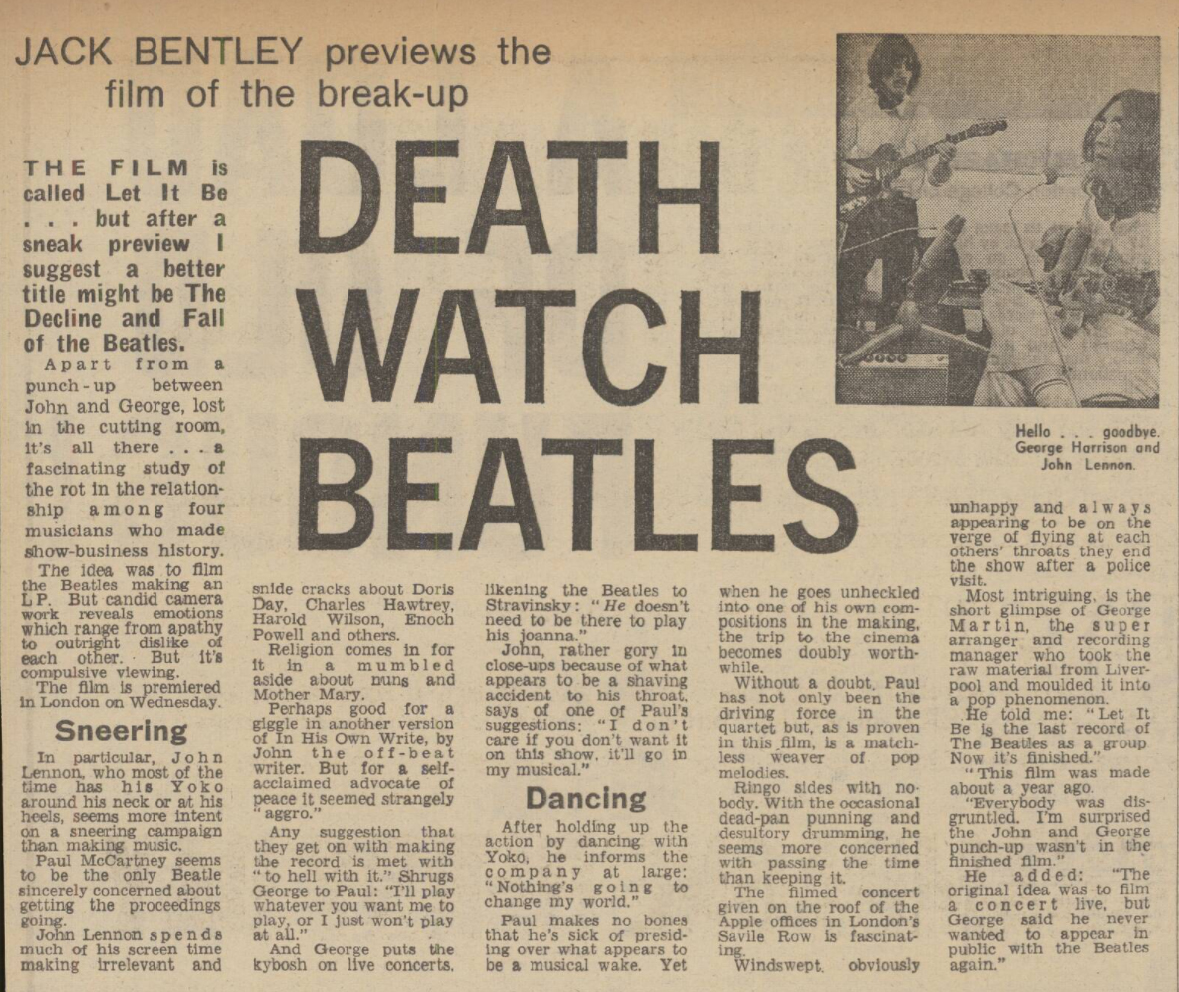
DEATH WATCH BEATLES
THE FILM is called Let It Be… but after a sneak preview I suggest a better title might be The Decline and Fall of the Beatles. Apart from a punch-up between John and George, lost in the cutting room, it’s all there… a fascinating study of the rot in the relationship among four musicians who made show-business history.
The idea was to film the Beatles making an LP. But candid camera work reveals emotions which range from apathy to outright dislike of each other. But it’s compulsive viewing. The film is premiered in London on Wednesday.
In particular, John Lennon, who most of the time has his Yoko around his neck or at his heels, seems more intent on a sneering campaign than making music. Paul McCartney seems to be the only Beatle sincerely concerned about getting the proceedings going. John Lennon spends much of his screen time making irrelevant and snide cracks about Doris Day, Charles Hawtrey, Harold Wilson, Enoch Powell and others. Religion comes in for it in a mumbled aside about nuns and Mother Mary.
Perhaps good for a giggle in another version of In His Own Write, by John the off-beat writer. But for a self-acclaimed advocate of peace it seemed strangely “aggro.”
Any suggestion that they get on with making the record is met with “to hell with it.” Shrugs George to Paul: “I’ll play whatever you want me to play, or I just won’t play at all.” And George puts the kybosh on live concerts, likening the Beatles to Stravinsky: “He doesn’t need to be there to play his joanna.”
John, rather gory in close-ups because of what appears to be a shaving accident to his throat, says of one of Paul’s suggestions: “I don’t care if you don’t want it on this show, it’ll go in my musical.”
After holding up the action by dancing with Yoko, he informs the company at large: “Nothing’s going to change my world.”
Paul makes no bones that he’s sick of presiding over what appears to be a musical wake. Yet when he goes unchecked into one of his own compositions in the making, the trip to the cinema becomes doubly worthwhile. Without a doubt, Paul has not only been the driving force in the quartet but, as is proven in this film, is a matchless weaver of pop melodies.
Ringo sides with nobody. With the occasional dead-pan punning and desultory drumming, he seems more concerned with passing the time than keeping it.
The filmed concert given on the roof of the Apple offices in London’s Savile Row is fascinating.
Windswept, obviously unhappy and always appearing to be on the verge of flying at each others’ throats they end the show after a police visit. Most intriguing is the short glimpse of George Martin, the super arranger and recording manager who took the raw material from Liverpool and moulded it into a pop phenomenon. He told me: “Let It Be is the last record of The Beatles as a group. Now it’s finished. This film was made about a year ago. Everybody was disgruntled. I’m surprised the John and George punch-up wasn’t in the finished film.”
He added: “The original idea was to film a concert live, but George said he never wanted to appear in public with the Beatles again.”
From Sunday Mirror, May 17, 1970
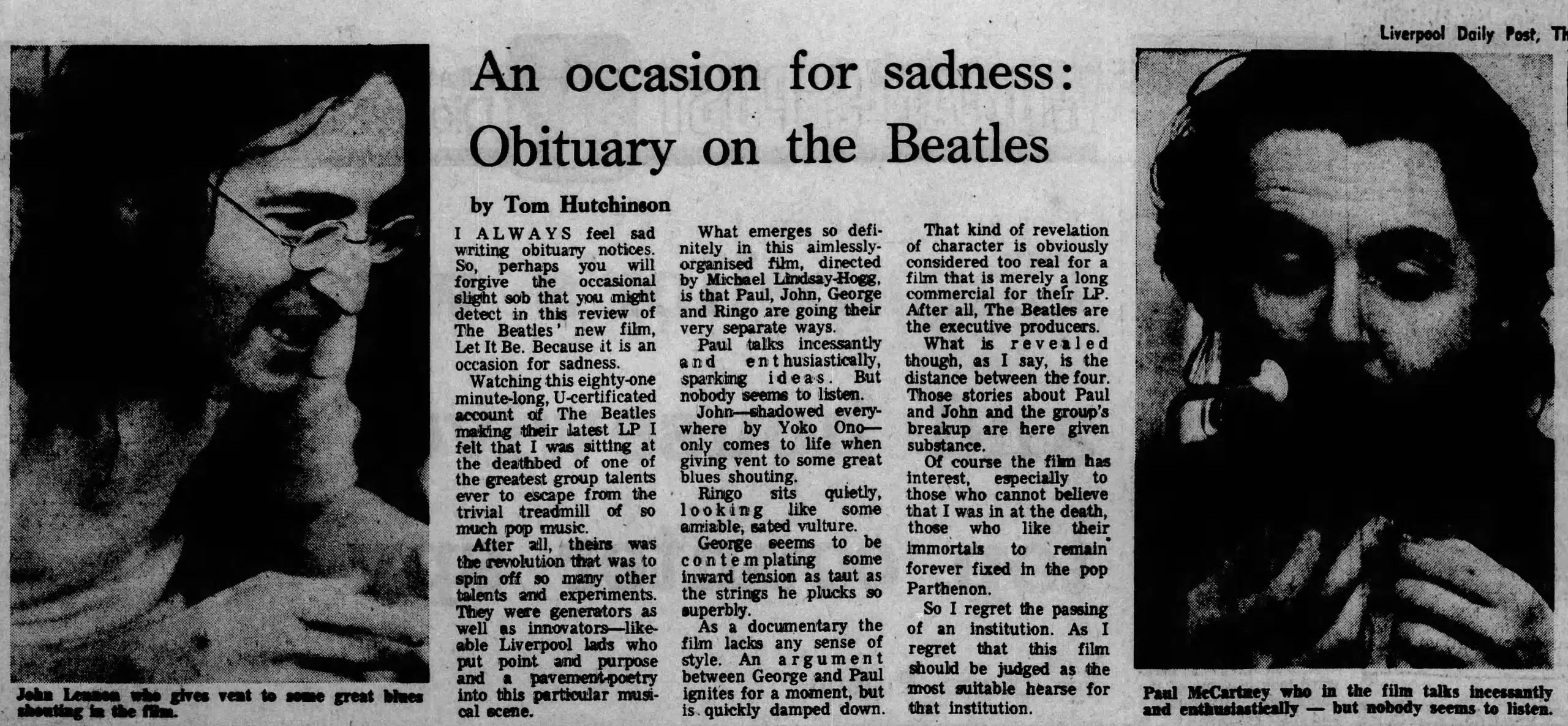
An occasion for sadness: Obituary on the Beatles
I ALWAYS feel sad writing obituary notices. So, perhaps you will forgive the occasional slight sob that you might detect in this review of The Beatles’ new film, Let It Be. Because it is an occasion for sadness.
Watching this eighty-one minute-long, U-certificated account of The Beatles making their latest LP I felt that I was sitting at the deathbed of one of the greatest group talents ever to escape from the trivial treadmill of so much pop music.
After all, theirs was the revolution that was to spin off so many other talents and experiments. They were generators as well as innovators — like able Liverpool lads who gave point and purpose and a pavement-poetry into this particular musical scene.
What emerges so definitely in this aimlessly-organised film, directed by Michael Lindsay-Hogg, is that Paul, John, George and Ringo are going their very separate ways.
Paul talks incessantly and enthusiastically, sparking ideas. But nobody seems to listen. John — shadowed everywhere by Yoko Ono — only comes to life when giving vent to some great blues shouting. Ringo sits quietly, looking like some amiable, bored vulture. George seems to be contemplating some inward tension as taut as the strings he plucks so superbly.
As a documentary the film lacks any sense of style. An argument between George and Paul ignites for a moment, but is quickly damped down.
That kind of revelation of character is obviously considered too real for a film that is merely a long commercial for their LP. After all, The Beatles are the executive producers.
What is revealed though, as I say, is the distance between the four. Those stories about Paul and John and the group’s breakup are here given substance.
Of course the film has interest, especially to those who cannot believe that I was in at the death, those who like their immortals to remain forever fixed in the pop Parthenon.
So I regret the passing of an institution. As I regret that this film should be judged as the most suitable hearse for that institution.
From Liverpool Daily Post (Merseyside edition), May 21, 1970
Beatles LP and film for May release
THE LONG delayed Beatles ‘Let It Be’ album, on which recording started in January last year, will be released on Apple on May 13, simultaneously in the UK and America, to coincide with the premiere of the group’s documentary film.
The LP, featuring much of the music to be heard in the film, which concentrates on the recording of the album, will be distributed in Britain by EMI, but is being handled in America by United Artists, distributors of the film.
The film, produced by Apple, will have a New York premiere on May 13, with a simultaneous British unveiling in London and Liverpool on May 20. The deal, concluded by business manager Allen Klein, provides for the film to be screened in 100 cities throughout the world around this time.
A surprise aspect of the album is the involvement of American producer Phil Spector, who now has a working association with Apple. According to an Apple press-statement, ‘Let It Be’ is “a new-phase Beatles album essential to the context of the film so that they perform live for many of the tracks. In comes the warmth, the freshness of live performance as reproduced for disc by Phil Spector.” In essence, this means that Spector has remixed some of the tracks and has also overdubbed orchestrations and a choir at certain points. Informed of the reference to Spector, George Martin, who was originally in control of the recording, expressed surprise that he had not been told directly. He added that he had heard the album in its new form.
Asked if he expected to be involved in any future Beatles’ recordings, Martin replied, “In view of the fact that the Beatles don’t exist as the four young men I once knew, I don’t want to record them as a split group, but I would like to record them as they were.”
Martin said that as far as he was aware he was still the group’s official producer, under an agreement with EMI, but that he had never had a contract with the group themselves. He added that apart from working with Ringo Starr and George Harrison, there had been no contact with the whole group since completion of the ‘Abbey Road’ album.
Apple has also released a statement concerning the status of the Beatles and their representation, following Paul McCartney’s recent remarks that Allen Klein “does not represent me in any way.”
The statement points out that a 10-year partnership agreement was entered into between the Beatles as individuals and Apple Corps in April 1967, in which Apple Corps is the majority partner in the Beatles and Company.
The agreement provided that, with the exception of films and songwriting, the partnership is entitled to the services of the Beatles as a group throughout the world in respect of all branches of the entertainment industry.
The statement adds that no individual Beatle can “offer his services, appear alone and/or with any other person in any branch of the entertainment industry as to which the partnership has special rights, without the consent of Apple Corps and the other Beatles.”
“It is reiterated that no person, film or corporation can act or negotiate for the Beatles or for the Apple group of companies other than ABKCO Industries, 1700 Broadway, New York City.”
The tracks on the ‘Let It Be’ album are: Two Of Us; Dig A Pony; Across The Universe; I Me Mine; Dig It; Let It Be; Maggie May; I’ve Gotta Feeling; One After One 09; The Long And Winding Road; For You Blue and Get Back.
From Record Mirror – April 25, 1970
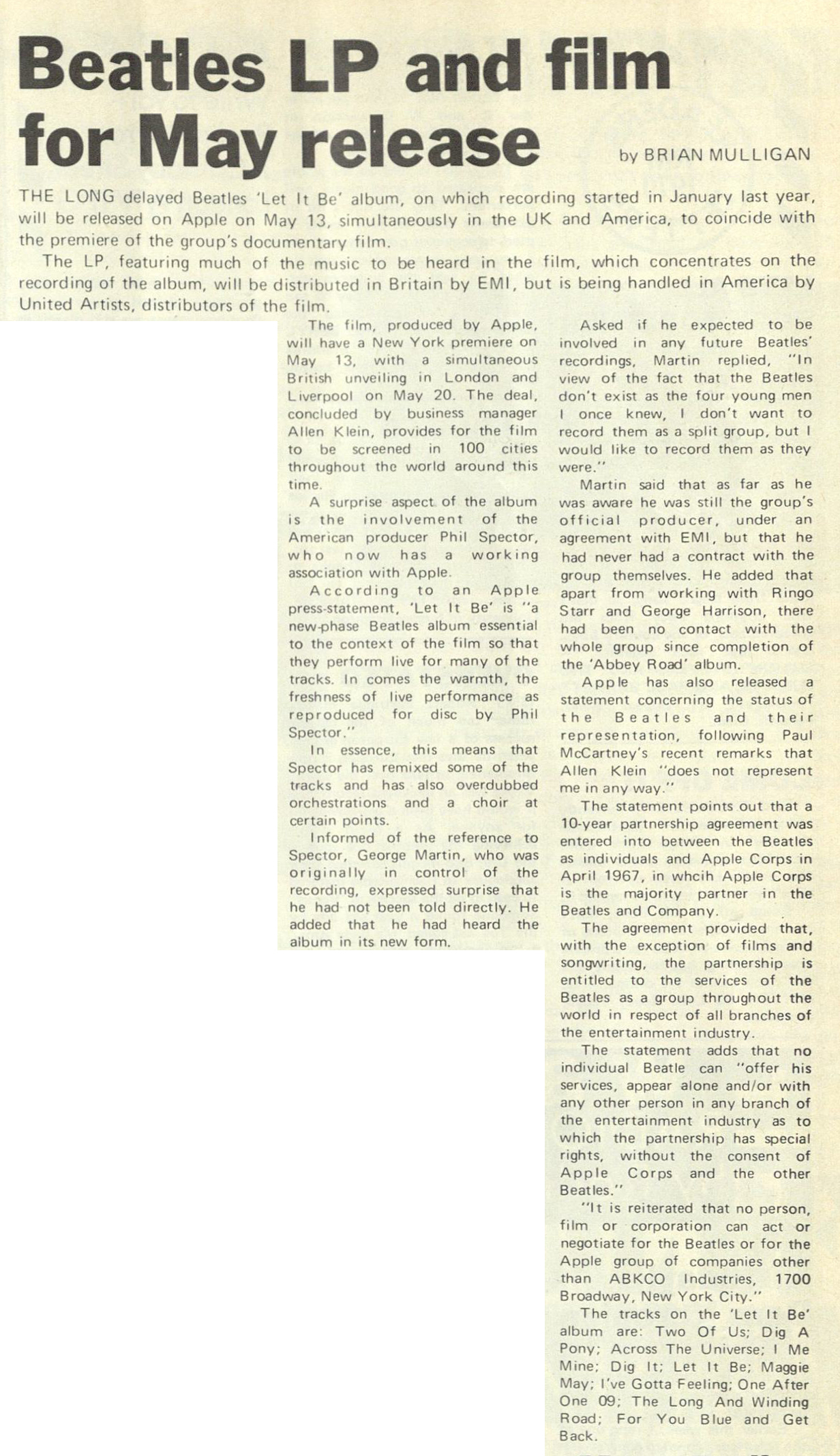
Beatles – a funky little band
THE Beatles are a funky little band. Coming out of the preview of their “Let It Be” movie this week, I suddenly felt that there was nothing I’d rather see than John, Paul, George and Ritchie up on stage at the Roundhouse or the Lyceum, blowing a relaxed set to a quiet crowd.
The first hour of “Let It Be” could be subtitled “In The Studios With The Beatles,” because it all takes place either in EMI’s Number 1 studio at Abbey Road, or in the basement room at Apple.
The film concentrates on the music and the people, the group working out their songs and also jamming for fun. The audience is a fly on the wall, and who hasn’t wanted to learn more about the Beatles’ processes of creation?
It’s an amusing and instructive experience. John and Paul camp it up a lot, George is extremely serious (To Paul: “If you want me to play it, I’ll play it. If you don’t want me to play it, I won’t.”) and Ringo is… well, Ringo, and one of the best sequences is when he’s in the throes of composing “Octopuses Garden,” with a little help from George.
There’s a lot of the workshop atmosphere, as when the band plays the backing to “Maxwell’s Silver Hammer,” with Paul shouting out the chord changes, and George comes into the studio and plays an acoustic version of “I Me Mine” (“It’s me heavy waltz”) which he’s just written. John leads the band in an early version of “Don’t Let Me Down,” which is extremely rough, but bears a considerable resemblance to The Band, which can’t be bad.
Later on there’s a great rock and roll jam, with Billy Preston joining in on electric piano as they play “You Really Got A Hold On Me” from their second album (they can’t remember the words), “Shake Rattle And Roll,” “Miss Ann,” and others.
But the best of the lot is the last 20 minutes, which is devoted to the mini-concert given by the band on the roof of Apple last year, mainly to make a promotional film for the “Get Back” single.
Director Michael Lindsay-Hogg makes the most of the crowd milling around in Savile Row and on the nearby office roofs, and of the discomfiture of the young policemen who aren’t quite how to stop four Members of the British Empire doing their thing.
But it’s the music that counts, and these open-air versions of “Get Back,” “Don’t Let Me Down,” “Dig A Pony,” “One After 909,” and the incredibly funky “I’ve Got A Feeling” are superlative in sound and quality. The band digs in with terrific feeling and guts, playing as a real unit.
The personalities came over well: Paul relaxed, happy, and earnest; John clowning and wailing, with Yoko hovering in the background; George affable but withdrawn; and Ringo grinning and pounding his drums, which are draped with blankets and tea-towels to get the effect which quietly revolutionised rock drumming.
Some people will undoubtedly call this movie an epitaph, and maybe it is. But for me the first impression was of life, not death, and I feel inclined to doubt that the spirit they were displaying 18 months ago, when the film was shot, has disappeared completely.
Perhaps if they could be persuaded to try a few live gigs, to transfer the Apple roof to a real auditorium, the joy and fun they’ve had together would come flooding back. It’s not too much to hope for.
From Melody Maker – May 23, 1970
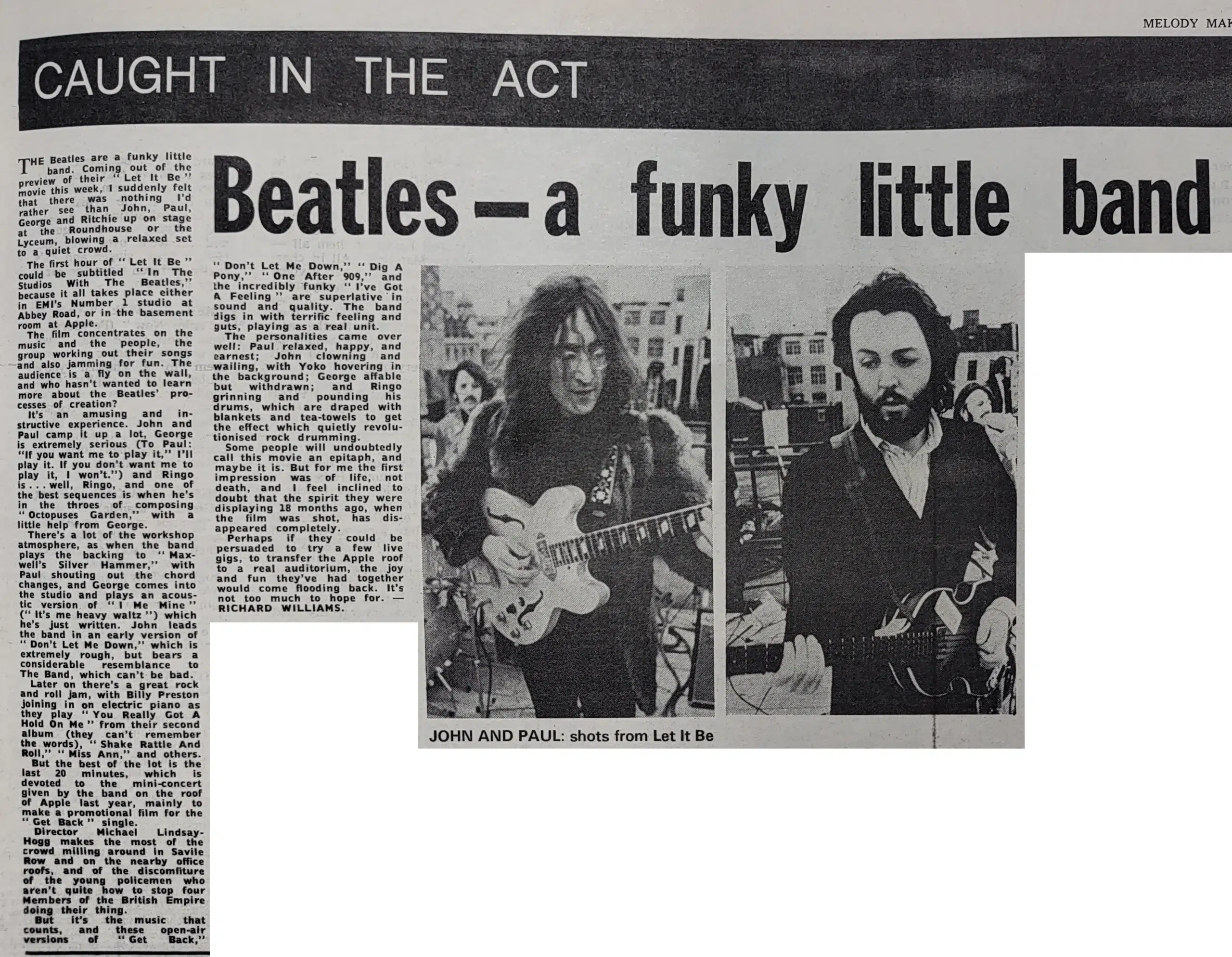
Unusual, fascinating Beatles documentary
No fan, follower, listener or committed or casual voyeur of the Beatles should miss the group’s colour documentary “Let It Be,” premiered in London and Liverpool this week. Occasionally too kind, now and again reflecting the tedium of constant rehearsal, “Let It Be” is most of all a sharp and fascinating insight into the minds of the Beatles and the finest musical excursion they have ever committed to film.
This unusual colour documentary serves, too, to highlight the poor value of the soundtrack album just released.
Compare the contents of the £3 LP with the list of songs featured wholly or partly in “Let It Be” — among them are the title number plus “Don’t Let Me Down,” “Maxwell’s Silver Hammer,” “Two Of Us,” “I’ve Got A Feeling,” “Oh Darling,” “One After 909,” “Jazz Piano Song,” “Across The Universe,” “Dig A Pony,” “Suzy Parker,” “I Me Mine,” “For You Blue,” “Bessame Mucho” and “Octopus Garden.”
And how about “You Really Got A Hold On Me,” “Shake, Rattle And Roll,” “Kansas City,” “Lawdy Miss Clawdy” as well as the original “Long And Winding Road,” “Get Back” and the excitement of the original uncut “Dig It”?
Daily and Sunday newspaper stories about rows in this film are totally misleading, and in its 81 minutes we are shown only a mild discussion between Paul and George on a question of musical policy. No more.
Where “Let It Be” scores is in its music; in the sharp editing and approach of producer Neil Aspinall; in moments to be savoured like the pipe-smoking, trilby-hatted gent walking over rooftops to see the Beatles playing on the Apple roof, and all the world as if he did it every day; in its humour; and in what it tells us about four often unlikeable yet likeable people.
One point to remember is that “Let It Be” was made a year ago and was far from being, as it appears to be fashionable to suggest “the death-knell” of the Beatles. The fact is that immediately after this they were in the prolific and good-humoured mood which went on to produce the “Abbey Road” album.
Lennon comes out in this film as apparently only half-committed to the Beatles, whilst Yoko sits constantly in the background, unsmiling.
McCartney is seen as the leader, the force, stamping his identity onto the proceedings. George is seen mostly in the role of quiet and genial co-operation. And Ringo comes over, mostly, with a mood of unsmiling acceptance.
Like the Beatles of not, “Let It Be” is an experience of the emotions that makes them tick and the attitudes that made them what they are.
I advise you to See it — Dig It.
From New Musical Express – May 23, 1970
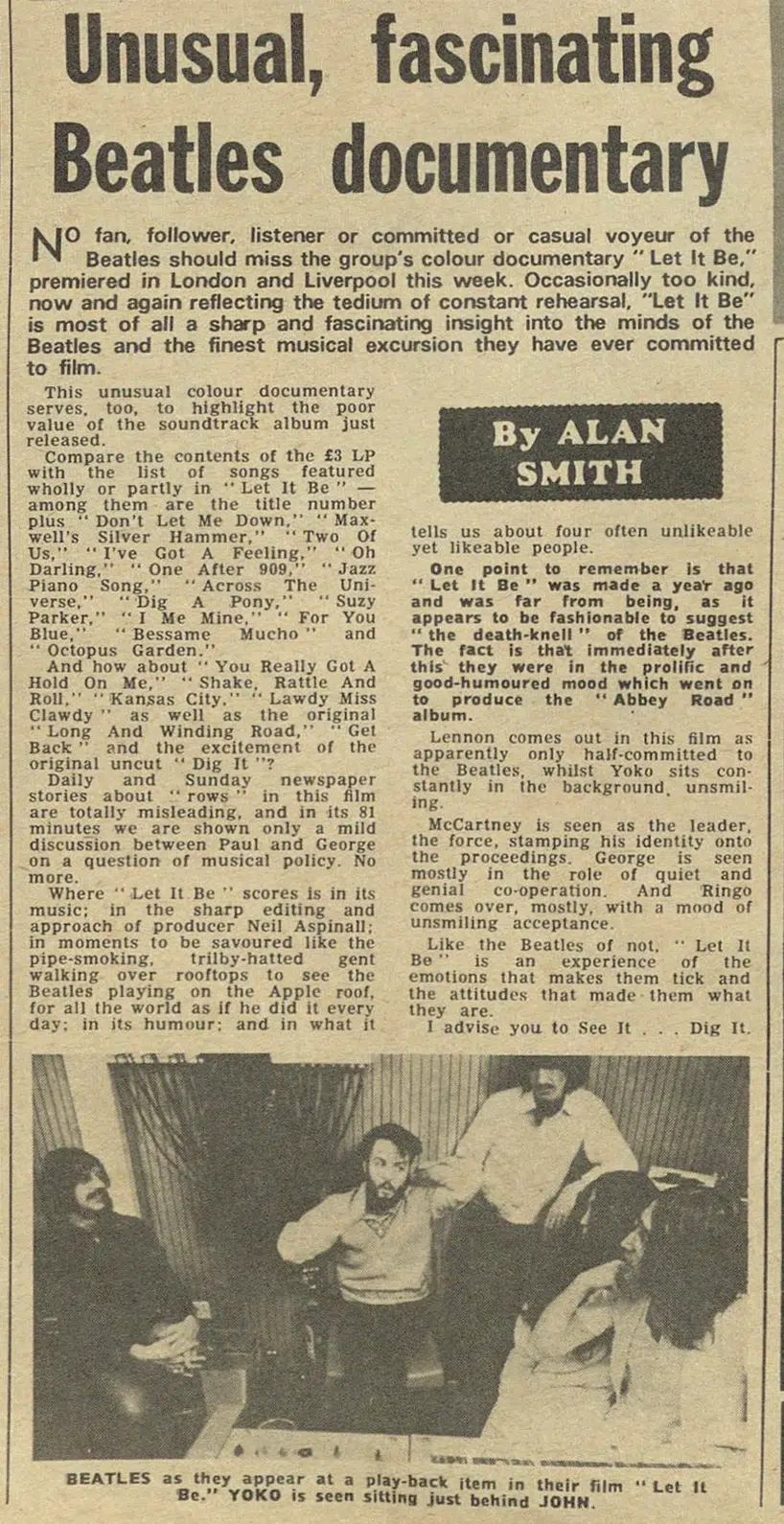
BEATLEMANIA LIVES
… even though the Fab Four have gone their own ways. The new Beatle craze is strictly on film, with ‘Let It Be’ doing great business at London’s Pavilion cinema. And soon Beatle fans in the provinces will be able to join in. The film goes on general release from June 28. With an added Beatle bonus. ‘Yellow Submarine’, the Beatle cartoon is to be re-released as the second feature to ‘Let It Be’.
The film ‘Let It Be’ provides a last, somewhat sad, look at the Beatles together — writing and playing as well as joking and philosophising.
Meanwhile, the sound-track of the film, also called ‘Let It Be’ has been notching up terrific sales — this week’s total, 175,773 copies sold in Britain. Which is enough to put if firmly at the top of the charts, even though it costs a pound more than most albums.
In the United States, however, business is phenomenal. The latest figures, for instance, show that a total of over three million copies have been sold in thirteen days. And that’s made sure that it has jumped from number 104 to number 2 in just one week. All that keeps the album from the number one spot is Paul McCartney’s solo album, ‘McCartney’.
The album is already the fourth best-selling Beatle album. At number one is ‘Abbey Road’ with about five million sales, followed by their first U.S. album, ‘Meet The Beatles’ with nearly four and a half million sales, and ‘Hey Jude’ — a collection of past hits, still to be released in Britain — with almost three and a half million copies sold.
Behind ‘Let It Be’ is ‘Sgt. Pepper’s Lonely Heart’s Club Band’ — perhaps their most famous album — with only two and a half million sales.
The Beatles are dead. Long live the Beatles.
From Record Mirror – June 6, 1970

Notice any inaccuracies on this page? Have additional insights or ideas for new content? Or just want to share your thoughts? We value your feedback! Please use the form below to get in touch with us.


