Tuesday, February 16, 1965
Recording "I Need You", "Another Girl", "Yes It Is"
For The Beatles
Last updated on July 29, 2026
Tuesday, February 16, 1965
For The Beatles
Last updated on July 29, 2026

Feb 15 - Jun 18, 1965 • Songs recorded during this session appear on Help! (UK - Mono)
Recording studio: EMI Studios, Studio Two, Abbey Road • London • UK
Previous session Feb 15 - Jun 18, 1965 • Recording "Help!"
Article Feb 16, 1965 • The Beatles receive multiple awards from EMI
Session Feb 16, 1965 • Recording "I Need You", "Another Girl", "Yes It Is"
Session Feb 17, 1965 • Recording "The Night Before", "You Like Me Too Much"
Article Feb 18, 1965 • Northern Songs goes public on the London Stock Exchange
AlbumSome of the songs worked on during this session were first released on the "Help! (UK - Mono)" LP
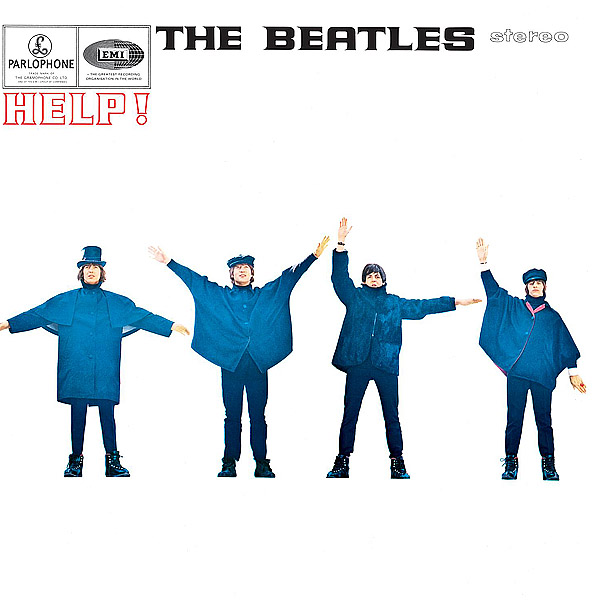
This was the second day of work on The Beatles’ “Help!” album. That morning, the group received awards from EMI chairman Sir Joseph Lockwood.
The previous day, The Beatles had recorded “Ticket To Ride” and begun work on “Another Girl” and “I Need You”. During this session, the recording of both “Another Girl” and “I Need You” was completed, and a further song, “Yes It Is”, was recorded.
The first session of the day, running from 2:00 pm to 5:00 pm, began with the completion of “I Need You”. The Beatles had recorded the basic track and added overdubs the previous day; work continued on Take 5. The vocals laid down by George Harrison and Paul McCartney in the previous session were replaced: George’s new double-tracked lead vocal, with harmonies from John and Paul, was recorded onto track four of the four-track tape. Track two received additional backing vocals from John and Paul, cowbell played by Ringo, and George’s twelve-string Rickenbacker guitar, the latter routed through a foot-controlled volume pedal he had recently acquired. This completed the recording of the track.
This marked the first occasion on which a tone pedal — later to become widely known as the wah-wah pedal — had been used on a Beatles recording.
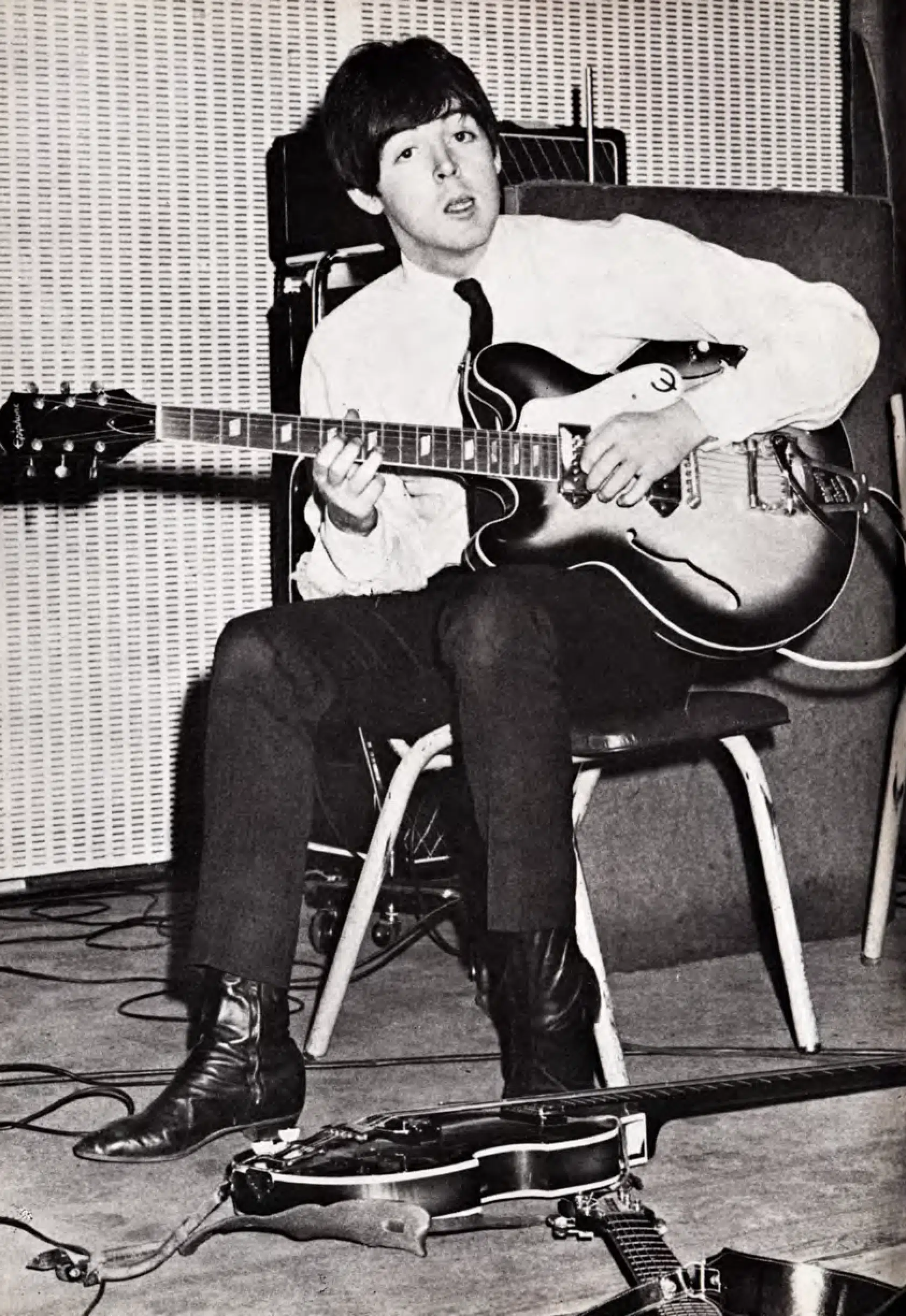
The session then turned to completing “Another Girl”. The basic track and initial overdubs had been recorded the previous day onto Take 1. On this day, the guitar parts were replaced: onto track two, John Lennon and George Harrison added backing guitars, while Paul McCartney recorded his lead guitar part. This completed the track.
The remainder of the day — a total of five hours, recorded as two distinct sessions (from 5:00 pm to 7:00 pm, and from 7:00 pm to 10:00 pm) in the EMI books — was devoted to John Lennon’s “Yes It Is”.
The basic track featured John on acoustic rhythm guitar and guide vocal, and Paul on bass — both instruments recorded onto track one — along with George on electric guitar using his volume pedal and Ringo on drums, both recorded onto track two.
Fourteen takes of the basic track were recorded, with Take 14 judged the best. John Winn, in his book “Way Beyond Compare: The Beatles’ Recorded Legacy, Volume One, 1957-1965“, provides a detailed account of the session: Take 1 was complete but sloppy, with Paul making errors in the third verse. As the tape rolled for Take 2, one of John’s guitar strings snapped during the first bridge. Between takes, John stated: “We’ll have to have an ending.” Take 3 was a false start; during take four, Paul raised a question about the arrangement and John decided to insert an extra bar between the first two verses — a feature retained in all subsequent takes. Takes 5 through 8 saw further errors, though Take 9 was a complete run-through with the ending fully worked out. Takes 10 and 11 were both false starts. Take 14 was complete and selected as the master.
A composite mix of Take 2 and Take 14 was released in “Anthology 2” in 2016
Take 2. Because the take broke down it is completed here with a section (in newly remixed and edited form) from the master, Take 14, distinguished by George’s tone-pedal guitar sounds and some fine three-part vocal harmony by John, Paul and George, emphasising how well the recording blossomed – and how quickly too: the Beatles recorded Yes It Is form start to finish inside five hours.
From the liner notes of “Anthology 2“
The three-part live vocal harmony — John, Paul and George singing together — was then recorded as an overdub onto Take 14, along with doubled guitar notes by George and a tambourine from Ringo.
This completed the recording. “Yes It Is” was not used on “Help!” but served as the B-side of the group’s next single, with “Ticket To Ride” as the A-side.
The three tracks completed on this day were mixed in mono on February 18 and in stereo on February 23.

Written by George Harrison
Recording • SI onto take 5
Recording • SI onto take 1
Recording • Take 1
AlbumReleased on bootleg Help! - Studio Sessions - Back To Basics
Recording • Take 2
AlbumOfficially released on Anthology 2
Recording • Take 3
AlbumReleased on bootleg Help! - Studio Sessions - Back To Basics
Recording • Take 4
AlbumReleased on bootleg Help! - Studio Sessions - Back To Basics
Recording • Take 5
AlbumReleased on bootleg Help! - Studio Sessions - Back To Basics
Recording • Take 6
AlbumReleased on bootleg Help! - Studio Sessions - Back To Basics
Recording • Take 7
AlbumReleased on bootleg Help! - Studio Sessions - Back To Basics
Recording • Take 8
AlbumReleased on bootleg Help! - Studio Sessions - Back To Basics
Recording • Take 9
AlbumReleased on bootleg Help! - Studio Sessions - Back To Basics
Recording • Take 10
AlbumReleased on bootleg Help! - Studio Sessions - Back To Basics
Recording • Take 11
AlbumReleased on bootleg Help! - Studio Sessions - Back To Basics
Recording • Take 12
Unreleased track
Recording • Take 13
Unreleased track
Recording • Take 14
AlbumReleased on bootleg Help! - Studio Sessions - Back To Basics
Recording • SI onto take 14
The Complete Beatles Recording Sessions • Mark Lewisohn
The definitive guide for every Beatles recording sessions from 1962 to 1970. We owe a lot to Mark Lewisohn for the creation of those session pages, but you really have to buy this book to get all the details - the number of takes for each song, who contributed what, a description of the context and how each session went, various photographies... And an introductory interview with Paul McCartney!
The Beatles Recording Reference Manual - Volume 2 - Help! through Revolver (1965-1966)
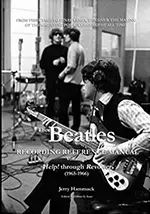
The second book of the Association for Recorded Sound Collections (ARSC)-nominated series, "The Beatles Recording Reference Manual: Volume 2: Help! through Revolver (1965-1966)" follows the evolution of the band from the end of Beatlemania with "Help!" through the introspection of "Rubber Soul" up to the sonic revolution of "Revolver". From the first take to the final remix, discover the making of the greatest recordings of all time.Through extensive, fully-documented research, these books fill an important gap left by all other Beatles books published to date and provide a unique view into the recordings of the world's most successful pop music act.
If we modestly consider the Paul McCartney Project to be the premier online resource for all things Paul McCartney, it is undeniable that The Beatles Bible stands as the definitive online site dedicated to the Beatles. While there is some overlap in content between the two sites, they differ significantly in their approach.

Notice any inaccuracies on this page? Have additional insights or ideas for new content? Or just want to share your thoughts? We value your feedback! Please use the form below to get in touch with us.

David Harvey • Jul 17, 2026 • 2 weeks ago
I'd be careful saying Paul rerecorded the lead guitar on Another Girl, because there was no pre-recorded lead guitar anyway (except for George's edit pieces).

The PaulMcCartney Project • Jul 29, 2026 • 3 days ago
Thanks David. I've fixed this.


