Monday, February 15, 1965
Recording "Ticket To Ride", "Another Girl", "I Need You"
For The Beatles
Last updated on May 1, 2026
Monday, February 15, 1965
For The Beatles
Last updated on May 1, 2026

Feb 15 - Jun 18, 1965 • Songs recorded during this session appear on Help! (UK - Mono)
Recording studio: EMI Studios, Studio Two, Abbey Road • London • UK
Previous session Nov 04, 1964 • "Beatles for Sale" Session #12
Article Feb 04, 1965 • Maclen (Music) Ltd. is formed
Article Feb 10, 1965 • "A Talent For Loving" is considered for The Beatles' third film
Session Feb 15, 1965 • Recording "Ticket To Ride", "Another Girl", "I Need You"
Session Feb 15 - Jun 18, 1965 • Recording "Help!"
Album Feb 15, 1965 • "Beatles For Sale (Mono)" by The Beatles released in the US
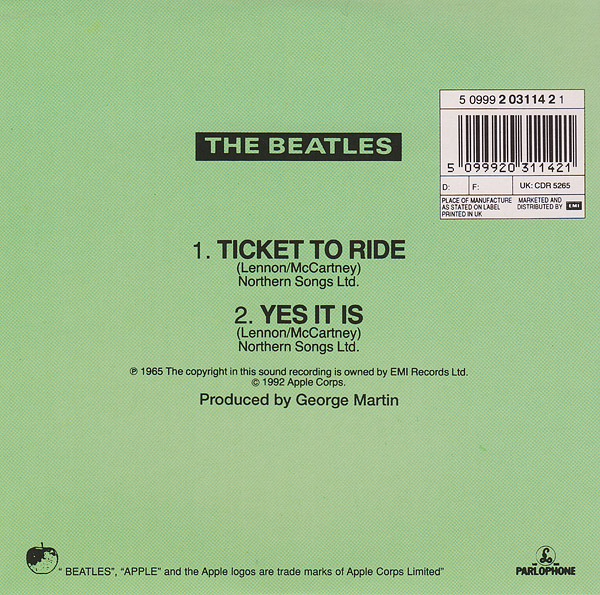
AlbumSome of the songs worked on during this session were first released on the "Ticket To Ride / Yes It Is (UK)" 7" Single

By The Beatles
On this day, The Beatles returned to EMI Studios, Abbey Road, for the first time since October 1964 and the completion of “Beatles For Sale“. They were about to begin filming their second feature film, “Help!“, on February 23, and needed to record songs for its soundtrack. In addition, they were under pressure to deliver a new single scheduled for release in the spring.
Two recording sessions took place that day, the first beginning at 2:30 pm.
Earlier that morning, John Lennon passed his driving test in Weybridge, the town where he was living at the time. Shortly before the session began, he was photographed sitting in his car outside EMI Studios, with Paul, George and Ringo standing beside it.
As they had done with A Hard Day’s Night the year before so the Beatles entered into a crash series of recording sessions before shooting their new motion picture (untitled at first but eventually named Help!). Due to fly to the Bahamas on 22 February, the Beatles spent six days at EMI from 15th to the 20th, taping the 11 numbers they offered up as candidates for the movie soundtrack. Six of these were selected, two went on to the non-soundtrack side of the Help! album, two remained unissued and […] Yes It Is, was set aside as the B-side of the Beatles’ next single, Ticket To Ride.
From Anthology 2 liner notes


Three songs were recorded that day: “Ticket To Ride“, “Another Girl” and “I Need You“.
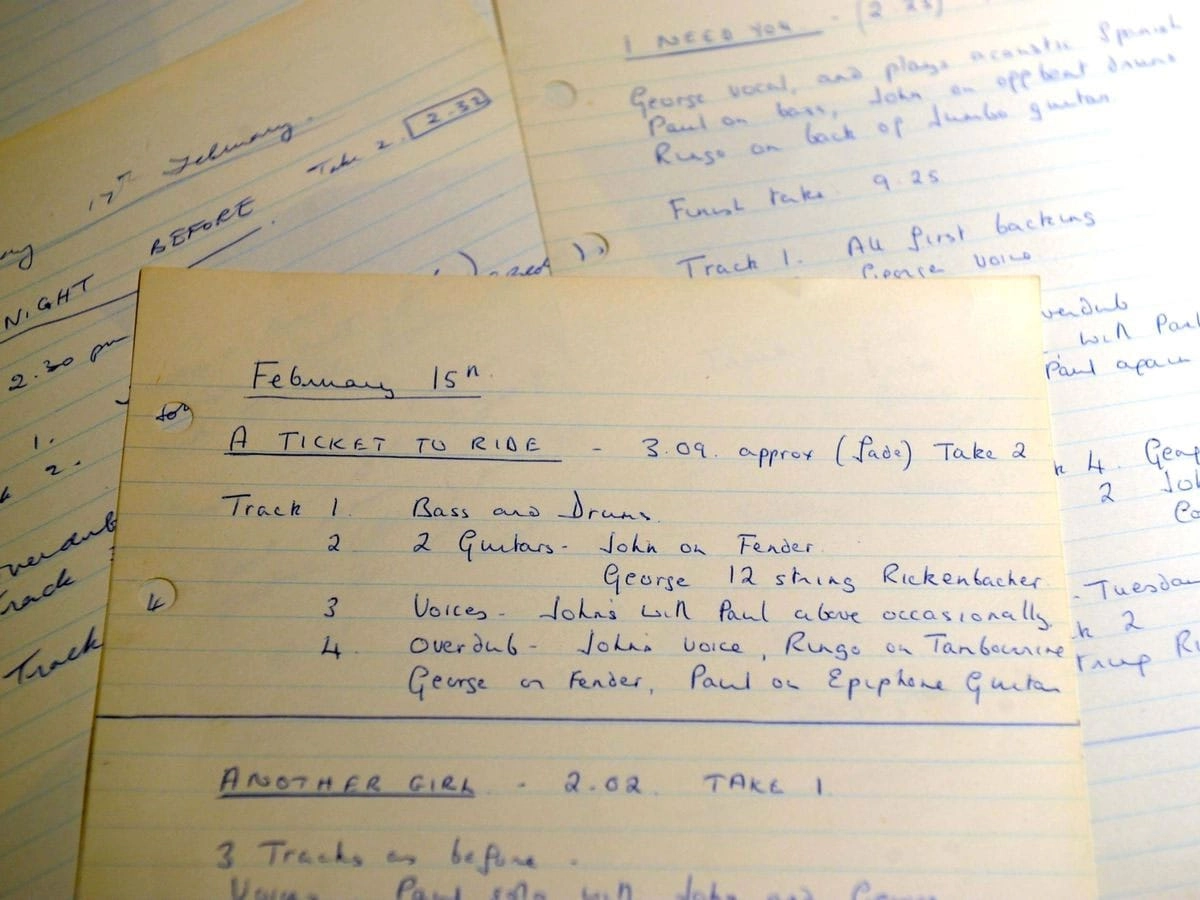
“Ticket To Ride” would become the A-side of their next single, and was recorded during the afternoon session, from 2:30 pm and 5:45 pm. A new recording technique was introduced during this session, as explained by Mark Lewisohn:
The group and George Martin adopted new recording techniques. One was to rehearse songs with a tape machine running, spooling back to record properly over the rehearsed material. Another was to make finished, releasable recordings in just one or two takes; an impressively economical operation which frequently belied the work involved. The secret here was that the rhythm track would usually be taped first and then they would overdub or ‘drop in’ extra sounds onto the tape at will. In this way, they might superimpose onto an existing take a good many unnumbered overdubs, which in previous years would each have been allotted a new number. So while a reasonably complex song like, say, ‘We Can Work It Out’ was perfected in just two takes (and only one of those was complete) it still took four hours and was the result of numerous additions, subtractions and perfections. These techniques were employed in this first session.
From “The Complete Beatles Recording Sessions” by Mark Lewisohn, 1988
The backing track of “Ticket To Ride” featured John on lead vocals and electric guitar, Paul on bass with backing vocals, George on electric guitar, and Ringo on drums. Only two takes were attempted: Take 1 broke down as a false start, while Take 2 was considered satisfactory and selected for overdubbing.
During the overdub stage, Paul added a lead electric guitar part, George contributed additional electric guitar lines, John double-tracked his lead vocal and added handclaps, and Ringo played tambourine. With these additions, the recording was completed.
“Ticket To Ride” was mixed in mono on February 18, and in stereo on February 23.
After a break, The Beatles reconvened with the engineering team for a second session starting at 7 pm.
“Another Girl” was written by Paul during his recent holiday in Tunisia with Jane Asher; he had returned from Tunisia the day before this session. The recording process for the song proved slightly more complex than that of “Ticket To Ride“.
The backing track featured Paul on bass and lead vocals, John on electric guitar with backing vocals, George on acoustic guitar with backing vocals, and Ringo on drums. Two takes were recorded, with Take 1 judged the best.
Overdubs were then added to Take 1. Paul double-tracked his lead vocal, John and George double-tracked their backing vocals, and Ringo added tom-tom drum strikes. George then recorded an edit piece intended for the end of the song, although this was ultimately not used.
“Another Girl” received a final overdub the following day, and was mixed in mono on February 18, and in stereo on February 23.
The final song recorded on this day was George’s “I Need You“, the third of his compositions to be recorded by The Beatles, following “Don’t Bother Me” in September 1963 and the demo “You Know What To Do” in June 1964.
Five takes of the backing track were recorded.
Take 1 featured George on acoustic guitar with guide vocals, Paul on bass, John shaking maracas and Ringo drums. Take 1 was released on “Anthology 4” in 2025.
From Take 2 onwards, the line-up changed: George was on acoustic guitar with guide vocals, Paul on bass, John playing a simple beat on Ringo’s drum kit, and Ringo providing percussion by tapping on the back of an acoustic guitar.
Take 5 was selected as the best. Overdubs then followed: George recorded double-tracked lead vocals, Paul added double-tracked backing vocals, and Ringo contributed cowbell.
Recording for the day was completed at 10:30 pm. “I Need You” would receive further overdubs during the following day’s session.
Released on “With The Beatles” in November 1963, ‘Don’t Bother Me’ is the first song written by George to be recorded for EMI. Although a studio demo of his composition ‘You Know What To Do’ (included on Anthology 1) was taped in June 1964, no songs by George appeared on any of The Beatles’ records from that year. On 15 February 1965, the first day of sessions to record numbers for possible inclusion in The Beatles’ second film, George had two ready to try – ‘I Need You’ and ‘You Like Me Too Much’. Take five of ‘I Need You’ was chosen as the performance onto which guitar phrases created with a foot-controlled volume pedal, a cowbell and harmonies were overdubbed. From take two onwards, Ringo had tapped out a rhythm on the back of a Jumbo acoustic guitar, while John hit a drum on the off-beat and George played the José Ramirez Spanish guitar he had used on ‘And I Love Her’. Take one, however, has a different line-up: Paul’s bass and Ringo playing his full drum kit are on track one; a steel string acoustic played by George was recorded on two; his lead vocal and John shaking maracas are on three.
From the liner note of “Anthology 4“
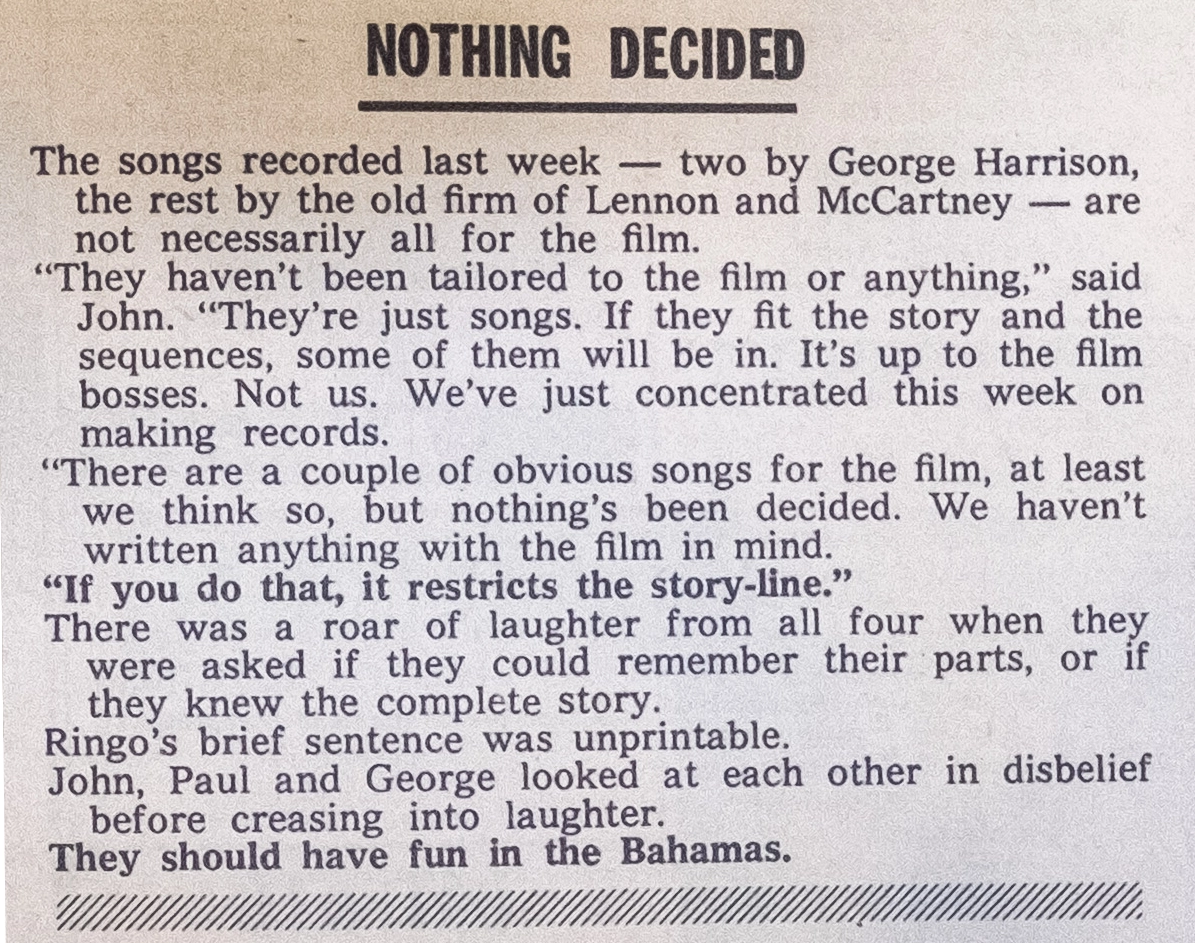
NOTHING DECIDED
The songs recorded last week — two by George Harrison, the rest by the old firm of Lennon and McCartney — are not necessarily all for the film.
“They haven’t been tailored to the film or anything,” said John. “They’re just songs. If they fit the story and the sequences, some of them will be in. It’s up to the film bosses. Not us. We’ve just concentrated this week on making records. There are a couple of obvious songs for the film, at least we think so, but nothing’s been decided. We haven’t written anything with the film in mind. If you do that, it restricts the story-line.”
There was a roar of laughter from all four when they were asked if they could remember their parts, or if they knew the complete story. Ringo’s brief sentence was unprintable. John, Paul and George looked at each other in disbelief before creasing into laughter.
They should have fun in the Bahamas.
From Melody Maker – February 27, 1965
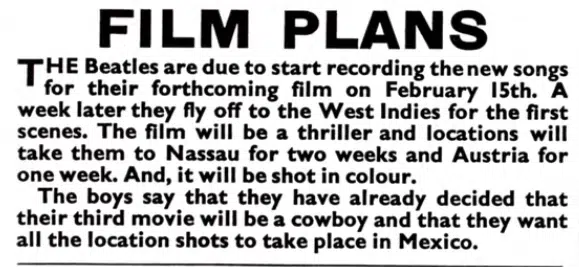
FILM PLANS
THE Beatles are due to start recording the new songs for their forthcoming film on February 15th. A week later they fly off to the West Indies for the first scenes. The film will be a thriller and locations will take them to Nassau for two weeks and Austria for one week. And, it will be shot in colour.
The boys say that they have already decided that their third movie will be a cowboy and that they want all the location shots to take place in Mexico.
From The Beatles Monthly Book – February 1965
THE FAB FOUR STEP ON THE GAS and NANCY LEWIS is geared up on the cars that mean so much to the most switched on pop group in showbiz…
ONE thing the Beatles are certainly switched on about is cars! And to make it complete, just recently John Lennon proudly announced to the world that he had passed his driving test. So now all four of them may be spotted at different times driving on the roads.
“I’ll still keep my chauffeur,” John said. “For the Rolls, of course.” For his own use, though, he has a Mini.
Ringo, who places fast cars high in his list of interests, is the proud owner of a maroon Facel Vega…. Word has it that he’s an excellent driver and can reach high speeds in a very short time with this new car.
George seemed to have some problems when he owned a silver E-type Jag. It was involved in a couple of minor “incidents.” A lorry driver who ran into him apologized, but said the car was so low he never saw it! Hope you have better luck with that new white Aston Martin, George!
Paul also has an Aston Martin, but his is blue. Talking with FAB’S Maureen, he boasted that his car can do 140 miles an hour. “Wanna ride?” he asked her. To which Mo replied, “Don’t ask silly questions!“
Ed. Unity told Paul about a ride she had with Adam Faith not too long ago. Going down the M1 in his Ford Galaxy at 110 miles an hour, something went wrong with the brakes. “The M once!” Unity said.
“I don’t understand what that means but it sounds very poetic,” replied Paul. “You should keep that.“
“A hundred and ten miles an hour. Gosh! That’s too fast to cog down,” said Mo. Paul loved that expression—he kept teasing Mo about “cogging down.“
After passing his test, John seemed quite anxious to show off his newly-acquired skill. Borrowing recording manager George Martin’s car, he interrupted their recording session long enough to prove his ability.
“I don’t think that just because I have passed my test—in my Mini—I am a good driver,” he admitted. “I am still learning.“
Chances are he’ll be out practising as often as possible. So don’t be too surprised if you spot him whizzing by some day. Be careful, though—the sight of a Beatle could be enough to distract even the most careful road user!
From Fabulous208 – March 27, 1965

Recording • Take 1
Recording • Take 2
Recording • SI onto take 2
Recording • Take 1
Recording • SI onto take 1
Recording • 10 unnumbered edit pieces
Written by George Harrison
Recording • Take 1
AlbumOfficially released on Anthology 4
Written by George Harrison
Recording • Take 2
Written by George Harrison
Recording • Take 3
Written by George Harrison
Recording • Take 4
Written by George Harrison
Recording • Take 5
Written by George Harrison
Recording • SI onto take 5
The Complete Beatles Recording Sessions • Mark Lewisohn
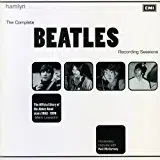
The definitive guide for every Beatles recording sessions from 1962 to 1970. We owe a lot to Mark Lewisohn for the creation of those session pages, but you really have to buy this book to get all the details - the number of takes for each song, who contributed what, a description of the context and how each session went, various photographies... And an introductory interview with Paul McCartney!
The Beatles Recording Reference Manual - Volume 2 - Help! through Revolver (1965-1966)
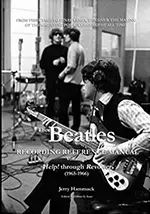
The second book of the Association for Recorded Sound Collections (ARSC)-nominated series, "The Beatles Recording Reference Manual: Volume 2: Help! through Revolver (1965-1966)" follows the evolution of the band from the end of Beatlemania with "Help!" through the introspection of "Rubber Soul" up to the sonic revolution of "Revolver". From the first take to the final remix, discover the making of the greatest recordings of all time.Through extensive, fully-documented research, these books fill an important gap left by all other Beatles books published to date and provide a unique view into the recordings of the world's most successful pop music act.
If we modestly consider the Paul McCartney Project to be the premier online resource for all things Paul McCartney, it is undeniable that The Beatles Bible stands as the definitive online site dedicated to the Beatles. While there is some overlap in content between the two sites, they differ significantly in their approach.

Notice any inaccuracies on this page? Have additional insights or ideas for new content? Or just want to share your thoughts? We value your feedback! Please use the form below to get in touch with us.