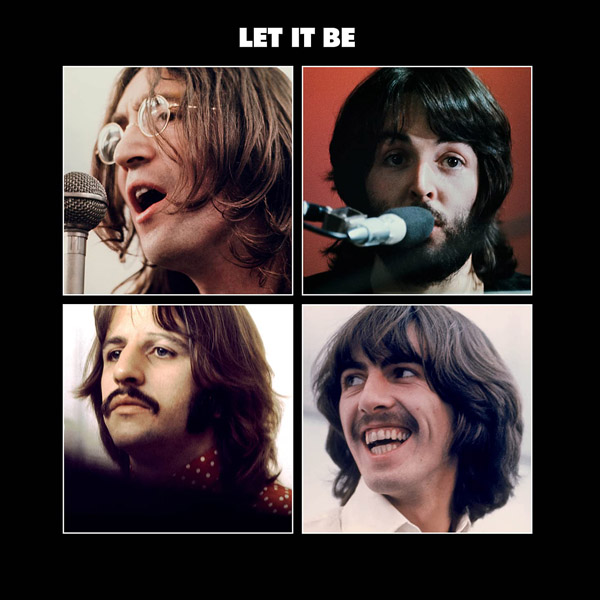

Jan 3 - April 2, 1970 • Songs recorded during this session appear on Let It Be (US version)
Recording studio: EMI Studios, Room 4, Abbey Road • London • UK
Session Mar 23, 1970 • Creating the master tapes of "McCartney" album
Session Mar 25, 1970 • Mixing "Let It Be" album #2
Session Mar 26, 1970 • Mixing "Let It Be" album #3
Session Mar 27, 1970 • Mixing "Let It Be" album #4
Album Mar 27, 1970 • "Sentimental Journey" by Ringo Starr released in the UK
AlbumSome of the songs worked on during this session were first released on the "Let It Be (UK - 1st pressing with "Get Back" book)" LP
At the request of Allen Klein, and with the support of John Lennon, American producer Phil Spector was brought in to rework the upcoming “Let It Be” album, using the “Get Back” tapes recorded in January 1969. This followed several earlier attempts by Glyn Johns. Spector’s mixing work began on March 23, 1970.
On this day, Spector worked on “The Long And Winding Road“, “Let It Be“, “Maggie Mae” and “Get Back“.
Phil Spector completed only one remix (RS1) of “The Long and Winding Road” on this day, using the same January 26, 1969 performance previously selected by Glyn Johns for his “Get Back” LP.
On April 1, 1970, Spector would apply his signature “Wall of Sound” treatment to the track by recording an orchestral arrangement composed by Richard Hewson. It is likely that the purpose of the mix created on this day was either to provide Hewson with a reference for scoring or to serve as a playback guide for the session musicians during the overdub session.
“Let It Be” had previously been subject to overdubs on two occasions. On April 30, 1969, George Harrison added a guitar overdub — marking the first departure from the original “no overdubs” philosophy of the “Get Back” project. Further overdubs were recorded on January 4, 1970, including a brass and cello arrangement scored by George Martin, along with a new guitar solo by George. These additions were used for the single version of “Let It Be,” released in the UK on March 6, 1970 — just two weeks before this session.
On this day, Phil Spector created four stereo mixes of “Let It Be” (RS1 to RS4), all based on the same January 31, 1969 performance used for the single. However, he discarded the April 1969 guitar overdub while retaining the orchestral elements and new guitar solo recorded on January 4, 1970. Spector then edited the four mixes together to create a composite version, which he labeled RS1. This final mix became the version released on the “Let It Be” album.
From beatlesebooks.com:
[Phil Spector] made four attempts at getting a new mix of the song, the fourth being deemed the best. Being the master of the famous “Wall Of Sound” as heard on his American productions, Spector added a good amount of tape echo to Paul’s maracas in the third set of verses and Ringo’s hi-hat in the second set of verses, punching up the drummer’s contribution to be a stand-out feature of the recording […]. He also elevated George Martin’s brass performance much higher in the mix, choosing Harrison’s searing new guitar work from January 4th, 1970 to give the song a more jarring presence.
One other trick that Phil Spector had up his sleeve was to extend the song from 3:50 to 4:01 by editing in a repeat of one of the final choruses, there now being three choruses instead of two. It took him four attempts to get this edit done satisfactorily, the best attempt identified as ‘remix stereo 1.’ […]
For the “Get Back” single released in March 1969, producer George Martin used a recording from January 27, 1969 (DDSI 27.63) for the main body of the song, and spliced in the coda from a performance recorded the following day (DDSI 28.43).
Phil Spector used the same January 27, 1969 recording as the foundation, creating five stereo remixes of the track, labeled RS1 to RS5. He then edited elements from RS1 and RS5 to produce the final version, which was also labeled RS3.
The following day, Spector combined it with John’s spoken words taken from the ending of DDSI 30.17 — the final rooftop performance of the song, recorded on January 30, 1969. John’s closing line — “I’d like to say thank you on behalf of the group and ourselves. I hope we passed the audition” — was featured in the “Let It Be” film.
For “Maggie Mae,” Phil Spector used the same take recorded on January 24, 1969, that Glyn Johns had selected for his “Get Back” LP. Spector created two stereo remixes (RS1 and RS2), both of which closely resembled Johns’ original mix. RS2 was chosen for inclusion on the “Let It Be” album.
Phil Spector continued his work on the “Get Back” tapes on the following day, March 27, 1970.
Mixing • DDSI.26.91 • Stereo mixing - Remix 1
Mixing • DDSI.31.64 • Stereo mixing - Remix 1 from take 30
Mixing • DDSI.31.64 • Stereo mixing - Remix 2 from take 30
Mixing • DDSI.31.64 • Stereo mixing - Remix 3 from take 30
Mixing • DDSI.31.64 • Stereo mixing - Remix 4 from take 30
Editing • DDSI.31.64 • Editing of stereo remixes 1-4, called remix stereo 1
AlbumOfficially released on Let It Be (UK - 1st pressing with "Get Back" book)
Mixing • DDSI.27.63 • Stereo mixing - Remix 1
Mixing • DDSI.27.63 • Stereo mixing - Remix 2
Mixing • DDSI.27.63 • Stereo mixing - Remix 3
Mixing • DDSI.27.63 • Stereo mixing - Remix 4
Mixing • DDSI.27.63 • Stereo mixing - Remix 5
Editing • DDSI.27.63/30.17 • Editing of RS3, RS5 and DDSI.30.17, called remix stereo 3
AlbumOfficially released on Let It Be (UK - 1st pressing with "Get Back" book)
Written by Paul McCartney, Ringo Starr, John Lennon, George Harrison
Mixing • DDSI.24.49 • Stereo mixing - Remix 1
Written by Paul McCartney, Ringo Starr, John Lennon, George Harrison
Mixing • DDSI.24.49 • Stereo mixing - Remix 2
AlbumOfficially released on Let It Be (UK - 1st pressing with "Get Back" book)
The Complete Beatles Recording Sessions • Mark Lewisohn
The definitive guide for every Beatles recording sessions from 1962 to 1970. We owe a lot to Mark Lewisohn for the creation of those session pages, but you really have to buy this book to get all the details - the number of takes for each song, who contributed what, a description of the context and how each session went, various photographies... And an introductory interview with Paul McCartney!
The Beatles Recording Reference Manual: Volume 5: Let It Be through Abbey Road (1969 - 1970)

The fifth and final book of this critically acclaimed series, "The Beatles Recording Reference Manual: Volume 5: Let It Be through Abbey Road (1969 - 1970)" follows The Beatles as they "get back to where they once belonged...". Not once, but twice. With "Let It Be", they attempted to recapture the spontaneity of their early years and recordings, while "Abbey Road" was a different kind of return - to the complexity, finish and polish that they had applied to their work beginning with "Revolver" and through to "The Beatles".
If we modestly consider the Paul McCartney Project to be the premier online resource for all things Paul McCartney, it is undeniable that The Beatles Bible stands as the definitive online site dedicated to the Beatles. While there is some overlap in content between the two sites, they differ significantly in their approach.

Notice any inaccuracies on this page? Have additional insights or ideas for new content? Or just want to share your thoughts? We value your feedback! Please use the form below to get in touch with us.


