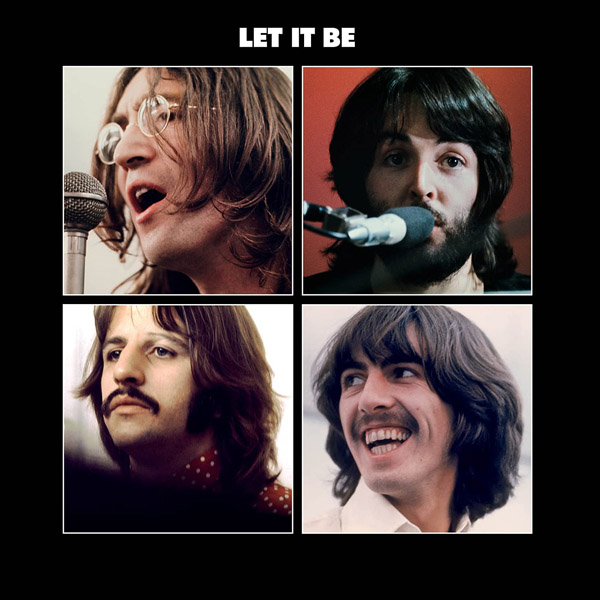
US Release date : May 18, 1970
Let It Be (US version)
By The Beatles • LP • Part of the collection “The Beatles • The original US LPs”
Last updated on June 21, 2025
US Release date : May 18, 1970
By The Beatles • LP • Part of the collection “The Beatles • The original US LPs”
Last updated on June 21, 2025
Previous album May 08, 1970 • "Let It Be (UK - 1st pressing with "Get Back" book)" by The Beatles released in the UK
Single May 11, 1970 • "The Long and Winding Road / For You Blue (US)" by The Beatles released in the US
Article May 18, 1970 • First public screening of the "Let It Be" Film
Album May 18, 1970 • "Let It Be (US version)" by The Beatles released in the US
Article May 20, 1970 • UK premiere of the “Let It Be” film
Article May 23, 1970 • US launch of the "Let It Be" film
Next album Nov 06, 1970 • "Let It Be (UK - 2nd pressing)" by The Beatles released in the UK
This album was recorded during the following studio sessions:

Designing the packaging for “Let It Be”
July 1969 - March 1970 ?

The Beatles win an Oscar for “Let It Be”
Apr 15, 1971
DDSI.21.69/31.13 • 3:37 • Studio version • A • Stereo
Paul McCartney : Acoustic guitar, Vocals, Whistling Ringo Starr : Drums John Lennon : Acoustic guitar, Vocals, Whistling George Harrison : Lead guitar George Martin : Producer Phil Spector : Producer Glyn Johns : Recording engineer
SessionRecording : Jan 31, 1969 • Studio : Apple Studios, 3 Savile Row, London
SessionSpoken intro : Jan 21, 1969 • Studio : Apple offices, 3 Savile Row • London • UK
SessionMixing : Mar 25, 1970 • Studio : EMI Studios, Room 4, Abbey Road
SessionMixing : Mar 27, 1970 • Studio : EMI Studios, Room 4, Abbey Road
DDSI.30.11 • 3:55 • Studio version • A • Stereo
Paul McCartney : Bass, Harmony vocal Ringo Starr : Drums John Lennon : Lead vocal, Rhythm guitar George Harrison : Lead guitar George Martin : Producer Phil Spector : Producer Peter Bown : Engineer Glyn Johns : Recording engineer Billy Preston : Electric piano
Concert From "The rooftop concert" in London, UK on Jan 30, 1969
SessionMixing : Mar 23, 1970 • Studio : EMI Studios, Room 4, Abbey Road
3:48 • Studio version • B • Stereo
Paul McCartney : Acoustic guitar, Backing vocals, Piano Ringo Starr : Drums, Percussion, Swarmandal John Lennon : Acoustic rhythm guitar, Backing vocals, Electric guitar, Organ, Vocals George Harrison : Backing vocals, Electric guitar, Maracas, Tambura George Martin : Hammond organ, Producer Phil Spector : Producer Phil McDonald : Assistant recording engineer Ken Scott : Recording engineer Peter Bown : Mixing engineer, Recording engineer Martin Benge : Recording engineer Lizzie Bravo : Backing vocals Gayleen Pease : Backing vocals Richard Lush : Assistant recording engineer Mike Sheady : Mixing engineer, Recording engineer Unknown : Eighteen violins, Four cellos, Four violas, Fourteen vocalists, Harp, Three trombones, Three trumpets Bill Parkinson : Guitar Martin Kershaw : Guitar
SessionRecording : Feb 04, 1968 • Studio : EMI Studios, Studio Three, Abbey Road
SessionOverdubs : Feb 08, 1968 • Studio : EMI Studios, Studio Two, Abbey Road
SessionOrchestral overdubs : Apr 01, 1970 • Studio : EMI Studios, Abbey Road
SessionMixing : Apr 02, 1970 • Studio : EMI Studios, Room 4, Abbey Road
Written by George Harrison
2:26 • Studio version • A • Stereo
Paul McCartney : Acoustic guitar, Bass, Electric piano, Hammond organ, Harmony vocals Ringo Starr : Drums George Harrison : Acoustic guitar, Electric guitar, Harmony vocals, Vocals George Martin : Producer Phil Spector : Producer Phil McDonald : Recording engineer Peter Bown : Recording engineer Unknown : Eighteen violins, Four cellos, Four violas, Fourteen vocalists, Harp, Three trombones, Three trumpets
SessionRecording : Jan 03, 1970 • Studio : EMI Studios, Studio Two, Abbey Road
SessionOverdubs : Apr 01, 1970 • Studio : EMI Studios, Abbey Road
SessionMixing : Apr 02, 1970 • Studio : EMI Studios, Room 4, Abbey Road
Written by Paul McCartney, Ringo Starr, John Lennon, George Harrison
DDSI.26.55/24.85 • 0:51 • Studio version • A • Stereo
Paul McCartney : Piano Ringo Starr : Drums John Lennon : Six-string bass guitar, Vocals George Harrison : Lead guitar George Martin : Shaker Phil Spector : Producer Glyn Johns : Recording engineer Billy Preston : Hammond organ
SessionRecording : Jan 26, 1969 • Studio : Apple Studios, 3 Savile Row, London
SessionSpeech recording : Jan 24, 1969 • Studio : Apple Studios, 3 Savile Row, London
SessionMixing : Mar 27, 1970 • Studio : EMI Studios, Room 4, Abbey Road
DDSI.31.64 • 4:03 • Studio version • B • Stereo
Paul McCartney : Backing vocals, Bass guitar, Electric piano, Maracas, Piano, Vocals Linda Eastman / McCartney : Backing vocals Ringo Starr : Drums George Harrison : Backing vocals, Lead guitar George Martin : Producer Phil Spector : Producer Phil McDonald : Recording engineer Jeff Jarratt : Recording engineer Glyn Johns : Recording engineer Billy Preston : Electric piano, Organ Unknown : Cellos, One baritone saxophone, Trombone, Two tenor saxophones, Two trumpets
SessionRecording : Jan 31, 1969 • Studio : Apple Studios, 3 Savile Row, London
SessionOverdubs : Jan 04, 1970 • Studio : EMI Studios, Studio Two, Abbey Road
SessionMixing : Mar 26, 1970 • Studio : EMI Studios, Room 4, Abbey Road
Written by Paul McCartney, Ringo Starr, John Lennon, George Harrison
DDSI.24.49 • 0:40 • Studio version • A • Stereo
Paul McCartney : Acoustic guitar, Vocals Ringo Starr : Drums John Lennon : Acoustic guitar, Vocals George Harrison : Lead guitar Phil Spector : Producer Peter Bown : Engineer Glyn Johns : Recording engineer
SessionRecording : Jan 24, 1969 • Studio : Apple Studios, 3 Savile Row, London
SessionMixing : Mar 26, 1970 • Studio : EMI Studios, Room 4, Abbey Road
DDSI.30.06 • 3:38 • Studio version • A • Stereo
Paul McCartney : Bass, Vocals Ringo Starr : Drums John Lennon : Rhythm guitar, Vocals George Harrison : Lead guitar, Vocals George Martin : Producer Glyn Johns : Recording engineer Billy Preston : Electric piano
Concert From "The rooftop concert" in London, UK on Jan 30, 1969
SessionMixing : Mar 23, 1970 • Studio : EMI Studios, Room 4, Abbey Road
DDSI.30.08 • 2:54 • Studio version • A • Stereo
Paul McCartney : Bass, Vocals Ringo Starr : Drums John Lennon : Rhythm guitar, Vocals George Harrison : Lead guitar George Martin : Producer Phil Spector : Producer Peter Bown : Engineer Glyn Johns : Recording engineer Billy Preston : Electric piano
Concert From "The rooftop concert" in London, UK on Jan 30, 1969
SessionMixing : Mar 23, 1970 • Studio : EMI Studios, Room 4, Abbey Road
DDSI.26.91 • 3:38 • Studio version • A • Stereo
Paul McCartney : Piano, Vocals Ringo Starr : Drums John Lennon : Bass George Harrison : Guitar Richard Hewson : Orchestra arrangement Phil Spector : Producer Peter Bown : Recording engineer Glyn Johns : Recording engineer Unknown : Eighteen violins, Four cellos, Four violas, Fourteen vocalists, Harp, Three trombones, Three trumpets
SessionRecording : Jan 26, 1969 • Studio : Apple Studios, 3 Savile Row, London
SessionOrchestra overdubs : Apr 01, 1970 • Studio : EMI Studios, Studio One, Abbey Road
SessionMixing : Apr 02, 1970 • Studio : EMI Studios, Room 4, Abbey Road
Written by George Harrison
DDSI.25.47 • 2:32 • Studio version • A • Stereo
Paul McCartney : Piano Ringo Starr : Drums John Lennon : Electric lap steel slide guitar George Harrison : Acoustic guitar, Vocals George Martin : Producer Glyn Johns : Recording engineer
SessionRecording : Jan 25, 1969 • Studio : Apple Studios, 3 Savile Row, London
SessionJohn's spoken intro : Jan 08, 1969 • Studio : Twickenham Film Studios, London, UK
SessionOverdubs : Jan 08, 1970 • Studio : Olympic Sound Studios, London
SessionMixing : Mar 25, 1970 (intro, March 30) • Studio : EMI Studios, Room 4, Abbey Road
DDSI.27.63/30.17 • 3:14 • Studio version • C • Stereo
Paul McCartney : Bass, Lead vocal Ringo Starr : Drums John Lennon : Backing vocal, Lead guitar George Harrison : Rhythm guitar George Martin : Producer Glyn Johns : Engineer Billy Preston : Electric piano Jerry Boys : Second engineer
Concert From "The rooftop concert" in London, UK on Jan 30, 1969
SessionRecording : January 27, 1969 • Studio : Apple Studios, 3 Savile Row, London
SessionMixing : Mar 26, 1970 • Studio : EMI Studios, Room 4, Abbey Road
In the UK, “Let It Be” was originally released in a box set that included a 164 page book, “The Beatles Get Back”.
The set’s deluxe presentation increased production costs by approximately 33%, making “Let It Be” the most expensive Beatles album at the time in terms of retail price. The high cost, along with issues with the book’s binding — many copies would later fall apart — led to the decision to discontinue the book for the second UK pressing in November 1970.
In the United States, United Artists — who distributed the album under the terms of the “Let It Be” film deal — declined to release the LP with the book, concerned that the elevated price would hurt sales. Instead, the U.S. edition featured a standard gatefold sleeve, which included a selection of photographs from the “Get Back” sessions.

BEATLES’ ALBUM HITS RECORD SALES PEAK IN UNITED STATES
The Beatles’ “Let It Be” album chalked up the largest initial sale in the history of America’s recording industry. Advance orders for the LP, which has just been issued in the States, totalled 3,700,000 albums — representing a gross retail price of 25,900,000 dollars! The controversial “Long And Winding Road” track from the album has been released in America as a single, and immediately earned the group another Gold Disc selling 1,200,000 copies within two days of issue.
Over one million copies of the “McCartney” album have now been sold in America during the four weeks it has been on sale there. And Ringo Starr’s “Sentimental Journey” LP has chalked up half-a-million sales in two weeks. A Ringo promotional film clip on the album was screened in U.S. TV’s top-rated “Ed Sullivan Show” last Sunday.
From New Musical Express – May 23, 1970

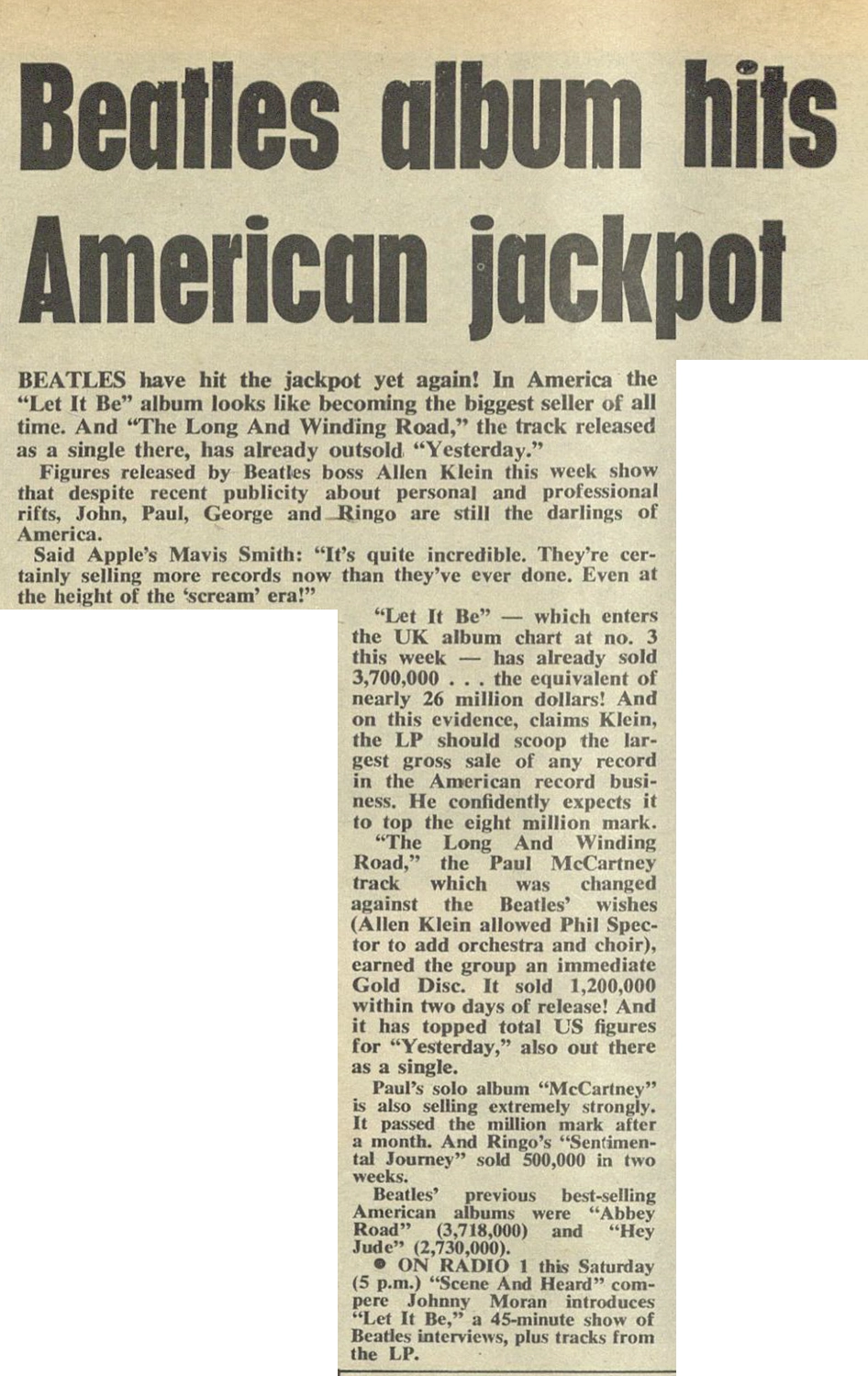
Beatles album hits American jackpot
BEATLES have hit the jackpot yet again! In America the “Let It Be” album looks like becoming the biggest seller of all time. And “The Long And Winding Road,” the track released as a single there, has already outsold “Yesterday.”
Figures released by Beatles boss Allen Klein this week show that despite recent publicity about personal and professional rifts, John, Paul, George and Ringo are still the darlings of America.
Said Apple’s Mavis Smith: “It’s quite incredible. They’re certainly selling more records now than they’ve ever done. Even at the height of the ‘scream’ era!”
“Let It Be” — which enters the UK album chart at no. 3 this week — has already sold 3,700,000… the equivalent of nearly 26 million dollars! And on this evidence, claims Klein, the LP should scoop the largest gross sale of any record in the American record business. He confidently expects it to top the eight million mark.
“The Long And Winding Road,” the Paul McCartney track which was changed against the Beatles’ wishes (Allen Klein allowed Phil Spector to add orchestra and choir), earned the group an immediate Gold Disc. It sold 1,200,000 within two days of release! And it has topped total US figures for “Yesterday,” also out there as a single.
Paul’s solo album “McCartney” is also selling extremely strongly. It passed the million mark after a month. And Ringo’s “Sentimental Journey” sold 500,000 in two weeks.
Beatles’ previous best-selling American albums were “Abbey Road” (3,718,000) and “Hey Jude” (2,730,000).
ON RADIO 1 this Saturday (5 p.m.) “Scene And Heard” compere Johnny Moran introduces “Let It Be,” a 45-minute show of Beatles interviews, plus tracks from the LP.
From Disc And Music Echo – May 23, 1970
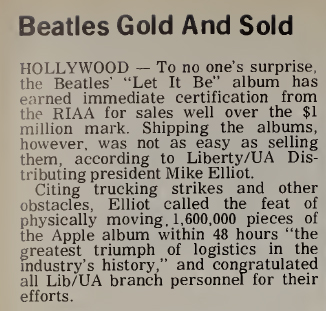
Beatles Gold And Sold
HOLLYWOOD — To no one’s surprise, the Beatles’ “Let It Be” album has earned immediate certification from the RIAA for sales well over the $1 million mark. Shipping the albums, however, was not as easy as selling them, according to Liberty/UA Distributing president Mike Elliot.
Citing trucking strikes and other obstacles, Elliot called the feat of physically moving 1,600,000 pieces of the Apple album within 48 hours “the greatest triumph of logistics in the industry’s history,” and congratulated all Lib/UA branch personnel for their efforts.
From Cashbox Magazine, May 30, 1970
LET IT BE, The Beatles (Apple AR 3400)
To those who found their work since the White Album as emotionally vapid as it was technically breathtaking, the news that the Beatles were about to bestow on us an album full of gems they’d never gotten around to polishing beyond recognition was most encouraging. Who among us, after all, wouldn’t have preferred a good old slipshod “Save The Last Dance For Me” to the self-conscious and lifeless “Oh! Darlin’” they’d been dealing in?
Well, it was too good to be true — somebody apparently just couldn’t Let It Be, with the result that they put the load on their new friend P. Spector, who in turn whipped out his orchestra and choir and proceeded to turn several of the rough gems on the best Beatle album in ages into costume jewelry.
Granted that he would have preferred to have been in on the project from its inception rather than having it all handed to him eight months after its announced release date (in which case we would never have been led to expect spontaneity and his reputation would still be intact), one can’t help but wonder why he involved himself at all, and wonder also, how he came to the conclusion that lavish decoration of several of the tracks would enhance the straightforwardness of the album.
To Phil Spector, stinging slaps on both wrists.
He’s rendered “The Long and Winding Road,” for instance, virtually unlistenable with hideously cloying strings and a ridiculous choir that serve only to accentuate the listlessness of Paul’s vocal and the song’s potential for further mutilation at the hands of the countless schlock-mongers who will undoubtedly trip all over one another in their haste to cover it. A slightly lesser chapter in the ongoing story of McCartney as facile romanticist, it might have eventually begun to grow on one as unassumingly charming, had not Spector felt compelled to transform an apparently early take into an extravaganza of oppressive mush. Sure, he was just trying to help it along, but Spectorized it evokes nothing so much as dewey-eyed little Mark Lester warbling his waif’s heart out amidst the assembled Oliver orchestra and choir.
“I Me Mine,” the waltz sections of which reminds one very definitely of something from one of The Al Jolson Story’s more maudlin moments, almost benefits from such treatment—it would have been fully as hilarious as “Good Night,” after all, had Spector obscured its raunchy guitar with the gooey strings he’s so generously lavished on the rest of it. As he’s left it, though, it, like “Winding Road,” is funny enough to find cloying but not funny enough to enjoy laughing at.
Elsewhere, Spector compounds his mush fixation with an inability to choose the right take (it is said that nothing on the “official album” comes from the actual film sessions, mind you). Inexplicably dissatisfied with the single version of “Let It Be,” for instance, he hunted up a take in which some jagged guitar and absurdly inappropriate percussion almost capsize the whole affair, decided that it might be real Class to orchestrally embellish the vocal, and thus dubbed in — yes! — brass. Here the effect isn’t even humorous — Spector was apparently too intent on remembering how the horns went on “Hey Jude” to listen closely enough to this one to realize that they’re about as appropriate here as piccolos would have been on “Helter Skelter.”
Happily though, he didn’t impose himself too offensively on anything else, and much of what remains is splendid indeed. Like John’s “All Across The Universe,” which, like “Julia,” is dreamy, childlike, and dramatic all at once and contains both an unusually inventive melody and tender devotional vocal.
Like the two rough-honed rockers, the crudely revival-ish “I’ve Got A Feeling” and “One After 909,” both of which are as much fun to listen to as they apparently were to make. “C’mon, baby, don’t be cold as ice” may be at once the most ridiculous and magnificent line Lennon–McCartney ever wrote.
Like John’s crossword-puzzlish “Dig a Pony,” which features an urgent old rocker’s vocal and, being very much in the same vein as such earlier Lennonisms as “Happiness Is a Warm Gun,” nearly makes up for the absence of “Don’t Let Me Down” and “The Last Dance.”
And especially like everyone’s two favorites, “Two of Us,” which is at once infectiously rhythmic and irresistibly lilting in the grand tradition of “I’ll Follow the Sun,” and the magnificent chunky, thumping, and subtly skiffly “Get Back,” which here lacks an ending but still contains delightful comping by John and Billy Preston.
All of these are, of course, available on the bootleg versions of the album, a further advantage of which is their pure unSpectoredness and the presence of various goodies that didn’t quite make it to the official release.
Musically, boys, you passed the audition. In terms of having the judgment to avoid either over-producing yourselves or casting the fate of your get-back statement to the most notorious of all over-producers, you didn’t. Which somehow doesn’t seem to matter much any more anyway. — JOHN MENDELSOHN
Well, by now you’ve probably heard the official album, admired the production, and scowled at its lack of balls. The bootlegs are of varying quality, have different takes, and cost about the same. The one here is the best we’ve heard, as well as one of the most complete, and it’ll do until George Martin gets around to putting out a bootleg of what it should have sounded like. — ED WARD
From Rolling Stone – June 11, 1970


Notice any inaccuracies on this page? Have additional insights or ideas for new content? Or just want to share your thoughts? We value your feedback! Please use the form below to get in touch with us.

Andrey Michael • Feb 11, 2022 • 4 years ago
Michael Buble just released a single from his upcoming album entitled "Higher" and the album contains a cover of Paul's "My Valentine." At the end of the lyric video for it, it cites "PRODUCED BY SIR PAUL McCARTNEY." Could you give any further info on this?

The PaulMcCartney Project • Feb 11, 2022 • 4 years ago
Hi, nice finding ! This seems a real piece of news. McCartney produced the cover of "My Valentine" by Michael Bublé. Will try to find more details about this ! Thanks !!
https://www.michaelbuble.com/news/michael-announces-release-new-album-higher-54641


