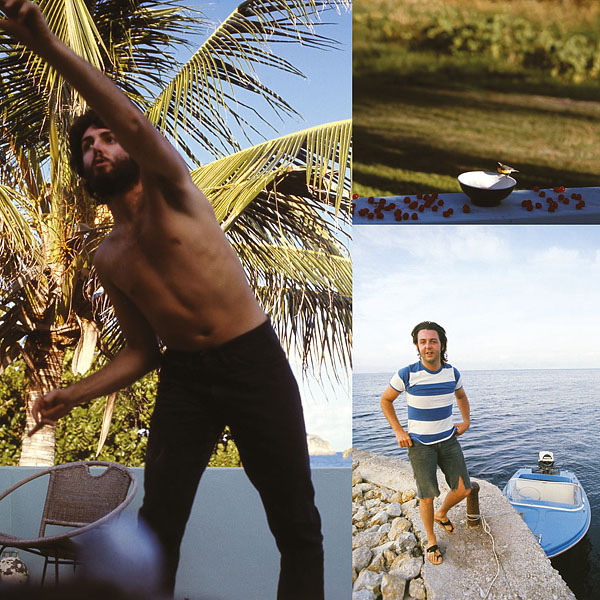
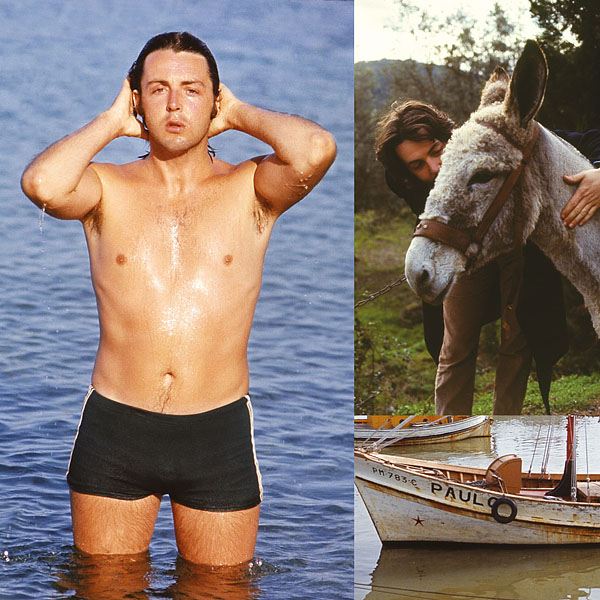
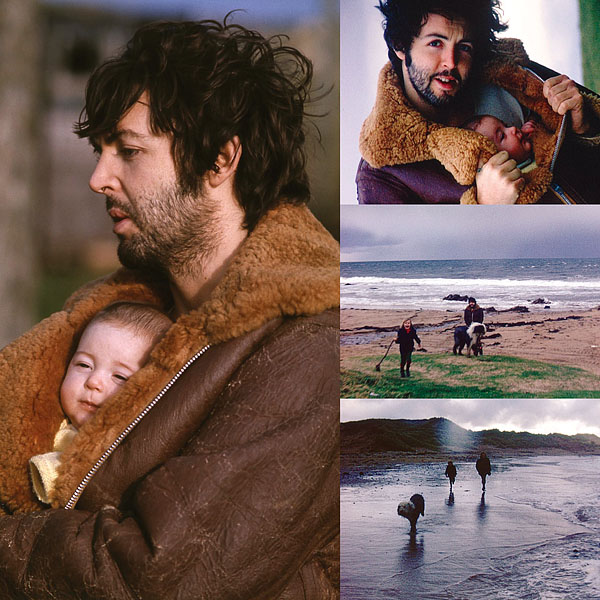
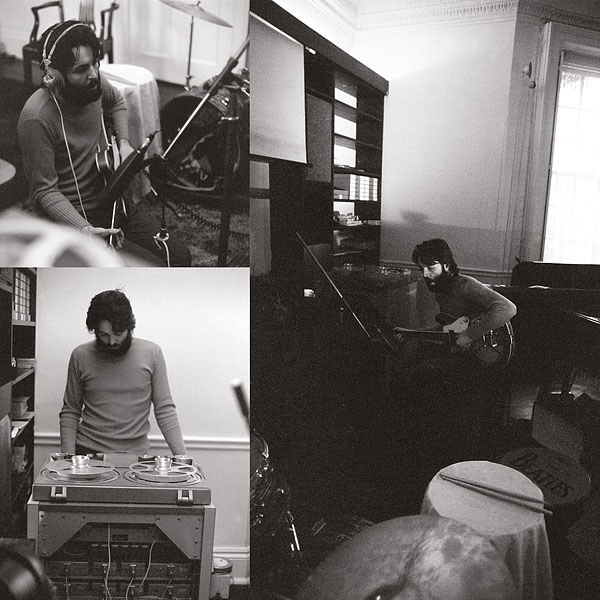
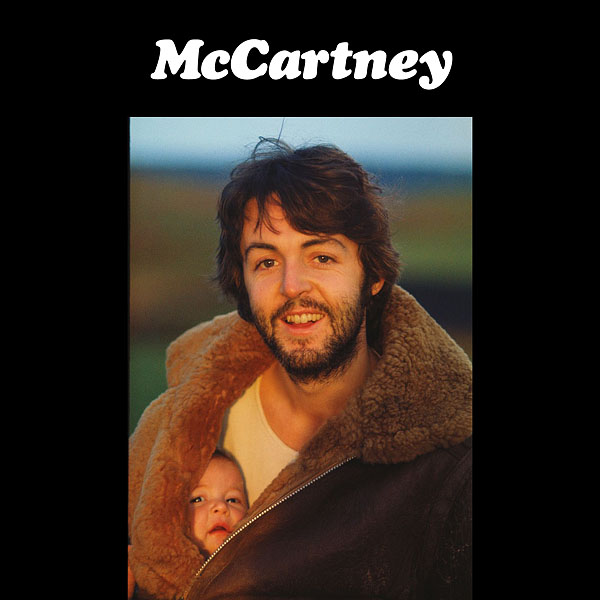
Album This song officially appears on the McCartney - Archive Collection Official album.
Timeline This song was officially released in 2011
Timeline This song was written, or began to be written, in 1956, when Paul McCartney was 14 years old)
This song was recorded during the following studio sessions:

Apr 09, 1970 • From Apple Records
Question-time with Paul conducted by Paul!
Apr 18, 1970 • From New Musical Express (NME)
Officially appears on McCartney
“Suicide” is one of the earliest songs written by Paul McCartney. Likely composed in 1956, when Paul was just fourteen, it was written in a cabaret style. As an aspiring songwriter, he imagined he was writing it for Frank Sinatra.
I wrote it in bed at that moment when you’re just dropping off and all these things are coming to you, but you ought to go to sleep. I used to keep pencil and paper by my bed, and I’ve got the ability to write in the dark, though some of the lines cross each other. I wrote this song called ‘Suicide’ which was very cabaret, ‘If when she tries to run away and he calls her back she comes … it’s okay, because she’s under both his thumbs …’ all that kind of shit. Very Sinatra, I thought. ‘She’ll limp along to his side … I call it suicide!’ It was murder! Horrible song! But you had to go through all those styles to discover your own. I only had one verse, so I cobbled together another.
Paul McCartney – From “Paul McCartney: Many Years from Now” by Barry Miles, 1997
On January 26, 1969, during the “Get Back” sessions, Paul performed a brief 46-second rendition of “Suicide,” consisting of a single verse.
Although the song disappears from the radar after Lennon and McCartney met, it popped up with several other oldies during the Get Back sessions, on January 26, 1969. Here we find audio of the song, with McCartney plonking through the track on piano, and Lennon joining in – obviously recognising it (thereby proving that it had been shown to him after the two teamed up). Interestingly there is a full lyric in place, which might have been written at the song’s genesis – it is impossible to be sure. (If it was, “Suicide” was an unusually sombre choice of title for an optimistic 14-year-old, let alone as a potential Sinatra hit.)
From earlybeatlessongs
Paul McCartney revisited “Suicide” in late 1969, during the recording sessions for his debut solo album, “McCartney“. But only a 9-second fragment of the song was released at the end of the experimental track “Glasses.”
That was a song I’d had forever, since I was about 16. I had my Dad’s old piano at home, that I used to tinker about on when there was no-one in the house. And my feelings were, then, that if you were ever going to be a songwriter, the height of it all was Sinatra. That would be the greatest stuff that you could do, really a little bit before rock ‘n’ roll, so you were thinking of standards and things. So around that time I wrote “When I’m 64” and this other thing. I thought it would be a bit of a Rat Pack, smoochy, with words like “When she tries to, run away, uh-huh…” Boom! And stabs from the band, you know. […]
So I never did anything with it but around the time of McCartney, I was just goofing around on piano and at the end of one of the takes there was a little bit of tape left, so I just did it and didn’t think to use it because it was Rat Pack, tongue in cheek. But I used that little fragment at the end of one of the tracks, ‘Glasses’.
Paul McCartney – From “McCartney – Archive Collection“, 2011
Paul returned to “Suicide” numerous times throughout his career.
In 1974, he recorded a home demo that appeared on the so-called “Piano Tape.” That same year, in August, he recorded it again during the sessions for the film “One Hand Clapping,” and the song briefly appears in the final cut.
In April 1976, Paul performed an a cappella version of the song during an interview with Alan Freeman.
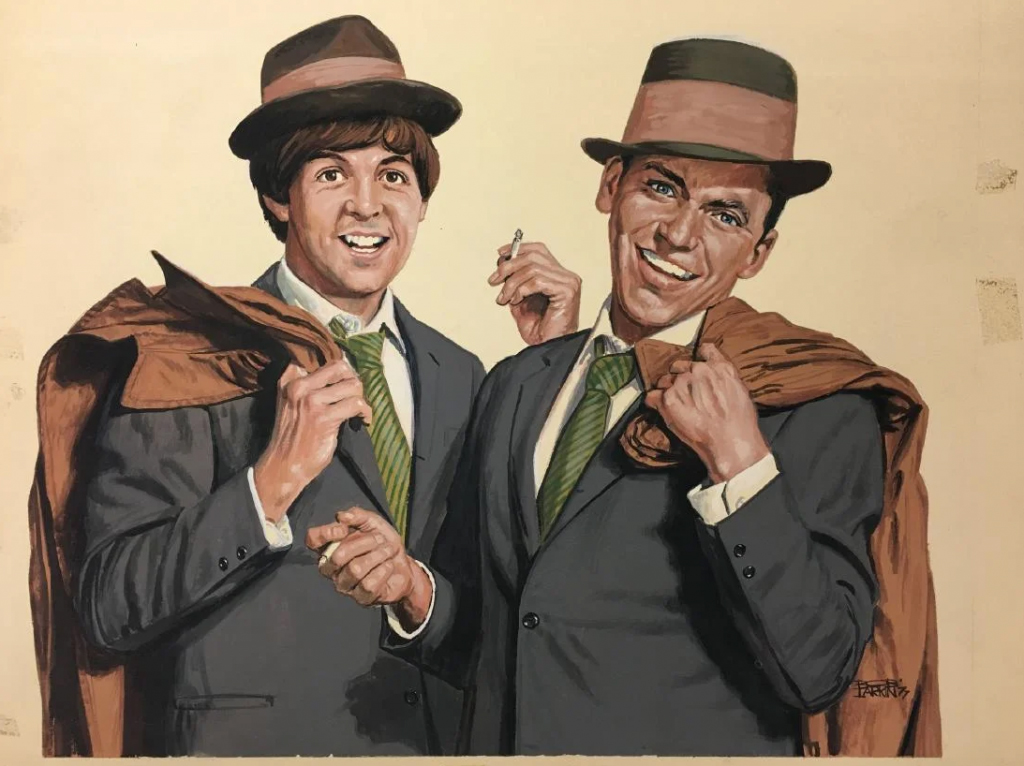
Seeing Frank Sinatra live at the Royal Albert Hall in March 1977 reignited Paul’s interest in the song, which until then existed only as a single-verse sketch. He completed the song by adding a second verse, recorded a formal demo on March 8, 1977, and arranged for it to be sent to Sinatra — who, at an earlier point, had expressed interest in receiving a song from him. To accompany the tape, Paul commissioned Marvel illustrator Bob Larkin to create a watercolor painting as a personal touch.
However, Sinatra did not take the gesture as intended. Believing “Suicide” to be a joke rather than a genuine offering, he was reportedly offended and declined to record it.
The funny thing was, years and years later, he rang me at Abbey Road studio, and it was a great moment when one of the engineers said, “Paul, Sinatra’s on the phone.’ And I was able to go, “Oh. I’ll be there in a minute,’ touch a fader and then go off. And everyone would go, ‘Oooooo! Sinatra’s on the phone!’ How many people have that? He was asking for a song, so I found the song, made a demo and sent it to him. Apparently he thought it was an almighty piss-take. ‘No way!’ he’s supposed to have said to one of his people. ‘Is this guy having me on?’ So my career with Sinatra ended in terrible ignominy. I think he couldn’t grasp it was tongue in cheek. It was only supposed to be a play on the word ‘suicide’, not actual physical suicide. If a girl lets a guy trample all over her, she’s committing some sort of suicide. I think he sent the demo back. Looking back on it ’m quite relieved he did, actually, it wasn’t a good song, it was just a teenage thought.
Paul McCartney – From “Paul McCartney: Many Years from Now” by Barry Miles, 1997
It was a real early song of mine, and I used to do it as a joke, really. […] I actually once got a request from Sinatra, for a song. And I spoke to him on the phone and told him about it, “Great, Paul, send it along.” “Thank you, Frank”. And I sent it him and he thought I was taking the piss. “Is this guy kidding?” You know, sending Sinatra a song called “Suicide”. He did not get it! But I did think, “Oh God, maybe I should have changed it a bit to send it to him.”
Paul McCartney – From “McCartney – Archive Collection“, 2011
Around 1979 or 1980, “Suicide” was considered for inclusion on the never-completed “Cold Cuts” project.
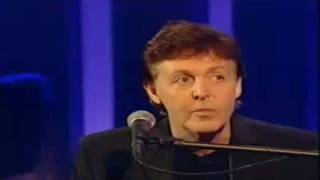
In 1984, Paul spoke about the song and its connection to Sinatra during an appearance on the television programme “Aspel & Company.” In 1999, he gave a brief performance of it during his appearance on the TV show “Parkinson.”
Over the years, the song was copyrighted multiple times under different titles — “Suicide,” “Call It Suicide,” and “I Call It Suicide.” It was finally officially released in 2011, when the 1969/1970 version was included in the “McCartney – Archive Collection“.
Singing a song of ruin, I'd
Bet he says nothin' doin'
I'd call it suicide
If when she tries to run away
And he calls her back, she comes
If there's a next time, well, he's okay
Cause she's under both his thumbs
She limp along to his side
Singing a song of ruin, I'd
Now I guess he says nothin' doin'
I'd call it, call it, I'd call it suicide
If when she tries to run away
And he calls her back, she comes
If there's a next time, he's okay
Cause she's under both his thumbs
She limp along to his side
Singing a song of ruin, I'd
Bet he says nothin' doin'
I'd call it suicide
If when she tries to run away
And he calls her back, she comes
If there's a next time, he's okay
Cause she's under both his thumbs
She limp along to his side
Singing a song of ruin, I'd
Bet he says nothin' doin'
I'd call it suicide
Ruin, I'd, ruin, I'd
Suicide, suicide
LP • Released in 1970
0:09 • Studio version • A • Stereo • Medley with "Glasses", "Hot As Sun"
Paul McCartney : Piano, Producer Phil McDonald : Mixing engineer
SessionRecording : Dec 23-30, 1969 • Studio : At home, Cavendish Avenue, St. John's Wood, UK
SessionMixing : Feb 21, 1970 • Studio : EMI Studios, Abbey Road Studios • London • UK

McCartney (by DCC Compact Classics)
CD • Released in 1992
0:09 • Studio version • A1992 • Stereo • Medley with "Glasses", "Hot As Sun" - 1992 remaster
Paul McCartney : Piano, Producer Phil McDonald : Mixing engineer Steve Hoffman : Remastering
SessionRecording : Dec 23-30, 1969 • Studio : At home, Cavendish Avenue, St. John's Wood, UK
SessionMixing : Feb 21, 1970 • Studio : EMI Studios, Abbey Road Studios • London • UK

CD • Released in 1993
0:09 • Studio version • A1993 • Stereo • Medley with "Glasses", "Hot As Sun" - 1993 remaster
Paul McCartney : Piano, Producer Phil McDonald : Mixing engineer Peter Mew : Remastering
SessionRecording : Dec 23-30, 1969 • Studio : At home, Cavendish Avenue, St. John's Wood, UK
SessionMixing : Feb 21, 1970 • Studio : EMI Studios, Abbey Road Studios • London • UK

McCartney - Archive Collection
Official album • Released in 2011
2:50 • Studio version • B • Stereo • Full version recorded in 1969
Paul McCartney : Mixing engineer, Piano, Producer, Vocals
SessionRecording : Dec 23-30, 1969 • Studio : At home, Cavendish Avenue, St. John's Wood, UK
SessionMixing : May 03, 2010 • Studio : Hog Hill Studio, Rye, UK
McCartney - Archive Collection
Official album • Released in 2011
0:09 • Studio version • A2011 • Stereo • Medley with "Glasses", "Hot As Sun" - 2011 remaster
Paul McCartney : Piano, Producer Phil McDonald : Mixing engineer Guy Massey : Remastering Steve Rooke : Remastering Simon Gibson : Remastering
SessionRecording : Dec 23-30, 1969 • Studio : At home, Cavendish Avenue, St. John's Wood, UK
SessionMixing : Feb 21, 1970 • Studio : EMI Studios, Abbey Road Studios • London • UK

LP • Released in 2017
0:09 • Studio version • A2011 • Stereo • Medley with "Glasses", "Hot As Sun"
Paul McCartney : Piano, Producer Phil McDonald : Mixing engineer Guy Massey : Remastering Steve Rooke : Remastering Simon Gibson : Remastering
SessionRecording : Dec 23-30, 1969 • Studio : At home, Cavendish Avenue, St. John's Wood, UK
SessionMixing : Feb 21, 1970 • Studio : EMI Studios, Abbey Road Studios • London • UK

LP • Released in 2020
0:09 • Studio version • A2020 • Stereo • Medley with "Glasses", "Hot As Sun" - 2020 half-speed mastering
Paul McCartney : Piano, Producer Phil McDonald : Mixing engineer Miles Showell : Mastering
SessionRecording : Dec 23-30, 1969 • Studio : At home, Cavendish Avenue, St. John's Wood, UK
SessionMixing : Feb 21, 1970 • Studio : EMI Studios, Abbey Road Studios • London • UK

McCartney I II III Limited Edition Colour 3LP Box Set
LP • Released in 2022
0:09 • Studio version • A2011 • Stereo • Medley with "Glasses", "Hot As Sun"
Paul McCartney : Piano, Producer Phil McDonald : Mixing engineer Guy Massey : Remastering Steve Rooke : Remastering Simon Gibson : Remastering
SessionRecording : Dec 23-30, 1969 • Studio : At home, Cavendish Avenue, St. John's Wood, UK
SessionMixing : Feb 21, 1970 • Studio : EMI Studios, Abbey Road Studios • London • UK

Official album • Released in 2022
0:09 • Studio version • A2011 • Stereo • Medley with "Glasses", "Hot As Sun"
Paul McCartney : Piano, Producer Phil McDonald : Mixing engineer Guy Massey : Remastering Steve Rooke : Remastering Simon Gibson : Remastering
SessionRecording : Dec 23-30, 1969 • Studio : At home, Cavendish Avenue, St. John's Wood, UK
SessionMixing : Feb 21, 1970 • Studio : EMI Studios, Abbey Road Studios • London • UK

McCartney (Japanese SHM-CD, 2024)
CD • Released in 2024
0:09 • Studio version • A2011 • Stereo • Medley with "Glasses", "Hot As Sun"
Paul McCartney : Piano, Producer Phil McDonald : Mixing engineer Guy Massey : Remastering Steve Rooke : Remastering Simon Gibson : Remastering
SessionRecording : Dec 23-30, 1969 • Studio : At home, Cavendish Avenue, St. John's Wood, UK
SessionMixing : Feb 21, 1970 • Studio : EMI Studios, Abbey Road Studios • London • UK

A/B Road Complete Get Back Sessions - Jan 26th, 1969 - 1 & 2
Bootleg • Released in 2004
0:47 • Rehearsal • Jan.26 - D2-12 - Suicide 26.28
SessionRecording : Jan 26, 1969 • Studio : Apple Studios, 3 Savile Row, London

Bootleg • Released in 2014
2:50 • Studio version • Stereo • Complete version of "Hot As Sun / Glasses / Suicide" medley
Paul McCartney : Mixing engineer, Piano, Producer, Vocals
SessionRecording : Dec 23-30, 1969 • Studio : At home, Cavendish Avenue, St. John's Wood, UK
SessionMixing : May 03, 2010 • Studio : Hog Hill Studio, Rye, UK

Bootleg
0:47 • Rehearsal • 1/26/69
SessionRecording : Jan 26, 1969 • Studio : Apple Studios, 3 Savile Row, London

“Suicide” has been played in 1 concerts and 1 soundchecks.

Dec 03, 1999 • UK • London • BBC Television Centre • TV show
Paul McCartney: Music Is Ideas. The Stories Behind the Songs (Vol. 2) 1990-2012
This new book by Luca Perasi traces Paul McCartney's post-Beatles output from 1990 to 2012 in the form of 250 song entries, filled with details about the recordings, stories behind the sessions and musical analysis. His pop albums, his forays into classical and avant-garde music, his penchant for covering old standards: a complete book to discover how these languages cross-pollinate and influence each other.The second volume in a series that has established itself as a unique guide to take the reader on a journey into the astonishing creativity of Paul McCartney.Read our exclusive interview with Luca Perasi

Notice any inaccuracies on this page? Have additional insights or ideas for new content? Or just want to share your thoughts? We value your feedback! Please use the form below to get in touch with us.

oldtownukesrick • May 24, 2020 • 6 years ago
Would have suited the white album

Sergio • Jun 22, 2020 • 6 years ago
Qué enorme disco podría ser trabajar las viejas canciones inéditas de la época beatle, finalizarlas con el toque de Paul y editarlas. Sería un éxito enorme hasta incluso como disco de The Beatles.