
Thursday, April 9, 1970
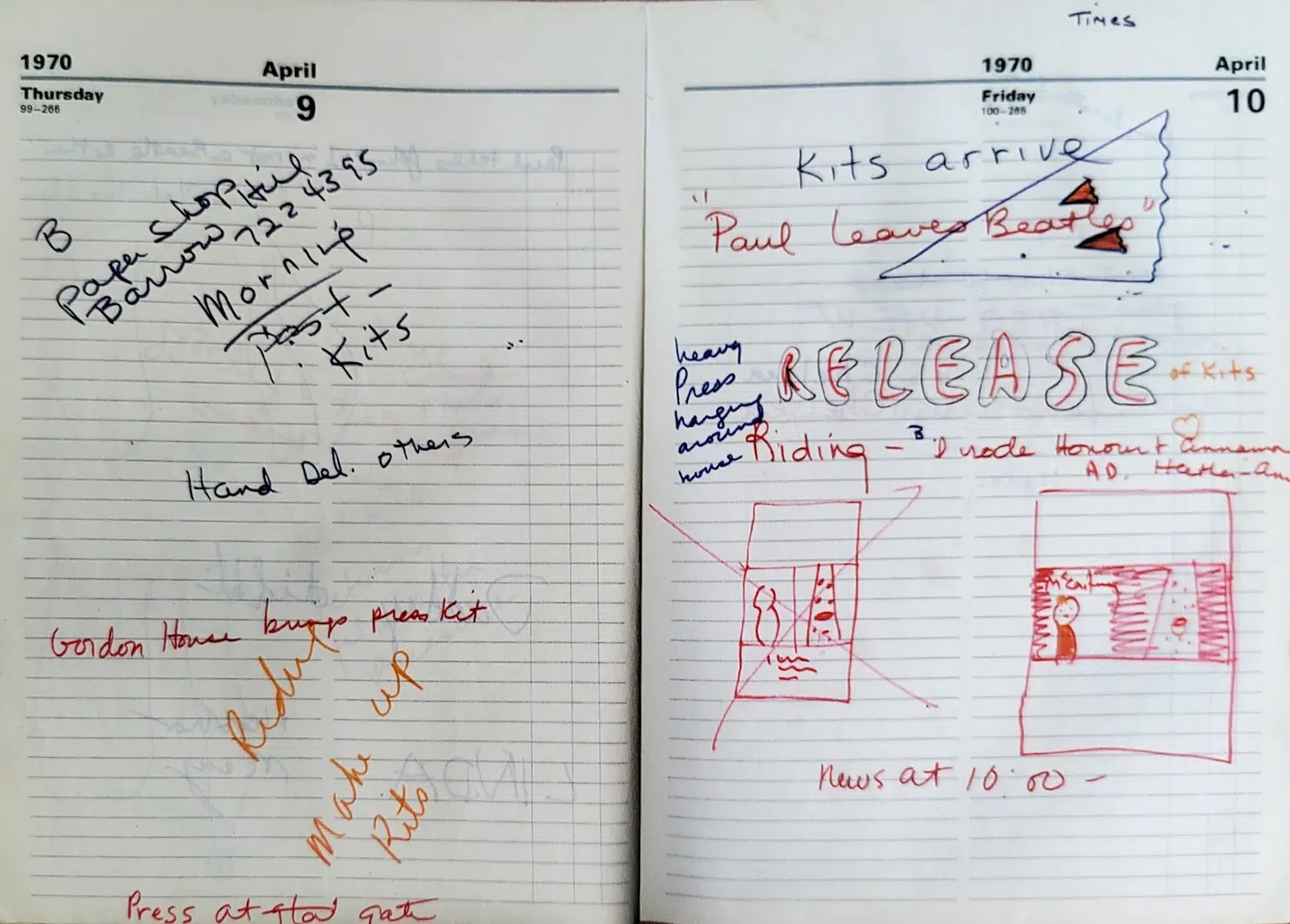
The “McCartney” press kit is sent to UK press
Last updated on August 20, 2025
Thursday, April 9, 1970
Last updated on August 20, 2025
Session Apr 02, 1970 • Mixing "Let It Be" album #6
Article Apr 07, 1970 • McCartney Productions Ltd. acquires the film rights for Rupert the Bear
Article Apr 09, 1970 • The "McCartney" press kit is sent to UK press
Interview Apr 09, 1970 • Paul McCartney interview for Apple Records
Article April 10 - End of April 1970 • Dispute over the release of "Let It Be"

Dispute over the release of “Let It Be”
April 10 - End of April 1970

Lee Eastman asks for The Beatles to be dissolved
Jun 15, 1970
John Eastman visits Paul and Linda in Scotland
July 11-20, 1970
In March 1970, tensions arose between Paul McCartney and the other Beatles over the release date of Paul’s first solo album, “McCartney“. The dispute was settled on April 2, when Ringo Starr phoned Paul to confirm that Apple had agreed to release the album on April 17.
Five days later, John Eastman — Paul’s lawyer and brother-in-law — issued a press statement in the United States announcing the imminent release of “McCartney.” The statement also revealed that McCartney Productions Ltd. (established in August 1969 to manage Paul’s business affairs) had acquired the film rights to the cartoon character Rupert the Bear. It further noted that “the private ventures will keep McCartney from directly working with the remainder of the Beatle quartet indefinitely,” prompting many US newspapers to report the end of The Beatles in their April 7 and April 8 editions.
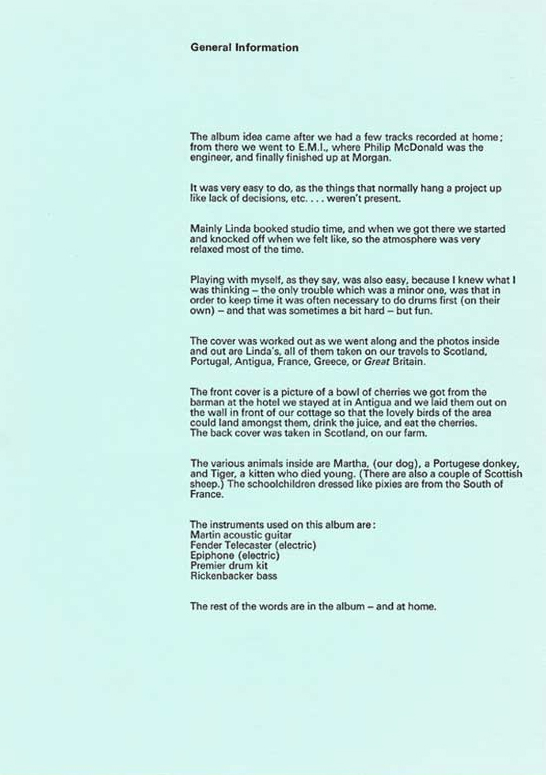
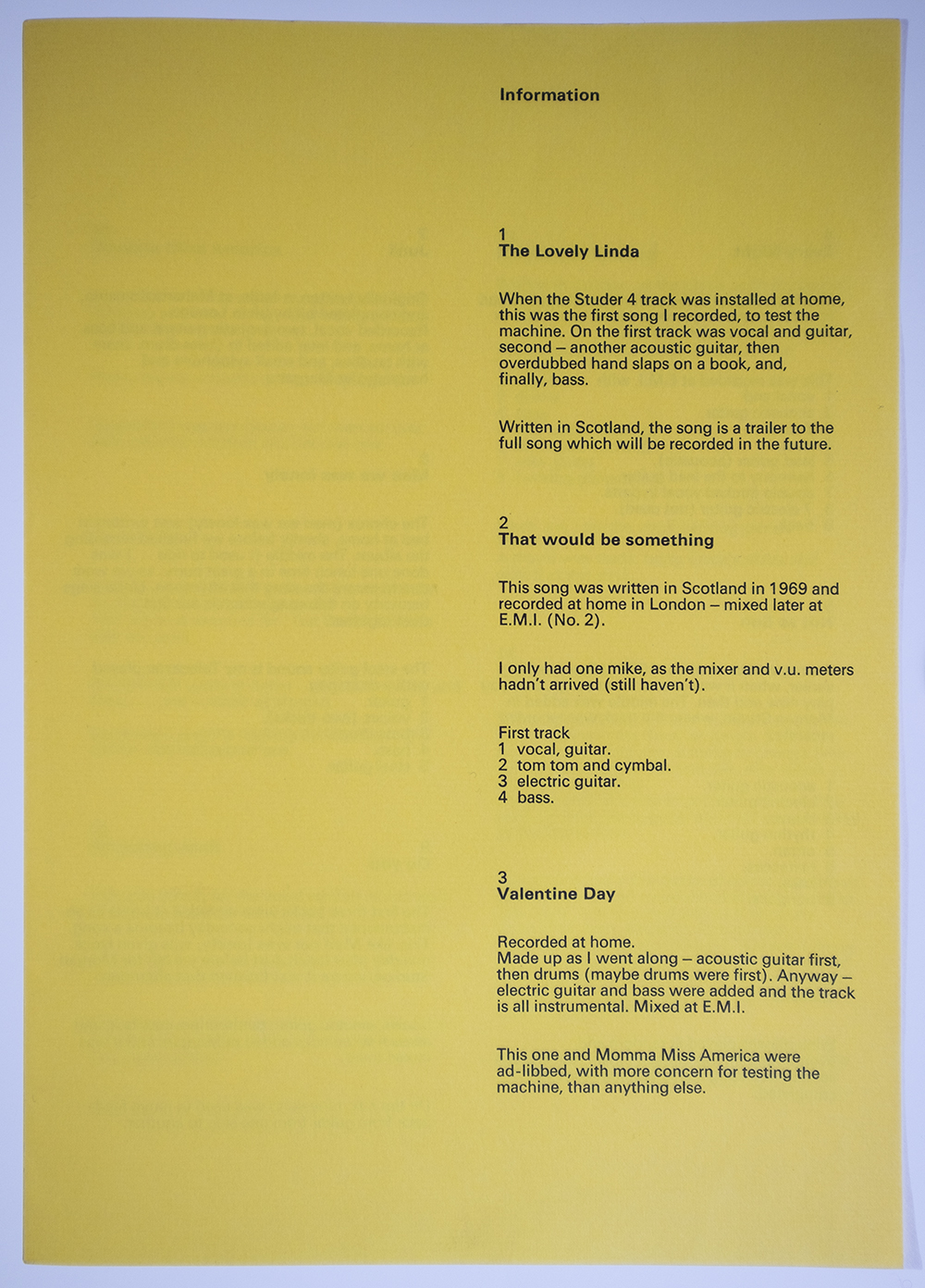
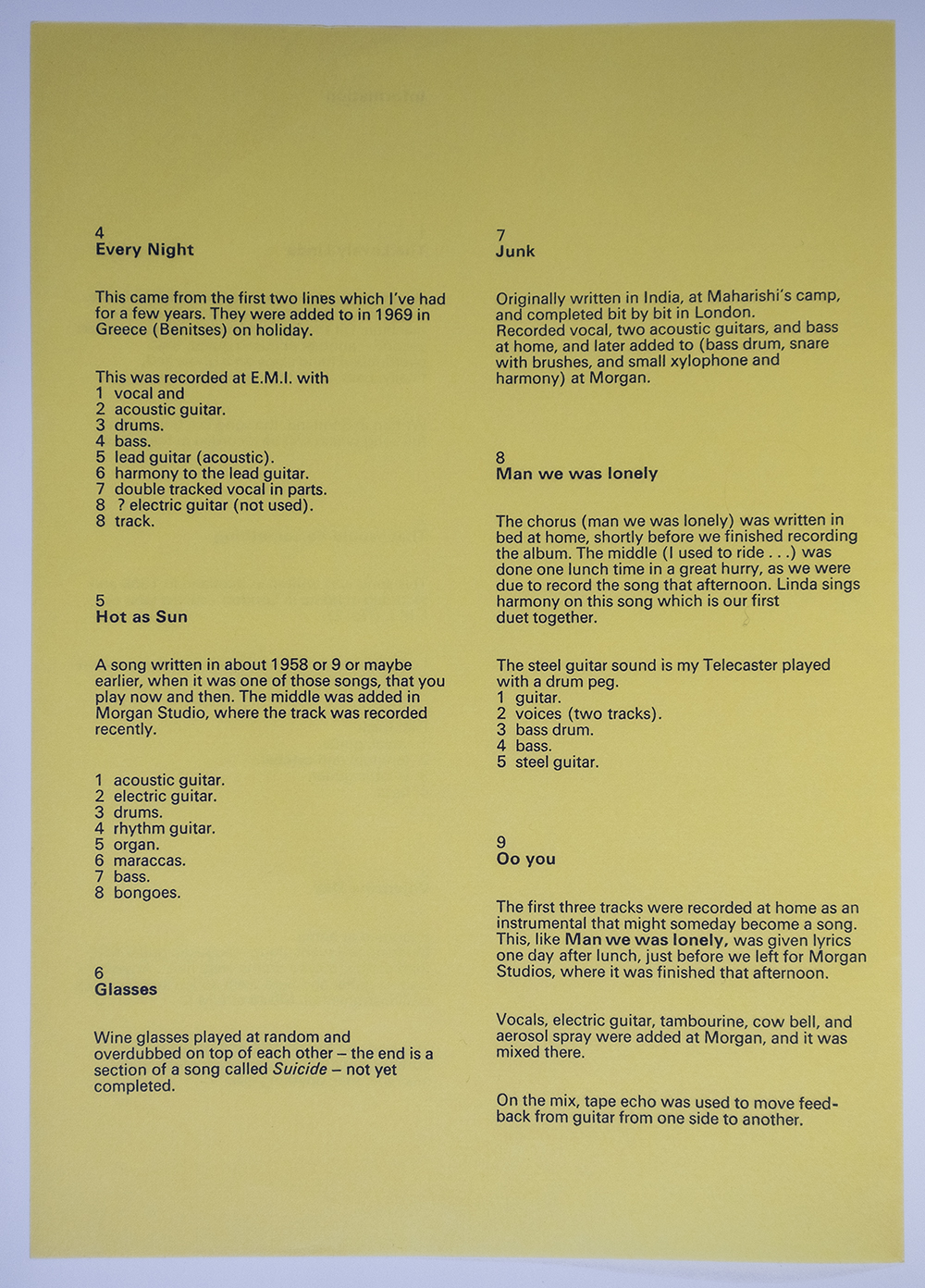
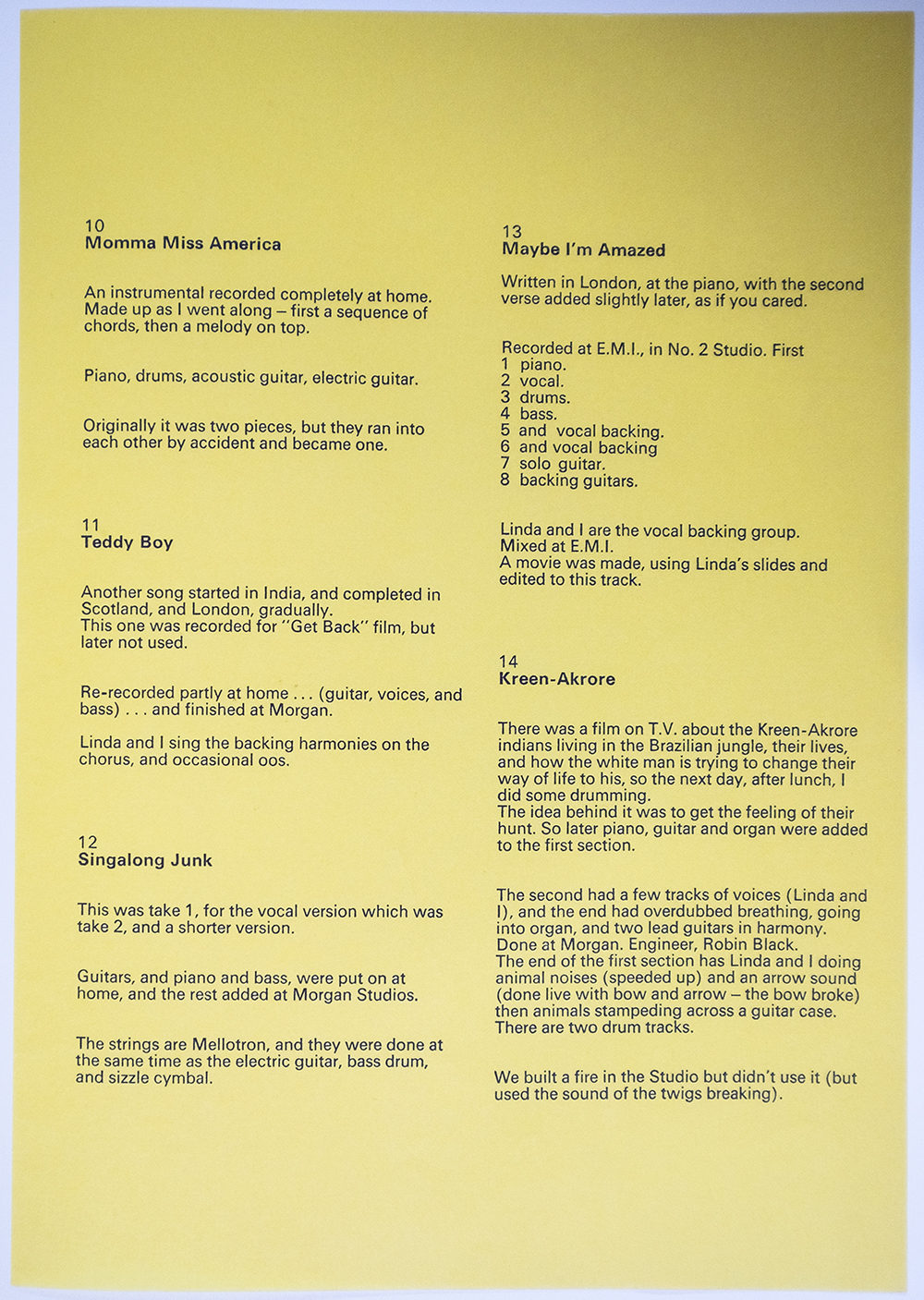
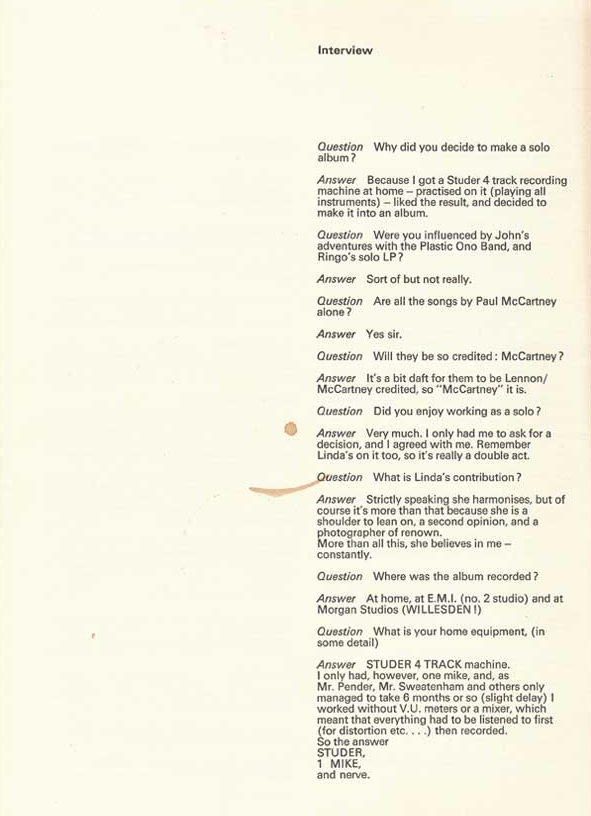
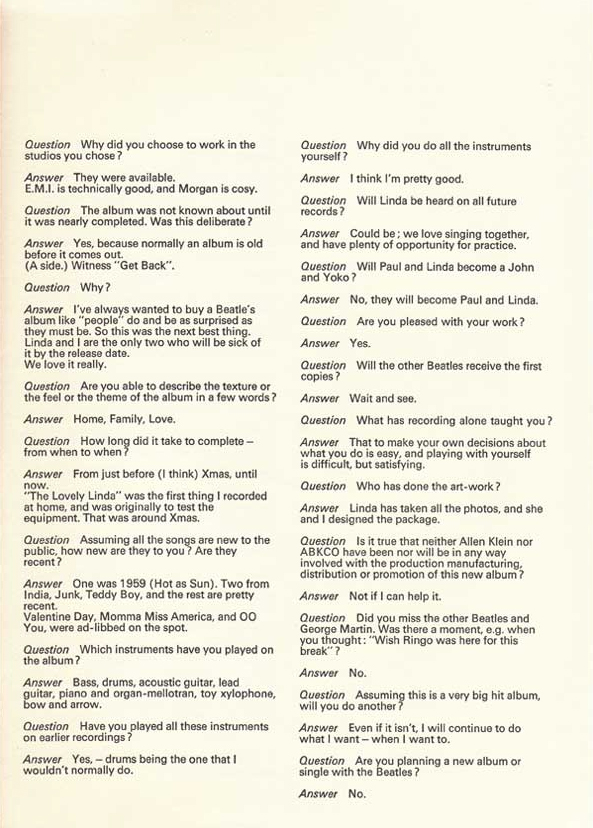
On this day, April 9, advanced copies of “McCartney“ were sent to the UK press, accompanied by a press kit. As Paul was reluctant to hold a press conference or take part in a wide range of interviews, Apple’s Peter Brown had suggested preparing a written Questions & Answers sheet to included in the kit. Paul approved the idea, with Brown drafting the questions and Paul providing brief, dry responses.
When Paul had told Life Magazine in November 1969 that “The Beatle thing is over“, the remark went largely unnoticed. By contrast, the Q&A circulated with the press kit was widely interpreted as the official announcement of The Beatles’ split. Later that same day, Apple Records felt obliged to issue a statement denying that the group was breaking up.
Are you planning a new album or single with the Beatles?
No.
Is this album a rest away from the Beatles or the start of a solo career?
Time will tell. Being a solo album means it’s the start of a solo career… and not being done with the Beatles means it’s a rest. So it’s both.
Is your break from the Beatles temporary or permanent, due to personal difference or musical ones?
Personal differences, business differences, musical differences, but most of all because I have a better time with my family. Temporary or permanent? I don’t know.
Do you see a time when Lennon-McCartney becomes an active songwriting partnership again?
No.
From “McCartney” press release Q&A
This is just not true. Although it is true that there are no plans at the moment for more Beatles recordings, this is quite normal. Next month, their new LP [Let It Be] will be issued. It has already been recorded so, consequently, as there is already material available, there are no plans for more recordings. I hope that The Beatles will get together for another recording session after the summer.
[Paul] communicates by telephone and, as he has got recording studios at his home, it is not necessary for him to come in. Paul will issue a statement today with the release of his new album, but any critical statements do not mean a real break-up of the group!
Mavis Smith – Assistant to Derek Taylor, head of PR
In the afternoon, Paul phoned John Lennon to inform him that the press kit had been issued and that it was likely to make headlines the following day.
He was also interviewed by Jann Wenner, founder of Rolling Stone magazine, for an interview to be published on April 30. This was one of only two interviews Paul gave to promote the new album, the other being with Ray Connolly for the Evening Standard.
Last, he let Apple know that he wouldn’t join the Apple Films board meeting scheduled the following day.
I received a phone call from Paul on Thursday afternoon. He said, ‘I’m going to leave The Beatles as well.’ I was happy to hear from Paul. It was nice to find that he was still alive! Anyway, Paul hasn’t left… I sacked him.
John Lennon – From “The Beatles: Off the Record” by Keith Badman, 2008
He called me in the afternoon of that day and said, ‘I’m doing what you and Yoko was doing last year. I’m putting out an album and I’m leaving the group, too,’ and I said, ‘Good!’ I was feeling a little strange because he was saying it this time, although it was a year later, and I said, ‘Good,’ because he was the one that wanted The Beatles most, and then the midnight papers came out …
John Lennon – From “The Beatles: Off the Record” by Keith Badman, 2008
I told John on the phone the other day that at the beginning of last year I was annoyed with him. I was jealous because of Yoko, and afraid about the break-up of a great musical partnership. It’s taken me a year to realise that they were in love. Just like Linda and me.
Paul McCartney – Interview with the Evening Standard, April 21-22, 1970
At the end of the day in London, the April 10, 1970, edition of The Daily Mirror began to appear on newsstands, carrying the front-page headline: “Paul is quitting The Beatles.” Journalist Ray Connolly of the Evening Standard later recalled:
I received [one press kit] at the Evening Standard, but the story was embargoed until the next day, so I didn’t print anything. But Don Short at the Daily Mirror did.
Ray Connolly – From “You Never Give Me Your Money: The Beatles After the Breakup,” by Peter Doggett, 2010
Inside the album package was an interview Paul had done with himself, making up the questions as well as the answers. It was self-serving, vain, and painted him in the poorest light. But it telegraphed one irrefutable message: the Beatles were dead.
Peter Brown – From “The Love You Make“, 2002
After the Beatles split, nobody said anything. Then you put up this question/answer thing in the sleeve of McCartney LP. Why?
Now, see, that’s one thing that really got misunderstood. I had talked to Peter Brown from Apple and asked him what we were going to do about press on the album. I said, ‘I really don’t feel like doing it, to tell you the truth,’ but he told me that we needed to have something. He said, ‘I’ll give you some questions and you just write out your answers. We’ll put it out as a press release.’ Well of course, the way it came out looked like it was specially engineered by me. I was digging at John really. There was no other way I could say it because the question was: ‘What do you think of John and Yoko’s music?’ and I said, ‘Well, it doesn’t bring me alot of pleasure.’ It was political, depending on how I said it. I was trying to say something without really saying, ‘I hate them!’ I was trying to say, ‘Well, they are not too cool. As you can see I am a little cool on this.’ I was just trying to hate John… a bit. All this was included in the albums we gave to the press, but the word got ’round that I put this interview in the real albums, which I didn’t. But it got around that I put out this really cutting statement. Looking back on it now, and not being in the mood I was in in that period, going through all sorts of changes, I can see how it looked to ordinary people who didn’t have the problems I was facing. As I say, I just feel that I have a kind of knack for doing crazy things like that. It’s an unfortunate thing in my character. You know, your character kind of sharpens up when it becomes your image. Now for me, this is a very strange game really, to meet the press, deal with the media. You know, I’m not a publicist, but being in the group for all that long time, you learn a way of dealing with it. You become a media person on the other side of the media. Before I used to spend literally as much time as you do doing interviews. So you become that kind of person. The rest of the group really hated it with a passion.
Paul McCartney – From interview with Music Express, 1982
[About the “McCartney” Q&A] At the time it just seemed to me that it was answers to questions, and I was being bitchy. That’s for sure. I’ll admit that because we were all being bitchy. And that was my, sort of, weedy way of being bitchy. One of the questions is: What do you think of John and Yoko’s thing? And I said, ‘Well, it doesn’t impress me very much.’ And leave it at that. And it came off very weird.
Paul McCartney – From interview with The Times, December 1971 – Quoted in “The McCartney Legacy: Volume 1: 1969 – 73” by Allan Kozinn and Adrian Sinclair, 2022
We were actually enjoying ourselves like children, Linda and I, actually enjoying life for the first time in a while. And I had put the killer scoop in there, and then I just sent this out to the press. Only the press got the ones with the questionnaire in. I think some of the press thought this was how I was releasing the album, with this questionnaire in it, so a few people said, “This is outrageous!’ and John, I think, was very hurt.
I personally think he was hurt because he wanted to tell. I don’t think it was anything more than that, I think it was just straightforward jealousy. He wanted to be the one, because he’d been the one to break up the Beatles and he hadn’t had the nerve to follow it through because Klein had told him, ‘Don’t tell anyone. Keep this thing rolling as long as we can.’ But we’d not seen each other for three or four months and I had been ringing, calling George and Ringo and asking ‘Do you think we’ll get back together?’ ‘Well, I don’t know, what about John?’ and I’d ring John. ‘Oh no! Fucking hell!’ So it was obviously not on. So I let the news out. So I was not loved for that by the other guys and that started a war between us.
Paul McCartney – From “Paul McCartney: Many Years from Now” by Barry Miles, 1997
For business reasons, we had agreed to keep quiet about the Beatles’ split, but after a while, I was going crazy with the hurt and the disappointment of it all, the sorrow of losing this great band, these great friends. I thought it was unfair not telling people, so I broke the news in a press release for the McCartney album. Not being in the greatest frame of mind, I was dreading the press asking me, ‘Are the Beatles happy?’ I didn’t want to lie through my teeth. So I announced in a press release that the Beatles had broken up. In actual fact, the breakup had happened months before, and it was John who did it. But it doesn’t matter who broke the Beatles up – the Beatles were ready to breakup. We’d come full circle and now we had to get on to something new, all of us.
Paul McCartney – From “Wingspan: Paul McCartney’s Band on the Run“, 2002
I issued the album and did this press release, which virtually had the announcement. I finally blew the whistle. And John was annoyed. He told me later that he wanted to be the one who announced it. But I felt that three or four months was enough to wait around. Either we were going to fuck about for another year, or we had to actually say to people, ‘You know what? About three or four months ago we actually broke up. I haven’t worked with them or spoken to them since then’
Paul McCartney – From “Conversations with McCartney” by Paul du Noyer, 2016
I’ll tell you what happened, from my recollection. Peter Brown said you’re putting a record out, so you’ll need to do publicity. There was no way I could sit around and do a press conference. But I recognised the need for some publicity. […] when the question came up in the questionnaire, I said, ‘No, we’re not re-forming.” Or whatever. I dropped the truth into that interview.
The idea came up. Just slip it in the press releases. You don’t need to do a publicity thing; all the people in the press would get free copies, as they always did and still do. So it was a press release. But it looked like it was part of the album. I don’t think people got it in the shops, to my recollection. It was just the press copies, and I thought, well, that’ll do it. If the Evening Standard wants to know what’s going on, there’s my press release.
So that was that. But the perception of it looked cold and calculating. ‘He’s just stuck this in. What is the guy on? And he’s suing the Beatles! What a bastard’ I caught it in the neck for that. I had to ride that wave of antagonism, knowing what I had done was right. And that in a way, I was just answering the questions that this guy had set me, like an exam.
Paul McCartney – 2010 interview – From “Conversations with McCartney” by Paul du Noyer, 2016
When people say I let it out, it was actually months after we had broken up. No one was saying anything and I was putting out this crazy press release with the McCartney album because Peter Brown said to me, ‘We need some press on this. You’d better do something,’ and I didn’t want to be interviewed. I didn’t feel secure enough to do that. So I said, ‘Okay, we’ll do a question and answer thing.’ So I said to Peter, ‘Write me out a questionnaire of what you think they’d ask me.’ He wrote it all out and I just filled it all in, like a questionnaire, and it all came out weird.
Paul McCartney – From “The Beatles: Off the Record” by Keith Badman, 2008


The McCartney Legacy: Volume 1: 1969 – 73

In this first of a groundbreaking multivolume set, THE MCCARTNEY LEGACY, VOL 1: 1969-73 captures the life of Paul McCartney in the years immediately following the dissolution of the Beatles, a period in which McCartney recreated himself as both a man and a musician. Informed by hundreds of interviews, extensive ground up research, and thousands of never-before-seen documents THE MCCARTNEY LEGACY, VOL 1 is an in depth, revealing exploration of McCartney’s creative and personal lives beyond the Beatles.
The Beatles Diary Volume 1: The Beatles Years
With greatly expanded text, this is the most revealing and frank personal 30-year chronicle of the group ever written. Insider Barry Miles covers the Beatles story from childhood to the break-up of the group.
The Beatles Diary Volume 2: After The Break-Up 1970-2001
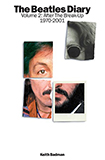
An updated edition of the best-seller. The story of what happened to the band members, their families and friends after the 1970 break-up is brought right up to date. A fascinating and meticulous piece of Beatles scholarship.
Maccazine - Volume 40, Issue 3 - RAM Part 1 - Timeline

This very special RAM special is the first in a series. This is a Timeline for 1970 – 1971 when McCartney started writing and planning RAM in the summer of 1970 and ending with the release of the first Wings album WILD LIFE in December 1971. [...] One thing I noted when exploring the material inside the deluxe RAM remaster is that the book contains many mistakes. A couple of dates are completely inaccurate and the story is far from complete. For this reason, I started to compile a Timeline for the 1970/1971 period filling the gaps and correcting the mistakes. The result is this Maccazine special. As the Timeline was way too long for one special, we decided to do a double issue (issue 3, 2012 and issue 1, 2013).
If we modestly consider the Paul McCartney Project to be the premier online resource for all things Paul McCartney, it is undeniable that The Beatles Bible stands as the definitive online site dedicated to the Beatles. While there is some overlap in content between the two sites, they differ significantly in their approach.

Notice any inaccuracies on this page? Have additional insights or ideas for new content? Or just want to share your thoughts? We value your feedback! Please use the form below to get in touch with us.


