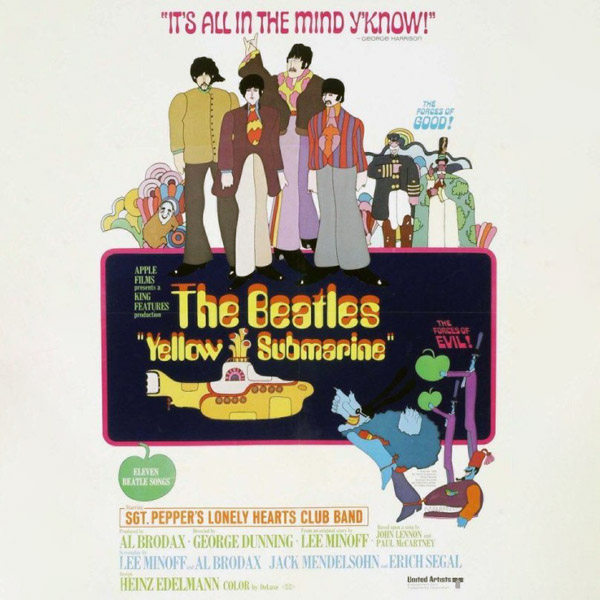
Release date : Jul 17, 1968
Yellow Submarine (Animated film)
Animated film • For The Beatles • Directed by George Dunning
Last updated on August 31, 2025
Release date : Jul 17, 1968
Animated film • For The Beatles • Directed by George Dunning
Last updated on August 31, 2025

“Yellow Submarine” animated film announced
Jun 07, 1967
“Yellow Submarine” world premiere
Jul 17, 1968
“Yellow Submarine” general release in the UK
Aug 04, 1968
“Yellow Submarine” premieres in the US
Nov 13, 1968

“Yellow Submarine” movie reissued
Jun 05, 2012


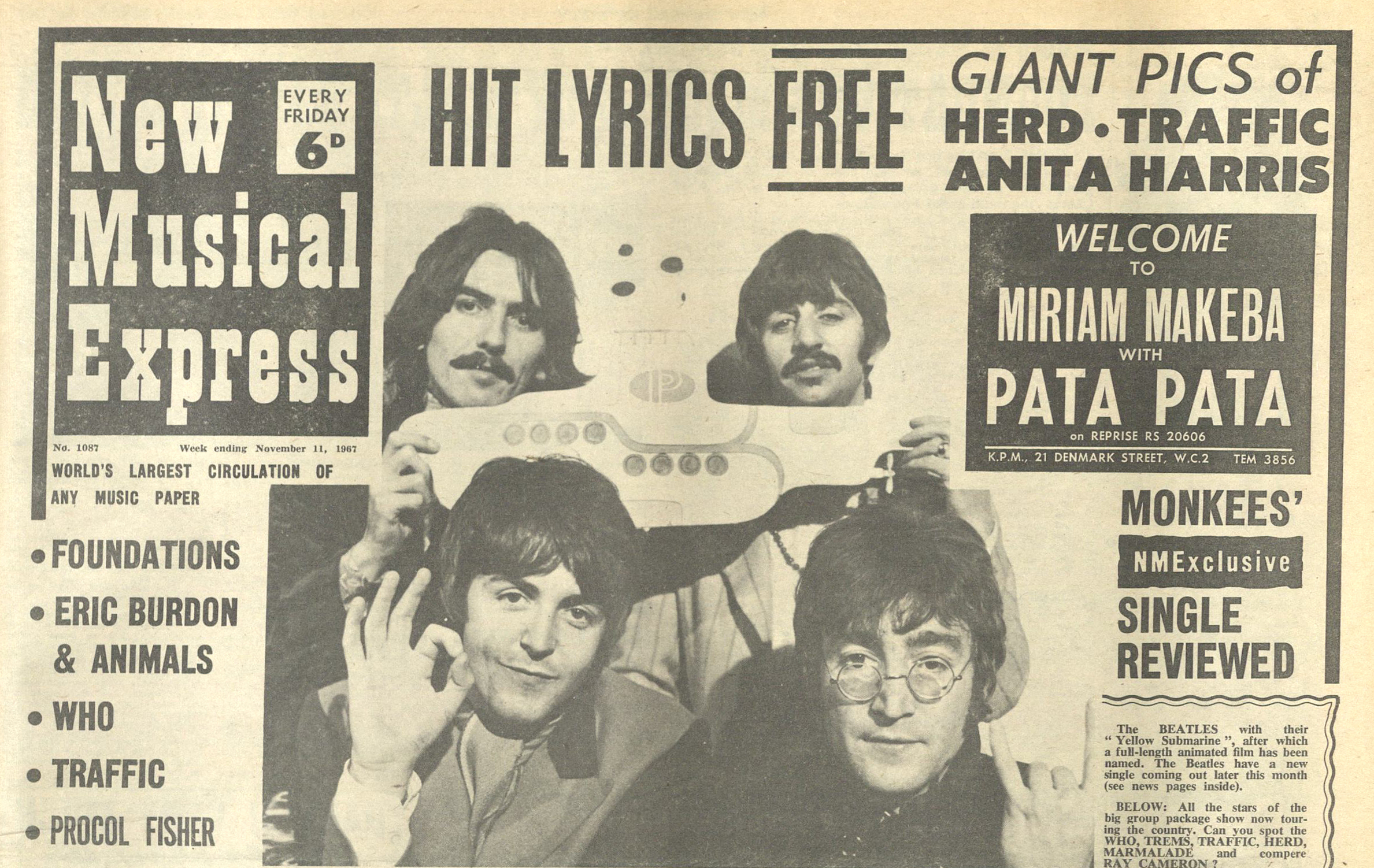
Beatle magic shines through cartoon frolic
THE BEATLES, ever game to have a bash at something different, have plunged gaily into Disney territory with a full-length cartoon extravaganza freely hitched on to one of their pop songs.
“Yellow Submarine,” which has its world premiere tonight at the London Pavilion, is a lively, jazzy jest which may leave many people cold, but will certainly be a surefire hit with the younger set. The boys appear in person only in a brief gag ending. But they are ever present in caricature form. These caricatures come uncannily to life as the Beatles toss away puns and wry, peculiarly illogical comments and sing a dozen of their top songs.
The story is as thin as a Bunnie’s waistline. After a crazy voyage, the Beatles arrive in Pepperland and join the amiable inhabitants in waging war against the Blue Meanies, who want to rid the land of happiness, love and music.
The film plays gentle havoc with time, Space, science, monsters and some extra special figments of fevered imaginations. But “Yellow Submarine” has created no memorable cartoon figures except perhaps the super-intellectual Boob, who has sprung from the Beatles’ “Nowhere Man.”
The animation and special-effects departments have done the film proud in the way they keep the screen alive with movement and surprises. However, it is the personality and pull of the Beatles themselves which makes this a worthwhile ninety minutes, and makes us forgive the bleak memory of the group’s “Magical Mystery Tour.”
From Daily Mirror – July 17, 1968

Those films…
The critics praised it… but the audiences stayed away. Was ‘Yellow Submarine’ a brilliant success… or just another miscalculation?
WHEN the first Beatles’ own film production, “Yellow Submarine,” appeared to be foundering on the sandbanks, in spite of widespread praise from the critics for its originality, people began saying, “Brian Epstein wouldn’t have let them make this movie.”
But the fact is that “Yellow Submarine” was a legacy that Epstein left them. It was he who had conducted all the early arrangements for it. He had been approached some months before his death by an American syndicate who had cartoon strips of fictional Beatles’ exploits running over there. They were immensely popular, especially with youngsters.
The syndicate executives suggested that a Beatles’ full-length animated cartoon film, in colour, with new songs by the Beatles in it, would be a sure-fire winner throughout the world. Brian liked the idea. He put it to the Beatles for their consideration. After they had seen the drawings of some of the odd animated characters it was proposed to bring into the film with their own cartoon images, they became tremendously enthusiastic and decided to back it.
One of Brian’s closest friends told me: “There’s no doubt he would have encouraged them to go ahead with Yellow Submarine. What’s more, he would certainly have wanted to put money into it.”
But when the film was released in this country a few weeks ago, the Rank Organisation, which had booked it into 270 of their cinemas, took it out of 100 within a week. They said this was “because of early audience results.”
Beatle “knockers” promptly seized on this as another example of their misjudgment, like Magical Mystery Tour. Was it? Apart from the point that it was Epstein who had first put Yellow Submarine to them as a promising project, there is the financial angle.
United Artists, the vast company responsible for distributing the film, came out with the definite assurance: “It will make money.” Aside from its showing all over this country, there is its American run to come, starting in October. And there is enormous interest throughout the United States in the film. It is already assured of success there, from advance bookings.
The Beatles were disappointed over Yellow Submarine being taken out of so many Rank theatres here but they are still quite convinced it’s a good film which will be a winner. And my inquiries around the movie world in London’s West End brought me to the conclusion that they will be proved right.
“It’s a bit way out and you wouldn’t call it Disney, but it has a lot of new ideas that are brilliant. Perhaps some of them are too advanced for some audiences, but it’s a movie that was well worth making,” film men said.
Did the half-hearted reception of Yellow Submarine mean that the Beatles might be discouraged from going on with more films? I asked the question at Apple, where the films’ section is run by Denis O’Dell and Brian Lewis, young men of experience and ideas.
“Not a chance of it,” was the emphatic answer.
Already they have more movies on the planning schedule. One is “The Jam,” built on a short story by Julio Cortazar, with John Barry producing it. Another could be “Walkout,” set in Australia.
But the most intriguing project is the idea of making a film of John Lennon’s zany books, “In His Own Write,” and “A Spaniard in the Works.” When these were recently put on the stage by the National Theatre group as a play, the audiences went wild with delight. As a film, it could turn out to be the maddest movie since “Hellzapoppin.’”
The Beatles are no mugs when it comes to film comedy. They have all proved themselves in the past to be natural actors possessing that vital, captivating something best described as “star dust.”
Never forget that their first two efforts, “A Hard Day’s Night” and “Help!” each grossed more than £3,000,000 at the world’s box offices. If they can get another original story which gives each of them the chance to exploit his own off-beat individual talents, there’s another fortune waiting to roll their way—this time into Apple Films. Until they find one, they will go ahead producing films featuring other people.
John Lennon said: “Any deals we make will be short term. We will make sure we get what we want or we won’t do it.”
In other words, they don’t intend to throw money down the drain on films for which they can see no quick and worthwhile returns.
John is the real filmmaking fan of the foursome. He really enjoys filming and wants to do more of it, preferably as a character actor as he was in “How I Won The War.” His influence with the other three is great. It was his idea in the first place to include films among Apple’s interests and he will keep his eyes, behind those steel-rimmed spectacles he wears, unblinkingly fixed on what is being done on the company’s movie side.
The crunch which they took over “Magical Mystery Tour” hasn’t put them off television films, either. Paul said: “We learned a lot last time and we won’t make the same mistakes again.”
They are also planning to move into the lucrative field of making commercials for TV. […]
From Liverpool Echo – September 6, 1968

THE STORY OF “YELLOW SUBMARINE”
AGAINST ALL ODDS, THE BEATLES’ CARTOON FILM TURNED OUT TO BE THE PERFECT PSYCHEDELIC MOVIE.
The Beatles’ first film, A Hard Day’s Night, will always be memorable in its way, because although it has moments of fantasy, it does give an idea of what Beatlemania was like, for those who weren’t there. Help! was very colourful and had some good tunes. But, of all the movie ventures involving the Beatles in the Sixties, I look back on Yellow Submarine as the most enjoyable, for its curiously satirical humour, innovative and high-quality animation, and for its sheer entertainment value for average cinema-goers.
When the concept of a cartoon film was first brought up with the Beatles, John reacted typically, blurting out something like: “Ringo, get your crayons, we’ve got a job for you.” Paul, as ever the practical Beatle, was concerned with realistic basics, and asked: “When are we going to find time to write the songs?” John replied bluntly: “We’re not!”
While Yellow Submarine was being made, the Beatles had an awful lot of other interesting projects on the boil. They were in the process of launching various bits of their freshly formed Apple empire, including fashion shops, music companies, a workshop for electronic innovations, and a home for new talent. In the wake of the highly regarded Sgt. Pepper album, the boys were also desperate to come up with some good follow-up songs — a very difficult task, because John and Paul had all but drained themselves for a while in their attempt to produce Sgt. Pepper.
On the film front, Paul in particular was bitterly disappointed by the panning the critics gave the Beatles at the end of 1967 for their Magical Mystery Tour film, shown on television that Christmas. Paul had his own personal axe to grind. He saw himself as the prime mover in future Beatles film projects — the producer, director, writer or whatever was required to take control of the group’s destiny in the medium of the cinema. Disregarding adverse industry, press and public reaction to Magical Mystery Tour (all of which tended to reduce the credibility of Paul and the others as film makers, whether performers or producers), Paul’s ambition to take the Beatles into a new era of feature movies came too late — by now the group was well on the way towards breaking into four separate creative units, each independent of the others.
The truth is that Paul would have liked to make a spectacular all-singing, all-dancing Hollywood-style musical with the Beatles, using financial backing from America, but it was a venture which never lifted off — partly because Magical Mystery Tour generated scepticism in significant sectors of the movie world, and partly because the Beatles were no longer interested in new projects involving the Fab Four as a group.
Added to their hefty professional workload in connection with new aspects of Apple, John and Paul had a lot on their plates in the way of personal problems. By now, both Yoko Ono and Linda Eastman were on the scene. John’s first wife, Cynthia, was watching the Lennon marriage disintegrate, and Jane Asher and Paul had parted company. Ending marriages and cultivating new romances can take an awesome amount of energy and an unlimited amount of time and thought! In the circumstances, I wasn’t surprised to see how little enthusiasm there appeared to be within the group for contributing time and ideas to Yellow Submarine. But that, in itself, was half the beauty of a cartoon production — they didn’t have to get physically involved at all if they didn’t wish to. Animation artists would do all the hard work and the Beatles would be called up to provide soundtrack songs, not necessarily new stuff at all but numbers from their own back catalogue — even the title song was a hit before work on the film started.
For me personally, however, the big shock was to learn that the Beatles would not even lend their own speaking voices to the making of Yellow Submarine. It seemed crazy to let the producers hire actors with soundalike abilities when John, Paul, George and Ringo could have been doing the job themselves.
I honestly believed that this would be the downfall of the film — that without the dialogue being spoken by John, Paul, George and Ringo, the whole thing would flop. Fortunately for everyone, I was proved wrong.
The full background story to Yellow Submarine is not widely known. Its origins go back to 1964 and the first flood of Beatlemania across America, when a man named Al Brodax contacted Brian Epstein.
Hungarian-American Brodax was boss of King Features, which made millions from cartoons like Popeye, first as strips in newspapers and magazines, and later as short TV and cinema features. His proposition was that King Features should make a series of about forty 30-minute cartoon programmes primarily intended for U.S. network television, each episode based on several Beatles songs.
At first, Epstein was not enthusiastic, saying that for a start he couldn’t think of anywhere near 120 songs by Lennon and McCartney which could be turned into cartoon stories. Then Brodax offered ‘Eppy’ a 50% partnership in the project’s potential profits, and dazzled him with the promise of many dollars.
The King cartoons ran on ABC for several years from the late summer of 1965, and were shown elsewhere around the world in 1966 and 1967, bringing in incredibly high profits. Two factors led to the proposal that Brodax should make Yellow Submarine.
The Beatles had a three-picture deal with United Artists, and Brian was having a hard time fending off the film company, who demanded their third production to follow A Hard Day’s Night and Help! at a time when Brian saw no possible chance of persuading the Beatles to go into the film studios again.
On the other hand, Brodax was reminding Brian in no uncertain terms that he’d been promised an opportunity to produce a full-length cartoon feature if the half-hour telly shows were successful. The outcome was that Brian not only committed the Beatles to lend their names to Yellow Submarine but promised a bunch of four new songs for the soundtrack.
The Beatles laughed out loud in his face when ‘Eppy’ announced the bit about four new compositions. Unwilling to put much effort into complying with this obligation, they shrugged it off and fed the film people unwanted scraps rather than sure-fire winners. It became a running joke at recording sessions among the inner circle of associates surrounding the Beatles. A song not considered up to scratch for the Beatles’ next album was praised to the skies by the lads in a sarcastic sort of way and then declared to be “ideal for Yellow Submarine.” “Do you think it’s good enough?” one of the Beatles would ask the others with a grin. “Nothing’s too good for the film so that’s what we’ll give ’em — nothing!”
Meanwhile, new music apart, the script for the animation feature film was taking on the appearance of a patchwork quilt, with contributions, corrections, additions and deletions coming from umpteen different sources representing Brodax, the Beatles or Brian Epstein. It would be unfair to say that the Beatles themselves remained totally disinterested. Ringo was the most concerned because the title was taken from a song with which he was directly associated. Also, a cartoon version of Ringo appealed to his dry and simple sense of humour, and fitted in alongside his own ambition to be a comedy movie actor.
All through the early stages of the production process, ‘Eppy’ was stalling because he knew the Beatles were never going to be fully behind the whole project. The fact is that the boys believed they had grown up mentally and musically beyond the simple chaps they were shown as in Yellow Submarine. They felt that the John, Paul, George and Ringo depicted by the animation teams and their scriptwriters were of the mid-Sixties Beatlemania years, and they hoped they had grown out of all that by moving on to more sophisticated work in the recording studios. As Paul confided at the time:
“When people see this cartoon film it’ll put our image back at least three years, to what people thought we were in the days when we were having jelly babies chucked at us in Odeon theatres.”
To get Brodax and his people off his back, Brian gave in and signed all the necessary paperwork as one of the final major acts of management he carried out prior to his death in August 1967. In the event, ‘Eppy’ never did see the final film, although he had demanded power of veto over anything he or the boys objected to. The four songs which the Beatles provided for the soundtrack were ‘All Together Now’, ‘Hey Bulldog’, ‘It’s All Too Much’ and ‘Only A Northern Song’, a leftover morsel from the Sgt. Pepper sessions. Though not brilliant, they blended well with what was on the screen.
Part of the contractual compromise reached between Epstein and Brodax was that the Beatles should make a ‘surprise’ live appearance at the end of the film. The Beatles really didn’t want to appear but they had a dramatic change of heart after viewing an almost-finished version of Yellow Submarine. They were so pleased with the way the whole production had been put together that they were only too happy to associate themselves more closely with it from then on.
The film had its West End world premiere at the London Pavilion, Piccadilly Circus, on Wednesday July 17th 1968. Shortly before 8pm that evening, wild scenes of Beatlemania were seen in the centre of the capital — the first for a couple of years — as thousands of fans gathered to welcome John, Paul, George and Ringo. All down Shaftesbury Avenue and Coventry Street, traffic came to a standstill. This hadn’t happened since the premieres for A Hard Day’s Night and Help!
The Beatles had suggested that guests might come attired all in yellow, and a few obliged. Outside the cinema, Blue Meanies jumped up and down on the pavement for the amusement of the crowds, and yellow-clothed promotion people handed out apples, symbolic not only of the apples dropped in the film but also of the Beatles’ new business ventures.
Members of the Bee Gees, Eric Clapton’s Cream and the Rolling Stones rubbed shoulders with Ringo and Maureen, Mary Hopkin, James Taylor and Twiggy in the foyer. George Harrison arrived in a bright yellow suit and floppy yellow hat, while Paul went for a yellow tie. Making his first public appearance with Yoko Ono at an ‘official’ event, John wore a white suit. Television crews followed the boys into the auditorium and had to be chased out before the film began.
Afterwards, 200 VIP guests, including some of the cream of the pop world’s most fashionable in-crowd at the time, made their way to the Royal Lancaster Hotel on Bayswater Road, where a midnight celebrity champagne party was held in the hotel’s new ‘Yellow Submarine’ disco. Intended for about 50 people, the venue’s tiny dance area was soon heaving with at least 100 happy bodies, including the Beatles.
The critics were extremely kind to Yellow Submarine, and so they should have been. It had been worth the wait and all the background business hassles. The film was certainly more of a treat for Beatles fans than the soundtrack album, because half the material on the record was orchestral stuff, which didn’t involve the boys at all.
From The Beatles Monthly Book – April 1993


Notice any inaccuracies on this page? Have additional insights or ideas for new content? Or just want to share your thoughts? We value your feedback! Please use the form below to get in touch with us.


