Sunday, May 4, 1997
Interview for Daily Express
Looking out for Linda
Press interview • Interview of Paul McCartney
Last updated on July 19, 2025
Sunday, May 4, 1997
Press interview • Interview of Paul McCartney
Last updated on July 19, 2025
Interview location: MPL Communications, 1 Soho Square • London • UK
Previous interview Apr 25, 1997 • Paul McCartney interview for The Times
EP Apr 28, 1997 • "Young Boy #1" by Paul McCartney released in the UK
Session Apr 30, May 01 & May 02, 1997 • "Standing Stone" recording sessions
Interview May 04, 1997 • Paul McCartney interview for Daily Express
Radio show May 05, 1997 • Flaming Pie Radio Special
Album May 05, 1997 • "Flaming Pie" by Paul McCartney released in the UK
Next interview May 17, 1997 • Paul McCartney interview for E! Online
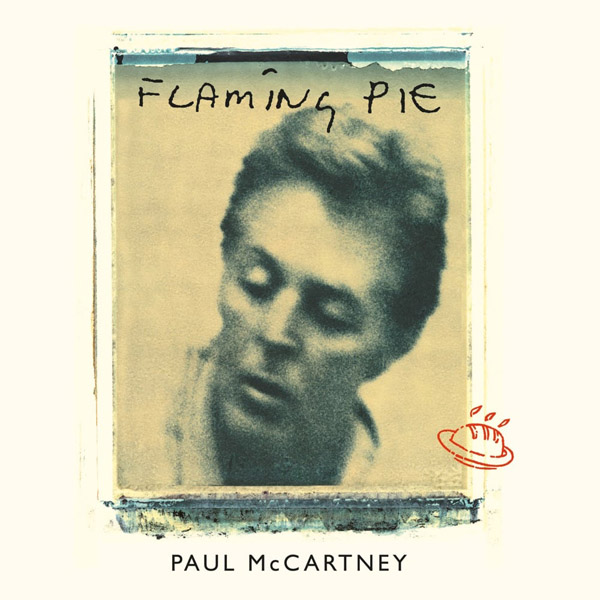
AlbumThis interview was made to promote the "Flaming Pie" Official album.

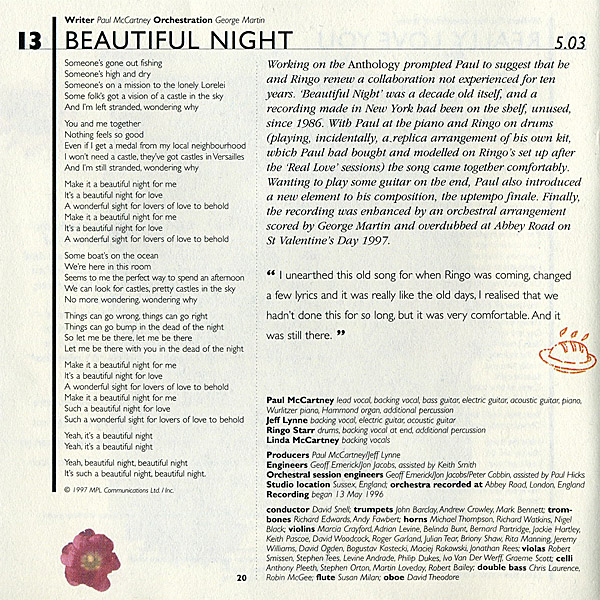
Officially appears on Anthology 1

Officially appears on Flaming Pie
Officially appears on Flaming Pie

Unreleased song

Officially appears on Help! (Mono)
Officially appears on Flaming Pie
The Beatles are finished, declares 'hideaway' Paul
Aug 27, 1970 • From Daily Express
Jul 14, 1972 • From Daily Express
This interview remains the property of the respective copyright owner, and no implication of ownership by us is intended or should be inferred. Any copyright owner who wants something removed should contact us and we will do so immediately.
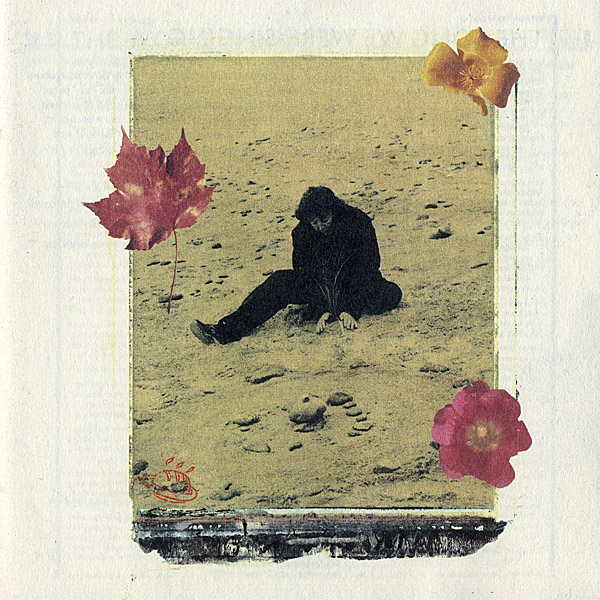
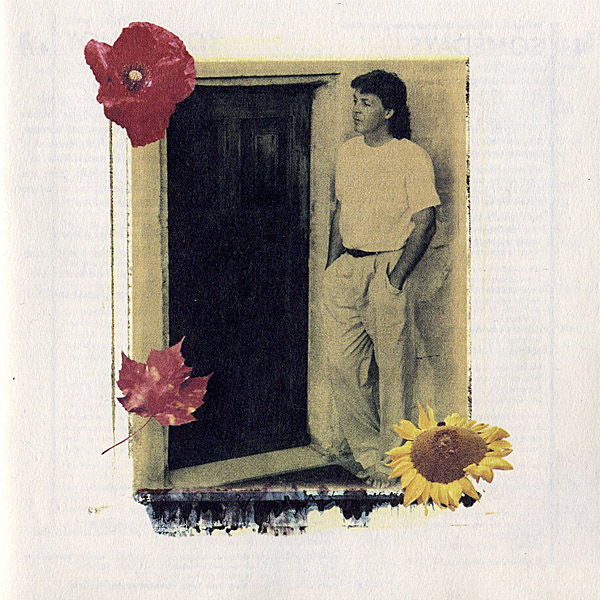
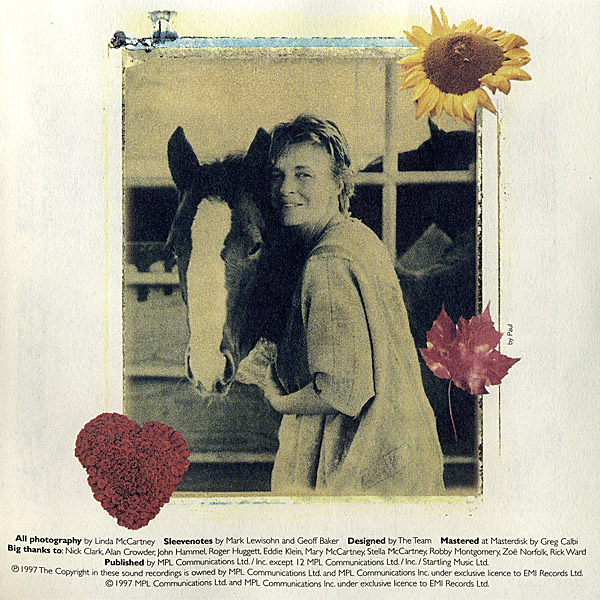
There has been Linda’s fight with cancer, a knighthood, and now a new album. In this exclusive interview, Sir Paul McCartney talks to Nick Bradshaw about living a life full of love and songs. Photographs of each other by Linda and Paul McCartney.
At times it could be hard work, but Paul McCartney was young and healthy, so he didn’t complain about the tough touring and recording schedule that The Beatles had in the Sixties. When The Beatles split, more than 25 years ago, he could have given up music, taken things easy and lived off the profits for ever — but he kept on going. So far, the Nineties have been particularly busy for him, with a series of ITV documentaries shown in 1995 — The Beatles Anthology — albums to accompany them, the recording and release of two “new” Beatles songs and the making of his new solo album.
These have also been traumatic times for Paul as he supported his wife Linda through a brave fight with breast cancer. They have gone through this together over the past 18 months with the support of their family and away from the media.
Now, though, the Anthology project is finished, Linda is on the mend and he is satisfied with his new album, due out on Tuesday. He has decided, for a short time at least, to take a deep breath and put the stresses behind him. He sits in his Soho office, in a denim shirt and blue jeans, looking calm and serenely content. Although Linda’s trips to her specialist in America have been well documented, Paul remains reticent about discussing his wife’s condition or releasing press statements on her health, for the very humane reason of not wanting to put any kind of jinx on her recovery. It’s understandable. He is very happy, however, to talk about the new album — Flaming Pie — but after a bite of cheese and pickle sandwich.
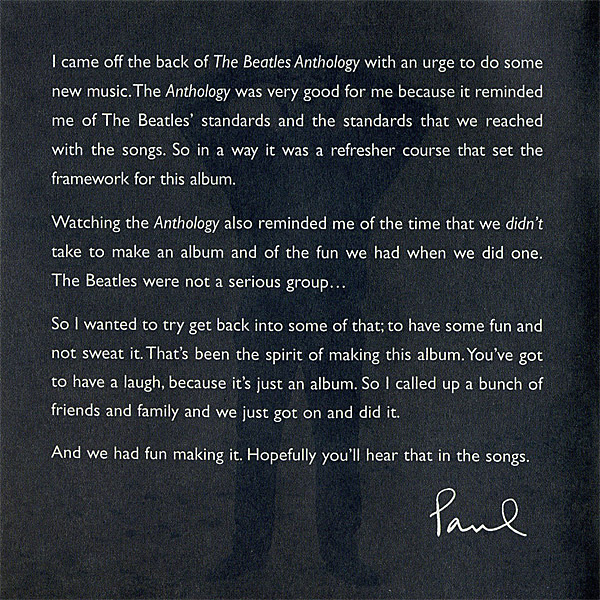
“I had a lot of fun making this album,” he says. “I really enjoyed making it and what I basically want to do now is to have a good time. I’ve started to ask myself if it’s been worth having a career with The Beatles, earning all this money and getting all the fame if at some point I don’t go ‘Now, can I have a good time?’
“When I started out in the business, the suits were in charge. The Beatles changed all that and turned that over. But I feel the suits are back in charge and I want to be subversive and to break that lock, do things on my terms and enjoy myself in the process.
“In my mind I don’t make records for those in the music business; I make a record for the kid who’s been out on the bus to buy it, he’s read the sleeve notes on the way home and he’s back in his bedroom hearing it. I identify very strongly with that kid, whether he is in Minnesota or Macclesfield. I’ve been that kid.”
As a result, promotion for this album has been fairly low key, and Paul has been giving precious few interviews. This doesn’t look like a man who has been overdoing it in order to secure a No 1 hit.
“I’ve been telling everyone involved in the promotion not to sweat it,” he says between bites of the sandwich. “I’ve said there’s no waking up in the middle of the night worrying about this album because it’s just an album. If you like it, you like it. If you don’t — don’t buy it.
“If you look down the track list of a Beatles album, they’re all good little songs. I thought I’d make an album now which, as far as I was concerned, was like that. I wanted to like every song on this album. One of my theories is that the enjoyment you have in the studio communicates itself to people. If I’m having fun in the studio, maybe it’ll sound like fun.”
It was 30 years ago today — give or take a week — that two of the most significant events in Paul McCartney’s life coincided. Professionally, there was the release of The Beatles’ groundbreaking album Sergeant Pepper’s Lonely Hearts Club Band. Personally, Paul met a young American freelance photographer called Linda Eastman, in London to cover the release of the album, who later became his wife. Is the timing of the new disc a clever marketing strategy?
“No, believe it or not it’s not timed to fit in with those dates; it’s just a coincidence. But it’s true, there are these big anniversaries.”
Paul and Linda have become one of the most durable double acts in pop history. Their marriage is still solid in an industry where it seems fashionable to have a new partner on your arm for each post-gig party or album release. Since the late Sixties there has only been one woman for Paul. There have, however, been numerous albums during that time; first as one of The Beatles, later as part of Wings and then as plain old Paul McCartney.
Now, though, Liverpool’s most prolific working class hero is a knight of the realm and Flaming Pie will be the first album to be released by Sir Paul McCartney. If, 40 years ago, someone had told him and his musical cohort John Lennon that one of them would one day have been knighted, would they have believed it?
“We’d have collapsed in fits of laughter; the mere idea of it was so unthinkable that we’d have thought it was a joke. Maybe we might have looked at a posh sports car and thought ‘Umm, maybe one day…’ but a knighthood, no way. It would just be an impossible dream.”
What seems to please him most is the fact that when he became Sir Paul, Linda automatically became Lady McCartney.
“The nice thing about it really is when me and Linda are sitting away on holiday, watching the sunset, I turn to her and say, ‘Hey, you’re a lady’. It’s a giggle, but it’s nice because you get to make your girlfriend a lady — although she always has been anyway. For me, it’s like a school prize. You don’t go after it but if you do some good drawings, then you can get the art prize and they give it you because they think you’re all right. And that’s the way I take it, really. It’s just something nice that’s offered and it’d be rude to turn it down, wouldn’t it?”
You would think it rude, if not crazy, to turn down the chance of releasing a record of Paul’s but that’s exactly what his record company EMI did at around the time of the release of The Beatles Anthology. Needless to say, Paul was fuming when he discovered that he was, for the time being at least, superfluous.
“We were all gearing up to do the Anthology and someone from EMI gave me the message that they didn’t need an album from me for a couple of years because they were promoting the Anthology. At first I was a little p***ed off. I thought, ‘Oh yeah, ye of little faith. Typical record company!’ But then I thought ‘OK, they’re right, I should be concentrating on the Anthology project. Also, it would have been very unseemly for any one of us to release a solo album in the middle of all that — not to mention stupid to try and go against The Beatles sales. So I waited, worked on the Anthology and all the while kept on writing.”
Now with the writing and waiting over, Flaming Pie is to be released. For years, Linda’s name has appeared alongside her husband’s on album sleeves. On the new disc, their names are joined by that of their 19-year-old son James, who plays guitar on the song Heaven On A Sunday. Paul has always maintained that he has never expected any of his children to follow him but when the conversation moves on to James and his musicianship, Paul’s eyes open wide with pride.
“It was great to have James playing with me on one track. He’s getting really good on the guitar now and I thought it would be a nice idea to record with him. When you’ve known someone for 20 years, you read them, they read you and you can react to one another. That’s what we did. I played the acoustic-y sort of part, like an old blues guy, and I left the young Turk to play the hot electric stuff,” Paul explains. “Of course, as a dad, I was just so proud. It’s just brilliant to be playing with your kid. People have often asked me if any of my kids are musical and I’ve always said that yes, they are all musical but I’ve never pushed them into music because of the he’s-the-son-of, she’s-the-daughter-of syndrome. I always feel a bit sorry for kids coming into that. So I decided I would never push them but if any of them had a passion I wouldn’t stand in their way, I’d support them.”
Of course, James is not the first of the McCartney offspring to show artistic flair. Eldest daughter Heather, 34, is regarded as one of Britain’s brightest young potters; Mary, 27, has followed her mother into photography and Stella, 25, was last month named as the new chief designer of Paris fashion house Chloé — which made her the instant victim of the “she’s-the-daughter-of” syndrome.
James, however, is the first to follow his father’s example:
“He got a guitar when he was about nine or 10. He hasn’t had a tutor. I said to him early on exactly what my Dad said to me: ‘Son, if you want to learn, get proper lessons’. James said, ‘You didn’t, Dad’ – which is exactly what I said to my Dad. The McCartney family saga continues.”
Recently the McCartney family has been enjoying much-needed holidays and Paul has found himself in an ideal state of mind to write.
“Because of my obligation to the Anthology projects, I didn’t have to produce an album, I didn’t even have to think about doing an album. I thought, ‘Great, what a lovely, lazy couple of years’. The only music I made was just for the fun of it. I always said that if I had to retire I’d still do this as a hobby and so it was: I was taking time out – temporarily retired, if you like – having holidays, not scheduled to be in a studio and the songs just came to me; I couldn’t stop them. I get like that on holidays. I know that on holiday you are supposed not to work but, as I say, the songs just came to me.”
The result is an album that sounds, on the whole, more like a Beatles album than anything he has released since the Fab Four split in 1970. High points include Some Days, with the rich swirling orchestration of Beatles producer George Martin and the beautifully poignant ballad Little Willow – destined to become a McCartney classic – written after hearing of the death of a close friend.
“I could have written a letter, but being me I wrote a song. Hopefully it will help her kids out a bit,” he says.
Ringo Starr plays drums on a couple of songs and Paul and Ringo share writing credits on the track Really Love You. “Our first together, I think,” says Paul, not altogether confident in this assertion but understandably so considering how many songs he has written over the years – particularly during The Beatles era.
There are many guest appearances but Flaming Pie is still very much a McCartney album, with Paul playing most of the instruments. “It’s home-made. Just me and a few friends,” is how he describes it. As if to rub things in for the rest of us, a couple of the tracks were written in under two hours each.
“It’s just a little game that I play with myself, where I try to write against the clock. John and I used to play this game and I don’t think it ever took us more than three hours to write a song. Songs were in the air and they came to us. We used to joke about the ease of writing a big hit: we’d sit about saying, ‘Hey, let’s write ourselves a swimming pool’.”
The song Young Boy, released as a single last week, is one of the tracks written against the clock.
“Linda was doing a veggie cookery thing for the New York Times while we were staying in Long Island. While she cooked lunch – Vegetable Soup, Aubergine Casserole and Applesauce Cake – I went off into a little back room with my guitar and started playing some chords and a song came up,” he explains.
“Anyway, she got on with lunch and then she came in and asked what I’d been doing. I said, ‘Oh, funny you should say that. I’ve written a song’.” I really just do it for that moment because I know that people don’t know how you write songs – not that I really know myself. The song Some Days was written in much the same way. Linda was doing a photo session in a Kent farmhouse and I wandered off into an empty bedroom and wrote that in a couple of hours.”
Since the early Eighties Paul has been wandering off not just to write but to paint.
“When I turned 40, everyone said life begins at 40 so I looked around for a couple of days and nothing appeared to begin. So I thought I had better start some stuff. So I started jogging a little bit, because I’d never done that before. That was good fun. Then I thought that I would love to paint, as I have always liked drawing – at school I did get a little art prize, nothing major, but I have always liked to fiddle around in that area.
“I’d always had this big block in my head, that it was those people who paint and not us, but when I got to 40 I thought now it was time to get down to an art shop and buy a canvas or two — which was odd: for me, the thought of me buying a canvas was like being arrogant, it was like an ego trip.
“So I bought a canvas, a few paints and a couple of brushes and I just started and I discovered that I really enjoyed it. And what painting gives me is very similar to what music gives me: if your day isn’t going great, it’s lovely to go into a room with a guitar and make the day go great by making some music and getting involved in the magic of that.
“If I’m on tour, in the middle of all that craziness, I’ll just have a day off sometimes and do a painting. It’s like therapy: I can put my feelings into it. It’s a freedom thing for me, which in many ways is very similar to music. I’ve got a little sailboat too, now because I always wanted to sail. It’s not a yacht, it’s literally just a one-man sailboat. I love that. Sailing’s another one of those things that if you were brought up where I was brought up, you didn’t do. They sailed. We rolled our trousers up and paddled.”
His parents may not have been well off but his recollections of childhood are invariably warm and he’s proud of his Scouse roots. He still enjoys taking the occasional trip back to Liverpool from his Sussex home on the South coast.
“I was driving around Liverpool one evening. I drove down to Forthlin Road and I pulled up right outside the house. I was pointing out to my kids which room had been mine and the spot where my Dad had planted a mountain ash tree when some bloke walks past, leans down towards the car window and says, ‘Yeah, he did used to live there’.”
Of late, Paul has visited students at the Liverpool Institute of Performing Arts which he helped set up in a disused school building where he’d been taught as a kid. What did it feel like going back to school as the master?
“It felt very good,” he says. “I tried to get them to give me their ideas because I’ve always said that if I come in to give a songwriting class – which this wasn’t – the first thing that I’ll have to say is that I don’t really know anything about how to do it, because the minute I know how to write a song I’ll be bored. To me, writing a song is like magic. Every time it happens it’s like, who lit the candle? I’m always, like, amazed by it and that’s what I follow. It’s not me doing it, it’s doing it and I’m merely following it.”
In the months to come, Paul is directing a movie made from Linda’s Beatles photos; he’s planning an art exhibition of the paintings he has produced over the past 15 years; he’s writing a symphonic poem to be performed by the London Symphony Orchestra in October; he’s planning his own radio show…
“Some people call me a workaholic but I don’t really think I am because I enjoy the work I do; I always assume that workaholics work too hard and don’t really enjoy it. I like working – there’s a lot of people out of a job and who want a job, so I’m always grateful to be in work. I like the teamwork.”
“But I like my time off too, because of the balance. I like to go off on an hour’s horse ride with Linda – that’s often why I’m late for things, because I can’t get down off that horse quick enough.”
When compiling the Anthology, Paul had, for the first time really, to sit down and listen to the work he produced as one of The Beatles. It had a profound effect. He realised that he’d got it right all those years ago, that what he needed to do next was to produce songs with that same Beatles simplicity.
“I’ve found that, until now, I’ve made things perhaps a little hard for myself. One tends to equate something being complex with it being good and, similarly, something being simple with being not good. As I’ve said before, the melody of Yesterday came to me in my sleep. You can’t get much simpler than that. When I first did Yesterday I told people the tune had come to me in a dream – but maybe I shouldn’t have done that because it makes it seem too simple. Maybe I should have said it was a song I’d been working on for eight months – in Tibet.
“I think the natural thing in a career is to view it as a progression. I’ve got my feel, the thing that makes a Paul McCartney song always sound like a Paul McCartney song, and throughout my career I have made efforts to try to get away from it and go in some other direction. I’m willing to try all the other things – you’ve got to, just to see if they’re better.
“But on this album I’ve started thinking that I don’t really need to go in another direction. The Anthology was very good for me: it reminded me of The Beatles’ standards and the standards we reached with the songs. Somebody pointed out to me that a lot of what these new groups are doing is my sound, so it’s actually mad if I don’t do it my way as well.”
The “new group” who have adopted The Beatles sound most is Oasis. The Gallagher brothers have been heralded by many, including themselves, as the new Lennon and McCartney. To some, this self-confidence has been read as sheer arrogance but, says Paul, if you are going to make it, you’ve got to have belief in yourself.
“I think if you really want to do well you have got to have a feeling that you’re good. Now that’s difficult because that belief sometimes is translated as conceit. I remember when John and I started out people would ask me if I thought we were good songwriters and I’d say. ‘I know we’re good’.
“It’s like the World Cup – when England go into these competitions a lot of people say: ‘We’ll be all right if we can beat the Polish’ or, ‘We’ll be OK if we can just get through against the Danes’. You’ve got to beat them all. You’ve got to beat Brazil! You can’t just be worrying about beating Northern Ireland – you’ve got to take on every b****y team in that competition and know that you can beat them all.”
But Paul knows that the hardest team to beat is your own old team – particularly when your old team won every trophy going for the best part of 10 years. With his own album in the wake of the Anthology, Paul is inevitably inviting comparisons.
“Yeah, well, whatever I do is inevitably going to be compared to The Beatles’ songs because I wrote a lot of those songs. Everyone gets compared to The Beatles but I don’t mind because at least I was lucky enough to have been in The Beatles.”
Indeed, even The Beatles have been reviewed in the light of The Beatles. When the single Free As A Bird was released by Paul, Ringo and George a couple of years ago, critics were quick to compare it unfavourably with Hey Jude, but they ignored the criticism and ploughed on with another “reunion” single, Real Love. In fact, Paul reveals now, they toyed with getting together to release a third reunion single: what’s more, they may still do so.
“There are a couple of things that may surface at some point. You see, with The Beatles, there’s always a surprise somewhere along the line.
“We did Free As A Bird and Real Love, those two songs of John’s, and that was very exciting, very moving for me and very comfortable having his voice in my headphones in the studio again. And the idea arose that there was a third track, another song we kind of had our eyes on called Now And Then.
It is said that, after Real Love, George Harrison was feeling less than comfortable about carrying on than Paul and Ringo were and that he blocked the release of a third song.
“I actually wanted to do it on Anthology 3,” admits Paul, “but we didn’t all agree. But things change and the thing is that it might not go away. There was only one of us who didn’t want to do it. It would have meant a lot of hard work, the song would have needed a lot of re-writing and people would have had to be very patient with us.”
“But there are these one or two things lurking in the bushes. The Beatles might just raise their ugly little heads again…”
The success of The Beatles Anthology series has re-established him, with John Lennon, as two of the most important songwriters of the late 20th century. The records alone have grossed £400 million to date. I suggest that having come full circle and, in Flaming Pie, produced an album of sweet, simple Beatlesque songs, he might think it time to retire.
“Retire!” he repeats, pretending to be shocked before breaking into a resigned grin. “No, I couldn’t. It’s not in my nature. Sure, at the beginning you get into a band because you’re hungry for the money and the birds and the fans. But even when The Beatles had enough money and certainly enough fame, we still kept on writing songs. Someone said to me recently, ‘Oh. I see you still enjoy your music, then.’ But it hadn’t occurred to me that anyone would think that I could ever go off it.”
Paul McCartney will keep coming up with new songs until he dies and, who knows, if John Lennon’s example is anything to go by, Paul could well be responsible for new songs even after that. Will he strive to give the world more hits?
He’d like to carry on being successful but he’s not going to let the charts and the music industry rule his life.
“I really don’t give a s**t if this album is a hit or not. I’ve been saying that and I mean it. Sure, everyone likes to have a hit – but not at the expense of having fun,” he says.
A couple of days after our conversation, Paul went to his offices again, this time carrying an acoustic guitar. He said hello to the receptionist, climbed the stairs to the top floor and stepped out on to the roof patio. In front of a film crew, his bemused staff and disbelieving passers-by, he performed two songs, then waved and went back inside.
Comparisons will be made between this surprise performance and the last time he performed on a London roof-top. On that occasion he was joined by John, George and Ringo for what turned out to be The Beatles’ last show. Once he would have avoided doing anything so similar to something he did as a Beatle. Now, though, Paul McCartney just does what he feels like.
Few people saw him on the roof. His impromptu gig probably won’t sell him any extra records but that wasn’t the point: it was something he wanted to do. And, besides, it was fun.


Notice any inaccuracies on this page? Have additional insights or ideas for new content? Or just want to share your thoughts? We value your feedback! Please use the form below to get in touch with us.