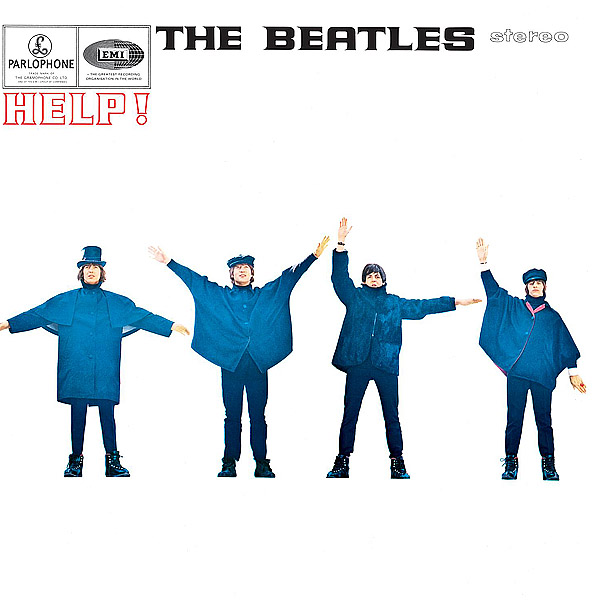
Monday, May 10, 1965
Recording "Dizzy Miss Lizzy", "Bad Boy"
For The Beatles
Last updated on July 14, 2026
Monday, May 10, 1965
For The Beatles
Last updated on July 14, 2026

Feb 15 - Jun 18, 1965 • Songs recorded during this session appear on Help! (UK - Mono)
Recording studio: EMI Studios, Studio Two, Abbey Road • London • UK
Previous session Apr 18, 1965 • Mixing "Help!", "The Night Before"
Interview May 09, 1965 • The Beatles interview for WOR-FM
Article May 10-11, 1965 • Filming “Help!” at Cliveden House • Days 1 and 2
Session May 10, 1965 • Recording "Dizzy Miss Lizzy", "Bad Boy"
Interview May 11, 1965 • The Beatles interview for KNUZ-AM
Interview May 15, 1965 • Paul McCartney interview for Record Mirror
Next session Jun 08, 1965 • Mixing "I Want To Hold Your Hand"
AlbumSome of the songs worked on during this session were first released on the "Help! (UK - Mono)" LP
For two days, on May 10 and 11, 1965, filming for “Help!” moved to Cliveden House, the grand country mansion overlooking the River Thames in Berkshire. On the evening of May 10, the group returned to London for a recording session at EMI Studios.
May 10 was also Larry Williams‘ birthday and the Beatles recorded two of his songs, “Dizzy Miss Lizzy” and “Bad Boy“, during a session lasting from 8 p.m. to 1:15 a.m.
The backing track of “Dizzy Miss Lizzy” featured John Lennon on electric guitar and lead vocals, Paul McCartney on bass, George Harrison on electric guitar and Ringo Starr on drums. Bass and drums were recorded on track one of the four-track tape, guitars on track two, and vocals on track three.
Take 1 was a false start. Take 2 was considered good enough. The Beatles then switched to “Bad Boy“, keeping the same instrumentation as for “Dizzy Miss Lizzy” and recording on the same tracks of the four-track tape.
Four takes were recorded. Only Take 2 and Take 4 were complete, and Take 4 was deemed the best. Overdubs followed on Take 4: John re-recorded his lead vocals onto track three, while Ringo played tambourine. On track four, Paul played electric piano, John added an organ part, and George added a lead guitar part. This completed the recording of the song.
The Beatles then returned to “Dizzy Miss Lizzy” and recorded five new takes of the backing track. Only Take 3 and Take 7 were complete, and Take 7 was deemed the best. It received overdubs: track four was given an electric piano part played by John, George added further guitar, and Ringo added cowbell.
The session ended with the creation of Remix Mono 1 and Remix Stereo 1 of “Dizzy Miss Lizzy“, and Remix Mono 1 and Remix Stereo 1 of “Bad Boy“. These four mixes served as the released mono and stereo versions of the two tracks.
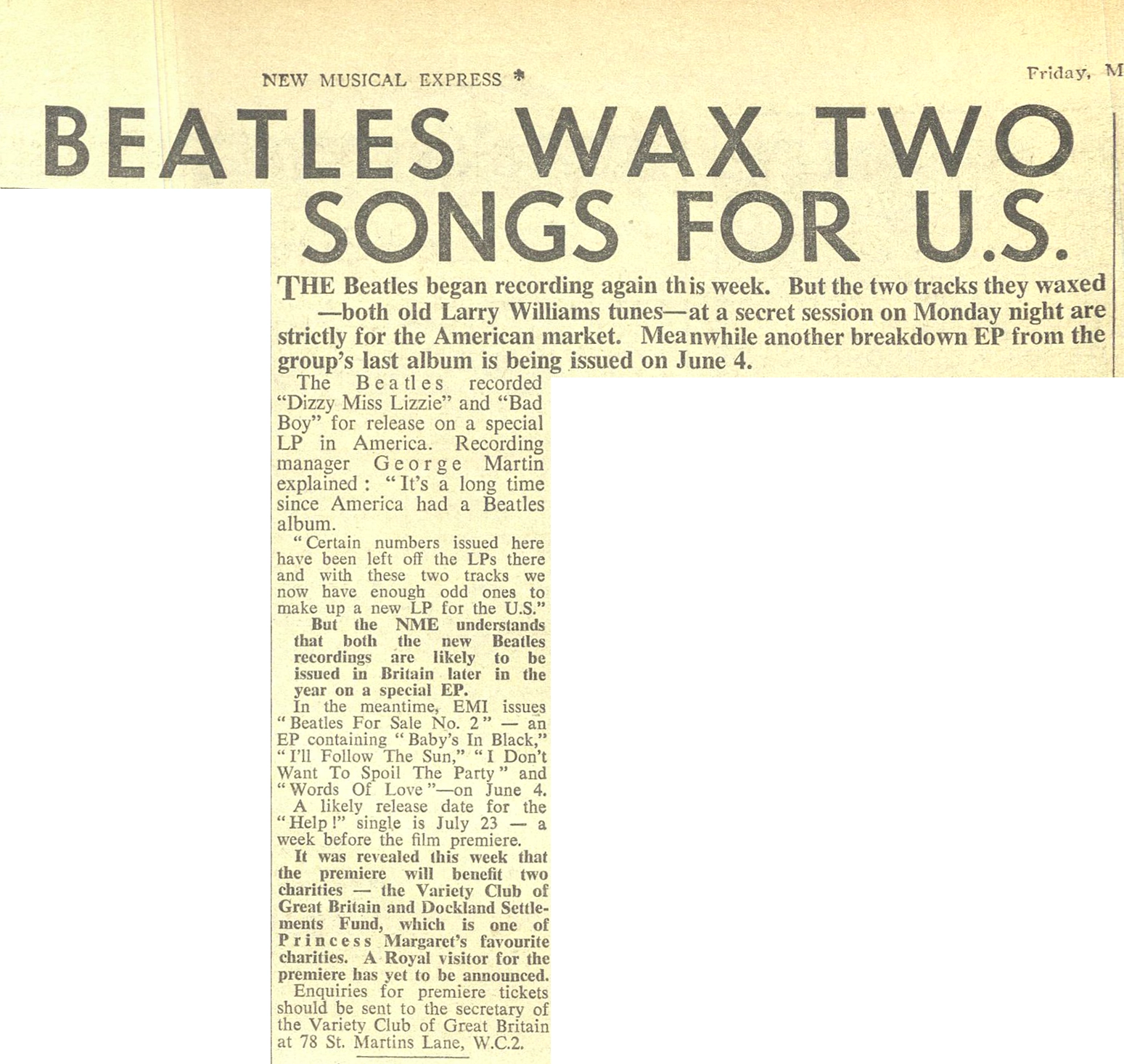
BEATLES WAX TWO SONGS FOR U.S.
THE Beatles began recording again this week. But the two tracks they waxed — both old Larry Williams tunes — at a secret session on Monday night are strictly for the American market. Meanwhile another breakdown EP from the group’s last album is being issued on June 4.
The Beatles recorded “Dizzy Miss Lizzie” and “Bad Boy” for release on a special LP in America. Recording manager George Martin explained: “It’s a long time since America had a Beatles album. Certain numbers issued here have been left off the LPs there and with these two tracks we now have enough odd ones to make up a new LP for the U.S.“
But the NME understands that both the new Beatles recordings are likely to be issued in Britain later in the year on a special EP.
In the meantime, EMI issues “Beatles For Sale No. 2” — an EP containing “Baby’s In Black,” “I’ll Follow The Sun,” “I Don’t Want To Spoil The Party” and “Words Of Love” — on June 4.
A likely release date for the “Help!” single is July 23 — a week before the film premiere.
It was revealed this week that the premiere will benefit two charities — the Variety Club of Great Britain and Dockland Settlements Fund, which is one of Princess Margaret’s favourite charities. A Royal visitor for the premiere has yet to be announced. Enquiries for premiere tickets should be sent to the secretary of the Variety Club of Great Britain at 78 St. Martins Lane, W.C.2.
From New Musical Express – May 14, 1965
Written by Larry Williams
Recording • Take 1
Written by Larry Williams
Recording • Take 2
Written by Larry Williams
Recording • Take 1
Written by Larry Williams
Recording • Take 2
Written by Larry Williams
Recording • Take 3
Written by Larry Williams
Recording • Take 4
Written by Larry Williams
Recording • SI onto take 4
Written by Larry Williams
Recording • Take 3
Written by Larry Williams
Recording • Take 4
Written by Larry Williams
Recording • Take 5
Written by Larry Williams
Recording • Take 6
Written by Larry Williams
Recording • Take 7
Written by Larry Williams
Recording • SI onto take 7
Written by Larry Williams
Mixing • Remix Mono 1 from take 7
AlbumOfficially released on Help! (UK - Mono)
Written by Larry Williams
Mixing • Remix Mono 1 from take 4
AlbumOfficially released on Beatles VI (Mono)
Written by Larry Williams
Mixing • Remix Stereo 1 from take 7
AlbumOfficially released on Help! (UK - Stereo)
Written by Larry Williams
Mixing • Remix Stereo 1 from take 4
AlbumOfficially released on Beatles VI (Stereo)
The Complete Beatles Recording Sessions • Mark Lewisohn
The definitive guide for every Beatles recording sessions from 1962 to 1970. We owe a lot to Mark Lewisohn for the creation of those session pages, but you really have to buy this book to get all the details - the number of takes for each song, who contributed what, a description of the context and how each session went, various photographies... And an introductory interview with Paul McCartney!
The Beatles Recording Reference Manual - Volume 2 - Help! through Revolver (1965-1966)
The second book of the Association for Recorded Sound Collections (ARSC)-nominated series, "The Beatles Recording Reference Manual: Volume 2: Help! through Revolver (1965-1966)" follows the evolution of the band from the end of Beatlemania with "Help!" through the introspection of "Rubber Soul" up to the sonic revolution of "Revolver". From the first take to the final remix, discover the making of the greatest recordings of all time.Through extensive, fully-documented research, these books fill an important gap left by all other Beatles books published to date and provide a unique view into the recordings of the world's most successful pop music act.

Notice any inaccuracies on this page? Have additional insights or ideas for new content? Or just want to share your thoughts? We value your feedback! Please use the form below to get in touch with us.


