Saturday, February 20, 1965
Recording "That Means a Lot", "You've Got To Hide Your Love Away", Mixing "If You've Got Trouble", "Tell Me What You See"...
For The Beatles
Last updated on May 2, 2026
Saturday, February 20, 1965
For The Beatles
Last updated on May 2, 2026

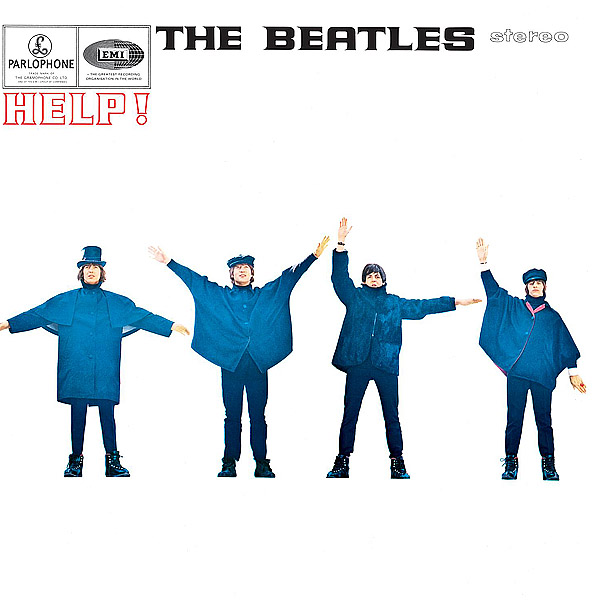
Feb 15 - Jun 18, 1965 • Songs recorded during this session appear on Help! (UK - Mono)
Recording studio: EMI Studios, Studio Two, Abbey Road • London • UK
Article Feb 19, 1965 • The Beatles attend a private party given by EMI's Joe Lockwood
Session Feb 19, 1965 • Recording "You're Going to Lose That Girl"
Session Feb 20, 1965 • Recording "That Means a Lot", "You've Got To Hide Your Love Away", Mixing "If You've Got Trouble", "Tell Me What You See"...
Article Feb 22, 1965 • The Beatles fly to the Bahamas to film "'Help!"
AlbumSome of the songs worked on during this session were first released on the "Help! (UK - Mono)" LP
This was the sixth day of work on The Beatles’ “Help!” album.
From 11 am to 12 pm, time was spent mixing in mono the tracks recorded during the previous two sessions: “If You’ve Got Trouble“, “Tell Me What You See“, “You’re Going To Lose That Girl.” Only one attempt was needed for each track was needed.
From 12 pm to 5:15 pm, The Beatles recorded a new song, “That Means A Lot.” The backing track featured Paul McCartney on bass, John Lennon on electric guitar, George Harrison on acoustic guitar, and Ringo Starr on drums, all recorded onto track one of the four-track tape. Four rehearsal takes preceded a single formal take, which proved satisfactory.
Overdubs onto Take 1 followed: track two received an additional bass part from Paul, tom-tom from Ringo, and a guitar introduction from John. A tape reduction combining those two tracks onto track three was then created and named Take 2.
Further overdubs were then recorded onto Take 2. Paul recorded his lead vocals onto track four, while John and George added backing vocals onto track two. Onto track one, Paul double-tracked his lead vocals, John and George contributed additional backing vocals, George Martin added a piano part, and Ringo added maracas.
On March 30, 1965, The Beatles recorded a remake of “That Means A Lot“, but set the song aside once more. It was passed to English singer P. J. Proby, whose cover version was released in September 1965. The original Beatles recording remained unreleased until its inclusion on Anthology 2 in 1996.
Within two days of recording If You’ve Got Trouble, the Beatles taped a further number for the Help! movie that would also remain unissued. Indeed, they made two concerted attempts at recording Paul’s That Means A Lot, dedicating five hours to the task on 20 February […] and then cutting a re-make on 30 March. But it was all to no avail. “We thought we’d give it to somebody who could sing it well,” John Lennon told the New Musical Express soon after the Beatles decided to relinquish the song, indicating P J Proby, the era’s most controversial singer, whose exclusive version was issued in September 1965 and reached 24 on the same paper’s singles chart.
From Anthology 2 liner notes
From 5:15 pm to 6 pm, a mono mix of “That Means A Lot” Take 2 was produced. This mix was later released on Anthology 2 in 1996.
The Beatles then returned to “You’ve Got To Hide Your Love Away” which had been recorded two days before, on February 18. Flautist John Scott was brought in to overdub a tenor flute and an alto flute — marking the first occasion on which an outside musician participated in a Beatles recording session, discounting the contribution of session drummer Andy White, who had played on “Love Me Do” in September 1962.
They told me roughly what they wanted, 3/4 time, and the best way of fulfilling their needs was to play both tenor flute and alto flute, the second as an overdub. As I recall, all four of them were there and Ringo was full of marital joys, he’d just come back from his honeymoon.
John Scott – From “The Complete Beatles Recording Sessions” by Mark Lewisohn, 1988
With the recording completed, “You’ve Got To Hide Your Love Away” was mixed in mono. A single attempt produced a satisfactory result.
Over those six days of work, The Beatles recorded nine tracks, to be released either on the single “Ticket To Ride / Yes It Is” or on the “Help!” album.
Two days after this session, The Beatles flew to the Bahamas to begin filming “Help!“. Their next recording session would take place on March 30.
Mixing • Mono mixing from take 1
Mixing • Mono mixing from take 4
AlbumOfficially released on Help! (UK - Mono)
You're Going to Lose That Girl
Mixing • Mono mixing from take 3
Recording • Take 1
Recording • Tape reduction take 1 into take 2
Recording • SI onto take 2
Mixing • Mono mixing from take 1
AlbumOfficially released on Anthology 2
You've Got to Hide Your Love Away
Mixing • Mono mixing from take 9
AlbumOfficially released on Help! (UK - Mono)
The Complete Beatles Recording Sessions • Mark Lewisohn
The definitive guide for every Beatles recording sessions from 1962 to 1970. We owe a lot to Mark Lewisohn for the creation of those session pages, but you really have to buy this book to get all the details - the number of takes for each song, who contributed what, a description of the context and how each session went, various photographies... And an introductory interview with Paul McCartney!
The Beatles Recording Reference Manual - Volume 2 - Help! through Revolver (1965-1966)
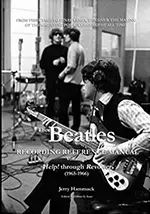
The second book of the Association for Recorded Sound Collections (ARSC)-nominated series, "The Beatles Recording Reference Manual: Volume 2: Help! through Revolver (1965-1966)" follows the evolution of the band from the end of Beatlemania with "Help!" through the introspection of "Rubber Soul" up to the sonic revolution of "Revolver". From the first take to the final remix, discover the making of the greatest recordings of all time.Through extensive, fully-documented research, these books fill an important gap left by all other Beatles books published to date and provide a unique view into the recordings of the world's most successful pop music act.

Notice any inaccuracies on this page? Have additional insights or ideas for new content? Or just want to share your thoughts? We value your feedback! Please use the form below to get in touch with us.


