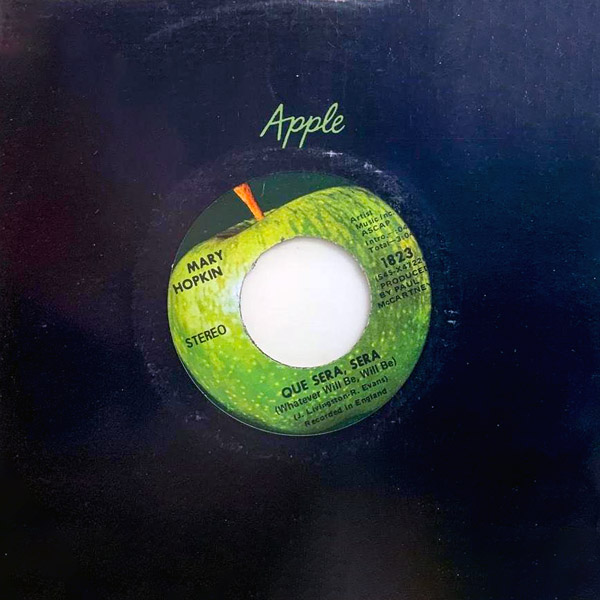
Released in 1970
Que Sera, Sera (Whatever Will Be, Will Be)
Written by Jay Livingston • Ray Evans
Last updated on April 26, 2025
Released in 1970
Written by Jay Livingston • Ray Evans
Last updated on April 26, 2025
Album This song officially appears on the Que Sera, Sera (Whatever Will Be, Will Be) / Fields Of St Etienne (US) 7" Single.
Timeline This song was officially released in 1970
This song was recorded during the following studio sessions:
Recording "Que Sera Sera", "Fields of St. Etienne" #2
July 6 or 13, 1969 ?

Officially appears on Goodbye / Sparrow

Officially appears on Those Were The Days / Turn! Turn! Turn!
Officially appears on Goodbye / Sparrow

Officially appears on Quelli Erano Giorni (Those Were The Days) / Turn! Turn! Turn!

Officially appears on Que Tiempo Tan Feliz (Those Were The Days) / Turn! Turn! Turn!

Officially appears on An Jenem Tag (Those Were The Days) / Turn! Turn! Turn!

Officially appears on Le Temps Des Fleurs (Those Were The Days) / Turn! Turn! Turn!
Officially appears on Those Were The Days / Turn! Turn! Turn!

Officially appears on Lontano Dagli Occhi / The Game
From Wikipedia:
“Que Será, Será (Whatever Will Be, Will Be)”[a] is a song written by Jay Livingston and Ray Evans and first published in 1955. Doris Day introduced it in the Alfred Hitchcock film The Man Who Knew Too Much (1956), singing it as a cue to their onscreen kidnapped son. The three verses of the song progress through the life of the narrator—from childhood, through young adulthood and falling in love, to parenthood—and each asks “What will I be?” or “What lies ahead?” The chorus repeats the answer: “What will be, will be.”
Day’s recording of the song for Columbia Records made it to number two on the Billboard Top 100 chart and number one in the UK Singles Chart. It came to be known as Day’s signature song. The song in The Man Who Knew Too Much received the 1956 Academy Award for Best Original Song. It was the third Oscar in this category for Livingston and Evans, who previously won in 1948 and 1950. In 2004 it finished at number 48 in AFI’s 100 Years…100 Songs survey of top tunes in American cinema. In 2012, the 1956 recording by Doris Day on Columbia Records was inducted into the Grammy Hall of Fame.
It was a number-one hit in Australia for pop singer Normie Rowe in September 1965.
The song popularized the title expression “que sera, sera” to express “cheerful fatalism”, though its use in English dates back to at least the 16th century. The phrase is evidently a word-for-word mistranslation of the English “What will be will be”, as in Spanish, it would be “lo que será, será”. […]
In 1969, Mary Hopkin recorded a cover of “Que Sera, Sera (Whatever Will Be, Will Be),” produced by Paul McCartney and featuring Ringo Starr on drums. Released as a single in the US, it reached number 77 on the Billboard Hot 100 and number 7 on the Adult Contemporary chart. The single marked the final collaboration between Mary Hopkin and Paul. For the next stage of her career, Mary would be produced by Mickie Most.
Tell us about “Que Sera Sera,” the last single Paul produced for you.
At the time, it was just one of Paul’s fun ideas. It was one sunny afternoon, we were sitting in Paul’s garden, and he said, “Do you like this song?” I said, “Well, I used to sing it when I was three!” And he said, “My dad likes it, let’s go and do it.” And so Ringo came along; it was all done in an afternoon. I was sort of swept along with Paul’s enthusiasm, really.
By the time I was halfway through the backing vocals, I said, “This is awful.” I really thought it was dreadful and I didn’t want it released.
Mary Hopkin – Interview with Goldmine Magazine, 1992
As far as I remember, it’s just Paul and Ringo. I don’t think he added anything else. It was all finished in that one afternoon.
Mary Hopkin – Interview with Goldmine Magazine, 1992
When I was just a little girl
I asked my mother, what will I be
Will I be pretty, will I be rich
Here's what she said to me.
Que Sera, Sera,
Whatever will be, will be
The future's not ours, to see
Que Sera, Sera
What will be, will be.
When I was young, I fell in love
I asked my sweetheart what lies ahead
Will we have rainbows, day after day
Here's what my sweetheart said.
Que Sera, Sera,
Whatever will be, will be
The future's not ours, to see
Que Sera, Sera
What will be, will be.
Now I have children of my own
They ask their mother, what will I be
Will I be handsome, will I be rich
I tell them tenderly.
Que Sera, Sera,
Whatever will be, will be
The future's not ours, to see
Que Sera, Sera
What will be, will be.

Que Sera, Sera (Whatever Will Be, Will Be) / Fields Of St Etienne (US)
7" Single • Released in 1970
3:04 • Studio version • A
Paul McCartney : Acoustic guitar, Bass, Electric guitar, Producer Ringo Starr : Drums Mary Hopkin : Acoustic guitar, Vocals
SessionRecording : July 6 or 13, 1969 ? • Studio : EMI Studios, Studio Two, Abbey Road • London • UK
SessionRecording : Aug 17, 1969 ? • Studio : EMI Studios, Abbey Road Studios • London • UK

LP • Released in 1972
3:04 • Studio version • A
Paul McCartney : Acoustic guitar, Bass, Electric guitar, Producer Ringo Starr : Drums Mary Hopkin : Acoustic guitar, Vocals
SessionRecording : July 6 or 13, 1969 ? • Studio : EMI Studios, Studio Two, Abbey Road • London • UK
SessionRecording : Aug 17, 1969 ? • Studio : EMI Studios, Abbey Road Studios • London • UK
Paul McCartney: Music Is Ideas. The Stories Behind the Songs (Vol. 1) 1970-1989
With 25 albums of pop music, 5 of classical – a total of around 500 songs – released over the course of more than half a century, Paul McCartney's career, on his own and with Wings, boasts an incredible catalogue that's always striving to free itself from the shadow of The Beatles. The stories behind the songs, demos and studio recordings, unreleased tracks, recording dates, musicians, live performances and tours, covers, events: Music Is Ideas Volume 1 traces McCartney's post-Beatles output from 1970 to 1989 in the form of 346 song sheets, filled with details of the recordings and stories behind the sessions. Accompanied by photos, and drawing on interviews and contemporary reviews, this reference book draws the portrait of a musical craftsman who has elevated popular song to an art-form.
The McCartney Legacy: Volume 1: 1969 – 73

In this first of a groundbreaking multivolume set, THE MCCARTNEY LEGACY, VOL 1: 1969-73 captures the life of Paul McCartney in the years immediately following the dissolution of the Beatles, a period in which McCartney recreated himself as both a man and a musician. Informed by hundreds of interviews, extensive ground up research, and thousands of never-before-seen documents THE MCCARTNEY LEGACY, VOL 1 is an in depth, revealing exploration of McCartney’s creative and personal lives beyond the Beatles.

Notice any inaccuracies on this page? Have additional insights or ideas for new content? Or just want to share your thoughts? We value your feedback! Please use the form below to get in touch with us.