Tuesday, September 16, 1969
John Lennon tells the other Beatles he’s leaving the band
Last updated on June 28, 2025
Tuesday, September 16, 1969
Last updated on June 28, 2025
Article September to November 1969 • ATV finalizes its acquisition of Northern Songs
Article Sep 09, 1969 • Paul McCartney, John Lennon and George Harrison discuss the future of The Beatles
Article Sep 16, 1969 • John Lennon tells the other Beatles he's leaving the band
Article Sep 16, 1969 • Maclen Ltd launches legal proceedings against Northern Songs Ltd
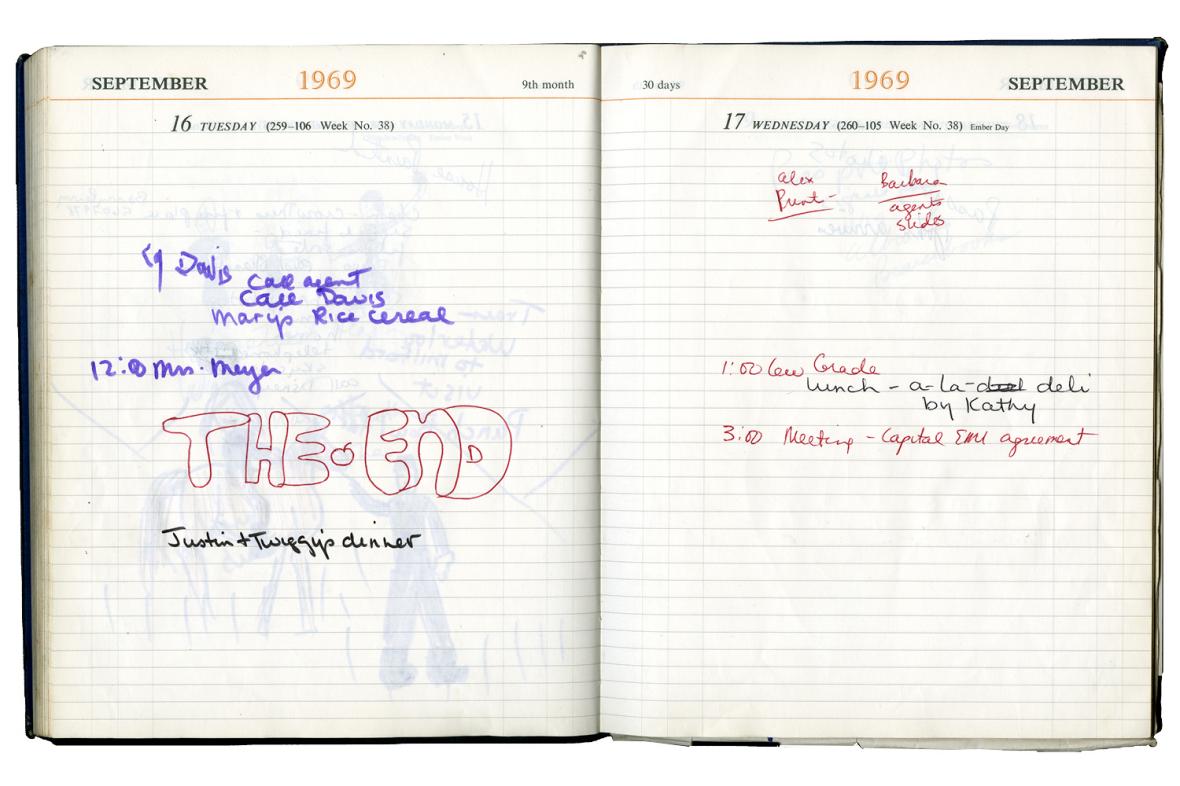
Article Sep 17, 1969 • Meeting to discuss the Capitol / EMI agreement

The Beatles hire Alexis “Magic Alex” Mardas
Aug 24, 1967

Apple Corps open offices in London
Jan 22, 1968

Designing the Apple Records logo
February - July 1968
Mar 29, 1968
Paul McCartney meets American scriptwriter Francie Schwartz
April or May 1968
Apple publishes an ad to find new talent
Apr 19, 1968
Paul and John meet Ron Kass in New York
May 12, 1968
The Beatles promote Apple Corps in New York
May 14, 1968
Paul and John fly from New York to London
May 15, 1968
The Apple shop mural is being removed
May 15-18, 1968
May 23, 1968
Paul McCartney celebrates his 26th birthday
Jun 18, 1968
On this day, John Lennon announced his decision to leave The Beatles to Paul McCartney and Ringo Starr.
On September 8, while Ringo was in the hospital undergoing tests, Paul, John, and George met to discuss the band’s future. With the release of “Abbey Road” just days away, the three Beatles discussed their next steps as a band, including potential future recording projects. John appeared fully engaged in the discussion, showing no outward signs of disinterest.
Just five days later, on September 13, John performed with his new group, the Plastic Ono Band, at a concert in Toronto. Nervous about facing a large audience again, he nonetheless received an enthusiastic welcome. It was during the return flight to London that John took the decision to leave The Beatles.
He shared this decision on this day. However, due to the new contract with Capitol / EMI, both Allen Klein and Paul urged John to keep the news confidential for the time being. John agreed.
Paul drew a bold ‘THE END’ in red letters across his diary entry for the day.
We weren’t going to say anything about it for months, for business reasons. But the really hurtful thing to me was that John was really not going to tell us. I think he was heavily under the influence of Allen Klein. And Klein, so I heard, had said to John – the first time anyone had said it – “What does Yoko want?” So since Yoko liked Klein because he was for giving Yoko anything she wanted, he was the man for John. That’s my theory on how it happened.
Paul McCartney – From interview with Playboy, 1984
When I got back [from Toronto] there were a few meetings and Allen said, ‘Cool it,’ ’cause there was a lot to do [with The Beatles] business-wise, and it wouldn’t have been suitable at the time. Then we were discussing something in the office with Paul and Paul was saying to do something, and I kept saying, ‘No, no, no’ to everything he said. So it came to a point that I had to say something. So I said, ‘The group’s over, I’m leaving.’ Allen was there, and he was saying, ‘Don’t tell.’ He didn’t want me to tell Paul even. But I couldn’t help it, I couldn’t stop it, it came out. And Paul and Allen said they were glad that I wasn’t going to announce it, like I was going to make an event out of it. I don’t know whether Paul said, ‘Don’t tell anybody,’ but he was damn pleased that I wasn’t. He said, ‘Oh well, that means nothing really happened if you’re not going to say anything.’
So that’s what happened. So, like anybody when you say divorce, their face goes all sorts of colours. It’s like he knew really that this was the final thing; and six months later he comes out with whatever. I was a fool not to do it, not to do what Paul did, which was use it to sell a record.”
John Lennon – From Lennon Remembers, Jann S Wenner, 1970
[In September,] I offered ‘Cold Turkey’ to the Beatles, but they weren’t ready to record a single. When I wrote it, I went to the other three Beatles and said, ‘Hey, lads, I think I’ve written a new single.’ But they all said, ‘Ummmm… arrrr… well,’ because it was going to be my project, and so I thought, ‘Bugger you, I’ll put it out myself.’ So I did it as the Plastic Ono Band. I don’t care what it goes out as, as long as it goes out.
John Lennon – October 1969 interview – Quoted in “Solid State: The Story of Abbey Road and the End of the Beatles” by Kenneth Womack, 2019 – Paul McCartney and George Harrison rejected “Cold Turkey” because of its theme. The song was about heroin addiction.
On half of the tracks on Abbey Road, I’m not even on them. I’m not even on half of the tracks on the double album. Even way back then, sometimes there might only be two Beatles on a track. It’s got to the situation where if you have the name ‘Beatles’ on it, it sells. So you got to think, ‘What are we selling?’ Do they buy it because it’s worth it, or just because it says ‘Beatles’?
John Lennon – From “The Beatles: Off the Record” by Keith Badman, 2008
After the Plastic Ono Band’s debut in Toronto, we had a meeting in Savile Row where John finally brought it to its head. He said: ‘Well, that’s it, lads. Let’s end it.’ And we all said ‘yes’. And though I said ‘yes’ because it was ending (and you can’t keep it together anyway, if this is what the attitude is) I don’t know if I would have said, ‘End it.’ I probably would have lingered another couple of years.
But when we all met in the office, we knew it was good. It wasn’t sulky and we weren’t really fighting. It was like a thought came into the room, and everyone said what they said. John didn’t think we should leave, just that we should break it up. It was not: ‘I’m leaving, you’re leaving.’ It was: ‘Well, that’s it! I’ve had enough. I want to do this…’
If that had happened in 1965, or 1967 even, it would have been a mighty shock. Now it was just ‘let’s get the divorce over with’, really. And John was always the most forward when it came to nailing anything.
Ringo Starr – From The Beatles Anthology, 2000
We were all summoned to sign a new Capitol contract at Apple. We all went round to do it, and it got a little bit “Well, why are we doing this? Are we sure the group is going to continue?”‘ “Oh, sure, it’ll all continue.” “Well, how’s it going to continue? What are we going to do? Massive big shows?”‘ Then I propounded the theory, “I think we should get back to our basics. I think we’ve got out of hand, we’ve overwhelmed ourselves and I think what we need is to re-establish our musical identity and find out who we are again, and so we should go back to little gigs.” At that point, John looked at me and said, “Well, I think yet daft!” Which was a little bit of a show-stopper. He said, “Well, I wasn’t gonna tell you till after we’d signed the Capitol contract. Klein asked me not to tell you. But, seeing as you asked me, I’m leaving the group.” So everyone went, “Gulp!” The weight was dropped, our jaws dropped along with it, everyone blanched except John, who coloured a little and said, “It’s rather exciting. It’s like I remember telling Cynthia I wanted a divorce.” And I think from what he was saying there was an adrenalin rush that came with telling. So that was it. We signed the new Capitol deal in a bit of a daze, not quite knowing why we’d done it. That’s my recollection.
Paul McCartney – From “Paul McCartney: Many Years from Now” by Barry Miles, 1997
Towards the end of 1969, John had quite gleefully told us it was over. There were a few of us in the Apple boardroom at the time. I think George was away visiting family, but Ringo and I were at the meeting, and John was saying no to every suggestion. I thought we should go back to playing smaller gigs again, but the answer came back: ‘No’. Eventually John said, ‘Oh, I’ve been wanting to tell you this, but I’m leaving The Beatles.’ We were all shocked. Relations had been strained, but we sat there saying, ‘What? Why? Why? Why?’ It was like a divorce, and he had just had a divorce from Cynthia the year before. I can remember him saying, ‘Oh, this is quite exciting.’ That was very John, and I had admired this kind of contrarian behaviour about him since we were kids, when I first met him. He really was a bit loony, in the nicest possible way. But whilst all of us could see what he meant, it was not quite so exciting for those left on the other side.
Paul McCartney – From “The Lyrics: 1956 to the Present“, 2021
The group was getting very tense and it looked like it was going to break up. We had a meeting and it was getting very serious. It was all Apple and Allen Klein, and no one was enjoying themselves. We had forgotten the music, it was just business … We were summoned to sign a new Capitol contract at Apple … and it got a little bit, ‘Well, why are we doing this? Are we sure the group is going to continue? What are we going to do? Massive big show?’ Then I propounded the theory, ‘I think we should get back to our basics. I think we’ve got out of hand. We’ve overwhelmed ourselves and I think what we need is to re-establish our musical identity and find out who we are again, and so we should go back to little gigs’ … Small bands, go back and do the clubs, sod it, let’s get back to square one and remember what it was all about, and get back.
Paul McCartney – From “The Beatles: Off the Record” by Keith Badman, 2008
I’d said: ‘I think we should go back to little gigs – I really think we’re a great little band. We should find our basic roots, and then who knows what will happen? We may want to fold after that, or we may really think we’ve still got it.’ John looked at me in the eye and said: ‘Well, I think you’re daft. I wasn’t going to tell you till we signed the Capitol deal’ – Klein was trying to get us to sign a new deal with the record company – ‘but I’m leaving the group!’ We paled visibly and our jaws slackened a bit.
I must admit we’d known it was coming at some point because of his intense involvement with Yoko. John needed to give space to his and Yoko’s thing. Someone like John would want to end The Beatles period and start the Yoko period; and he wouldn’t like either to interfere with the other. But what wasn’t too clever was this idea of: ‘I wasn’t going to tell you till after we signed the new contract.’ Good old John – he had to blurt it out. And that was it. There’s not a lot you can say to, ‘I’m leaving the group,’ from a key member.
I didn’t really know what to say. We had to react to him doing it; he had control of the situation. I remember him saying, ‘It’s weird this, telling you I’m leaving the group, but in a way it’s very exciting.’ It was like when he told Cynthia he was getting a divorce. He was quite buoyed up by it, so we couldn’t really do anything: ‘You mean leaving’? So that’s the group, then…’ It was later, as the fact set in, that it got really upsetting.
Paul McCartney – From The Beatles Anthology, 2000
Towards the end of 1969, John had quite gleefully told us it was over. There were a few of us in the Apple boardroom at the time. I think George was away visiting family, but Ringo and I were at the meeting, and John was saying no to every suggestion. I thought we should go back to playing smaller gigs again, but the answer came back: “No”. Eventually John said, “Oh, I’ve been wanting to tell you this, but I’m leaving the Beatles.’” We were all shocked. Relations had been strained, but we sat there saying, “What? Why? Why? Why?” It was like a divorce, and he had just had a divorce from Cynthia the year before. I can remember him saying, “Oh, this is quite exciting.” That was very John, and I had admired this kind of contrarian behaviour about him since we were kids, when I first met him. He really was a bit loony, in the nicest possible way. But while all of us could see what he meant, it was not quite so exciting for those left on the other side.
Paul McCartney – From The Sunday Times Magazine, 2021
All of them had left the group at one time or another, starting with Ringo. [But when] John came into the office and said, ‘the marriage is over! I want a divorce,’… that was the final thing. That’s what really got to Paul, you know, because I took Paul home and I ended up in the garden crying my eyes out.
Mal Evans – From “The Beatles: Off the Record” by Keith Badman, 2008
In the months that followed, numerous signs pointed to an impending breakup of The Beatles — including an unambiguous comment by Paul McCartney in a Life magazine interview published in November 1969.
However, what would later be seen as the official announcement came eight months later, in April 1970, when McCartney issued a press release for his debut solo album, “McCartney.”
The Beatle thing is over. It has been exploded, partly by what we have done, and partly by other people. We are individuals, all different. John married Yoko, I married Linda. We didn’t marry the same girl.
Paul McCartney – From interview with Life Magazine, November 1969
The Beatles Diary Volume 1: The Beatles Years
With greatly expanded text, this is the most revealing and frank personal 30-year chronicle of the group ever written. Insider Barry Miles covers the Beatles story from childhood to the break-up of the group.
If we modestly consider the Paul McCartney Project to be the premier online resource for all things Paul McCartney, it is undeniable that The Beatles Bible stands as the definitive online site dedicated to the Beatles. While there is some overlap in content between the two sites, they differ significantly in their approach.

Notice any inaccuracies on this page? Have additional insights or ideas for new content? Or just want to share your thoughts? We value your feedback! Please use the form below to get in touch with us.


