
Saturday, September 20, 1969
Interview for Evening Standard
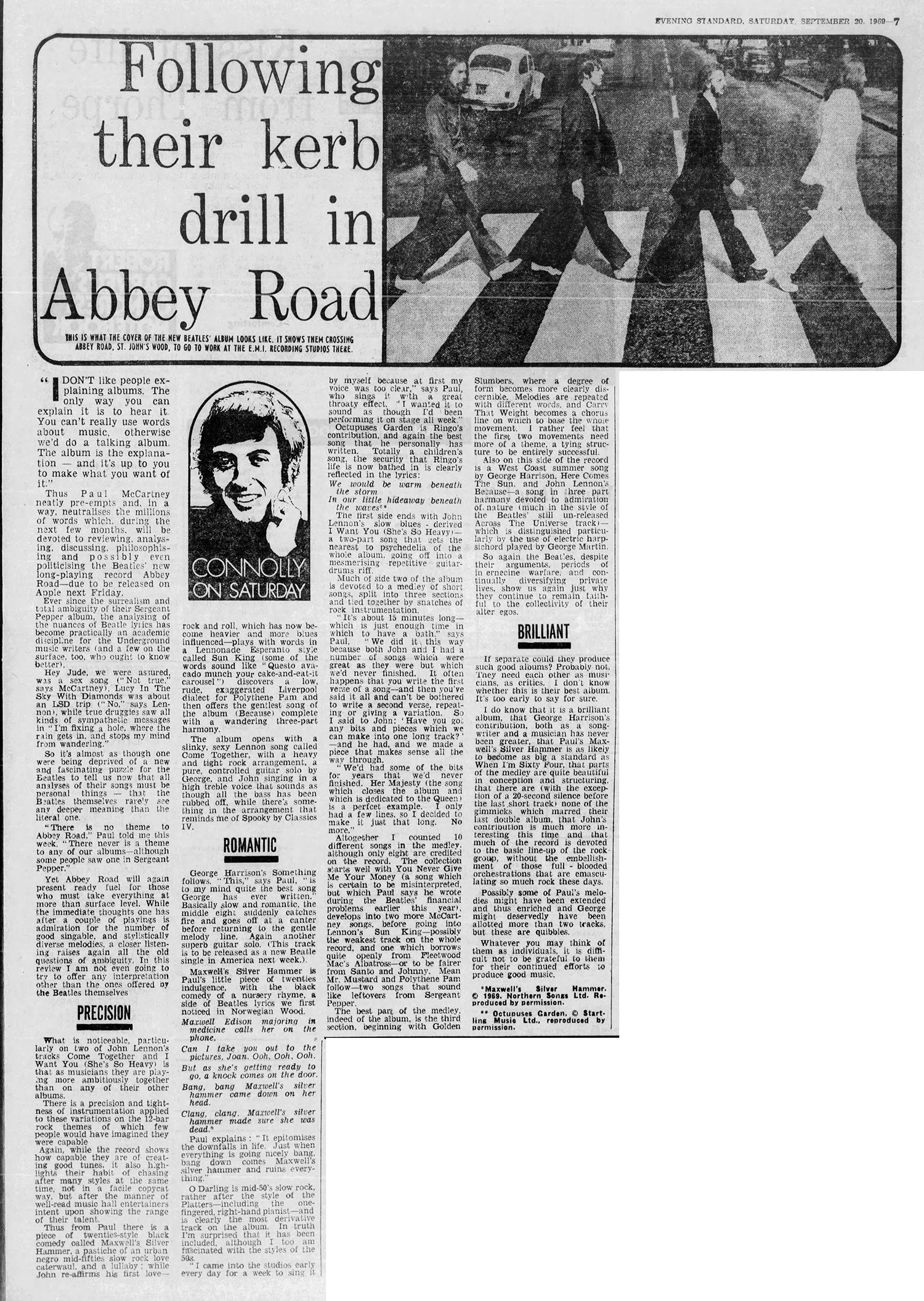
Following their kerb drill in Abbey Road
Press interview • Interview of Paul McCartney
Last updated on May 8, 2025
Saturday, September 20, 1969
Press interview • Interview of Paul McCartney
Last updated on May 8, 2025
Previous interview Jul 19, 1969 • Allen Klein interview for Record Retailer
Article Sep 20, 1969 • US radio WKBW broadcasts the "Get Back" LP
Article Sep 20, 1969 • The Beatles sign the new Capitol / EMI agreement
Interview Sep 20, 1969 • Paul McCartney interview for Evening Standard
Interview Sep 21, 1969 • Paul McCartney interview for BBC Radio 1
Article Sep 22, 1969 • US radio WBCN broadcasts the “Get Back” LP
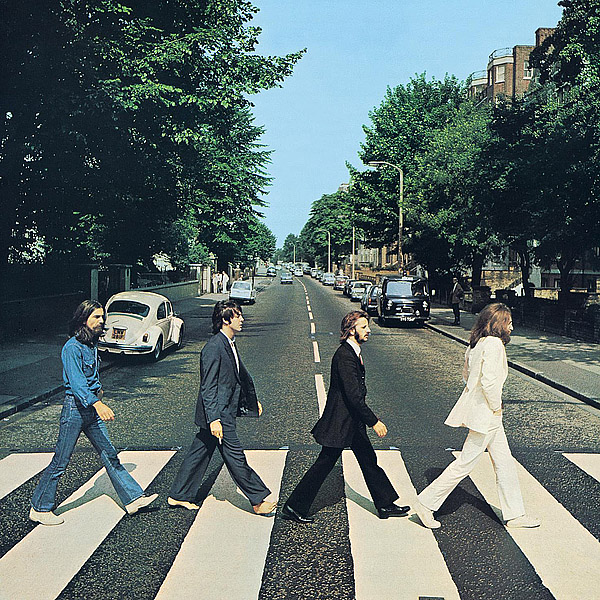
AlbumThis interview was made to promote the "Abbey Road" LP.

Officially appears on Abbey Road
Officially appears on Abbey Road
Officially appears on Abbey Road
Officially appears on Abbey Road
Officially appears on Abbey Road
Officially appears on Abbey Road
Officially appears on Abbey Road
Officially appears on Abbey Road
This interview remains the property of the respective copyright owner, and no implication of ownership by us is intended or should be inferred. Any copyright owner who wants something removed should contact us and we will do so immediately.
‘I don’t like people explaining albums. The only way you can explain it is to hear it. You can’t really use words about music, otherwise we’d do a talking album. The album is the explanation and it’s up to you to make what you want of it.’
Thus, Paul McCartney pre-empts and neutralises the millions of words which, during the next few months, will be devoted to reviewing, analysing, discussing, and philosophising on Abbey Road, the Beatles new album which is due to be released next Friday.
Ever since the surrealism and ambiguity of Sergeant Pepper, analysing the nuances of Beatle lyrics has become practically an academic discipline for Underground music writers, and a few on the surface, too, who ought to know better.
Hey Jude, we were assured, was a sex song (‘Not true,’ says McCartney), Lucy In The Sky With Diamonds was about an LSD trip (‘No,’ says Lennon), while druggies saw all kinds of messages in ‘I’m fixing a hole, where the rain gets in, and stops my mind from wandering’.
So it’s almost as though we are being deprived of a new and fascinating puzzle for the Beatles to tell us now that all analyses of their songs must be personal things, that the Beatles themselves rarely see any deeper meaning than the literal one.
‘There is no theme to Abbey Road,’ Paul told me this week. ‘There never is a theme to any of our albums, although some people saw one in Sergeant Pepper.’
Yet Abbey Road will again present ready fuel for those who must take everything at more than surface level. While the immediate thoughts one has after a couple of playings is admiration for the number of good singable, and stylistically diverse melodies, a closer listening raises again all the old questions of ambiguity. In this review I am not even going to try to offer any interpretation other than the ones offered oy the Beatles themselves.
What is noticeable, particularly on two of John Lennon’s tracks Come Together and I Want You (She’s So Heavy) is that as musicians they are playing more ambitiously together than on any of their other albums.
There is a precision and tightness of instrumentation applied to these variations on the 12-bar rock themes of which few people would have imagined they were capable.
Again, while the record shows how capable they are of creating good tunes, it also highlights their habit of chasing after many styles at the same time, not in a facile copycat way, but after the manner of well-read music hall entertainers intent upon showing the range of their talent.
Thus from Paul there is a piece of twenties-style black comedy called Maxwell’s Silver Hammer, a pastiche of an urban negro mid-fifties slow rock love caterwaul, and a lullaby; while John re-affirms his first love – rock and roll, which has now become heavier and more blues influenced — plays with words in a Lennonade Esperanto style called Sun King (some of the words sound like “Questo ava-cado munch your cake-and-eat-it carousel”), discovers a low, rude, exaggerated Liverpool dialect for Polythene Pam and then offers the gentlest song of the album (Because) complete with a wandering three-part harmony.
The album opens with a slinky, sexy Lennon song called Come Together, with a heavy and tight rock arrangement, a pure, controlled guitar solo by George, and John singing in a high treble voice that sounds as though all the bass has been rubbed off. while there’s something in the arrangement that reminds me of Spooky by Classics IV.
George Harrison’s Something follows.
‘This,’ says Paul, ‘is to my mind the best song George has ever written.’
Basically slow and romantic, the middle eight suddenly catches fire and goes off at a canter before returning to the gentle melody line. Again another superb guitar solo. (This track is to be released as a new Beatle single in America next week.)
Maxwell’s Silver Hammer is Paul’s little piece of twenties indulgence, with the black comedy of a nursery rhyme, a side of Beatles lyrics we first noticed in Norwegian Wood.
Maxwell Edison majoring in medicine calls her on the phone.
Can I take you out to the pictures. Joan. Ooh. Ooh. Ooh.
But as she’s getting ready to go, a knock comes on the door.
Bang, bang Maxwell’s silver hammer came down on her head.
Clang, clang. Maxwell’s silver hammer made sure she was dead
Paul explains:
‘It epitomises the downfalls in life. Just when everything is going nicely, bang, bang, along comes Maxwell’s silver hammer and ruins everything,’
Oh Darling is mid-50’s slow rock, rather after the style of the Platters — including the one-fingered. right-hand pianist — and is clearly the most derivative track on the album. In truth I’m surprised that it has been included, although I too am fascinated with the styles of the 50s.
‘I came into the studios early every day for a week to sing it by myself because at first my voice was too clear,’ says Paul, who sings it with a great throaty effect. ‘I wanted it to sound as though I’d been performing it on the road all week.’
Octupus’s Garden is Ringo’s contribution, and again the best song that he personally has written. Totally a children’s song, the security that Ringo’s life is now bathed in is clearly reflected in the lyrics:
We would be warm beneath the storm
In our little hideaway beneath the waves
The first side ends with John Lennon’s slow blues – derived I Want You (She’s So Heavy) – a two-part song that gets the nearest to psychedelia of the whole album, going off into a mesmerising repetitive guitar-drums riff.
Much of side two is devoted to a medley of short songs, split into three sections and tied together by snatches of rock instrumentation.
‘It’s about 15 minutes long, which is just enough time in which to have a bath,’ says Paul. ‘We did it this way because both John and I had a number of songs which were great as they were, but which we’d never finished. It often happens that you write the first verse of a song and then you’ve said it all and can’t be bothered to write a second verse, repeating or giving a variation. So, I asked John if he had any bits and pieces which they could make into one long track? He had, and we made a piece that makes sense all the way through.
‘We’d had some of the bits for years that we’d never finished. Her Majesty (the song which closes the album and which is dedicated to the Queen) is a perfect example. I only had a few lines, so I decided to make it just that long. No more.’
Altogether I counted 10 different songs in the medley, although only eight are credited on the record. The collection starts well with You Never Give Me Your Money (a song which is certain to be misinterpreted, but which Paul says he wrote during the Beatles’ financial problems earlier this year), develops into two more McCartney songs, before going into Lennon’s Sun King — possibly the weakest track on the whole record, and one which borrows quite openly from Fleetwood Mac’s Albatross — or to be fairer from Santo and Johnny. Mean Mr. Mustard and Polythene Pam follow — two songs that sound like leftovers from Sergeant Pepper.
The best part, of the medley, indeed of the album, is the third section, beginning with Golden Slumbers, where a degree of form becomes more clearly discernible. Melodies are repeated with different words, and Carry That Weight becomes a chorus line on which to base the whole movement. I rather feel that the first two movements need more of a theme, a tying structure to be entirely successful.
Also on this side of the record is a West Coast summer song by George Harrison, Here Comes The Sun, and John Lennon’s Because — a song in three part harmony devoted to admiration of nature (much in the style of the Beatles’ still un-released Across The Universe track) -which is distinguished particularly by the use of electric harpsichord played by George Martin.
So again the Beatles, despite their arguments, periods of in ernecine warfare, and continually diversifying private lives, show us again just why they continue to remain faithful to the collectivity of their alter egos.
If separate could they produce such good albums? Probably not. They need each other as musicians. as critics. I don’t know whether this is their best album. It’s too early to say for sure.
I do know that it is a brilliant album, that George Harrison’s contribution, both as a songwriter and a musician has never been greater, that Paul’s Maxwell’s Silver Hammer is as likely to become as big a standard as When I’m Sixty Four, that parts of the medley are quite beautiful in conception and structuring, that there are (with the exception of a 20-second silence before the last short track) none of the gimmicks which marred their last double album, that John’s contribution is much more interesting this time and that much of the record is devoted to the basic line-up of the rock group, without the embellishment of those full-blooded orchestrations that are emasculating so much rock these days.
Possibly some of Paul’s melodies might have been extended and thus enriched and George might deservedly have been allotted more than two tracks, but these are quibbles.
Whatever you may think of them as individuals, it is difficult not to be grateful to them for their continued efforts to produce good music.

Notice any inaccuracies on this page? Have additional insights or ideas for new content? Or just want to share your thoughts? We value your feedback! Please use the form below to get in touch with us.