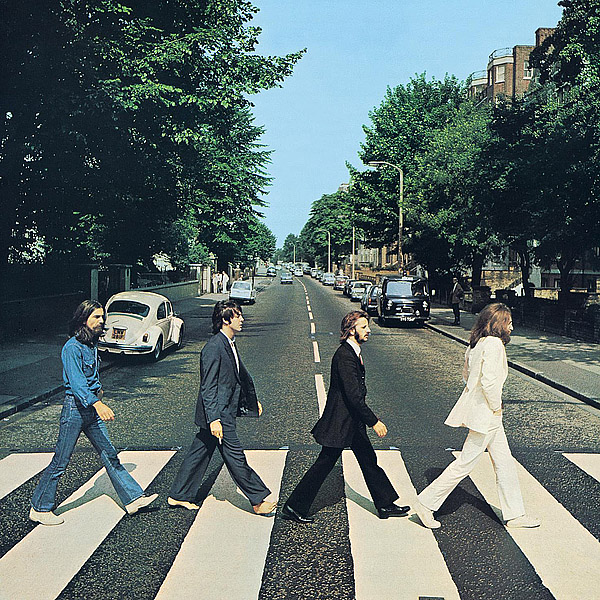

Feb 22 - Aug 25, 1969 • Songs recorded during this session appear on Abbey Road
Previous session Jul 18, 1969 • Recording and mixing "Oh! Darling", "Octopus's Garden"
Interview Jul 19, 1969 • Allen Klein interview for Record Retailer
Article Jul 20, 1969 • The Beatles are shown a rough cut of the "Let It Be" film
Session Jul 21, 1969 • Recording "Come Together"
Session Jul 22, 1969 • Recording "Oh! Darling", "Come Together"
Session Jul 23, 1969 • Recording "Oh! Darling", "Come Together", "The End"
AlbumSome of the songs worked on during this session were first released on the "Abbey Road" LP

By The Beatles
Since the beginning of the “Abbey Road” sessions in early July, John Lennon had contributed little — either due to his recovery from a car accident on July 1 or a lack of interest in participating. On this day, however, he re-engaged by introducing “Come Together,” his first new composition since April’s “The Ballad Of John And Yoko“.
In a session that ran from 2:30 pm to 9:30 pm, The Beatles recorded eight takes of the basic track onto a four-track tape. John handled guide vocals, handclaps, and tambourine (on track four); Paul McCartney played bass (track one); George Harrison contributed guitar (track two); and Ringo Starr was on drums (track three).
Take 1 was released on “Anthology 3” in 1996.
Takes 4, 5, and 7 were incomplete, though Take 5 was included in the “Abbey Road (50th anniversary boxset)” released in 2019.
Take 6 was considered the best and was copied onto an eight-track tape at the end of the session. “Come Together” would receive its first overdubs on the following day.
The first time [John] played it for us, chugging away on his acoustic guitar, it was a lot faster than the final version that made it to the album. It was Paul who suggested it be done at a slower tempo, with a “swampy” kind of sound, and Lennon went along with it uncomplainingly; he always took well to constructive
criticism.John was in a pretty good mood that day, too—he seemed to come to life when we were working on one of his own songs, rather than one of Paul’s or George’s. True, all three of them exhibited a lack of patience if it wasn’t their song—there was always a definite drop-off in interest whenever any one of them was working on another Beatle’s composition—but John was consistently the most flagrant offender.
Geoff Emerick – From “Here, There and Everywhere: My Life Recording the Music of The Beatles“, 2006
“Come Together” changed at a session. We said, “Let’s slow it down. Let’s do this to it, let’s do that to it”, and it ends up however it comes out. I just said, “Look, I’ve got no arrangement for you, but you know how I want it”. I think that’s partly because we’ve played together a long time. So I said, “Give me something funky”, and set up a beat, maybe, and they all just join in.
John Lennon – 1969 interview
I laid that bass line down which very much makes the mood. It’s actually a bass line that people now use very often in rap records. If it’s not a sample, they use that riff. But that was my contribution to that.
Paul McCartney – From “Paul McCartney: Many Years from Now” by Barry Miles, 1997
It really happened quite organically in the studio. My famous occasion with bass radically altering the whole attitude of the song was when John came in. I said, ‘Ah, ah, ah, wait a minute, wait a minute, that’s Chuck Berry’s song!’ There’s a Chuck Berry song which is called ‘You Can’t Catch Me,’ which not only was like that (rhythmically), the opening line is ‘here come old flat top.’ That actually IS the Chuck Berry song! So I said, ‘Oh, man, you know, look, it’s a great song, I love it, but we gotta do something to get away from that.’ So I suggested we slowed it down, which now gave it a kind of really nice ‘swampy’ backup. And it changed his attitude to it (vocally).
Paul McCartney – From “McCartney 3,2,1” documentary series, 2021 – Quoted in beatlesebooks.com
The basic track of John Lennon’s Come Together – the song that opened Abbey Road – was recorded in a single session, the “best” version, Take 8, being bounced down into Take 9 which then received overdubs over the next few days and became the master. Typically, John delivered a committed live vocal with every take, and this Anthology selection, previously unreleased, is Take 1. Not playing an instrument, John clapped his hands while singing, adding tambourine late in the piece, with the other Beatles contributing what for the first take is a notably cohesive bass, guitar and drums backing to fill out this four-track recording. The absence of the echo that, at John’s request, would smother the master version lends a stark clarity to the lyrics, which altered slightly when the definitive vocal was overdubbed.
From Anthology 3 liner notes
This day also marked Geoff Emerick’s first day as recording engineer for the “Abbey Road” sessions. He had previously walked out on The Beatles’ sessions during the recording of the White Album, on July 16, 1968. Although he resumed working with them as engineer for “The Ballad Of John And Yoko” on April 14, 1969, his involvement in the Abbey Road sessions had been informal until this point.
According to his memoir “Here, There and Everywhere: My Life Recording the Music of The Beatles“, Emerick had been present in the studio since early July 1969, but not in an official position, until that day.
You returned because the band promised to make nice and get along for Abbey Road.
That’s right. It came about through a conversation George Martin had with Paul. I had left EMI, but I was employed by The Beatles and was overseeing the construction of a new studio for them at Apple.
After Let It Be, which I understand was not very pleasant for anybody, Paul was very keen to make a record the way the band used to. He wanted George Martin and I behind the console and everybody working together. He said things would be better than what they had been.
Did you take Paul at his word, that there would be a spirit of harmony?
Yes, I did take him at his word. And John said the same thing to George Martin. In the back of my head I might have had some reservations, like, ‘Well, we’ll see…’ But I was surprised and pleased at how everybody got along.
Geoff Emerick – From MusicRadar, 2014 interview
Recording • Take 1
AlbumOfficially released on Anthology 3
Recording • Take 2
Recording • Take 3
Recording • Take 4
Recording • Take 5
AlbumOfficially released on Abbey Road (50th anniversary boxset)
Recording • Take 6
Recording • Take 7
Recording • Take 8
Tape copying • Tape copying of take 6, called take 9
The Complete Beatles Recording Sessions • Mark Lewisohn
The definitive guide for every Beatles recording sessions from 1962 to 1970. We owe a lot to Mark Lewisohn for the creation of those session pages, but you really have to buy this book to get all the details - the number of takes for each song, who contributed what, a description of the context and how each session went, various photographies... And an introductory interview with Paul McCartney!
The Beatles Recording Reference Manual: Volume 5: Let It Be through Abbey Road (1969 - 1970)

The fifth and final book of this critically acclaimed series, "The Beatles Recording Reference Manual: Volume 5: Let It Be through Abbey Road (1969 - 1970)" follows The Beatles as they "get back to where they once belonged...". Not once, but twice. With "Let It Be", they attempted to recapture the spontaneity of their early years and recordings, while "Abbey Road" was a different kind of return - to the complexity, finish and polish that they had applied to their work beginning with "Revolver" and through to "The Beatles".
Solid State: The Story of "Abbey Road" and the End of the Beatles
Acclaimed Beatles historian Kenneth Womack offers the most definitive account yet of the writing, recording, mixing, and reception of Abbey Road. In February 1969, the Beatles began working on what became their final album together. Abbey Road introduced a number of new techniques and technologies to the Beatles' sound, and included "Come Together," "Something," and "Here Comes the Sun," which all emerged as classics.
If we modestly consider the Paul McCartney Project to be the premier online resource for all things Paul McCartney, it is undeniable that The Beatles Bible stands as the definitive online site dedicated to the Beatles. While there is some overlap in content between the two sites, they differ significantly in their approach.

Notice any inaccuracies on this page? Have additional insights or ideas for new content? Or just want to share your thoughts? We value your feedback! Please use the form below to get in touch with us.


