
April or May 1968
Paul McCartney meets American scriptwriter Francie Schwartz
Last updated on August 31, 2025
April or May 1968
Last updated on August 31, 2025
Previous article Mar 29, 1968 • Derek Taylor joins Apple
Album Apr 06, 1968 • "Sher-oo! (Stereo)" by Cilla Black released in the UK
Album Apr 06, 1968 • "Sher-oo! (Mono)" by Cilla Black released in the UK
Article April or May 1968 • Paul McCartney meets American scriptwriter Francie Schwartz
Article Apr 19, 1968 • Apple publishes an ad to find new talent
Article May 1968 • Paul McCartney meets with duo Drew And Dy

The Beatles hire Alexis “Magic Alex” Mardas
Aug 24, 1967

Apple Corps open offices in London
Jan 22, 1968

Designing the Apple Records logo
February - July 1968
Mar 29, 1968
Apple publishes an ad to find new talent
Apr 19, 1968
Paul and John meet Ron Kass in New York
May 12, 1968
The Beatles promote Apple Corps in New York
May 14, 1968
Paul and John fly from New York to London
May 15, 1968
The Apple shop mural is being removed
May 15-18, 1968
May 23, 1968
Paul McCartney celebrates his 26th birthday
Jun 18, 1968
Francie Schwartz, an American scriptwriter born in 1944, moved to London in April 1968 where she was employed by Apple Corps. She began a romantic relationship with Paul McCartney, leading to the end of his four-year engagement with Jane Asher. By August 1968, Schwartz had ended her involvement with both Paul and Apple and returned to the United States.
In an article published by Rolling Stone in November 1969, she recalled meeting Paul for the first time in “April 1968,” adding that “the next day, he and John flew to New York, appeared on the Johnny Carson show, stated their intentions for Apple.” In reality, Paul and John travelled to New York to promote Apple on May 11, 1968.
In her memoir “Body Count“, published in 1972, Schwartz wrote that she arrived in London on April 3, 1968, and soon after visited the Apple Corps office at 95 Wigmore Street, where she had her first encounter with Paul.
After this initial meeting, she did not see him again until June 4, 1968, when she was invited to a Beatles recording session at Abbey Road.
In April, 1968, the Apple offices were on Wigmore Street in a gray six-or-seven story building. There was a reception room strangely similar to the intake room at Bellevue Mental Hospital, but with nicer carpeting. There was a skinny English receptionist who politely juggled the many freaks, writers, authors, musicians, and con-men who walked in hoping to take something out.
Just my luck: Paul McCartney, M.B.E. was standing there talking to four business-suited VIP’s when I walked in. He was also in the mood to be interrupted by a strange lady with a film property.
I’d never seen him in person before. The impact was surprising. Diffused. Magical. Yes, he’s very pretty. Yes, he’s very charming. But who the hell is he? We talked small talk in that room, and I went away without script, totally Beatlized. […]
Paul McCartney asked me what I wanted to do.
“Be free. Make it better.” I said. He nodded thoughtfully.
The next day, he and John flew to New York, appeared on the Johnny Carson show, stated their intentions for Apple: To receive and develop the work of unrecognized writers and artists, and help “The Little Man.” […]
Francie Schwartz – From Rolling Stone, November 15, 1969
I went to Wigmore Street, despite the fact that her girl on the phone told me that Paul was out of town, or very busy.
I thought, well, you’ve come this far, he has to be there. I know he’s there. So I went, and he was there.
He was standing ten feet from the receptionist’s desk. I watched him turn around when the girl whispered my name into his ear. I felt the electricity, but it wasn’t from the maleness, the animal masculinity of Robert, or the wry sophistication that Harry had; he was exciting to me only in an odd cerebral way. I could see he was terribly well protected, and that he was moody and evasive. I looked at him hard and wondered,
“Is this it? Is this the guy that millions and millions of chicks are moaning and groaning over? Writing letters about and masturbating about, and dreaming about?”
He came over and looked at me, and he probably sensed that I was full of ideas. He was curious.
I gave him the treatment for Richard’s story, a picture of me to make sure he remembered who I was and a very respectful and formal letter. He dimpled and laughed as he asked me where he could reach me.
I left Sassoon’s address, and the next day while I was there having my hair cut like Mia Farrow, someone handed me a letter, with bold black type along the side, “95 WIGMORE STREET.”
I ripped it open. It was a handwritten note, signed love, with intriguing hints, empty slashes. I called him immediately. The note had said, “Come, call, do something constructive.”
He knew from the beginning that he didn’t have to vamp it up with the Liverpool luggy accent. He had the voice of someone who could be a great mimic.
“When are you coming over?” he said.
“Whenever you want me to. How about right now?”
“Well, where are you?” he asked with a slight Irish overtone.I looked into his reception room, and he came out to meet me, brushing his pasty pockets of a baggy French suit. He was ready to start the play.
Francie Schwartz – From “Body Count“, 1972
The Beatles Diary Volume 1: The Beatles Years
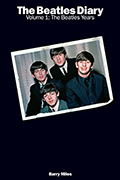
With greatly expanded text, this is the most revealing and frank personal 30-year chronicle of the group ever written. Insider Barry Miles covers the Beatles story from childhood to the break-up of the group.

Notice any inaccuracies on this page? Have additional insights or ideas for new content? Or just want to share your thoughts? We value your feedback! Please use the form below to get in touch with us.


