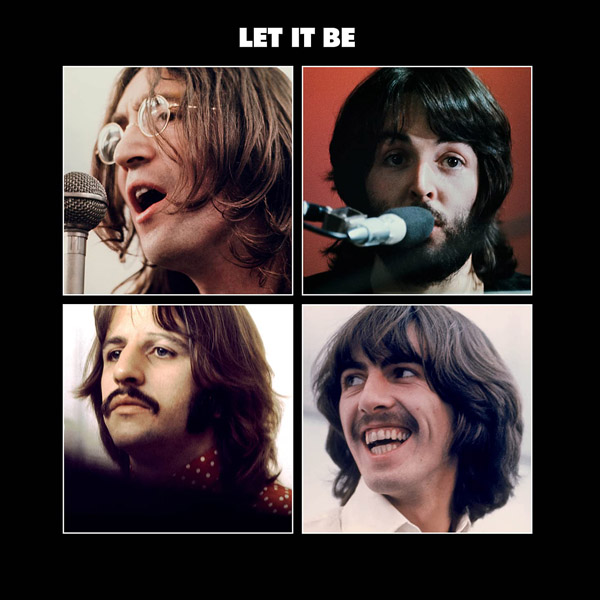
Wednesday, April 1, 1970
Overdubs for "Let It Be" album
For The Beatles
Last updated on October 15, 2025
Wednesday, April 1, 1970
For The Beatles
Last updated on October 15, 2025

Jan 3 - April 2, 1970 • Songs recorded during this session appear on Let It Be (US version)
Album Mar 27, 1970 • "Sentimental Journey" by Ringo Starr released in the UK
Session Mar 30, 1970 • Mixing "Let It Be" album #5
Session Apr 01, 1970 • Overdubs for "Let It Be" album
Session Apr 02, 1970 • Mixing "Let It Be" album #6
Article Apr 07, 1970 • McCartney Productions Ltd. acquires the film rights for Rupert the Bear
AlbumSome of the songs worked on during this session were first released on the "Let It Be (UK - 1st pressing with "Get Back" book)" LP

By The Beatles
This day marked the final recording session for a Beatles album — and the last to feature the contribution of a Beatle. Under the supervision of producer Phil Spector, orchestral and choral overdubs were recorded for three songs: “Across The Universe“, “The Long And Winding Road” and “I Me Mine“.
Ringo Starr was present to play the drums on each song, alongside the orchestra.
Brian Gibson was a technical engineer for this session, and vividly remembered this session:
Phil Spector is one of the weirdest persons I have ever met in the recording industry. He’s totally paranoid. A most odd character, extremely insecure. He has that famous ‘Phil Spector Sound’ that consists of lots of echo and everything. But whereas all the record producers that I’ve encountered have in the back of their mind the way a song will sound when finally mixed, at the recording stage they tend to leave tracks completely dry, perhaps with just a bit of monitor echo, but certainly without any of the effects added later…
On “Let It Be”, though, Spector worked in the completely opposite way. He wanted to hear it, while it was being recorded, exactly the way it would sound when finished: with all the tape echo, plate echo, chamber echo, all the effects. This was horrendously difficult in studio one which is, technically, quite primitive. Spector was on the point of throwing a bit wobbly – ‘I wanna hear this!’, ‘I must have that!’ – when Ringo took him quietly aside and said, ‘Look, they can’t do that, they’re doing the best they can. Just cool it.’ Ringo didn’t need to do that but I think he could see that Spector was getting towards the end of his tether and was giving everybody a hard time. He wanted everyone to know who he was, he liked to assert himself.
Brian Gibson – Technical engineer – From “The Complete Beatles Recording Sessions” by Mark Lewisohn, 1988
It was a similar experience for Peter Bown, the engineer assisting Phil Spector on this session:
My God, do I remember that session! Spector had three sets of (musical) parts for the musicians but he’d only booked them in for two. Out of the blue he distributed these extra parts, without intimating that there would be any extra payment. I warned Phil that he’d never get away with it, and of course the orchestra got up and walked out. I worked with these musicians often and knew them well, so I went into the control room, put a wedge under the door and tried to keep out of it. I got home very very late, well after midnight, and took the phone off the hook because I knew Spector would try and call. The moment I put it back Spector was on the line, asking me to return to the studio and continue, which I did. The musicians got their extra payment. This session was on the first of April 1970 – but it was one April Fool’s joke which did not come off.
Peter Bown – Engineer – From “The Complete Beatles Recording Sessions” by Mark Lewisohn, 1988
The first task of the day was to create reduction mixes of the three songs, to give room for the orchestra overdubs.
“Across The Universe” had been recorded on a four-track tape in February 1968. A tape reduction of Take 8 was performed and copied onto a new eight-track tape, occupying three tracks. It was labelled Take 9. Sound effects and backing vocals from The Beatles and the two fans invited to the session (Lizzie Bravo and Gayleen Pease) were omitted.
For “The Long And Winding Road,” Phil Spector reduced the original eight-track tape to five tracks. He achieved this by combining Ringo Starr’s drum track, Billy Preston’s electric piano, and George Harrison’s guitar onto a single track. A track reserved for backing vocals — unused during the recording — was dropped. According to engineer Brian Gibson, one of Paul McCartney’s vocal tracks may have been wiped during this process, though this claim appears to be unfounded.
On “The Long And Winding Road”, [Phil] wanted to overdub orchestra and choir but there weren’t the available tracks on the tape, so he wiped one of Paul’s two vocal tracks in order to put the orchestra on.
Brian Gibson – Technical engineer – From “The Complete Beatles Recording Sessions” by Mark Lewisohn, 1988
Three attempts were made to create this reduction mix, labeled Take 17 through Take 19. Take 18 was selected as the best.
On March 23, Spector worked on “I Me Mine“, creating three stereo mixes from Take 16 — labeled RS1 to RS3 — and editing them together to add a second chorus, extending the song’s length from 1:34 to 2:25.
On this day, he created two new reduction mixes of Take 16, labeled Takes 17 and 18, by combining George’s acoustic guitar, Paul’s organ, and Paul’s electric piano onto a single track. This freed up two tracks for the orchestral overdubs. He then edited the two mixes together, again extending the tape from 1:34 to 2:25. The end result was also labeled Take 18.
Once those reduction mixes were completed, the orchestra overdubs were recorded. The ensemble included eighteen violins, four violas, four cellos, three trumpets, three trombones, two guitars, a harp, and fourteen vocalists — along with Ringo Starr on drums, whose contributions on this day would be barely audible in the final mixes.
The orchestral arrangements for “The Long And Winding Road” and “I Me Mine” were written and conducted by Richard Hewson, who had previously worked with Paul McCartney on the arrangement of Mary Hopkin’s “Those Were The Days.” Hewson was paid £40 for this session.
The arrangement for “Across The Universe” was handled by Brian Rogers, while John Barham provided the choral arrangements for both “The Long And Winding Road” and “Across The Universe.”
The final mixing for those three songs would be done the day after, on April 2, 1970.
I was one of the two guitarists on Across the Universe and Long and Winding Road. The other guitarist was Martin Kershaw who has now sadly passed away. I did speak to Ringo very briefly. Great memories.
Bill Parkinson – From comments on The Beatles Bible, August 15, 2024
From mcbeatle.de:
It wasn’t until the Spring of 1970 that Hewson did his most important arranging job for the Beatles: the lush orchestrations for the Let It Be album.
“I got the call about 7:00 p.m. It was to be recorded the following day. I hate working at night; I’m not very good at it.” Hewson went to Apple and picked up the demo for ‘The Long and Winding Road’ and George’s ‘I Me Mine’ (the scoring for “Across the Universe” was assigned to another arranger, Brian Rogers). The former featured just piano, drums and McCartney’s vocal.
Hewson quickly began work for the session the following day, at 7 in the evening on April 1st at Abbey Road.
“They said they wanted the whole thing orchestrated. I didn’t meet Phil Spector until the actual session.” But the two had plenty of contact, via the telephone. “He said, ‘I want it orchestrated with a massive orchestra.’ So I lined up an orchestra with what I thought was a massive orchestra. All through the night, he kept ringing up saying, ‘Let’s have some more violins. Let’s have three harps instead of one,’ and all that. There were so many musicians in the end that we couldn’t get them all in! We actually, literally, had to shut the door and say there’s enough.“
The session the following day was, as has been documented numerous times, no picnic either. Spector’s unusual behavior didn’t help matters. “He was surrounded by these bodyguards, all wearing these fedoras, you know, those gangster-type hats. He looked like a gangster.”
Spector didn’t do much to improve his relationship with the musicians. “They turned the lights out in the control room. He was in there sitting in the dark with all these weird guys. I was actually a little frightened to go in there.“
Spector had the orchestra play the parts repeatedly, which quickly wore on the musicians. “He kept going, ‘Let’s have another take.’ He didn’t ever want to listen to a playback, he just wanted to play it over and over again. The guys were saying, ‘We played it. We can’t play it any better.’ It wasn’t that difficult music for those guys. They’re brilliant musicians. The first reading through is pretty well perfect, and the second one is right on. Eventually, after the tenth time, they got fed up and left.“
The only Beatle present was Ringo who, true to form, kept drumming faithfully along. “He was very cheery, and he didn’t seem to mind. He kept drumming every time we took a take.“
The results have always gotten mixed reviews from fans, but decidedly negative reviews from the group. “I know McCartney wasn’t too happy with the idea. I heard about it later. I know both he and George Martin didn’t like all that stuff, though Paul’s never said anything about it. I’ve worked with George Martin several times since. One time, I actually pulled his leg and said, ‘What about that, then?’ He sort of changed the subject!”
How does the arranger himself feel about it? “It was just a job for me. I know they weren’t really keen on this big orchestra treatment. But history shows that it did well.“
The orchestral overdubs added to “The Long And Winding Road” provoked Paul McCartney’s anger when he finally heard Phil Spector’s mix. Two weeks after this session, on April 14, 1970, Paul wrote a letter to Allen Klein requesting that the added instrumentation be reduced in volume — but no changes were made.
Upset by the experience, Paul did not speak to arranger Richard Hewson for a year. However, they eventually reconciled and collaborated again — first on “Thrillington” in 1971, and later on “My Love” in 1973.
I think he’d simmered down because, after all, the song became a huge hit as a massive orchestral thing and he toured with an orchestra so, come on Paul, it wasn’t so bad after all, was it?
Richard Hewson – From The Northern Echo, April 2, 2018
Dear Sir,
In future, no one will be allowed to add to or subtract from a recording of one of my songs without my permission.
I had considered orchestrating ‘The Long And Winding Road’ but I had decided against it. I, therefore, want it altered to these specifications:
1. Strings, horns, voices and all added noises to be reduced in volume.
2. Vocal and Beatle instrumentation to be brought up in volume.
3. Harp to be removed completely at the end of the song and original piano notes to be substituted.
4. Don’t ever do it again.Signed
Paul McCartney
c.c. Phil Spector
John Eastman


Tape copying • Tape reduction take 8 into take 9
Recording • SI onto take 9
Tape copying • DDSI.26.91 • Tape reduction into take 17
Tape copying • DDSI.26.91 • Tape reduction into take 18
Tape copying • DDSI.26.91 • Tape reduction into take 19
Recording • DDSI.26.91 • SI onto take 18
Written by George Harrison
Tape copying • Tape reduction of extended edit of take 16 into take 17
Written by George Harrison
Tape copying • Tape reduction of extended edit of take 16 into take 18
Written by George Harrison
Recording • SI onto take 18
The Complete Beatles Recording Sessions • Mark Lewisohn
The definitive guide for every Beatles recording sessions from 1962 to 1970. We owe a lot to Mark Lewisohn for the creation of those session pages, but you really have to buy this book to get all the details - the number of takes for each song, who contributed what, a description of the context and how each session went, various photographies... And an introductory interview with Paul McCartney!
The Beatles Recording Reference Manual: Volume 5: Let It Be through Abbey Road (1969 - 1970)

The fifth and final book of this critically acclaimed series, "The Beatles Recording Reference Manual: Volume 5: Let It Be through Abbey Road (1969 - 1970)" follows The Beatles as they "get back to where they once belonged...". Not once, but twice. With "Let It Be", they attempted to recapture the spontaneity of their early years and recordings, while "Abbey Road" was a different kind of return - to the complexity, finish and polish that they had applied to their work beginning with "Revolver" and through to "The Beatles".
If we modestly consider the Paul McCartney Project to be the premier online resource for all things Paul McCartney, it is undeniable that The Beatles Bible stands as the definitive online site dedicated to the Beatles. While there is some overlap in content between the two sites, they differ significantly in their approach.

Notice any inaccuracies on this page? Have additional insights or ideas for new content? Or just want to share your thoughts? We value your feedback! Please use the form below to get in touch with us.

Mariusz • May 14, 2025 • 10 months ago
There are some very obscure photos from this last session. Maybe it will help to identify some of the musicians in the orchestra. See: https://www.reddit.com/r/beatles/comments/18wn5nu/the_last_beatle_recording_session_on_april_1st/#lightbox

The PaulMcCartney Project • May 15, 2025 • 10 months ago
Thanks Marius ! I will add this.
Mariusz • Oct 01, 2025 • 5 months ago
As written above: "The ensemble included eighteen violins, four violas, four cellos, three trumpets, three trombones, a harp, and fourteen vocalists — along with Ringo Starr on drums (...)". Mark Lewisohn, in his "The Complete Beatles Recording Sessions", indicated that the orchestra also included two guitarists (see p. 199), which is significant because it marks the second time, besides Clapton, that guitarists from outside the band have appeared on Beatles recordings.
And here's an interesting fact. I don't think any source names the musicians in this orchestra. Meanwhile, in the comments section for April 1, 1970, on The Beatles Bible, Bill Parkinson wrote a brief note in July 2024, stating that he was one of the two guitarists present at the session. He also mentioned the other guitarist, Martin Kershaw (see https://www.beatlesbible.com/1970/04/01/recording-across-the-universe-the-long-and-winding-road-i-me-mine/). I can't verify this information anywhere, but it seems likely.
The PaulMcCartney Project • Dec 31, 2025 • 2 months ago
Thanks a lot Mariusz, I've updated the page accordingly


