
May 1970
John Lennon and Paul McCartney win five BMI Awards
Last updated on August 15, 2025
May 1970
Last updated on August 15, 2025
Interview Apr 30, 1970 • Paul McCartney interview for RollingStone
Article May 1 - August 1970 • Paul and Linda McCartney go and live in Scotland for four months
Article May 1970 • John Lennon and Paul McCartney win five BMI Awards
Session May-August 1970 • Home recordings - "Ram" demos
Article May 02, 1970 • Paul McCartney is asked to participate in festival in Cornwall

Officially appears on Help! (Mono)

Officially appears on Hey Jude / Revolution

Officially appears on Goodbye / Sparrow

Officially appears on Get Back / Don't Let Me Down (UK - Mono)

Officially appears on The Beatles (Mono)

The Beatles win four Ivor Novello Awards
Mar 23, 1964

The Beatles receive a Carl Alan Award
Mar 08, 1965

The Beatles to receive MBEs – announcement
Jun 11, 1965

The Beatles win three Ivor Novello awards
Jul 12, 1966
The Beatles win two Ivor Novello awards
Mar 23, 1967

“Hey Jude” wins an Ivor Novello award
May 22, 1969

George Martin and Geoff Emerick win NME Awards
Feb 28, 1970
“Get Back” gets an Ivor Novello award
May 10, 1970

“Let It Be” gets a Grammy Award
Mar 16, 1971

The Beatles win an Oscar for “Let It Be”
Apr 15, 1971
Wings wins the Best Live Show award
Feb 03, 1977
Feb 27, 1980
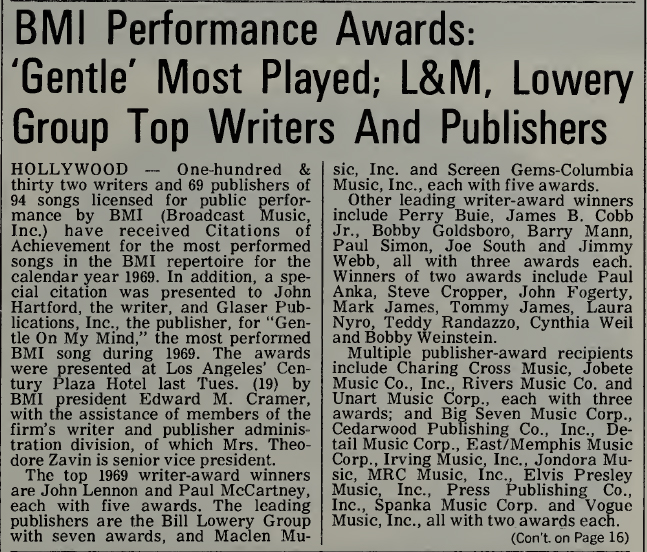
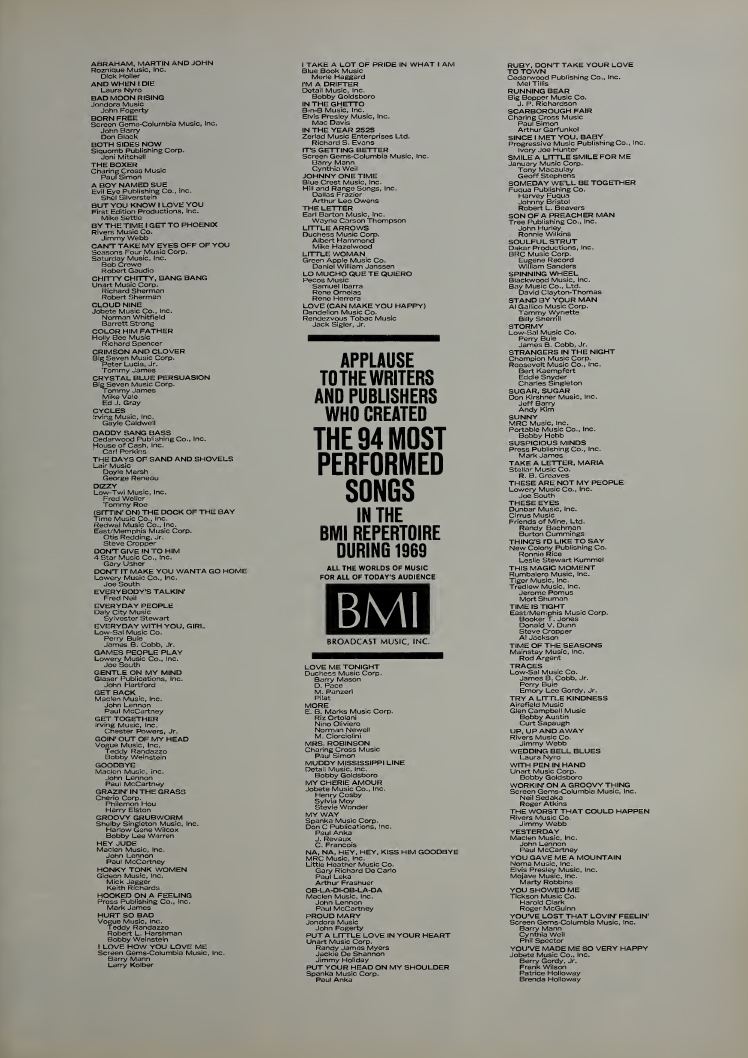
At the annual BMI Awards, John Lennon and Paul McCartney won five awards each, for the songs “Get Back,” “Goodbye,” “Hey Jude,” “Ob-La-Di, Ob-La-Da,” and “Yesterday.”
From BMI Film & TV Awards – Wikipedia:
The BMI Film & TV Awards are accolades presented annually by Broadcast Music, Inc., honoring songwriters, composers, and music publishers in various genres. Based in the United States, the awards include the BMI Christian Awards, BMI Country Awards, BMI Film and TV Awards, BMI Latin Awards, BMI London Awards, BMI Pop Awards, BMI R&B/Hip-Hop Awards, and the BMI Trailblazers of Gospel Music Honors. The main pop music award was founded in 1952.
BMI Performance Awards: ‘Gentle’ Most Played; L&M, Lowery Group Top Writers And Publishers
HOLLYWOOD — One-hundred & thirty two writers and 69 publishers of 94 songs licensed for public performance by BMI (Broadcast Music, Inc.) have received Citations of Achievement for the most performed songs in the BMI repertoire for the calendar year 1969. In addition, a special citation was presented to John Hartford, the writer, and Glaser Publications, Inc., the publisher, for “Gentle On My Mind,” the most performed BMI song during 1969. The awards were presented at Los Angeles’ Century Plaza Hotel last Tues. (19) by BMI president Edward M. Cramer, with the assistance of members of the firm’s writer and publisher administering division, of which Mrs. Theodora Zavin is senior vice-president.
The top 1969 writer award winners with six each were Paul McCartney, John Lennon and Maclen Music, Inc. Other leading winners with each five awards include Screen Gems-Columbia Music, Inc., and Lowery Music, Inc.
Other leading writer-award winners include Perry Buie, James B. Cobb Jr., Bobby Goldsboro, Barry Mann, Paul Simon, Joe South and Jimmy Webb, all with three awards each. Winners of two awards include Paul Anka, Steve Cropper, John Fogerty, Mark James, Tommy James, Laura Nyro, Teddy Randazzo, Cynthia Weil and Bobby Weinstein.
Multiple publisher-award recipients include Charing Cross Music, Jobete Music Co., Inc., Rivers Music Co. and Unart Music Corp., each with three awards; and Big Seven Music Corp., Cedarwood Publishing Co., Inc., DeCailly Music Co., Memphis Music, Inc., Press Music Co., Inc., Jondora Music, Inc., Elvis Presley Music, Spanka Music Publishing Co., Inc., and Wilderness Music, Inc., all with two awards.
From Cashbox Magazine, May 30, 1970
The McCartney Legacy: Volume 1: 1969 – 73

In this first of a groundbreaking multivolume set, THE MCCARTNEY LEGACY, VOL 1: 1969-73 captures the life of Paul McCartney in the years immediately following the dissolution of the Beatles, a period in which McCartney recreated himself as both a man and a musician. Informed by hundreds of interviews, extensive ground up research, and thousands of never-before-seen documents THE MCCARTNEY LEGACY, VOL 1 is an in depth, revealing exploration of McCartney’s creative and personal lives beyond the Beatles.
The Beatles Diary Volume 1: The Beatles Years
With greatly expanded text, this is the most revealing and frank personal 30-year chronicle of the group ever written. Insider Barry Miles covers the Beatles story from childhood to the break-up of the group.
The Beatles Diary Volume 2: After The Break-Up 1970-2001
An updated edition of the best-seller. The story of what happened to the band members, their families and friends after the 1970 break-up is brought right up to date. A fascinating and meticulous piece of Beatles scholarship.
Maccazine - Volume 40, Issue 3 - RAM Part 1 - Timeline

This very special RAM special is the first in a series. This is a Timeline for 1970 – 1971 when McCartney started writing and planning RAM in the summer of 1970 and ending with the release of the first Wings album WILD LIFE in December 1971. [...] One thing I noted when exploring the material inside the deluxe RAM remaster is that the book contains many mistakes. A couple of dates are completely inaccurate and the story is far from complete. For this reason, I started to compile a Timeline for the 1970/1971 period filling the gaps and correcting the mistakes. The result is this Maccazine special. As the Timeline was way too long for one special, we decided to do a double issue (issue 3, 2012 and issue 1, 2013).

Notice any inaccuracies on this page? Have additional insights or ideas for new content? Or just want to share your thoughts? We value your feedback! Please use the form below to get in touch with us.


