
Thursday, April 15, 1971
The Beatles win an Oscar for “Let It Be”
Last updated on June 25, 2025
Thursday, April 15, 1971
Last updated on June 25, 2025
Previous article April 1971 • Paul & Linda McCartney travel back to UK
Session Apr 07, 1971 • Recording "Dear Boy", "Uncle Albert/Admiral Halsey"
Single Apr 12, 1971 • "Another Day / Oh Woman Oh Why (Promo)" by Paul McCartney released in the US
Article Apr 15, 1971 • The Beatles win an Oscar for "Let It Be"
Interview Apr 16, 1971 • Paul McCartney interview for Life Magazine
Article Apr 25, 1971 • John Lennon, George Harrison, Ringo Starr decide not to appeal High Court order

1970 • For The Beatles • Directed by Michael Lindsay-Hogg

The Beatles win four Ivor Novello Awards
Mar 23, 1964

The Beatles receive a Carl Alan Award
Mar 08, 1965

The Beatles to receive MBEs – announcement
Jun 11, 1965

The Beatles win three Ivor Novello awards
Jul 12, 1966
The Beatles win two Ivor Novello awards
Mar 23, 1967

“Hey Jude” wins an Ivor Novello award
May 22, 1969

George Martin and Geoff Emerick win NME Awards
Feb 28, 1970
“Get Back” gets an Ivor Novello award
May 10, 1970

“Let It Be” gets a Grammy Award
Mar 16, 1971
Wings wins the Best Live Show award
Feb 03, 1977
Feb 27, 1980
At the 43rd Academy Awards in 1971, The Beatles were honored with the Oscar for Best Original Song Score for their final film, “Let It Be.” Despite the win, none of the Fab Four attended the ceremony.
Paul McCartney was actually in Los Angeles at the time, and producer Quincy Jones made an attempt to persuade him to show up. Paul declined.
In the end, it was Quincy Jones who accepted the Oscar on behalf of the Beatles.
This is fantastic. I just wanted an excuse to get close to it, and I wish The Beatles were all here together tonight to receive this, but I have to get back to conduct the orchestra. On their behalf, thank you very much!
Quincy Jones – From Far Out Magazine, May 22, 2023
I remember going by the studio on 799 Seventh Avenue. Paul was in the studio. I said, ‘Paul, I think you should show up for this Oscar event because you guys have a good shot at it, and you could possibly get nominated and possibly win.’
Paul and I had a great relationship. He said, ‘No, Quincy, you’re not gonna convince me’. I said, ‘Okay, I won’t care, don’t go’. And he didn’t go. That was the first year I conducted the orchestra. I had to put my baton down and go up and make a speech and pick up the Oscar for Lennon and McCartney for ‘Let It Be’.
Quincy Jones – From Far Out Magazine, May 22, 2023
The Oscar and the unexpected lure the viewers
[…] I asked Bob why people who never go to the movies watch the Oscars.
“The possibility of seeing the unexpected,” he said. “That was what television was all about once — being in on things as they happened. Jackie Gleason breaking his leg on camera, the corpse getting up on Climax and slowly walking away! The mistakes, the uncertainties, the star tripping on her dress on the way to the stage, the he-man breaking down over his award.
“A perfect example was Paul McCartney turning up at the Grammy Awards in his tennis shoes to accept the awards for the Beatles for ‘Let It Be.’ Nobody knew McCartney was there. The excitement of his appearance in the auditorium communicated itself over television. It’s something you’ll never get on film.”
Maybe McCartney, sneakers and all, will turn up Thursday night. “Let It Be” is also nominated for an Oscar in the peculiar category of “best original song-score,” whatever that is. Also there’s a major tribute to the now dissolved Beatles and their contributions to movie music in “Hard Day’s Night,” “Help!,” “Yellow Submarine” and “Let It Be.”
“Some good ideas are born of desperation,” said Finkel. “None of the nominated songs really adapted themselves to a big production number — so this tribute will be it.” […]
From Los Angeles Times – April 11, 1971

Oscar Rock ‘Salute’ Had No Rock Sound
THE BEATLES’ “Let It Be” film score was awarded an Oscar, leaving no more worlds for the group to conquer. However, I’m afraid the Academy didn’t distinguish itself all that much. The three awards were all earned. However, it was difficult to sit through that “salute” to the Beatles.
First of all I can’t see how anyone could salute a rock group of any type without at least having some sort of rock instrumentation serving as the basis for the presentation. Instead, Quincy Jones was saddled with a full orchestra. If there were guitars, a bass, a drummer around, I sure didn’t hear them. And then they put a dancer out and choreographed the whole bit with a chorus line, sparkling lights and all. I’m afraid it was an unintended slap at the Beatles and the music they created.
Maybe those responsible for the nature of the “salute” got the idea of what they did wrong when Harry Belafonte came out and sang a simple, version of a pretty ballad with beautiful results. In direct contrast to the Ziegfeld acrobatics, they butchered the rest of the medley with.
Speaking of the Beatles, Paul McCartney has a very fascinating interview in the current Life. Paul talks about the breakup of the group, and how and why he feels it happened. What is most interesting about the interview is the deep feelings Paul expresses about the whole hassle.
It becomes obvious the decisions he and the other Beatles reached came only after long painful thoughts and considerations were made.
However, I haven’t lost all hopes for the Beatles coming together again. First of all, Paul talks about how close they were and how they are all still good friends. He also refers to John Lennon many times, showing what a strong influence the two have had on each other.
One of the Beatles — I think it was Ringo — said recently: “You know, we all have recording studios in our homes and we’re still friends. One of these days we’ll all be at one of them together and we’ll say: ‘Let’s record!’ And we’ll do it. And it will happen.“
That leaves hope, although Paul says he is going to organize another band this summer. We’ll see.
From The San Bernardino County Sun – April 20, 1971

The McCartney Legacy: Volume 1: 1969 – 73

In this first of a groundbreaking multivolume set, THE MCCARTNEY LEGACY, VOL 1: 1969-73 captures the life of Paul McCartney in the years immediately following the dissolution of the Beatles, a period in which McCartney recreated himself as both a man and a musician. Informed by hundreds of interviews, extensive ground up research, and thousands of never-before-seen documents THE MCCARTNEY LEGACY, VOL 1 is an in depth, revealing exploration of McCartney’s creative and personal lives beyond the Beatles.
The Beatles Diary Volume 2: After The Break-Up 1970-2001
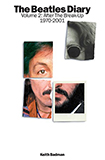
An updated edition of the best-seller. The story of what happened to the band members, their families and friends after the 1970 break-up is brought right up to date. A fascinating and meticulous piece of Beatles scholarship.
Maccazine - Volume 40, Issue 3 - RAM Part 1 - Timeline

This very special RAM special is the first in a series. This is a Timeline for 1970 – 1971 when McCartney started writing and planning RAM in the summer of 1970 and ending with the release of the first Wings album WILD LIFE in December 1971. [...] One thing I noted when exploring the material inside the deluxe RAM remaster is that the book contains many mistakes. A couple of dates are completely inaccurate and the story is far from complete. For this reason, I started to compile a Timeline for the 1970/1971 period filling the gaps and correcting the mistakes. The result is this Maccazine special. As the Timeline was way too long for one special, we decided to do a double issue (issue 3, 2012 and issue 1, 2013).

Notice any inaccuracies on this page? Have additional insights or ideas for new content? Or just want to share your thoughts? We value your feedback! Please use the form below to get in touch with us.


