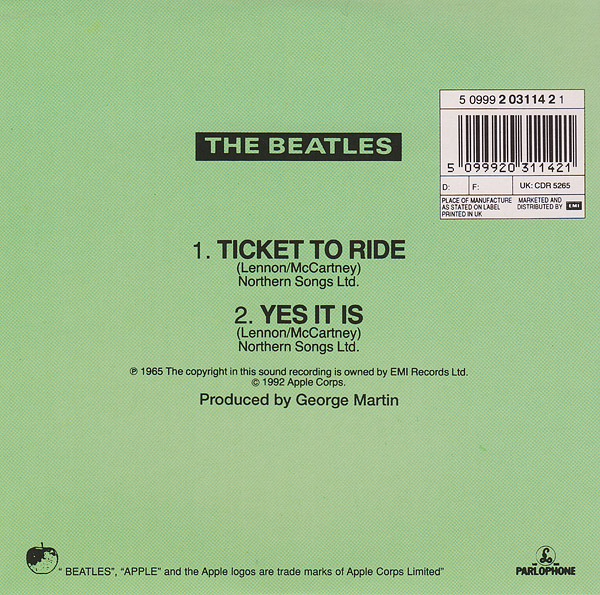
Album This song officially appears on the Ticket To Ride / Yes It Is (UK) 7" Single.
Timeline This song was officially released in 1965
This song was recorded during the following studio sessions:
From Wikipedia:
“Ticket to Ride” is a song by the English rock band the Beatles, written primarily by John Lennon and credited to Lennon–McCartney. Issued as a single in April 1965, it became the Beatles’ seventh consecutive number 1 hit in the United Kingdom and their third consecutive number 1 hit (and eighth in total) in the United States, and similarly topped national charts in Canada, Australia and Ireland. The song was included on their 1965 album Help! Recorded at EMI Studios in London in February that year, the track marked a progression in the Beatles’ work through the incorporation of drone and harder-sounding instrumentation relative to their previous releases. Among music critics, Ian MacDonald describes the song as “psychologically deeper than anything the Beatles had recorded before” and “extraordinary for its time”.
“Ticket to Ride” appears in a sequence in the Beatles’ second feature film, Help!, directed by Richard Lester. Live performances by the band were included in the Beatles at Shea Stadium concert film, on the live album documenting their concerts at the Hollywood Bowl, and on the 1996 Anthology 2 box set. In 1969, “Ticket to Ride” was covered by the Carpenters, whose version peaked at number 54 on the Billboard Hot 100.
Composition
“Ticket to Ride” was primarily written by John Lennon, and credited to Lennon–McCartney. In 1965, Lennon claimed that the song was “three-quarters mine and Paul [McCartney] changed it a bit. He said let’s alter the tune.” However, speaking in 1980, Lennon said that McCartney’s contribution was limited to “the way Ringo [Starr] played the drums” on the recording. In his 1997 authorised biography, Paul McCartney contradicts this, providing an account more similar to Lennon’s 1965 assessment: “we sat down and wrote it together … give him 60 percent of it … we sat down together and worked on that for a full three-hour songwriting session.”
The song is written in the key of A major. The structure of the composition is in an expanded variation of the AABA pop song format, with eight bars of verse and eight bars of chorus forming the A section, and a nine-bar primary bridge forming the B section. The sustained A chord over the verses creates an implied drone common in Indian music and supports a melody that author Ian MacDonald terms “raga-like”.
The song’s coda features a change of tempo. In the view of musicologist Walter Everett, the latter section marks a progression on previous Beatles songs that similarly revisit aspects of a composition when ending with a coda. In the case of “Ticket to Ride”, the section consists of a repeated refrain similar to the last line of the chorus (“My baby don’t care”), played over a constant A major chord and set to the double-time rhythm used in the bridge. Lennon said this closing section was one of his “favourite bits” in the song. He also claimed that “Ticket to Ride” was the first heavy metal record ever made. According to MacDonald, the track’s heavy sound may have been influenced by Lennon and George Harrison’s first encounter with LSD, the precise date for which varies among Beatles biographers. Author Simon Philo calls the song “avant-garde masquerading as pop”.
While the lyrics describe a girl “riding out of the life of the narrator”, the inspiration of the title phrase is unclear, as is the meaning of the song. McCartney said the title referred to “a British Railways ticket to the town of Ryde on the Isle of Wight”, and Lennon said it described cards indicating a clean bill of health carried by Hamburg prostitutes in the 1960s. The Beatles played in Hamburg early in their musical career, and a “ride” was British slang for having sex. Gaby Whitehill and Andrew Trendall of Gigwise have interpreted the song to be about a woman leaving her boyfriend to become a prostitute.
Recording
It was [a] slightly new sound at the time, because it was pretty fuckin’ heavy for then. If you go and look in the charts for what other music people were making, and you hear it now, it doesn’t sound too bad. It’s all happening, it’s a heavy record.
John Lennon, 1970The Beatles recorded “Ticket to Ride” on 15 February 1965 at EMI Studios in London. It was the band’s first recording session since completing the Beatles for Sale album on 26 October 1964, after which they had toured the UK and played a season of Christmas shows in London until mid-January. The session inaugurated what author Mark Lewisohn describes as “a more serious application in the recording studio” by the group, which included taping rehearsals of each song they worked on and concentrating on backing or rhythm tracks, after which they would overdub more detailed instrumental parts. Everett views the recording as a radical departure for the Beatles, due to the vocals and lead guitar parts being overdubbed for the first time.
The song’s main guitar riff was played by Harrison on his Rickenbacker 12-string guitar and was among the parts taped with the rhythm track. Author Mark Hertsgaard highlights the idea for this riff and for Starr’s “jagged, whack-and-jump” drum pattern as examples of McCartney’s increasing importance as the Beatles’ musical director. According to Harrison, however, the Rickenbacker riff was his own idea, based on the way Lennon strummed the chord when introducing the song to the band. Harrison also said that the “staggered” motion of the riff then inspired the pattern that Starr decided to play. In addition to Lennon’s lead vocal and McCartney’s harmony, the overdubs included further electric guitar parts by Lennon and Harrison (on Rickenbacker 325 and Fender Stratocaster, respectively), over the verses, and by McCartney (on Epiphone Casino), who supplied the fills that close the bridges and the solo over the coda.
Release
In March 1965, the Beatles and their manager, Brian Epstein, selected “Ticket to Ride” and “Yes It Is” to be the A- and B-sides, respectively, of the group’s first single release of the year. The record was issued by EMI’s Parlophone label on 9 April 1965 in the United Kingdom, and by Capitol Records on 19 April in the United States. A contemporary news report stated that the Beatles were due to promote the single on television shows such as Top of the Pops and Thank Your Lucky Stars, and that the band were forming an independent production company with their producer, George Martin, which would earn them a more favourable financial return on their recordings. A portion of the group’s Top of the Pops performance of “Ticket to Ride” survived only because it was later used in the Doctor Who episode “The Executioners”, which aired on BBC1 on 22 May. The episode was part of the serial The Chase and sees the Doctor using a time–space machine in the future to observe historical figures such as William Shakespeare, Abraham Lincoln and the Beatles. In addition to their television promotion, the group performed the song during their last session for BBC Radio, on 26 May, which was broadcast as The Beatles (Invite You to Take a Ticket to Ride).
“Ticket to Ride” topped Britain’s official singles chart for three weeks. It went straight in at number 1 on the national listings compiled by Melody Maker, where it also stayed for three weeks, and similarly topped Ireland’s singles chart in its first week of release there. In America, the song was number 1 on the Billboard Hot 100 chart for one week. According to Billboard‘s Hits of the World listings for 15 May 1965, “Ticket to Ride” was also the top-selling single in Australia. The US single’s face label stated that the A-side was from the forthcoming United Artists release Eight Arms to Hold You, which was the original title of the Beatles’ second film, directed by Richard Lester. The title was changed to Help! after the single’s release. In the film, the song plays over a sequence during which the Beatles attempt to ski and frequently fall over. The track appeared on the band’s 1965 album Help!, which was issued on 6 August in the UK and on 13 August in the US.
“Ticket to Ride” was the seventh consecutive chart-topping single for the Beatles in the UK and the first Beatles track released with a running time exceeding three minutes. On the American charts, it was the third of six number 1 singles in a row, a record at the time, along with “I Feel Fine“, “Eight Days a Week“, “Help!“, “Yesterday” and “We Can Work It Out” – all achieved in the space of twelve months from January 1965. Everett writes that although the song achieved “classic” status, it was a surprise among Beatles singles in that it failed to achieve gold accreditation from the Recording Industry Association of America. When the song hit number 1 there, the Beatles became the fourth consecutive English group to hold down the top spot, after the Mancunian groups Freddie and the Dreamers, Wayne Fontana and the Mindbenders, and Herman’s Hermits. As part of EMI’s plan to exploit the 20th anniversary of each Beatles single, “Ticket to Ride” was reissued in the UK in April 1985 and peaked at number 70 on the UK Singles Chart.
Appearance in Help! and promotional film
“Ticket to Ride” features in a scene in the film Help! The Beatles are seen attempting to ski and avoiding a team of assassins from a cult whose quest is to murder Starr. The scene was filmed at Obertauern in the Austrian Alps in March 1965.
On 23 November 1965, the Beatles filmed promotional clips for “Ticket to Ride” and four other songs, including both sides of their upcoming single at the time, “We Can Work It Out” / “Day Tripper” , at Twickenham Film Studios in south-west London. The films were directed by Joe McGrath, who had worked on Help! as an assistant to Lester. In the case of “Ticket to Ride”, the clip was made for inclusion in Top of the Pops‘ round-up of the biggest hits of 1965.
Against a backdrop of oversized tickets, the Beatles are shown miming to the song, with Starr standing at his drum kit and the other band members sitting in director’s chairs. Part of the clip appeared in the 1995 documentary The Beatles Anthology. In 2015, it was included in full on the Beatles’ video compilation 1.
Critical reception
“Ticket to Ride” is a watershed single, the moment when the Beatles moved from cuddly mop-tops to strange and interesting sonic explorers. So it’s fitting that it carries an enigma at its core [regarding the song’s meaning] – the first Rosebud in a catalogue of many.
Music critic Johnny Black, 2006In his contemporary review of the single, Derek Johnson of the NME admired the “depth of sound” and “tremendous drive” of the recording. Music critics Richie Unterberger of AllMusic and Ian MacDonald both feel that “Ticket to Ride” is an important milestone in the evolution of the musical style of the Beatles. Unterberger said, “the rhythm parts on ‘Ticket to Ride’ were harder and heavier than they had been on any previous Beatles outing, particularly in Ringo Starr’s stormy stutters and rolls.” MacDonald describes it as “psychologically deeper than anything the Beatles had recorded before … extraordinary for its time – massive with chiming electric guitars, weighty rhythm, and rumbling floor tom-toms”, and he views the production as a signal of the band’s next major change of musical direction, with “Tomorrow Never Knows” in April 1966. MacDonald also comments that, while the Kinks’ “See My Friends” has been identified as the inspiration for the Beatles’ use of Indian instrumentation later in 1965, the subtle drone in “Ticket to Ride” could equally have influenced the Kinks when they recorded “See My Friends”.
Writing for Mojo in 2002, musician and journalist Bob Stanley said the track was “where moptop Beatlemania ends and [the Beatles]’ weightless, ageless legend begins”. In his song review for Blender, Johnny Black similarly described it as a “watershed” recording and attributed its relatively poor US sales to the song’s “weird soup of hypnotically chiming, droning guitars, stuttering drums and contrasting vocal textures that, in the context of the 1965 charts, was far ahead of its time”. Neil McCormick of The Daily Telegraph sees a darker edge to Lennon’s lyric writing during the Help! period and he cites “the drone of riffing, proto-heavy-rock song Ticket to Ride” as an example of the band’s more sophisticated sound, and of how the album “contains some of their greatest early songs”. Writing for Rough Guides, Chris Ingham similarly views the track as “magnificently brooding” and “the most intense music The Beatles had yet recorded”. In his review of Help! for BBC Music, David Quantick includes “Ticket to Ride” among the album’s “flashes of brilliance” and describes it as “the song that saw The Beatles take on The Kinks, the Stones and The Who at their own, more rocky game”.
“Ticket to Ride” has been included in many critics’ best-song lists. Dave Marsh ranked it 29th on his 1989 list “The 1001 Greatest Singles Ever Made”. The track appeared at number 17 on Rolling Stone‘s list of the “100 Greatest Beatles Songs” and at number 23 on a similar list compiled by Mojo. In his commentary for Mojo, John Harris said that “Ticket to Ride” was “the sound of a four-piece group hurtling way beyond the beat-pop being churned out by their peers” but also showed the band developing the same sound that the Byrds adopted on their “pivotal” debut single, “Mr. Tambourine Man”. In 2009, the staff of PopMatters ranked “Ticket to Ride” at number 10 in their list of the 25 “Classic” Beatles tracks, which they defined as “not necessarily the ‘best songs'” by the band, but those “through which (perhaps) we might gain the deepest appreciation for their popular genius”. David Gassman said the track was most notable as an early example of the Beatles incorporating Indian sounds, anticipating “Norwegian Wood” and “Within You Without You“. He also described the song as “Exhibit A that Ringo Starr is one of the greatest rock ‘n’ roll drummers of all time” and said it was among the band’s best singles. In 2014, USA Today named it the best Beatles song, saying: “No single better reflects the ambition, tension and pure pop genius that made the Beatles unique … Ticket to Ride is perfection all the way through.” The music staff of Time Out London ranked it at number 11 on their 2018 list of the best Beatles songs.
Live performances
The Beatles played “Ticket to Ride” throughout their June–July 1965 European tour. A live performance from the 1 August 1965 broadcast of Blackpool Night Out was included on the Anthology 2 compilation and shown during The Beatles Anthology documentary. On 14 August, the group recorded a live performance of the song for The Ed Sullivan Show, broadcast the following month.
“Ticket to Ride” was also included in the set list for the Beatles’ 1965 US tour and their UK tour at the end of the year. The 15 August performance at Shea Stadium appears in the 1966 documentary The Beatles at Shea Stadium, although the audio for the song was re-recorded in London prior to release. The group’s 29 August performance at the Hollywood Bowl was chosen for the 1977 album The Beatles at the Hollywood Bowl. […]
We wrote the melody together; you can hear on the record, John’s taking the melody and I’m singing harmony with it. We’d often work those out as we wrote them. Because John sang it, you might have to give him 60 per cent of it. It was pretty much a work job that turned out quite well…
John just didn’t take the time to explain that we sat down together and worked on that song for a full three-hour songwriting session, and at the end of it all we had all the words, we had the harmonies, and we had all the little bits. […]
I think the interesting thing was a crazy ending: instead of ending like the previous verse, we changed the tempo. We picked up one of the lines, ‘My baby don’t care’, but completely altered the melody. We almost invented the idea of a new bit of a song on the fade-out with this song; it was something specially written for the fade-out, which was very effective but it was quite cheeky and we did a fast ending. It was quite radical at the time.
Paul McCartney – From “Paul McCartney: Many Years from Now” by Barry Miles, 1997
I distinctly remember when Paul wrote it. It is one of the songs I was lucky enough to hear the day it was completed. He played “Ticket to Ride” for me and sang me some examples of little guitar licks that he was planning on adding. And those twisty, bendy guitar phrases, which became Paul’s guitar part, create several of the very cool surprises contained in this arrangement and this record.
Peter Asher – From “The Beatles from A to Zed: An Alphabetical Mystery Tour“, 2019
From The Usenet Guide to Beatles Recording Variations:
- [a] mono 18 Feb 1965.
UK: Parlophone R5265 single 1965, Parlophone PMC 1255 Help! 1965, Parlophone PMC 7016 Collection of Oldies 1966.
US: Capitol 5407 single 1965, Capitol MAS 2386 Help! 1965, Apple SKBO-3403 The Beatles 1962-1966 1973.
CD: EMI single 1989.- [a1] mock stereo made from [a] 1965, by Capitol.
US: Capitol SMAS 2386 Help! 1965.- [b] stereo 23 Feb 1965.
UK: Parlophone PCS 3071 Help! 1965, Parlophone PCS 7016 Collection of Oldies 1966, Apple PCSP 717 The Beatles 1962-1966 1973.
US: Capitol SV-12199 Reel Music 1982, Capitol SV-12245 20 Greatest Hits 1982.- [c] stereo 1987.
CD: EMI CDP 7 46439 2 Help! 1987, EMI CDP 7 97036 2 The Beatles 1962-1966 1993.Mono [a] has some added reverb. Capitol’s version seems to have the same additional reverb as on the fake stereo mix: the mono LP version sounds like [a1] reduced to mono. Another mono mix was made for the original film soundtrack of Help! on 15 March 1965.
The stereo versions fade a little longer than [a]. In [b] the whole track has been given a bass boost to make up for poor bass guitar sound, or at least on the Parlophone LP it has. The bass guitar guitar has better presence in [c] but the rest is less bassy and the vocal sounds sharper.
I think I'm gonna be sad
I think it's today, yeah
The girl that's driving me mad
Is going away
She's got a ticket to ride
She's got a ticket to ride
She's got a ticket to ride
But she don't care
She said that living with me
Is bringing her down, yeah
For she would never be free
When I was around
She's got a ticket to ride
She's got a ticket to ride
She's got a ticket to ride
But she don't care
I don't know why she's riding so high
She ought to think twice
She ought to do right by me
Before she gets to saying goodbye
She ought to think twice
She ought to do right by me
I think I'm gonna be sad
I think it's today, yeah
The girl that's driving me mad
Is going away, yeah, oh
She's got a ticket to ride
She's got a ticket to ride
She's got a ticket to ride
But she don't care
I don't know why she's riding so high
She ought to think twice
She ought to do right by me
Before she gets to saying goodbye
She ought to think twice
She ought to do right by me
She said that living with me
Was bringing her down, yeah
For she would never be free
When I was around, oh
She's got a ticket to ride
She's got a ticket to ride
She's got a ticket to ride
But she don't care
My baby don't care
My baby don't care
My baby don't care
My baby don't care
My baby don't care
My baby don't care

Ticket To Ride / Yes It Is (UK)
7" Single • Released in 1965
3:06 • Studio version • A
Paul McCartney : Backing vocals, Bass, Lead guitar Ringo Starr : Drums, Tambourine John Lennon : Electric guitar, Handclaps, Lead vocals George Harrison : Electric guitar George Martin : Producer Norman Smith : Recording engineer
SessionRecording : Feb 15, 1965 • Studio : EMI Studios, Studio Two, Abbey Road
SessionMixing : Feb 18, 1965 • Studio : EMI Studios, Studio Two, Abbey Road

Ticket To Ride / Yes It Is (US)
7" Single • Released in 1965
3:06 • Studio version • A
Paul McCartney : Bass, Harmony vocals, Lead guitar Ringo Starr : Drums, Handclaps, Tambourine John Lennon : Double-tracked lead vocals, Rhythm guitar George Harrison : Rhythm guitar George Martin : Producer Norman Smith : Recording engineer
SessionRecording : Feb 15, 1965 • Studio : EMI Studios, Studio Two, Abbey Road
SessionMixing : Feb 18, 1965 • Studio : EMI Studios, Studio Two, Abbey Road

LP • Released in 1965
3:10 • Studio version • A • Mono
Paul McCartney : Bass, Harmony vocals, Lead guitar Ringo Starr : Drums, Handclaps, Tambourine John Lennon : Double-tracked lead vocals, Rhythm guitar George Harrison : Rhythm guitar George Martin : Producer Norman Smith : Recording engineer
SessionRecording : Feb 15, 1965 • Studio : EMI Studios, Studio Two, Abbey Road
SessionMixing : Feb 18, 1965 • Studio : EMI Studios, Studio Two, Abbey Road

LP • Released in 1965
3:10 • Studio version • B • Stereo
Paul McCartney : Bass, Harmony vocals, Lead guitar Ringo Starr : Drums, Handclaps, Tambourine John Lennon : Double-tracked lead vocals, Rhythm guitar George Harrison : Rhythm guitar George Martin : Producer Norman Smith : Recording engineer
SessionRecording : Feb 15, 1965 • Studio : EMI Studios, Studio Two, Abbey Road
SessionMixing : Feb 23, 1965 • Studio : EMI Studios, Studio Two, Abbey Road

Official album • Released in 1965
3:07 • Studio version • A • Mono
Paul McCartney : Bass, Harmony vocals, Lead guitar Ringo Starr : Drums, Handclaps, Tambourine John Lennon : Double-tracked lead vocals, Rhythm guitar George Harrison : Rhythm guitar George Martin : Producer Norman Smith : Recording engineer
SessionRecording : Feb 15, 1965 • Studio : EMI Studios, Studio Two, Abbey Road
SessionMixing : Feb 18, 1965 • Studio : EMI Studios, Studio Two, Abbey Road

Official album • Released in 1965
3:11 • Studio version • A1 • Stereo • Mock stereo made from [A]
Paul McCartney : Bass, Harmony vocals, Lead guitar Ringo Starr : Drums, Handclaps, Tambourine John Lennon : Double-tracked lead vocals, Rhythm guitar George Harrison : Rhythm guitar George Martin : Producer Norman Smith : Recording engineer
SessionRecording : Feb 15, 1965 • Studio : EMI Studios, Studio Two, Abbey Road
SessionMixing : Feb 18, 1965 • Studio : EMI Studios, Studio Two, Abbey Road

A Collection of Beatles Oldies (Mono)
LP • Released in 1966
3:01 • Studio version • A • Mono
Paul McCartney : Bass, Harmony vocals, Lead guitar Ringo Starr : Drums, Handclaps, Tambourine John Lennon : Double-tracked lead vocals, Rhythm guitar George Harrison : Rhythm guitar George Martin : Producer Norman Smith : Recording engineer
SessionRecording : Feb 15, 1965 • Studio : EMI Studios, Studio Two, Abbey Road
SessionMixing : Feb 18, 1965 • Studio : EMI Studios, Studio Two, Abbey Road

A Collection of Beatles Oldies (Stereo)
LP • Released in 1966
3:01 • Studio version • B • Stereo
Paul McCartney : Bass, Harmony vocals, Lead guitar Ringo Starr : Drums, Handclaps, Tambourine John Lennon : Double-tracked lead vocals, Rhythm guitar George Harrison : Rhythm guitar George Martin : Producer Norman Smith : Recording engineer
SessionRecording : Feb 15, 1965 • Studio : EMI Studios, Studio Two, Abbey Road
SessionMixing : Feb 23, 1965 • Studio : EMI Studios, Studio Two, Abbey Road

Official album • Released in 1973
3:10 • Studio version • B • Stereo
Paul McCartney : Bass, Harmony vocals, Lead guitar Ringo Starr : Drums, Handclaps, Tambourine John Lennon : Double-tracked lead vocals, Rhythm guitar George Harrison : Rhythm guitar George Martin : Producer Norman Smith : Recording engineer
SessionRecording : Feb 15, 1965 • Studio : EMI Studios, Studio Two, Abbey Road
SessionMixing : Feb 23, 1965 • Studio : EMI Studios, Studio Two, Abbey Road

Official album • Released in 1973
3:10 • Studio version • B • Stereo
Paul McCartney : Bass, Harmony vocals, Lead guitar Ringo Starr : Drums, Handclaps, Tambourine John Lennon : Double-tracked lead vocals, Rhythm guitar George Harrison : Rhythm guitar George Martin : Producer Norman Smith : Recording engineer
SessionRecording : Feb 15, 1965 • Studio : EMI Studios, Studio Two, Abbey Road
SessionMixing : Feb 23, 1965 • Studio : EMI Studios, Studio Two, Abbey Road


The Beatles At The Beeb - Volume 12
Live bootleg • Released in 2003
0:57 • Live • Short version
Concert From "The Beatles (Invite You To Take A Ticket To Ride)" in London, UK on Jun 07, 1965
The Beatles At The Beeb - Volume 12
Live bootleg • Released in 2003
2:48 • Live
Concert From "The Beatles (Invite You To Take A Ticket To Ride)" in London, UK on Jun 07, 1965
1965 • For The Beatles
Ticket To Ride (Intertel promo video)
1965 • For The Beatles • Directed by Joe McGrath
“Ticket To Ride” has been played in 37 concerts.

Sep 12, 1965 • USA • New York City • CBS Studio 50 • TV show

San Francisco • Cow Palace • USA
Aug 31, 1965 • 2pm show • Part of The Beatles' 1965 US tour
San Francisco • Cow Palace • USA
Aug 31, 1965 • Evening show • Part of The Beatles' 1965 US tour
Los Angeles • Hollywood Bowl • USA
Aug 30, 1965 • Part of The Beatles' 1965 US tour
Los Angeles • Hollywood Bowl • USA
Aug 29, 1965 • Part of The Beatles' 1965 US tour
The Lyrics: 1956 to the Present

"Ticket To Ride" is one of the songs featured in the book "The Lyrics: 1956 to the Present," published in 2021. The book explores Paul McCartney's early Liverpool days, his time with the Beatles, Wings, and his solo career. It pairs the lyrics of 154 of his songs with his first-person commentary on the circumstances of their creation, the inspirations behind them, and his current thoughts on them.

Notice any inaccuracies on this page? Have additional insights or ideas for new content? Or just want to share your thoughts? We value your feedback! Please use the form below to get in touch with us.