Feb 19 to Mar 24, 1968 (Paul)
The Beatles in India
Last updated on August 31, 2025
Feb 19 to Mar 24, 1968 (Paul)
Last updated on August 31, 2025
Previous article Feb 10, 1968 • Paul McCartney attends a Scaffold concert
Film Feb 11, 1968 • Shooting of "Lady Madonna (Version 3)" promo film
Session Feb 15, 1968 • Mixing "Lady Madonna"
Article Feb 19 to Mar 24, 1968 (Paul) • The Beatles in India
Article Feb 19, 1968 • Paul McCartney and Ringo Starr travel to India
Article Feb 23, 1968 • The Daily Express publishes psychedelic photos of The Beatles
Aug 24, 1967 • The Beatles meet Maharishi Mahesh Yogi
Aug 25, 1967 • The Beatles travel to Bangor with Maharishi Mahesh Yogi
Aug 26, 1967 • The Beatles join a seminar with Maharishi Mahesh Yogi
Aug 27, 1967 • The Beatles leave Bangor and react to Brian Epstein's death
Aug 31, 1967 • The Beatles meet Maharishi Mahesh Yogi in Kensington
October 14-15, 1967 • Paul McCartney and George Harrison visit the Maharishi in Sweden
Feb 19 to Mar 24, 1968 (Paul) • The Beatles in India
Feb 19, 1968 • Paul McCartney and Ringo Starr travel to India
Mar 24, 1968 • Paul and Jane leave Rishikesh
Mar 26, 1968 • Press Conference - Paul and Jane are back from India

Officially appears on The Beatles (Mono)
Officially appears on The Beatles (Mono)
Officially appears on The Beatles (Mono)
Officially appears on The Beatles (Mono)
The Continuing Story of Bungalow Bill
Officially appears on The Beatles (Mono)
Officially appears on The Beatles (Mono)
Officially appears on The Beatles (Mono)
Officially appears on The Beatles (Mono)
Officially appears on The Beatles (Mono)
Why Don't We Do It In The Road?
Officially appears on The Beatles (Mono)
Officially appears on The Beatles (Mono)
Officially appears on The Beatles (Mono)
Officially appears on The Beatles (Mono)
Officially appears on The Beatles (Mono)
Everybody's Got Something to Hide Except Me and My Monkey
Officially appears on The Beatles (Mono)
Officially appears on The Beatles (Mono)
Officially appears on The Beatles (Mono)
Officially appears on The Beatles (Mono)
Officially appears on The Beatles (Mono)

Officially appears on Abbey Road
Officially appears on Abbey Road

Officially appears on Off The Ground
THERE ONCE WAS A GURU FROM RISHIKESH (Part 1)
May 04, 1968 • From The Saturday Evening Post
THERE ONCE WAS A GURU FROM RISHIKESH (Part 2)
May 18, 1968 • From The Saturday Evening Post
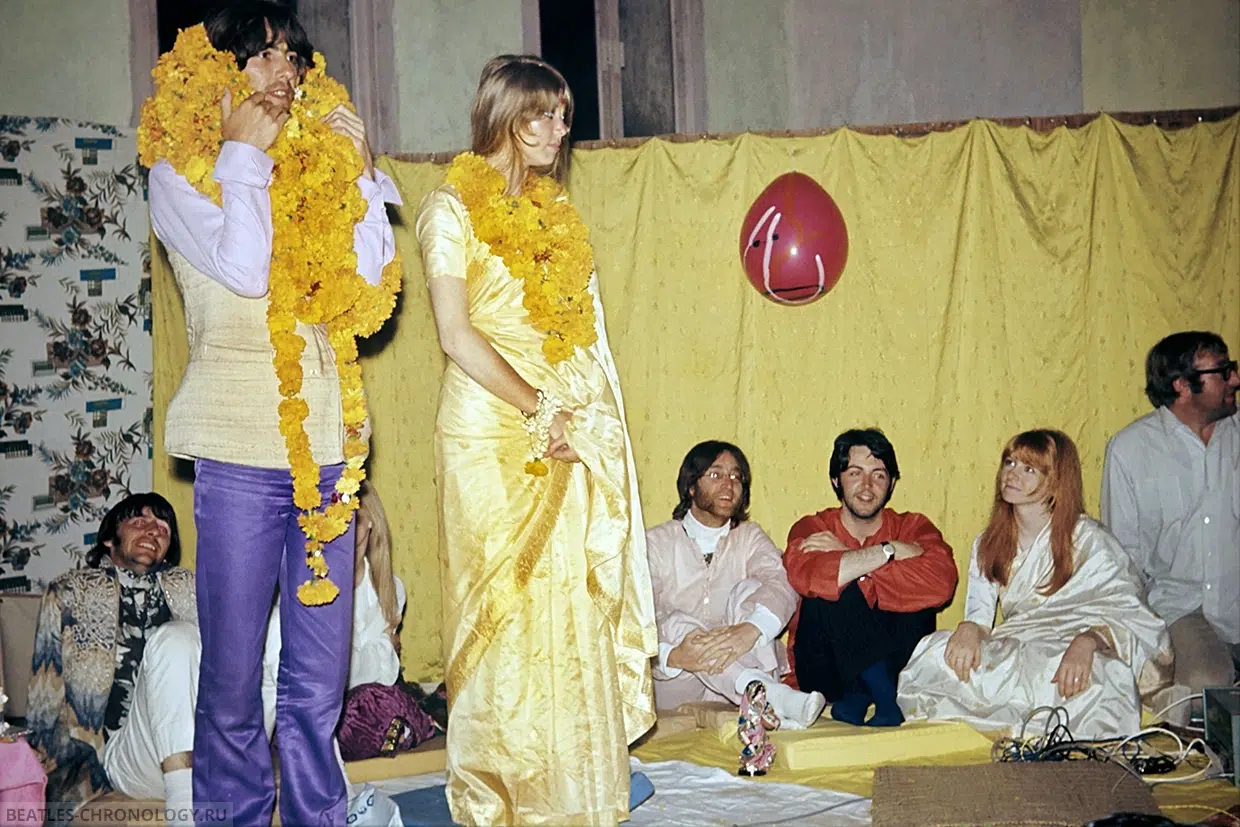
On February 25, 1968, George Harrison celebrated his 25th birthday. A party was held in his honour, featuring communal chanting, a sitar performance by George, and a firework display. During the celebration, the Maharishi presented him with a plastic globe of the world, deliberately placed upside down. “George, the globe I am giving you symbolizes the world today. I hope you will help us all in the task of putting it right,” he said. George promptly turned the globe upright, replying, “I’ve done it!”, which drew warm applause from the other students present.
The Maharishi presented George Harrison with a cake and a plastic globe turned upside-down. ‘This is the world,’ he said. ‘It needs to be corrected.’ We sang ‘Happy Birthday’ to George, and then when the laughter and applause subsided, the Hindu porters laughed and danced and threw firecrackers at one another in the doorway of the lecture hall.
Lewis Lapham – From “With The Beatles” by Lewis Lapham, 2005
We had a big party for George’s birthday. It was crowded with people and we all got dressed up and had red and yellow paint on our foreheads.
Ringo Starr – From “The Beatles Anthology” book, 2000
I had my twenty-fifth birthday in Rishikesh (a lot of people had birthdays while we were there), and they had lots of flowers and garlands and things like that. Maharishi made me play my sitar.
George Harrison – From “The Beatles Anthology” book, 2000
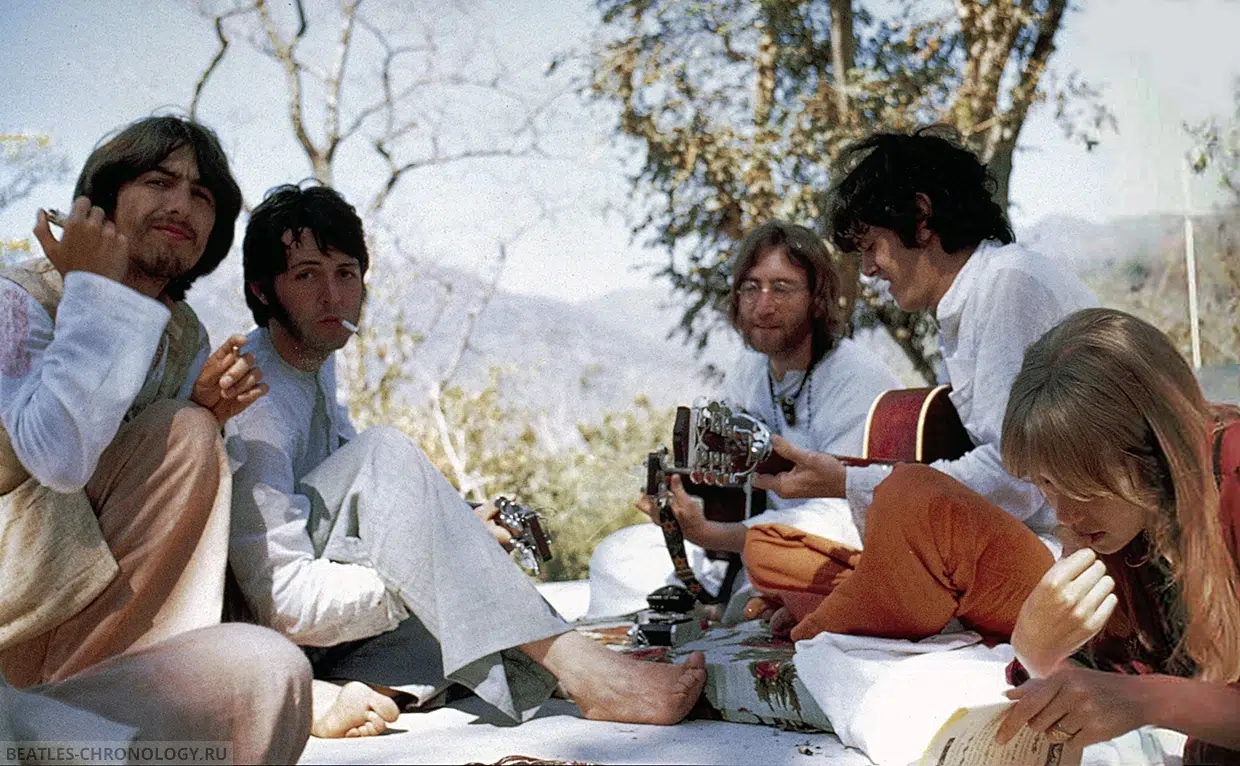
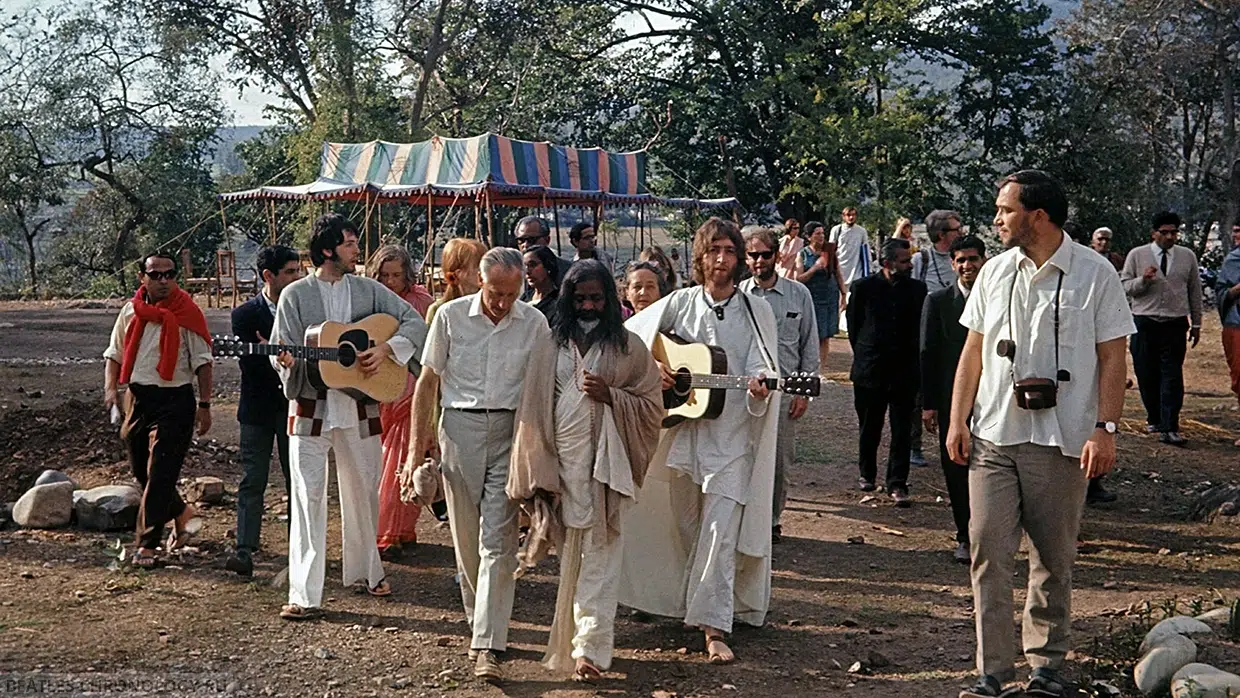
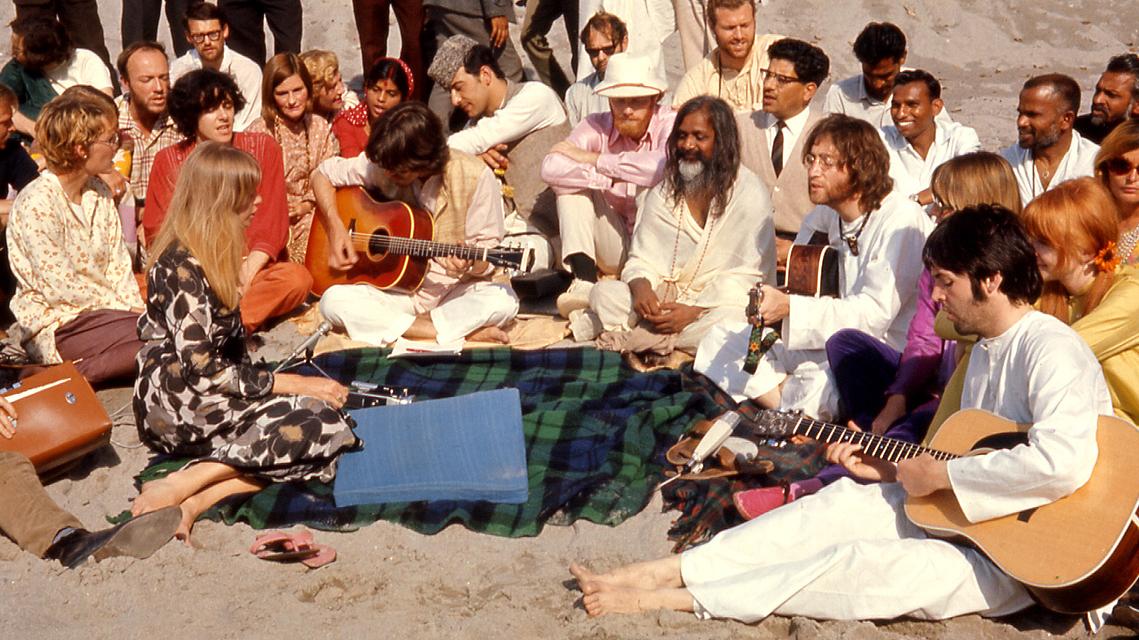
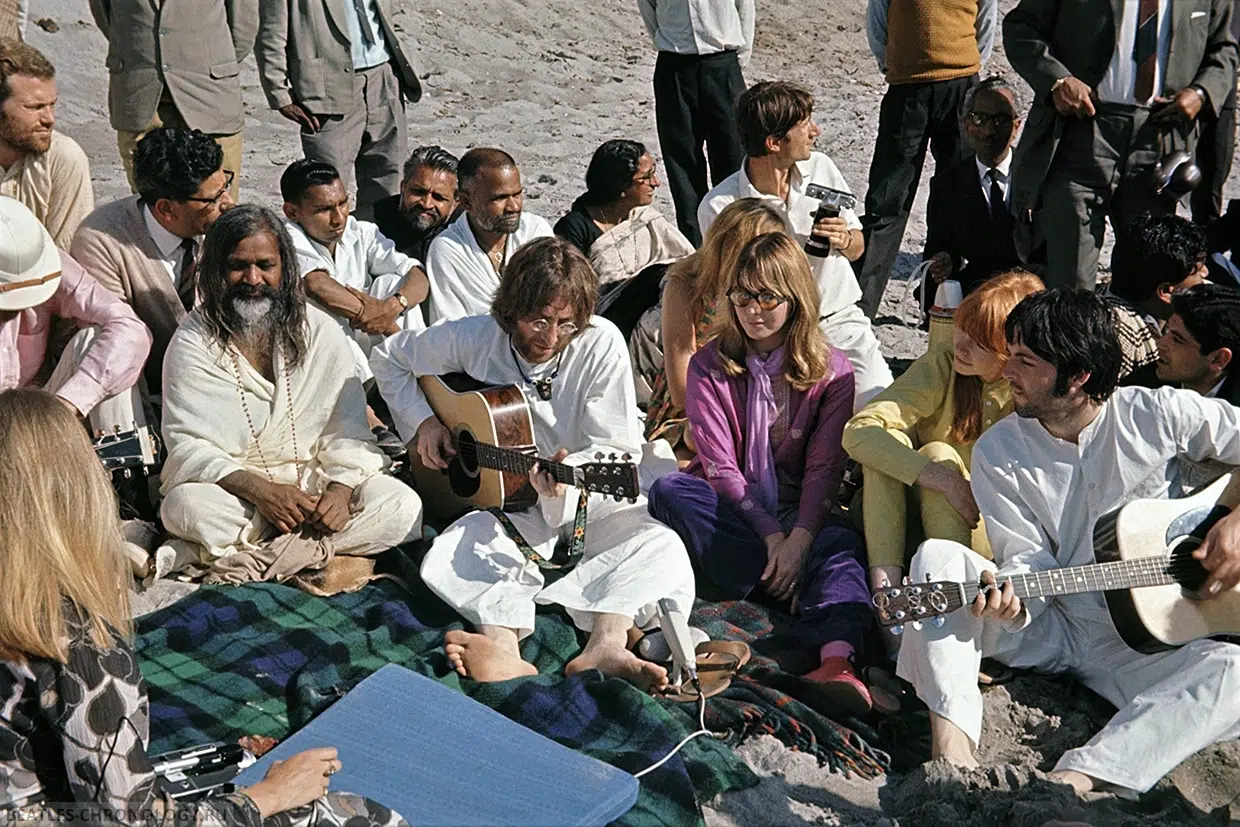
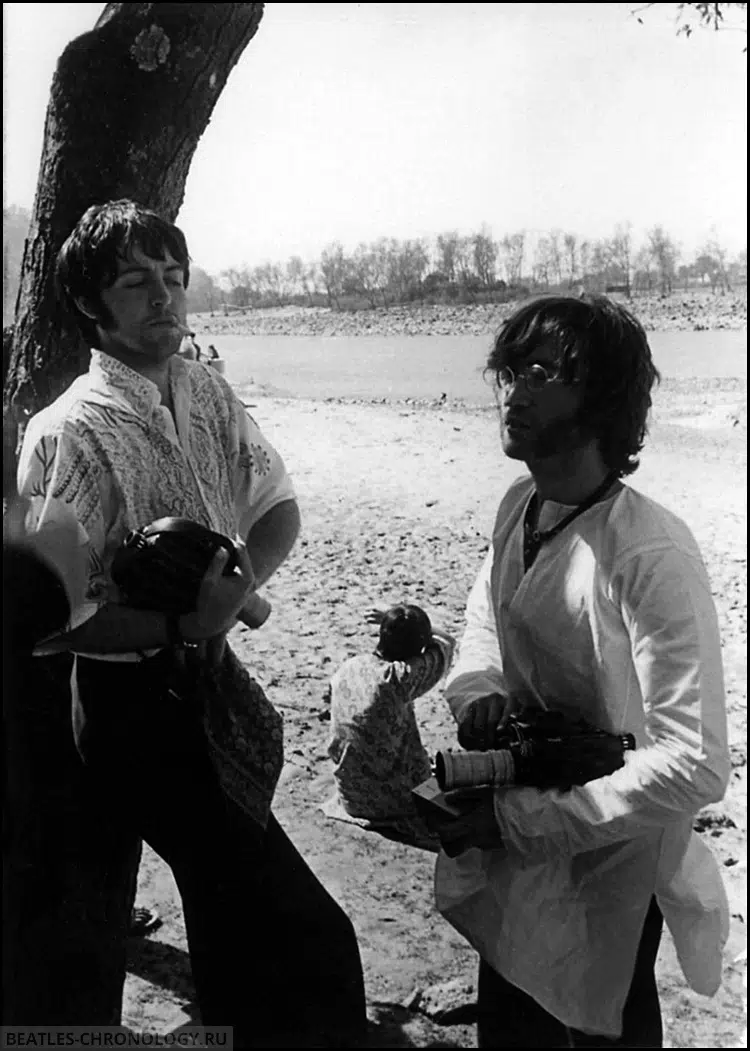
As well as peace, there were also times of joy and celebration. George, Pattie, and musicians, Paul Horn and Beach Boy Mike Love, all celebrated their birthdays within a few days of each other. On Pattie and Paul Horn’s birthday we all watched Paul playing the horn with an Indian musician called Shah Jahan. Donovan, who had recently arrived, played and sang a Beach Boys-inspired song, along with Paul and George, for Mike Love’s birthday celebration. Whether it was a special occasion, I can’t remember, but there was one day when we all traipsed down to the Ganges in our colorful Indian kurta shirts and loose fitting cotton pajamas, made by the tailor who sat cross-legged in a tent at the ashram, ready for our special outing. We sat with Maharishi beside the Holy River; George, John, and Paul playing their guitars with Donovan while everyone else sang some of the better-known songs.
Jenny Boyd – From “Jennifer Juniper – A journey beyond the muse” by Jenny Boyd, 2023
On March 1, 1968, Ringo Starr and his wife Maureen left Rishikesh and returned to England. Both were unhappy about being away from their children, and Ringo in particular struggled with the food. A childhood bout of peritonitis had left him with an intolerance for spicy dishes, and although he had brought a supply of baked beans and was served specially prepared eggs during his stay, it was not enough to persuade him to remain. Maureen, meanwhile, suffered from a strong phobia of flies, which were impossible to avoid in the ashram, further contributing to their decision to leave.
Ringo came home early; he couldn’t stand the food and his wife couldn’t stand the flies. It was understandable; he was a very British lad. There were curries and spicy food – and he has a stomach that gets upset easily (probably due to the peritonitis when he was a kid). Maureen didn’t like the flies – if there was one fly in the room, she would know exactly where it was at any given time. I remember her once being trapped in a room because there was a fly over the door. So obviously conditions in Rishikesh were not ideal for them.
Paul McCartney – From “The Beatles Anthology” book, 2000
It’s all a bit hard to remember now. I was only there for two weeks, then I left. I wasn’t getting what I thought I would out of it.
The food was impossible for me because I’m allergic to so many different things. I took two suitcases with me, one of clothes and the other full of Heinz beans (there’s a plug for you). Then one morning the guys who were dealing with the food said, ‘Would you like some eggs?’ And I said, ‘Oh yeah, sure,’ and the next morning they said it again. I thought, ‘Oh yeah, great – things are looking up.’
Then I saw them burying the shells. That was the first of several incidents that made me think that it was not what I thought it would be. You weren’t supposed to have eggs inside this religious and spiritual ashram. I thought: ‘What do you mean, you’re burying the shells? Can’t God see that too?’
We came home because we missed the children. I wouldn’t want anyone to think we didn’t like it there. I said it was like Butlins holiday camp, we had learnt by then that you could say anything and they’d print it. It was a good experience – it just didn’t last as long for me as it did for them.
Ringo Starr – From “The Beatles Anthology” book, 2000
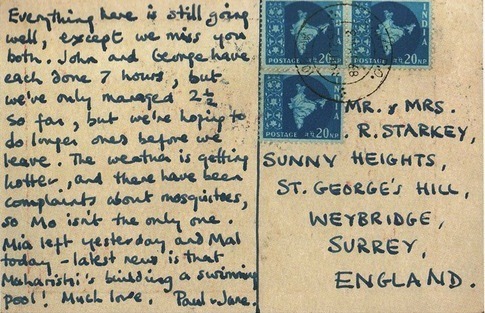
In September 1967, Denis O’Dell joined Apple, the company founded by The Beatles, as director and head of Apple Films. At the time, the group was still contractually bound to deliver a third film to United Artists, and O’Dell put forward the idea of adapting J. R. R. Tolkien’s “The Lord of the Rings” trilogy.
In early March 1968, O’Dell received a telegram from The Beatles in India, inviting him to join them to work on a possible film related to Transcendental Meditation. Seeing this as an opportunity to raise “The Lord of the Rings” idea, he travelled to Rishikesh with Neil Aspinall, who had also been summoned.
During their stay at the ashram, The Beatles — minus Ringo, who had left Rishikesh on March 1 — read Tolkien’s books and began to show enthusiasm for the project. The planned film on Transcendental Meditation, however, didn’t materialize.
I then started to introduce my idea of making a film version of The Lord of the Rings. I had brought copies of the books with me and with a little help from Donovan – long an ardent admirer of Tolkien – persuaded John, Paul and George to take a look at the trilogy. Rather than each having to read the books from cover to cover, each was given one of the books. Paul read the first, The Fellowship of the Ring, John read The Two Towers and George The Return of the King.
Fortunately the meditation project began to take a back seat as Paul, John and George became increasingly enthused about the possibilities of a musical film of the Tolkien trilogy. The three Beatles were truly inspired by the idea, each beginning to earmark roles for themselves. John was keen to play Gandalf and was so enthusiastic that he told me it would be no problem to get ‘at least a double album’ of musical material together for the project. For once, it seemed, at least three of the Beatles had reached an agreement about a film they all wanted to do. And when Paul and myself decided to return to London, leaving John and George in India, I really did believe that after the disappointment of Magical Mystery Tour we were finally on to a winner. I saw the film as a massive project that would exploit and stretch the Beatles’ screen-acting potential, expand their musical horizons and elevate them into the world’s biggest box-office stars.
Denis O’Dell – From “At the Apple’s Core: The Beatles from the Inside“, 2002
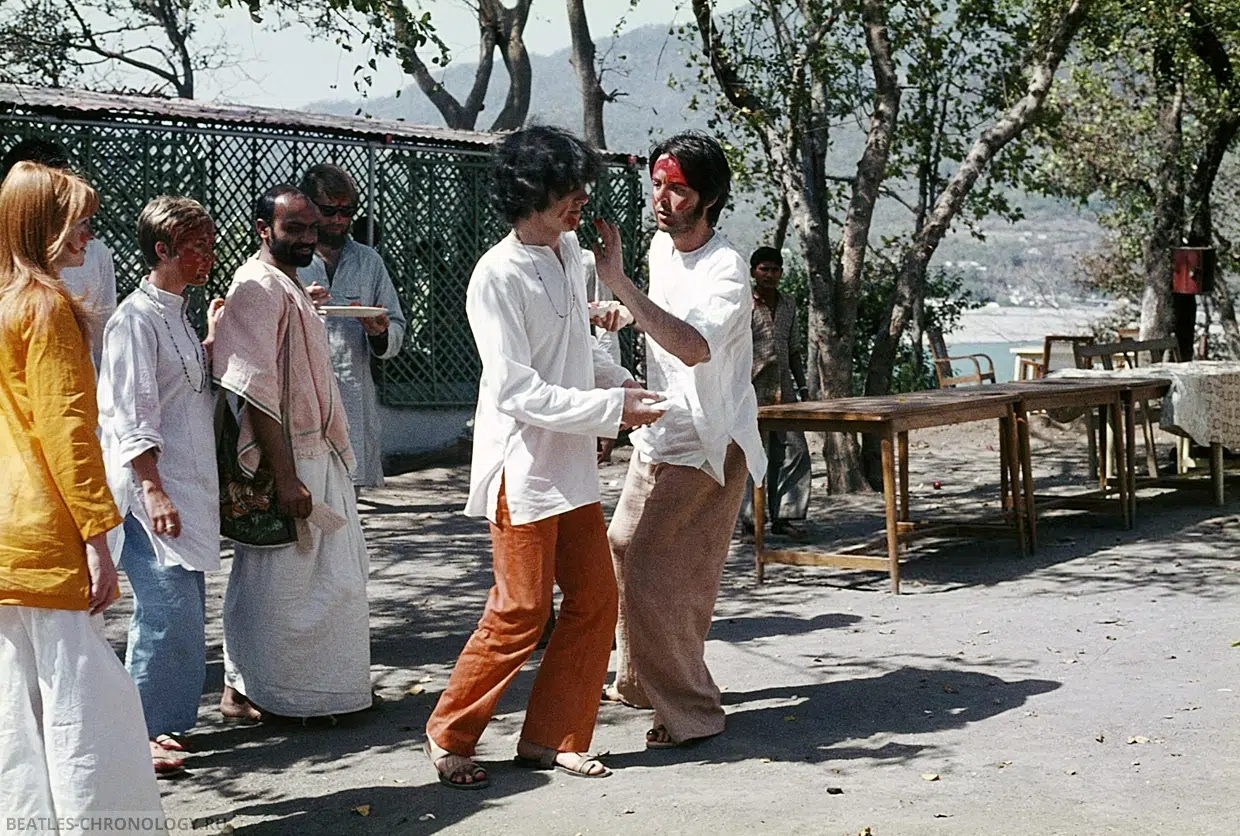
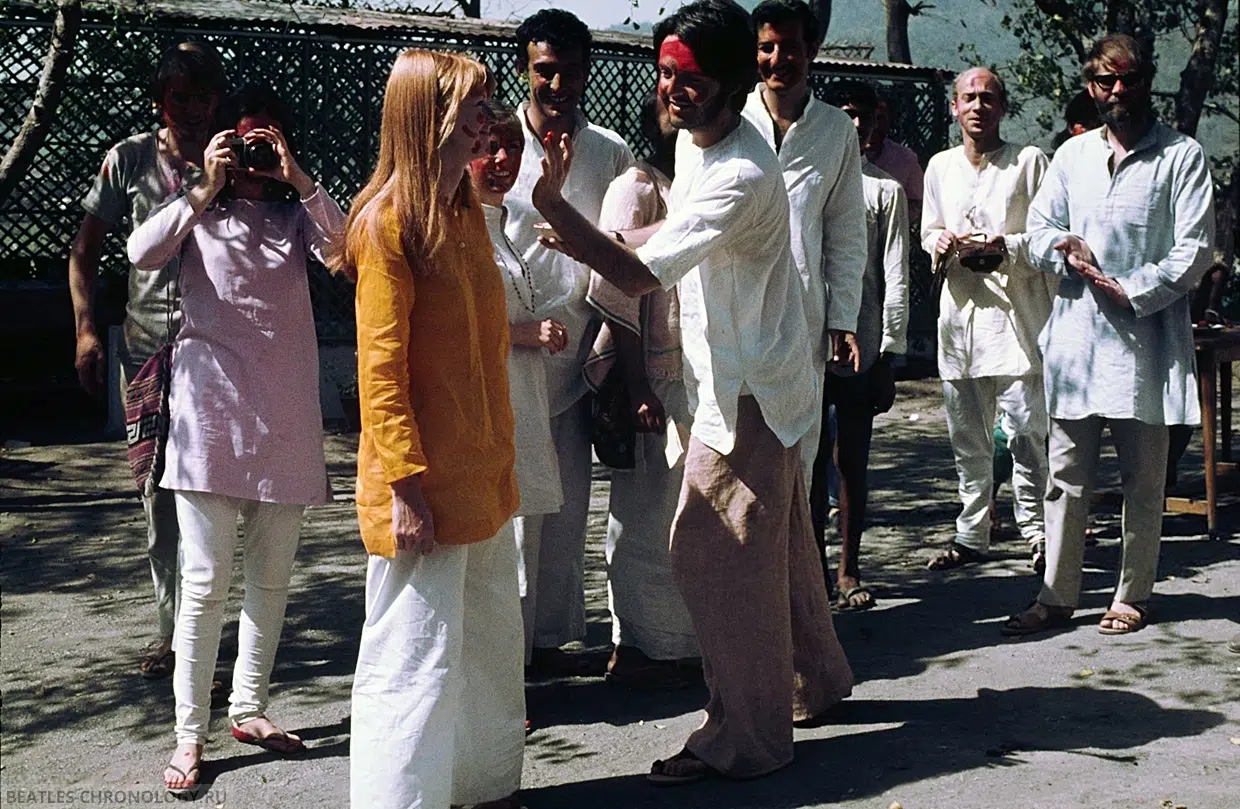
Holi is a major Hindu festival, known as the Festival of Colours, Love and Spring. It commemorates the eternal and divine love of Radha and Krishna. In northern India, the celebrations often involve children playfully spraying coloured powder solutions at one another, while adults traditionally smear dry coloured powder on each other’s faces. During their stay in Rishikesh, The Beatles were photographed joining in the festivities, laughing and covering each other’s faces with coloured powder.
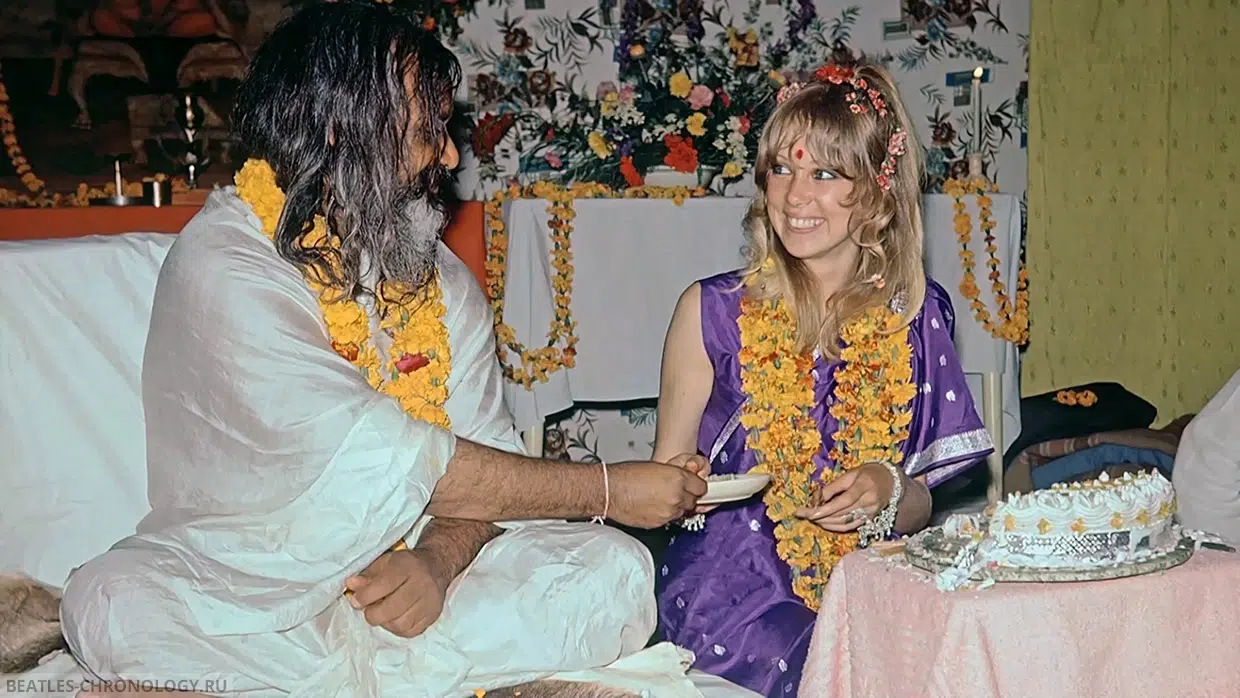
On March 17, Pattie Harrison celebrated her 24th birthday. A number of photographs from the occasion were published in one of the April 1968 issue of Disc and Music Echo. These included images of Pattie receiving her birthday cake, The Beatles with local entertainer Shah Jahan and their flautist friend Paul Horn, George Harrison checking a yogi’s pulse, and Paul McCartney playing a tamboura.
If it was anyone’s birthday, and there was a surprising number while we were there, including George’s twenty-fifth and my twenty-fourth, there would be cake and a party. At George’s everyone put red and yellow paint on their faces and wore garlands of flowers, and an Indian musician came to play for him. The same musician played on my birthday, and gave me a beautiful dilruba—an Indian string instrument—with a bird’s head engraved at the neck. John drew me a picture of us all meditating and wrote “Happy Birthday Pattie love from John and Cyn” on it, and Cynthia, who was an accomplished artist, made me a lovely painting.
Pattie Boyd – From “Wonderful Tonight: George Harrison, Eric Clapton, and Me“, 2008
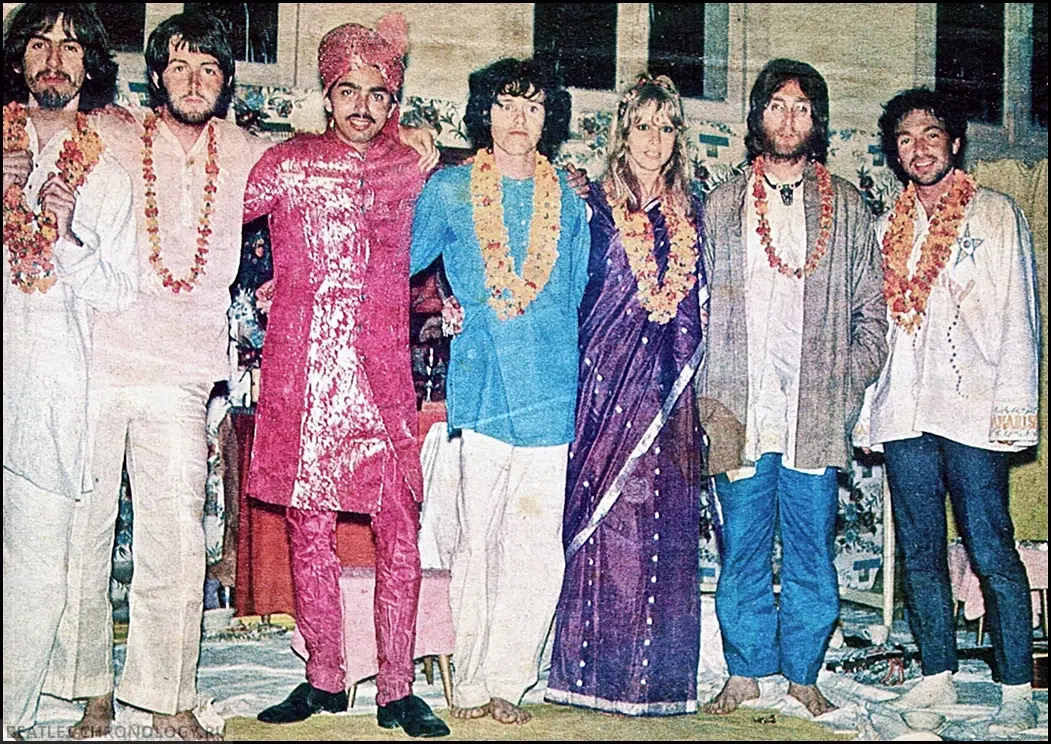
Nancy Cooke de Herrera was an American socialite and early Western promoter of Transcendental Meditation, sometimes referred to as “Maharishi’s ambassador to the West.” She was present at the ashram during the Beatles’ stay in Rishikesh in 1968, accompanied by her son, Rik.
During their time there, Nancy Cooke de Herrera and Rik joined a local hunting party and Rik shot a tiger in the nearby jungle. News of the event quickly circulated among the guests, unsettling many, as it stood in stark contrast to the principle of non-violence taught at the ashram. Donovan later recalled Maharishi’s visible disappointment upon hearing what had happened.
The episode inspired John Lennon to write “The Continuing Story of Bungalow Bill,” recorded later that year for the White Album.
‘The Continuing Story Of Bungalow Bill’ was written about a guy who took a short break to go shoot a few poor tigers, and then came back to commune with God. There used to be a character called Jungle Jim, and I combined him with Buffalo Bill. It’s a sort of teenage social-comment song and a bit of a joke.
John Lennon – From “The Beatles Anthology” book, 2000
The beat started. Suddenly, I was aware of a movement in the underbrush. I saw Avi point. As I kicked Rik to look, we heard a furious roar — Rik said it startled him so much that he almost pulled the trigger right then. A second later, the tiger broke in front and like a streak of lightning leaped at us. Rik’s gun went off instantaneously, hitting the animal’s head and stopping its charge. At almost the same instant, Avi fired, hitting it also near the ear and killing it. For a second, all was quiet and there was a tiger lying two feet from our ladder.
“Rik, I’m so proud of you!”
“Mom, I’ve never shot so fast in my life. That was real luck. I’m sure glad Avi had that big gun, or that animal could have recovered and been up in the machand with us!”
The elephants returned; everyone was shouting and congratulating Rik. After the initial excitement was over. Avi said to us. “Cool it, unless you want to pay $7,000. You don’t want the Burkes to get uptight.” Against the real tradition of the hunt, they claimed the skin, saying it was just a fluke they were not in the machand at the time. Rik didn’t care, he had had the thrill of shooting the tiger.
As for me, once I got down the ladder and saw the tiger up close, I felt sick. There wasn’t a blemish on his coat; he’d been shot down in the prime of his life — what a terrible thing to kill such a magnificent young animal. I would never go hunting again.
The next day, on returning to the ashram, we went directly to see Maharishi. John Lennon, Paul McCartney, Jane Asher, and George Harrison were there with him. Rik was worried about his killing the tiger. “Is that bad karma for me, Maharishi?”
The answer was, “You had a desire, and now you have satisfied it and will no longer have the desire.” (Maharishi must have been right, for Rik hasn’t been hunting since.)
“But wouldn’t you call that slightly life-destructive?” sneered John.
“Well, it was the tiger or us,” I volunteered, getting into the act.
Paul, with Jane sitting alongside, her head on his shoulder, asked, “Tell us the details, man — what an experience.” He always went out of his way to be friendly to everyone.
Nancy Cooke de Herrera – From “All you need is love : an eyewitness account of when spirituality spread from the East to the West” by Nancy Cooke de Herrera, 2003
On March 24, Paul McCartney and Jane Asher left Rishikesh to return to London, along with Neil Aspinall and Denis O’Dell.
I was quite happy. I was wondering how the others were going to get out of it, though, and then they arrived back with a story that Maharishi had made a pass at an attractive blonde American girl with short hair (not Mia Farrow).
Paul McCartney – From “The Beatles Anthology” book, 2000
Paul and Jane left after about a month. Paul was keen to get back to London and Apple, the business the Beatles were about to launch. The Apple shop had opened just before we left but there was an office to find and a new manager to replace Brian. He had always been more interested in business than the others and I guess a month of meditating was enough for him.
Pattie Boyd – From “Wonderful Tonight: George Harrison, Eric Clapton, and Me“, 2008
Jane Asher and Paul had to leave the last week in March, after six tranquil weeks. Jane had a theatrical commitment she could not break. It was a heartwarming scene when they said their goodbyes. Paul got on his knees and said, “Maharishi, you will never fathom what these days have meant to us. To have the unbroken peace and quiet and all your loving attention — only a Beatle could know the value of this. You kept your word to us, you protected us from the press and all outsiders. This has been the ultimate luxury. We will never forget you. When John and George get back, we’ll work on the plans we’ve made here.”
As Rik and I walked to the upper gate with them, Paul gave Rik his tripod. He said to me, “I’m going away a new man.” Jane beamed with happiness. John stood by the gate and, strumming his guitar, bid them a fond farewell. John almost seemed like a different person from the white, pinched-faced man who had arrived. He posed happily for me as I took a picture of him with his foot on a rock, playing his guitar.
Nancy Cooke de Herrera – From “All you need is love : an eyewitness account of when spirituality spread from the East to the West” by Nancy Cooke de Herrera, 2003
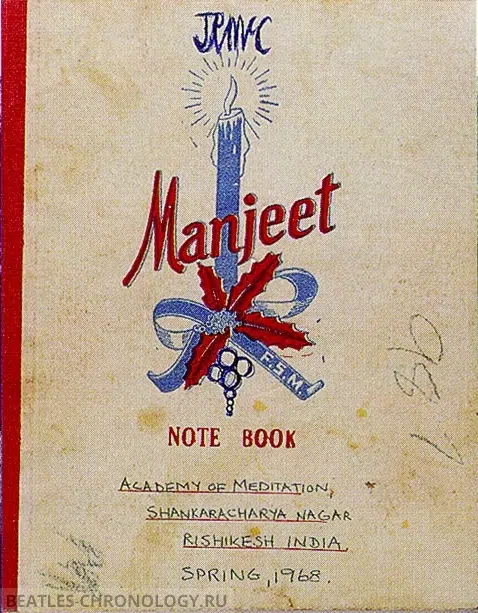
After nearly two months in Rishikesh, John and George left the ashram on April 12, 1968, accompanied by their wives Cynthia and Pattie, as well as Alexis “Magic Alex” Mardas.
Their departure followed claims made by Mardas, who alleged that Maharishi had attempted to obtain sexual favours from female guests at the retreat. Troubled by these accusations, John and George chose to leave the course abruptly. The story of Maharishi’s supposed misconduct spread quickly, though it was later questioned by several participants, with many suggesting that the allegations had been exaggerated or unfounded.
A couple of weeks before we were due to leave, Magic Alex accused the Maharishi of behaving improperly with a young American girl, who was a fellow student. Without allowing the Maharishi an opportunity to defend himself, John and George chose to believe Alex and decided we must all leave.
I was upset. I had seen Alex with the girl, who was young and impressionable, and I wondered whether he – whom I had never once seen meditating – was being rather mischievous. I was surprised that John and George had both chosen to believe him. It was only when John and I talked later that he told me he had begun to feel disenchanted with the Maharishi’s behavior. He felt that, for a spiritual man, the Maharishi had too much interest in public recognition, celebrities and money.
Cynthia Lennon – From “John“, 2006
There was a big hullabaloo about him trying to get off with Mia Farrow and a few other women, things like that. We’d stayed up all night discussing was it true or not true. And when George started thinking it might be true, I thought it must be true because if George is doubting him there must be something in it.
John Lennon – From “The Beatles Anthology” book, 2000
Someone started the nasty rumour about Maharishi, a rumour that swept the media for years. There were many stories about how Maharishi was not on the level or whatever, but that was just jealousy about Maharishi. We’d need analysts to get into it. I don’t know what goes through these people’s minds, but this whole piece of bullshit was invented. It’s probably even in the history books that Maharishi ‘tried to attack Mia Farrow’ – but it’s bullshit, total bullshit. Just go and ask Mia Farrow.
George Harrison – From “The Beatles Anthology” book, 2000
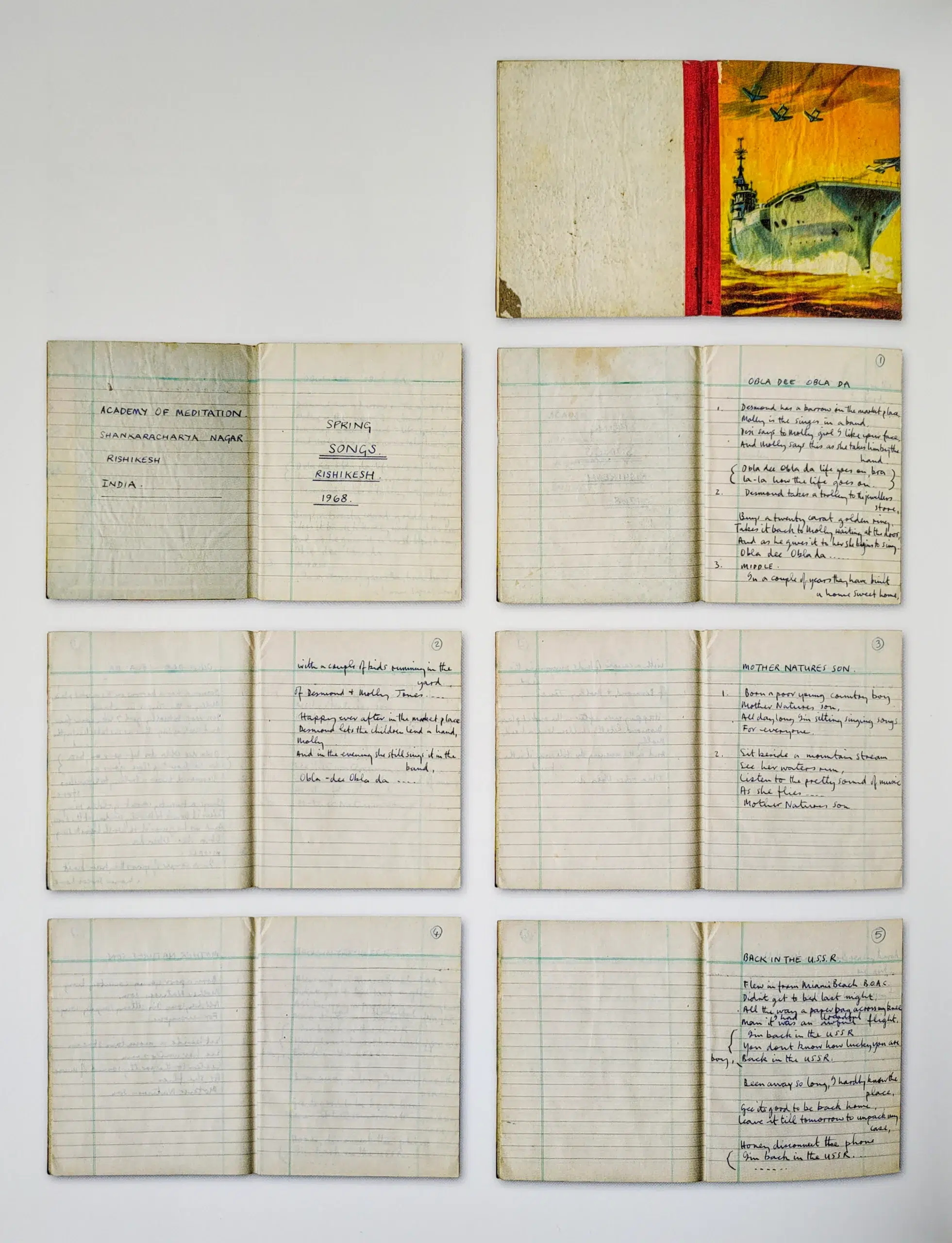
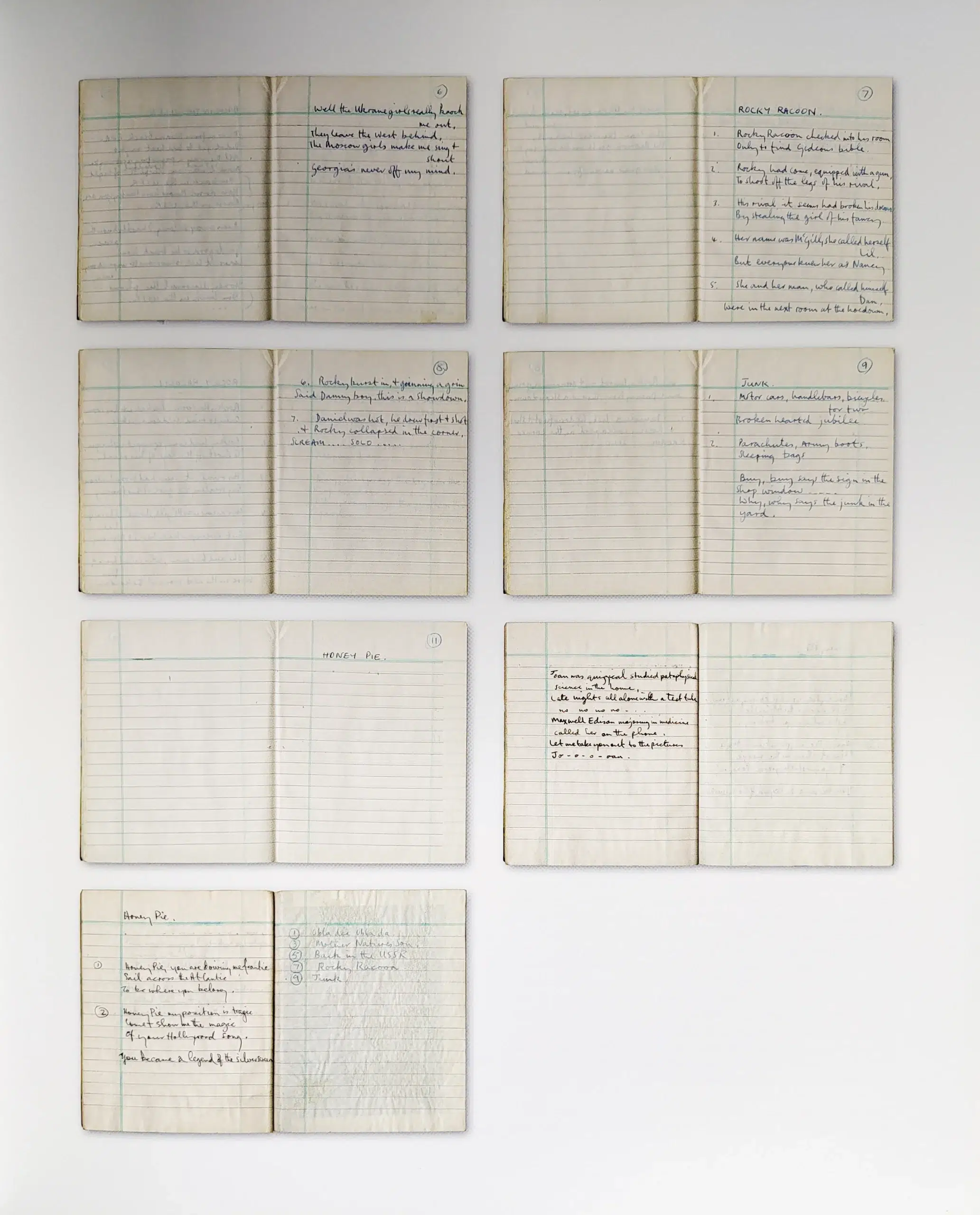
About 30 songs were written during the Beatles’ stay in Rishikesh. Most of them became part of the White Album, released in November 1968. A couple of them were recorded for the 1969 album “Abbey Road.” Paul McCartney also released three songs written in Rishikesh during his solo career.
We wrote about thirty new songs between us. Paul must have done about a dozen. George says he’s got six, and I wrote fifteen. And look what meditation did for Ringo – after all this time he wrote his first song.
John Lennon
George, John, and Paul wrote several songs while we were there—several went into the White Album—and Donovan taught them his finger-picking technique on the guitar. Someone was always playing a guitar and there would be discussions and singing, a nice little hubbub of social activity.
Pattie Boyd – From “Wonderful Tonight: George Harrison, Eric Clapton, and Me“, 2008
We ate breakfast outside, with lots of crows vying for our food. I was sitting there one day when Paul came to the table with his acoustic guitar, saying, “Hey, listen to this, Mike: ‘Flew in from Miami Beach B.O.A.C., didn’t get to bed last night…’” He was writing “Back in the U.S.S.R.” I told him, “You should sing about all the girls around the Soviet Union: the Ukraine girls, the Moscow girls, Georgia on my mind.”
We all had so much fun playing music for each other. For my birthday, the Beatles wrote a song called “Spiritual Regeneration” that ended with “Happy birthday, Michael Love.” It sounded just like the Beach Boys, the same rhythms, the same harmonies.
Mike Love, of the Beach Boys – From Smithsonian (smithsonianmag.com), January 2018
Regardless of what I was supposed to be doing, I did write some of my best songs while I was there. It was a nice scene. Nice and secure and everyone was always smiling. The experience was worth it if only for the songs that came out, but it could have been the desert or Ben Nevis.
The funny thing about the camp was that although it was very beautiful and I was meditating about eight hours a day, I was writing the most miserable songs on earth. In ‘Yer Blues’, when I wrote, ‘I’m so lonely I want to die,’ I’m not kidding. That’s how I felt.7’ Up there trying to reach God and feeling suicidal.
John Lennon – From “The Beatles Anthology” book, 2000
Mike Love was in Rishikesh. Donovan was there. I can remember people like that. Mia Farrow was there, and her sister, Prudence. John wrote the song ‘Dear Prudence’ for her because she had a panic attack and couldn’t come out of her chalet.
Paul McCartney – From “The Beatles Anthology” book, 2000
I wrote a couple of little things while I was there. I had a song called ‘I Will’, but I didn’t have any words for it. And I wrote a bit of ‘Ob-La-Di, Ob-La-Da’. We went to a cinema show in a village where a guy put up a mobile screen and all the villagers came along and loved it. I remember walking down a little jungle path with my guitar to get to the village from the camp. I was playing: ‘Desmond has a barrow in the market place…’
Paul McCartney – From “The Beatles Anthology” book, 2000
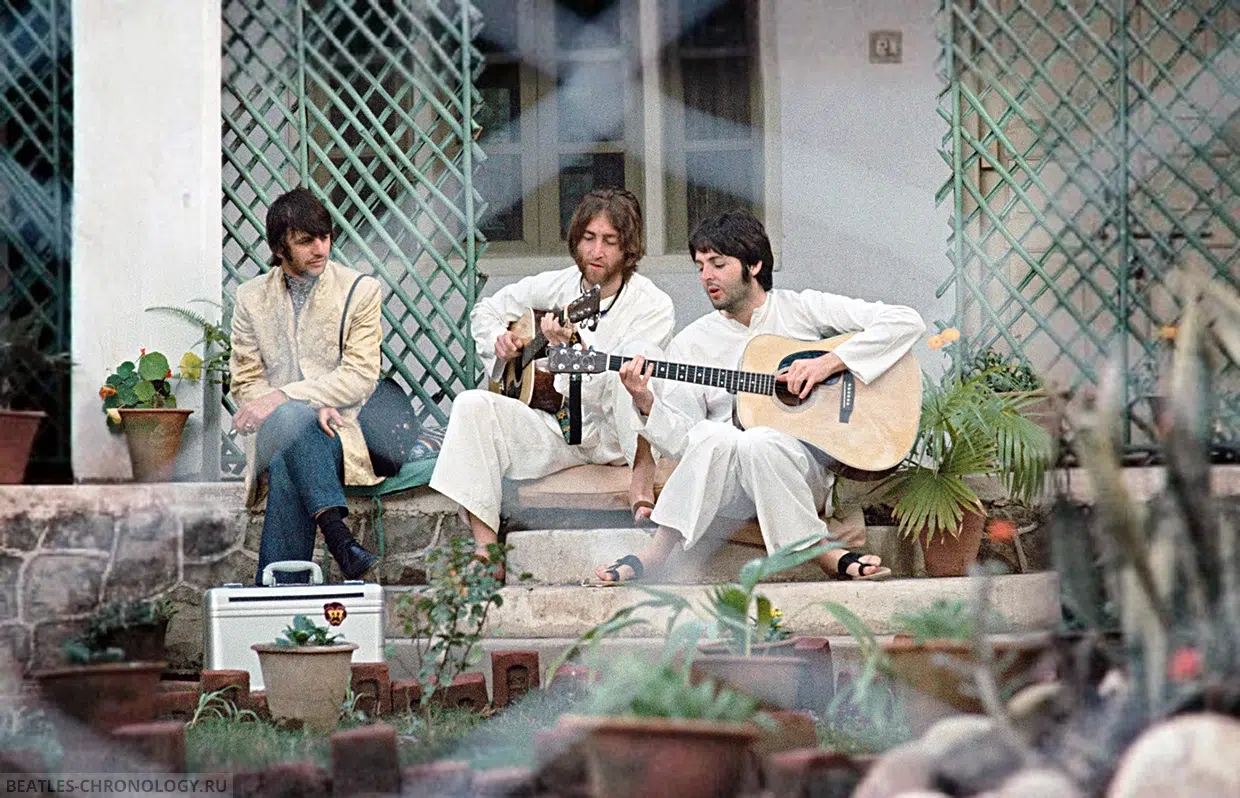
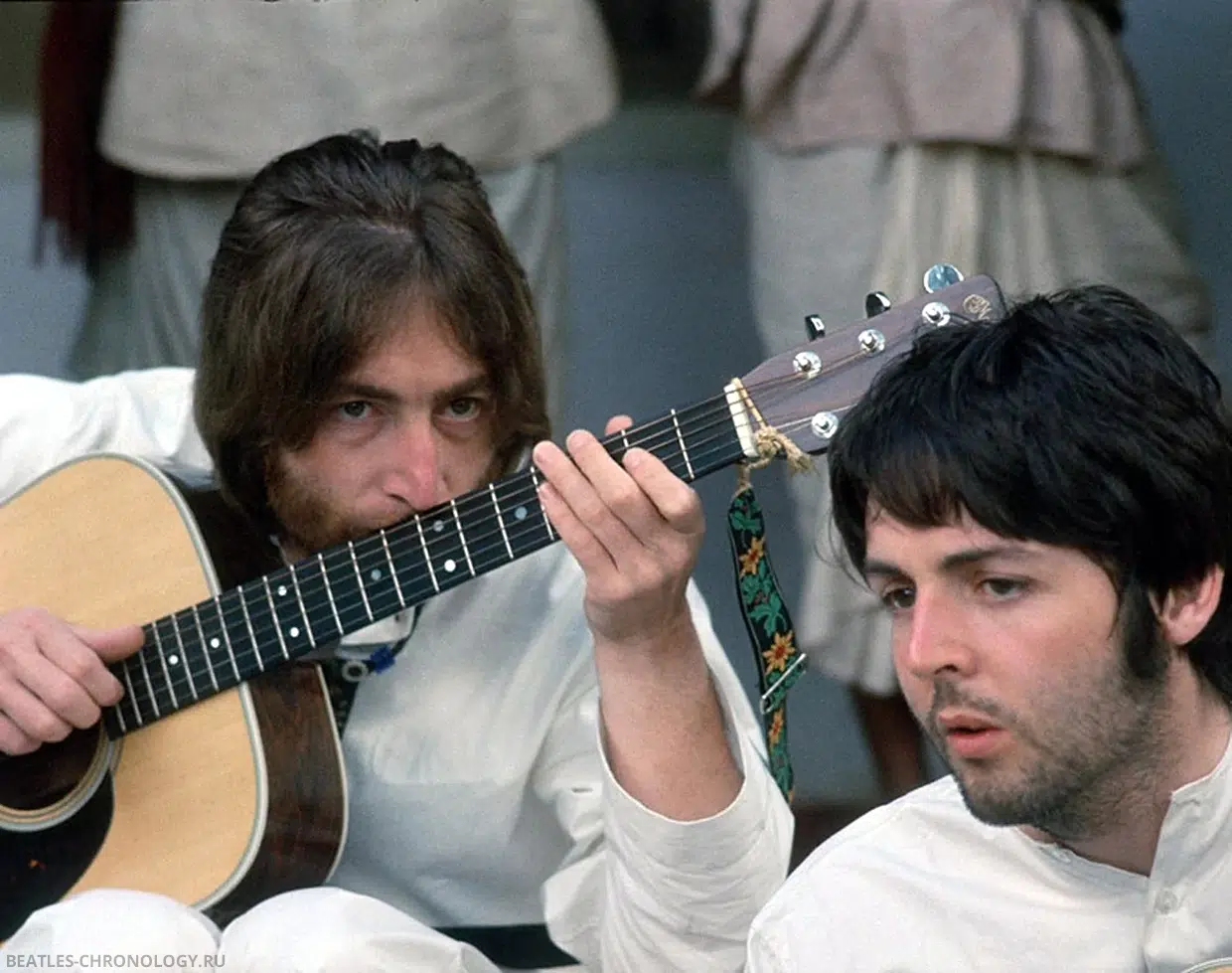
Later that afternoon, I heard guitars and the sound of Paul’s and John’s voices. They were sitting with Ringo among the potted plants on the steps of their bungalow. […] They were strumming their Martin acoustic guitars, singing fragments of songs, musically meandering through some of my favorites: “Michelle,” “All You Need Is Love,” “Norwegian Wood,” “Eleanor Rigby,” and others. Ringo was dressed in his favorite heavy, gold-brocade Nehru jacket and jeans […] John and Paul wore white cotton kurta pajamas, the most comfortable clothers to wear in India […] Paul started strumming again and John joined in. Paul had a pad of paper sitting on the step beneath him, and he started to sing the words that he had scribbled down. It was the chorus to “Ob-La-Di, Ob-La-Da.” They repeated it over and over again, and when they stopped Paul looked at me with a twinkle in his eyes and Said, “That’s all there is so far We’ve got the chorus but no words yet.”
Paul Saltzman – From “The Beatles in Rishikesh” by Paul Saltzman, 2000
Songs written in Rishikesh and released on the “The Beatles”, November 1968:
Songs written in Rishikesh released on “Abbey Road” in 1969:
written in Rishikesh and released by Paul McCartney on solo albums:
I learnt how to meditate. I don’t meditate as much now, but I say to my kids that it’s not a bad thing to learn, because if you’re stuck somewhere or if you’re a bit disturbed, it is a great thing to do.
Paul McCartney – From “The Beatles Anthology” book, 2000
The demand for TM grew, in spite of the bad press Maharishi had received from The Beatles’ rebellion. Unfortunately, some of the other celebrities who had been at the ashram kept quiet and said nothing. I wondered what Paul McCartney thought; had he forgotten the love in his heart the day he said goodbye to Maharishi? Never a word was heard from him, or Mia, or Donovan—at least publicly. There were times when a word from them would have helped.
Nancy Cooke de Herrera – From “All you need is love : an eyewitness account of when spirituality spread from the East to the West” by Nancy Cooke de Herrera, 2003
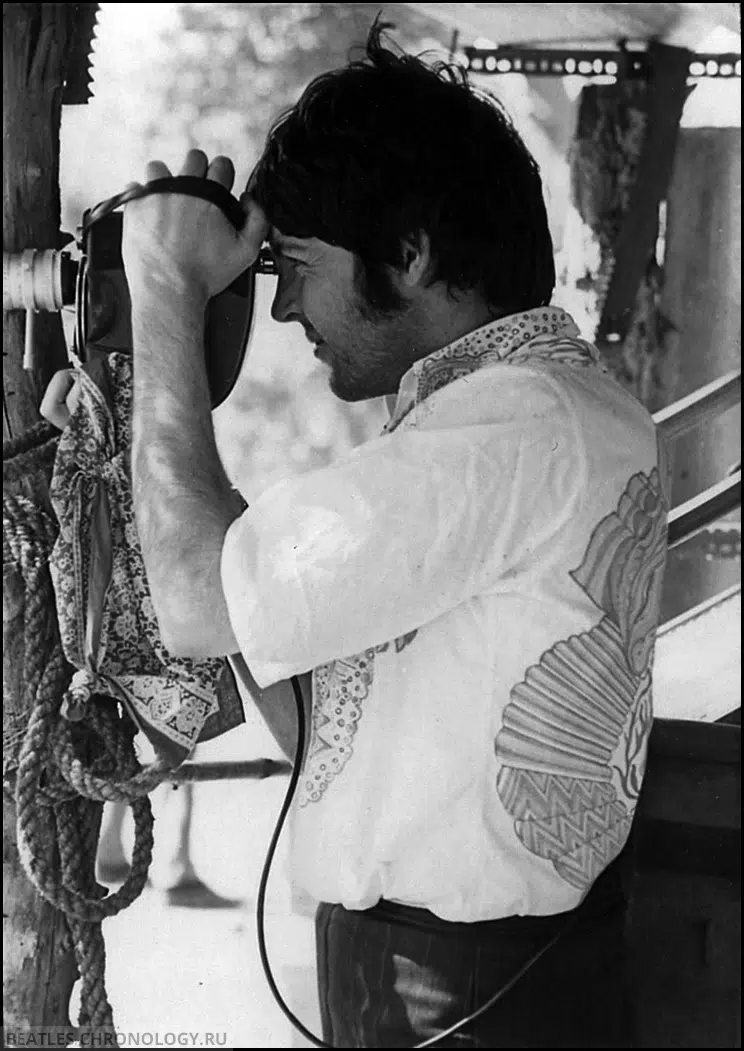
The Beatles shot extensive reels of film during their stay in Rishikesh, capturing both daily life at the ashram and their interactions with fellow guests. Denis O’Dell, head of Apple Films, was invited to India to explore the possibility of turning this material into a professional production for public release, but the idea never went beyond the planning stage.
Months later, on January 25, 1969, during the “Get Back” sessions at Apple Studios, Paul McCartney told the others that he had edited their Rishikesh home movies into a complete film and had watched the finished version the night before:
George Harrison: What were we doing?
Paul McCartney: We, uh… I don’t really know, you know? But it’s like we totally, sort of, put our own personalities under, for the sake of it. And you can really see, you know, we’re all…
John Lennon: Who’s writing all them songs?
Paul McCartney: That was probably when we did…
John Lennon: In your room.
Paul McCartney: Yeah. Right. I remember, yeah. But just sort of… There’s a…
George Harrison: Do you regret having gone there?
Paul McCartney: No, no. Oh, no. I just think, what we did there, we weren’t really very truthful there. You know, things like sneaking behind [The Maharishi’s] back and sort of saying, “It’s a bit like school, isn’t it?” But you can see on the film that it is very like school.
John Lennon: You want to call it “What We Did On Our Holidays”?
Paul McCartney: But it is very like that. There’s a long shot of you, sort of, walking with him. And it’s just not you, you know?
From Peter Jackson’s film “The Beatles: Get Back“, 2021
The Beatles Diary Volume 1: The Beatles Years
With greatly expanded text, this is the most revealing and frank personal 30-year chronicle of the group ever written. Insider Barry Miles covers the Beatles story from childhood to the break-up of the group.

Notice any inaccuracies on this page? Have additional insights or ideas for new content? Or just want to share your thoughts? We value your feedback! Please use the form below to get in touch with us.


