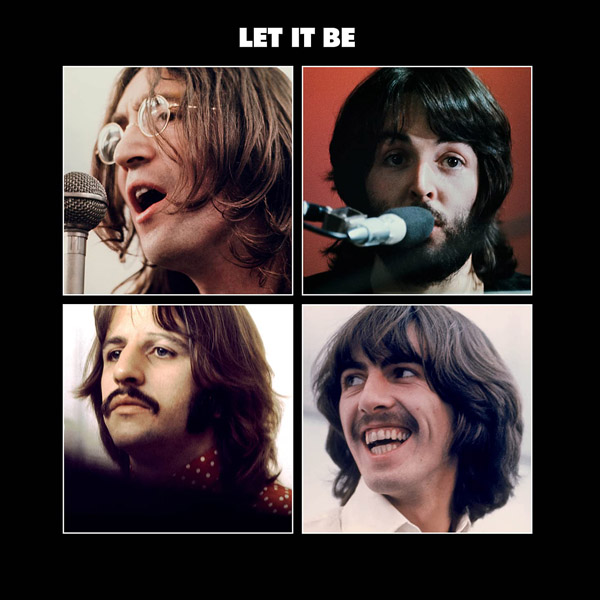
Monday, January 5, 1970
Mixing "I Me Mine", "Across The Universe" for the "Get Back" album (4th compilation)
For The Beatles
Last updated on June 4, 2025
Monday, January 5, 1970
For The Beatles
Last updated on June 4, 2025

Jan 3 - April 2, 1970 • Songs recorded during this session appear on Let It Be (US version)
Recording studio: Olympic Sound Studios • London • UK
Session Jan 3 - April 2, 1970 • The "Let It Be" sessions
Session Jan 04, 1970 • Recording and mixing "Let It Be"
Session Jan 05, 1970 • Mixing "I Me Mine", "Across The Universe" for the "Get Back" album (4th compilation)
Album Jan 09, 1970 • "Magic Christian Music" by Badfinger released in the UK
AlbumSome of the songs worked on during this session were first released on the "Let It Be (UK - 1st pressing with "Get Back" book)" LP
On December 15 and 21, 1969, engineer Glyn Johns began work on a new version of the “Get Back” LP. His previous attempts had been rejected, but Apple Records asked him to give it another try — this time ensuring the album aligned with Michael Lindsay-Hogg’s forthcoming documentary, which was then nearing completion. Meanwhile, manager Allen Klein was still weighing a proposal he had made to the Beatles a few weeks earlier to bring in producer Phil Spector.
To align the record with the film’s musical content, Johns removed “Teddy Boy,” which no longer appeared in the latest cut of the documentary, and added “Across The Universe” and “I Me Mine.”
On this day, he continued that effort in a session that lasted from 7 pm to 11:30 pm. He began by mixing take 16 of “I Me Mine“, recorded by Paul McCartney, George Harrison and Ringo Starr on January 3, 1970.
He also likely prepared a new stereo mix of “Across The Universe,” using the original February 1968 tapes. In doing so, he omitted the backing vocals recorded by The Beatles and by Gayleen Pease and Lizzie Bravo, two fans invited to the session at the time. He also incorporated some new lead vocals by John Lennon, recorded at an unknown date. This stripped-down mix was released on the “Let It Be (50th anniversary boxset)” released in 2021.
A further session on January 8 would be needed for Glyn Johns to complete this new version of the “Get Back” LP.
Once the film had been reedited to Klein’s specifications, John and Paul asked me to change some of the material on my version of the album. This included going in with John to redo his vocal on “Across the Universe,” a track that had been recorded in 1968. This was to be my last experience working with him.
Glyn Johns – From “Sound Man: A Life Recording Hits with The Rolling Stones, The Who, Led Zeppelin, The Eagles, Eric Clapton, The Faces…“, 2014
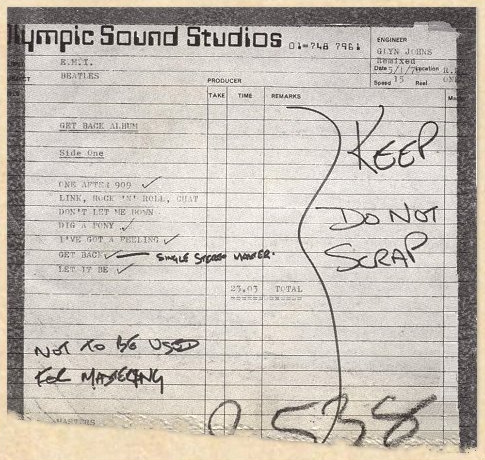
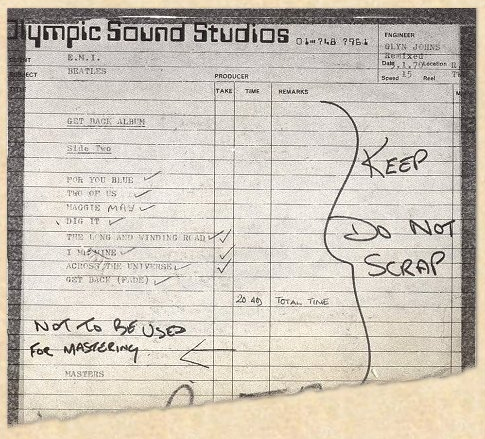
A few months after the end of the “Get Back” sessions, engineer/producer Glyn Johns was given the task of compiling an actual album. Glyn made four different variants of the album, two of them having been considered for release at some point.
| Compilation 1 – January 1969 | Compilation 2 – Early May 1969 | Compilation 3 – Late May 1969 | Compilation 4 – January 1970 |
| Mixed: January 24, 1969 January 26, 1969 January 27, 1969 January 30, 1969 | Mixed: February 5, 1969 March-May, 1969 March 4, 1969 April 3, 1969 April 4, 1969 April 7, 1969 May 2, 1969 May 7, 1969 May 9, 1969 | Mixed: May 15, 1969 May 28, 1969 | Additional recording: January 3, 1970 January 8, 1970 Mixed: December 15, 1969 December 21, 1969 January 5, 1970 January 8, 1970 |
| Side one 1. Get Back (false start) — DDSI 23.78 2. Get Back — DDSI 23.79 3. I’ve Got a Feeling (fragment) — DDSI 23.80 4. Help! (fragment) — DDSI 23.81 5. Teddy Boy — DDSI 24.33 6. Two of Us (fragment – false start) — DDSI 24.48 7. Two of Us — DDSI 24.69 8. Dig a Pony — DDSI 23.66 9. I’ve Got a Feeling — DDSI 22.71 Side two 10. The Long and Winding Road — DDSI 26.91 11. Let It Be — DDSI 26.74 12. Don’t Let Me Down — DDSI 22.60 13. For You Blue — DDSI 25.46 14. Get Back — DDSI 27.63 15. The Walk — DDSI 27.83 | Side one 1. One After 909 2. Rocker 3. Save the Last Dance for Me 4. Don’t Let Me Down 5. Dig a Pony 6. I’ve Got a Feeling 7. Get Back Side two 8. For You Blue 9. Teddy Boy 10. Two of Us 11. Maggie Mae 12. Dig It 13. Let It Be 14. The Long and Winding Road 15. Get Back (reprise) | Side one 1. One After 909 — DDSI.30.08 2. Rocker — DDSI.22.58 3. Save the Last Dance for Me — DDSI.22.59 4. Don’t Let Me Down — DDSI.22.80 5. Dig a Pony — DDSI.23.70 6. I’ve Got a Feeling — DDSI.22.71 7. Get Back — DDSI.27.63 & 28.43 Side two 8. For You Blue — DDSI.25.47 9. Teddy Boy — DDSI.24.33 10. Two of Us — DDSI.24.69 11. Maggie Mae — DDSI.24.49 12. Dig It — Excerpt of DDSI.24.85 13. Let It Be — 31.64 + overdubbed guitar solo 14. The Long and Winding Road — DDSI.26.91 15. Get Back (reprise) — DDSI.28.43 | Side one 1. One After 909 2. Rocker 3. Save the Last Dance for Me 4. Don’t Let Me Down 5. Dig a Pony 6. I’ve Got a Feeling 7. Get Back 8. Let It Be Side two 9. For You Blue 10. Two of Us 11. Maggie Mae 12. Dig It 13. The Long and Winding Road 14. I Me Mine 15. Across the Universe 16. Get Back (reprise) |
| Bootlegged on “Kum Back“ | Bootlegged on “O.P.D.“ |
Written by George Harrison
Mixing • Stereo mixing - Remix 1 from take 16
Mixing • Stereo mixing - Remix 3 from take 8
AlbumOfficially released on Let It Be (50th anniversary boxset)
Master tape banding and compilation for GetBack LP
Mixing
The Complete Beatles Recording Sessions • Mark Lewisohn
The definitive guide for every Beatles recording sessions from 1962 to 1970. We owe a lot to Mark Lewisohn for the creation of those session pages, but you really have to buy this book to get all the details - the number of takes for each song, who contributed what, a description of the context and how each session went, various photographies... And an introductory interview with Paul McCartney!
The Beatles Recording Reference Manual: Volume 5: Let It Be through Abbey Road (1969 - 1970)

The fifth and final book of this critically acclaimed series, "The Beatles Recording Reference Manual: Volume 5: Let It Be through Abbey Road (1969 - 1970)" follows The Beatles as they "get back to where they once belonged...". Not once, but twice. With "Let It Be", they attempted to recapture the spontaneity of their early years and recordings, while "Abbey Road" was a different kind of return - to the complexity, finish and polish that they had applied to their work beginning with "Revolver" and through to "The Beatles".
If we modestly consider the Paul McCartney Project to be the premier online resource for all things Paul McCartney, it is undeniable that The Beatles Bible stands as the definitive online site dedicated to the Beatles. While there is some overlap in content between the two sites, they differ significantly in their approach.

Notice any inaccuracies on this page? Have additional insights or ideas for new content? Or just want to share your thoughts? We value your feedback! Please use the form below to get in touch with us.


