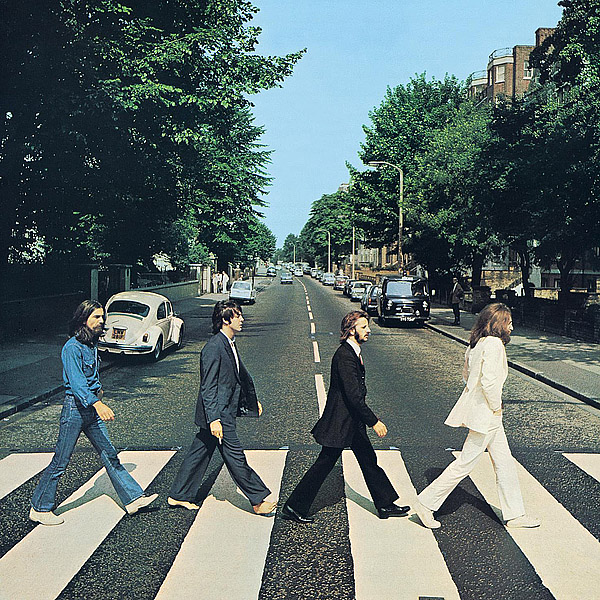
Album This song officially appears on the Abbey Road LP.
Timeline This song was officially released in 1969
Timeline This song was written, or began to be written, in 1969, when Paul McCartney was 27 years old)
This song was recorded during the following studio sessions:

Flaming Pie - Digging Around The Back
Summer 1997 • From Club Sandwich

Paul McCartney Interview - The story behind the classics
Sep 09, 2009 • From Clash

Being Ringo: A Beatle’s All-Starr Life
Apr 15, 2015 • From RollingStone

Paul McCartney Looks Back: The Rolling Stone Interview
Aug 10, 2016 • From RollingStone

Dec 06, 2017 • From Triple J / ABC.net.au
From Wikipedia:
“The End” is a song by the English rock band the Beatles from their 1969 album Abbey Road. It was composed by Paul McCartney and credited to Lennon–McCartney. It was the last song recorded collectively by all four Beatles, and is the final song of the medley that constitutes the majority of side two of the album. The song features the only drum solo recorded by Ringo Starr with the Beatles.
Composition and recording
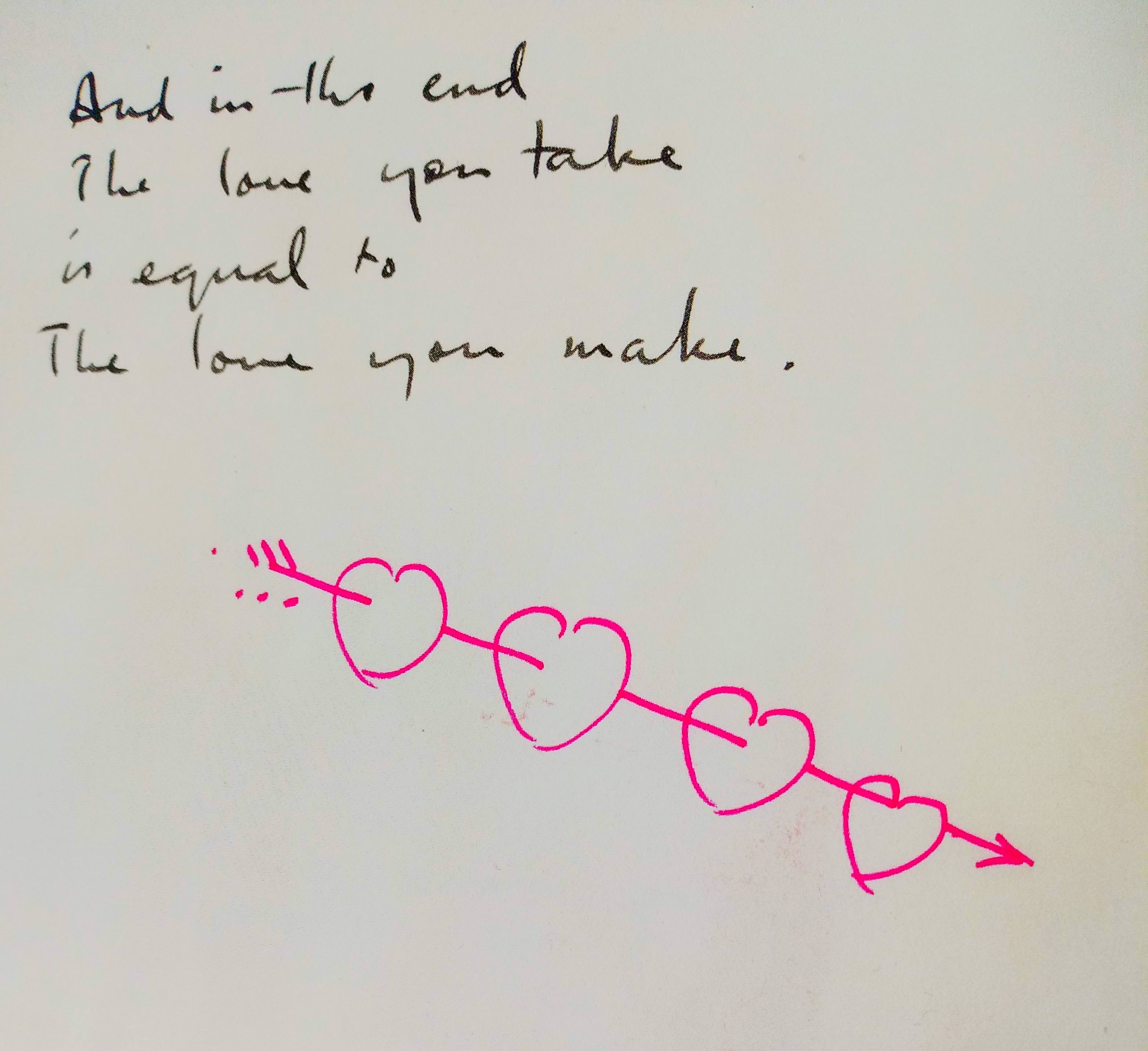
McCartney said, “I wanted [the medley] to end with a little meaningful couplet, so I followed the Bard and wrote a couplet.” In his 1980 interview with Playboy, John Lennon acknowledged McCartney’s authorship by saying, “That’s Paul again … He had a line in it, ‘And in the end, the love you get is equal to the love you give,’ which is a very cosmic, philosophical line. Which again proves that if he wants to, he can think.” Lennon misquoted the line; the actual words are, “And in the end, the love you take, is equal to the love you make…”
Recording began on 23 July 1969, when the Beatles recorded a one-minute, thirty-second master take that was extended via overdubs to two minutes and five seconds. At this point, the song was called “Ending”. The first vocals for the song were added on 5 August, additional vocals and guitar overdubs were added on 7 August, and bass and drums on 8 August, the day the Abbey Road cover picture was taken. Orchestral overdubs were added on 15 August, and the closing piano and accompanying vocal on 18 August.
All four Beatles have a solo in “The End”, including a Ringo Starr drum solo. Starr disliked solos, preferring to cater drum work to whoever sang in a particular performance, and in fact this is the only drum solo Starr recorded with the Beatles. His solo on “The End” was recorded with twelve microphones around his drum kit; in his playing, he said he copied part of Ron Bushy’s drumming on the Iron Butterfly track “In-A-Gadda-Da-Vida”. The take in which Starr performed the solo originally had guitar and tambourine accompaniment, but other instruments were muted during mixing, giving the effect of a drum solo.
McCartney, George Harrison and Lennon perform a rotating sequence of three, two-bar guitar solos. The idea for a guitar instrumental over this section was Harrison’s, and Lennon suggested that the three of them each play a section. The solos begin approximately 53 seconds into the song. Geoff Emerick, the Beatles’ recording engineer, later recalled: “John, Paul and George looked like they had gone back in time, like they were kids again, playing together for the sheer enjoyment of it. More than anything, they reminded me of gunslingers, with their guitars strapped on, looks of steely-eyed resolve, determined to outdo one another. Yet there was no animosity, no tension at all – you could tell they were simply having fun.”
The first two bars are played by McCartney, the second two by Harrison, the third two by Lennon, and then the sequence repeats twice. Each has a distinctive style which McCartney felt reflected their personalities. McCartney’s was more melodic, Harrison made heavy use of string bends, and Lennon used heavy distortion. Immediately after Lennon’s third solo, the piano chords of the final line “And in the end …” begin. Then the orchestration arrangement takes over with a humming chorus and Harrison playing a final guitar solo that ends the song.
“The End” was initially intended to be the final track on Abbey Road, but it ended up being followed by “Her Majesty“. Although “The End” stands as the last known new recording involving all four members of the Beatles during the band’s existence, one additional song, “I Me Mine“, was recorded by three members of the group (Lennon being absent due to having privately left in September 1969) in January 1970 for the album Let It Be.
The 1996 compilation album Anthology 3 contains a remixed version of “The End”, restoring tambourine and guitar overdubs mixed out of the original, and edited to emphasise the guitar solos and orchestral overdub. The track is followed by a variant on the long piano chord that ends “A Day in the Life” (reversed, then played forwards), concluding the compilation and also ending The Beatles Anthology. The drum solo was later used at the beginning of “Get Back” on the 2006 album Love.
Musical structure
The song commences in A major, with an initial I–IV–II–V–I structure matching the vocals on “Oh, yeah, all right!” This is followed by a ♯iv dim–I pattern (D♯dim to A chord) on “dreams tonight.” During this, the accompanying bass and one guitar move chromatically from A to B and D♯, while the second guitar harmonises a minor third higher to reach F♯. An eight-bar drum solo as a final statement of recognition to their “steady, solid drummer” ends with a crescendo of eighth notes and bass and rhythm guitar in seventh chords to the chant “Love you.” The sequential three guitar solos rotate through I7 (A7 chord)–IV7 (D7 chord) changes in the key of A in a mix of “major and minor pentatonic scales with slides, double-stops, repeated notes, low-bass string runs and wailing bends”. Gould terms these live studio takes “little character sketches”:
Paul opens with a characteristically fluid and melodically balanced line that sounds a high A before snaking an octave down the scale; George responds by soaring to an even higher D and sustaining it for half a bar before descending in syncopated pairs of 16th notes; John then picks upon the pattern of George’s 16ths with a series of choppy thirds that hammer relentlessly on the second and flattened seventh degrees of the scale. The second time through, Paul answers John’s bluesy flattened 7ths with bluesy minor thirds and then proceeds to echo George’s earlier line, spiraling up to that same high D; George responds with some minor thirds of his own, while mimicking the choppy rhythm of John’s part; John then drops two octaves to unleash a growling single-note line. On this final two-bar solo, Paul plays almost nothing but minor thirds and flattened sevenths in a herky-jerky rhythm that ends with a sudden plunge to a low A; George then reaches for the stars with a steeply ascending line that is pitched an octave above any notes heard so far; and John finishes with a string of insistent and heavily distorted 4ths, phrased in triplets, that drag behind the beat and grate against the background harmony.
The final “Ah” is in C with a spiritually evocative Plagal cadence IV–I (F–C chord) on piano while the voices do an F to E shift. “And in the end the love you take” is in A major, but the G/A chord supporting the word “love” begins to dissolve the listener’s certainty that the chord is in A, by adding a ♭VII. The next line shifts us to the fresh key of C, with a iv (F) chord that threatens the dominance of the departing A key’s F♯: “Is eq-ual” (supported successively by IV (F)–iii (Em) chords with an A–G bass line) “to the love” (supported successively by ii (Dm)–vi (Am)–ii7 (Dm7) chords with a F–E bass line) “you make” (supported by a V7 (G7) chord). The final bars in the key of C involve a I–II–♭III rock-type progression and a IV–I soothing cadence that appear to instinctively reconcile different musical genres.
Critical reception
Richie Unterberger of AllMusic considered “The End” to be “the group’s take on the improvised jamming common to heavy rock of the late ’60s, though as usual, The Beatles did it with far more economic precision than anyone else.” John Mendelsohn of Rolling Stone said it was “a perfect epitaph for our visit to the world of Beatle daydreams: ‘The love you take is equal to the love you make.'”
In 2007, “The End” was ranked at number 7 on Q magazine’s list “The 20 Greatest Guitar Tracks”. […]
We were looking for the end to an album, and ‘In the end the love you take is equal to the love you make’ just came into my head. I just recognized that would be a good end to an album. And it’s a good little thing to say– now and for all time, I think. I can’t think of anything much better as a philosophy, because all you need is love. It still is what you need. There ain’t nothin’ better. So, you know, I’m very proud to be in the band that did that song, and that thought those thoughts, and encouraged other people to think them to help them get through little problems here and there. So … we done good!
Paul McCartney – 1994 interview – Quoted in The Beatles, “The End,” from ‘Abbey Road’ (1969): Deep Beatles
In ‘The End’ there were three guitar solos where John, George and I took a line each, which was something we’d never done before. And we finally persuaded Ringo to play a drum solo, which he’d never wanted to do. And it climaxed with, “And in the end, the love you take is equal to the love you make”…
Paul McCartney – From “The Beatles Anthology” book, 2000
I was always fascinated by the couplet as a form in poetry. […] I was particularly fascinated by how Shakespeare used the couplet to close out a scene, or an entire play. [“And in the end the love you take is equal to the love you make”] is one of those couplets that can keep you thinking for a long time. It may be about good karma. What goes around comes around, as they say in America.
Paul McCartney – From “The Lyrics: 1956 to the Present“, 2021
Shakespeare ended his acts with a rhyming couplet so that the audience would know they were over. I wanted it to end with a little meaningful couplet, so I followed the Bard and wrote a couplet.
Paul McCartney – From “Solid State: The Story of Abbey Road and the End of the Beatles” by Kenneth Womack, 2019
Ringo would never do drum solos. He hated drummers who did lengthy drum solos. We all did. And when he joined The Beatles we said, “Ah, what about drum solos then?”, thinking he might say, “Yeah, I’ll have a five-hour one in the middle of your set,” and he said, “I hate ’em!” We said, “Great! We love you!” And so he would never do them. But because of this medley I said, “Well, a tokensolo?” and he really dug his heels in and didn’t want to do it. But after a little bit of gentle persuasion I said, “Yeah, just do that, it wouldn’t be Buddy Rich gone mad,” because I think that’s what he didn’t want to do.
Paul McCartney – From “The Complete Beatles Recording Sessions” by Mark Lewisohn, 1988
I think Ringo was always paranoid that he wasn’t a great drummer because he never used to solo. He hated those guys who went on and on, incessantly banging while the band goes off and has a cup of tea or something. […] Other drummers would say that although they liked his style, Ringo wasn’t technically a very good drummer. It was a bit condescending and I think we let it go too far. I think his feel and soul and the way he was rock solid with his tempo was a great attribute. I always say if you can leave a drummer and turn your back on him, then you’re very lucky. You could just tell Ringo how it went and leave him; there was always this great noise and very steady tempo coming from behind you.
Paul McCartney – From “Solid State: The Story of Abbey Road and the End of the Beatles” by Kenneth Womack, 2019
The orchestral overdub for ‘The End’ was the most elaborate I have ever heard: a 30-piece playing for not too many seconds—and mixed about 40 dBs down. It cost a lot of money: all the musicians have to be paid, fed and watered; I screw every pound note out of it whenever I play the record!
Alan Brown – Engineer – From “The Complete Beatles Recording Sessions” by Mark Lewisohn, 1988
From The Usenet Guide to Beatles Recording Variations:
[a] stereo 19 Aug 1969. crossfaded 19 Aug 1969.
UK: Apple PCS 7088 Abbey Road 1969.
US: Apple SO-383 Abbey Road 1969.
CD: EMI CDP 7 46446 2 Abbey Road 1987.[b] stereo 1996.
CD: Apple CDP 8 34451 2 Anthology 3 1996.The crossfade joins this to the preceding song, Golden Slumbers / Carry That Weight. A few seconds were edited off the album master, so the master tape of the song differs from the album. Lewisohn does not specify what was cut, but a version with a longer sustained final note has turned up on bootleg; whether it is on any legitimate release is unknown.
The deliberately different Anthology remix has “considerably more guitar” and brings up the orchestra more at the end. It then edits hard into a sound processed from “A day in the life”, 22 Feb 1967, which is arguably a separate item.
Oh yeah, all right
Are you gonna be in my dreams tonight?
Love you, love you
Love you, love you
Love you, love you
Love you, love you
Love you, love you
Love you, love you
Love you, love you
Love you, love you
Love you, love you
Love you, love you
Love you, love you
Love you, love you
And in the end, the love you take
Is equal to the love you make

LP • Released in 1969
2:22 • Studio version • A • Stereo
Paul McCartney : Backing vocals, Bass, Lead guitar, Piano, Vocals Ringo Starr : Drums, Tambourine John Lennon : Lead guitar, Rhythm guitar George Harrison : Lead guitar, Rhythm guitar George Martin : Producer Geoff Emerick : Recording engineer Phil McDonald : Recording engineer Unknown : Four cellos, Four horns, Four violas, One bass trombone, One double-bass, One trombone, Three trumpets, Twelve violins
SessionRecording : Jul 23, 1969 • Studio : EMI Studios, Studio Three, Abbey Road
SessionOverdubs : 5, 7, 8, 15, 18 Aug 1969 • Studio : EMI Studios, Abbey Road
SessionMixing : Aug 19, 1969 • Studio : EMI Studios, Studio Two, Abbey Road

Tripping the Live Fantastic: Highlights!
Official live • Released in 1990
6:42 • Live • L1 • Medley with "Golden Slumbers / Carry That Weight"
Performed by : Paul McCartney • Linda Eastman / McCartney • Robbie McIntosh • Hamish Stuart • Paul Wickens • Chris Whitten Paul McCartney : Producer Eddie Klein : Assistant engineer Matt Butler : Assistant engineer Peter Henderson : Producer Bob Clearmountain : Mixing engineer, Producer Jeff Cohen : Recording engineer Geoff Foster : Assistant engineer Scott Hull : Assistant engineer George Cowan : Assistant engineer Paul Rushbrook : Assistant engineer
Concert From the concert in Toronto, Canada on Dec 07, 1989

Official live • Released in 1990
6:42 • Live • L1 • Medley with "Golden Slumbers / Carry That Weight"
Performed by : Paul McCartney • Linda Eastman / McCartney • Robbie McIntosh • Hamish Stuart • Paul Wickens • Chris Whitten Paul McCartney : Producer Eddie Klein : Assistant engineer Matt Butler : Assistant engineer Peter Henderson : Producer Bob Clearmountain : Mixing engineer, Producer Jeff Cohen : Recording engineer Geoff Foster : Assistant engineer Scott Hull : Assistant engineer George Cowan : Assistant engineer Paul Rushbrook : Assistant engineer
Concert From the concert in Toronto, Canada on Dec 07, 1989

Official album • Released in 1996
2:22 • Studio version • B • Stereo • No other group has delivered such an apt farewell as the Beatles: except for the brief Her Majesty, thrown into the Abbey Road master tape almost as an afterthought, the last song on the Beatles recorded it, only one of the seven basic track takes of this piece has vocals - the master, Take 7. The version presented here is a new remix, however, embracing numerous elements omitted during the mix sessions for Abbey Road. In particular, there is considerable more guitar, and a further appreciation of the "sparring" section can be gained - from 19 until 55 seconds in, Paul, George and John, in that order, take turns to play two-bars (about four seconds) of the guitar solo. The 30-piece orchestral overdub, taped at tremendous cost considering it lasts less than 20 seconds, also appears more prominently in this new mix.
Paul McCartney : Backing vocals, Bass, Lead guitar, Piano, Vocals Ringo Starr : Drums, Tambourine John Lennon : Lead guitar, Rhythm guitar George Harrison : Lead guitar, Rhythm guitar George Martin : Producer Geoff Emerick : Recording engineer Phil McDonald : Recording engineer Unknown : Four cellos, Four horns, Four violas, One bass trombone, One double-bass, One trombone, Three trumpets, Twelve violins
SessionRecording : Jul 23, 1969 • Studio : EMI Studios, Studio Three, Abbey Road
SessionOverdubs : 5, 7, 8, 15, 18 Aug 1969 • Studio : EMI Studios, Abbey Road

Official live • Released in 2002
4:40 • Live • L2 • Medley with "Sgt. Pepper's Lonely Hearts Club Band"
Paul McCartney : Executive producerPerformed by : Paul McCartney • Rusty Anderson • Abe Laboriel Jr. • Paul Wickens • Brian Ray David Kahne : Producer Michael Brauer : Recording engineer Ricardo Chavarria : Assistant engineer
Concert From the concert in Ft. Lauderdale, USA on May 17, 2002

Abbey Road (Stereo - 2009 remaster)
Official album • Released in 2009
2:22 • Studio version • A2009 • Stereo • 2009 stereo remaster
Paul McCartney : Backing vocals, Bass, Lead guitar, Piano, Vocals Ringo Starr : Drums, Tambourine John Lennon : Lead guitar, Rhythm guitar George Harrison : Lead guitar, Rhythm guitar George Martin : Producer Geoff Emerick : Recording engineer Phil McDonald : Recording engineer Guy Massey : Remastering Steve Rooke : Remastering Allan Rouse : Project co-ordinator Unknown : 1 bass trombone, 1 double-bass, 1 trombone, 12 violins, 3 trumpets, 4 horns, 4 violas
SessionRecording : Jul 23, 1969 • Studio : EMI Studios, Studio Three, Abbey Road
SessionOverdubs : 5, 7, 8, 15, 18 Aug 1969 • Studio : EMI Studios, Abbey Road
SessionMixing : Aug 19, 1969 • Studio : EMI Studios, Studio Two, Abbey Road

Official live • Released in 2009
4:39 • Live • L3 • Medley with "Sgt. Pepper's Lonely Hearts Club Band". Could have been recorded on 17, 18 or 21 July 2009
Paul McCartney : Executive producerPerformed by : Paul McCartney • Rusty Anderson • Abe Laboriel Jr. • Paul Wickens • Brian Ray Geoff Emerick : Audio mixing Paul Hicks : Audio mixing Jonas Westling : Additional engineering Richard Lancaster : Additional engineering John Henry : Recording engineer
Concert From the concert in New York, USA on Jul 17, 2009

Official album • Released in 2016
2:51 • Outtake • B2016 • Stereo • No other group has delivered such an apt farewell as the Beatles: except for the brief Her Majesty, thrown into the Abbey Road master tape almost as an afterthought, the last song on the Beatles recorded it, only one of the seven basic track takes of this piece has vocals - the master, Take 7. The version presented here is a new remix, however, embracing numerous elements omitted during the mix sessions for Abbey Road. In particular, there is considerable more guitar, and a further appreciation of the "sparring" section can be gained - from 19 until 55 seconds in, Paul, George and John, in that order, take turns to play two-bars (about four seconds) of the guitar solo. The 30-piece orchestral overdub, taped at tremendous cost considering it lasts less than 20 seconds, also appears more prominently in this new mix.
Paul McCartney : Backing vocals, Bass, Lead guitar, Piano, Vocals Ringo Starr : Drums, Tambourine John Lennon : Lead guitar, Rhythm guitar George Harrison : Lead guitar, Rhythm guitar George Martin : Producer Geoff Emerick : Recording engineer Phil McDonald : Recording engineer Unknown : 1 bass trombone, 1 double-bass, 1 trombone, 12 violins, 3 trumpets, 4 horns, 4 violas
SessionRecording : Jul 23, 1969 • Studio : EMI Studios, Studio Three, Abbey Road
SessionOverdubs : 5, 7, 8, 15, 18 Aug 1969 • Studio : EMI Studios, Abbey Road

Abbey Road (Picture Disc - Limited Edition - 2019)
LP • Released in 2019
2:22 • Studio version • C • Stereo • 2019 Stereo Mix
Paul McCartney : Backing vocals, Bass, Lead guitar, Piano, Vocals Ringo Starr : Drums, Tambourine John Lennon : Lead guitar, Rhythm guitar George Harrison : Lead guitar, Rhythm guitar George Martin : Producer Geoff Emerick : Recording engineer Giles Martin : Producer Phil McDonald : Recording engineer Sam Okell : Mix engineer Unknown : 1 bass trombone, 1 double-bass, 1 trombone, 12 violins, 3 trumpets, 4 horns, 4 violas
SessionRecording : Jul 23, 1969 • Studio : EMI Studios, Studio Three, Abbey Road
SessionOverdubs : 5, 7, 8, 15, 18 Aug 1969 • Studio : EMI Studios, Abbey Road
SessionMixing : Circa 2019 • Studio : EMI Studios, Abbey Road Studios • London • UK

Abbey Road (50th anniversary boxset)
Official album • Released in 2019
2:22 • Studio version • C • Stereo • 2019 Stereo Mix
Paul McCartney : Backing vocals, Bass, Lead guitar, Piano, Vocals Ringo Starr : Drums, Tambourine John Lennon : Lead guitar, Rhythm guitar George Harrison : Lead guitar, Rhythm guitar George Martin : Producer Geoff Emerick : Recording engineer Giles Martin : Producer Phil McDonald : Recording engineer Sam Okell : Mix engineer Unknown : 1 bass trombone, 1 double-bass, 1 trombone, 12 violins, 3 trumpets, 4 horns, 4 violas
SessionRecording : Jul 23, 1969 • Studio : EMI Studios, Studio Three, Abbey Road
SessionOverdubs : 5, 7, 8, 15, 18 Aug 1969 • Studio : EMI Studios, Abbey Road
SessionMixing : Circa 2019 • Studio : EMI Studios, Abbey Road Studios • London • UK

Driving USA Super Tree Volume 13 - Uniondale, NY 21 April 2002
Live bootleg
3:05 • Live
Concert From the concert in Uniondale, USA on Apr 21, 2002

Live at The Palace - Auburn Hills, Detroit MI May 1, 2002
Live bootleg
3:41 • Live
Concert From the concert in Detroit, USA on May 01, 2002


“The End” has been played in 616 concerts and 3 soundchecks.

Nov 25, 2025 • Part of Got Back Tour

Nov 24, 2025 • Part of Got Back Tour

Hamilton • TD Coliseum • Canada
Nov 21, 2025 • Part of Got Back Tour

Montreal • Bell Center • Canada
Nov 18, 2025 • Part of Got Back Tour

Montreal • Bell Center • Canada
Nov 17, 2025 • Part of Got Back Tour
The Lyrics: 1956 to the Present

"The End" is one of the songs featured in the book "The Lyrics: 1956 to the Present," published in 2021. The book explores Paul McCartney's early Liverpool days, his time with the Beatles, Wings, and his solo career. It pairs the lyrics of 154 of his songs with his first-person commentary on the circumstances of their creation, the inspirations behind them, and his current thoughts on them.
Solid State: The Story of "Abbey Road" and the End of the Beatles
Acclaimed Beatles historian Kenneth Womack offers the most definitive account yet of the writing, recording, mixing, and reception of Abbey Road. In February 1969, the Beatles began working on what became their final album together. Abbey Road introduced a number of new techniques and technologies to the Beatles' sound, and included "Come Together," "Something," and "Here Comes the Sun," which all emerged as classics.

Notice any inaccuracies on this page? Have additional insights or ideas for new content? Or just want to share your thoughts? We value your feedback! Please use the form below to get in touch with us.