Thursday, January 8, 1970
Recording & mixing "For You Blue" for the Get Back album (4th compilation), Mixing "Let It Be"
For The Beatles
Last updated on June 4, 2025
Thursday, January 8, 1970
For The Beatles
Last updated on June 4, 2025

Jan 3 - April 2, 1970 • Songs recorded during this session appear on Let It Be (US version)
Recording studio: Olympic Sound Studios • London • UK
Session Jan 04, 1970 • Recording and mixing "Let It Be"
Session Jan 05, 1970 • Mixing "I Me Mine", "Across The Universe" for the "Get Back" album (4th compilation)
Session Jan 08, 1970 • Recording & mixing "For You Blue" for the Get Back album (4th compilation), Mixing "Let It Be"
Album Jan 09, 1970 • "Magic Christian Music" by Badfinger released in the UK
Article January 12-15, 1970 • Paul and Linda spend time in New York
Next session Jan 17, 1970 • Recording "Junk"
March - May 1969 • Mixing the Get Back album (2nd & 3rd compilations)
April - May 1969 • The “Get Back” LP rumours • April to May 1969
May 13, 1969 • Photo shoot of the "Get Back" LP album
May 28, 1969 • Mixing the "Get Back" album (3rd compilation)
June - July 1969 • The "Get Back" LP rumours • June to July 1969
August 1969 • The “Get Back” LP rumours • August 1969
September - December 1969 • The "Get Back" LP rumours • September to December 1969
Dec 15, 1969 • Mixing the "Get Back" album (4th compilation)
Jan 08, 1970 • Recording & mixing "For You Blue" for the Get Back album (4th compilation), Mixing "Let It Be"
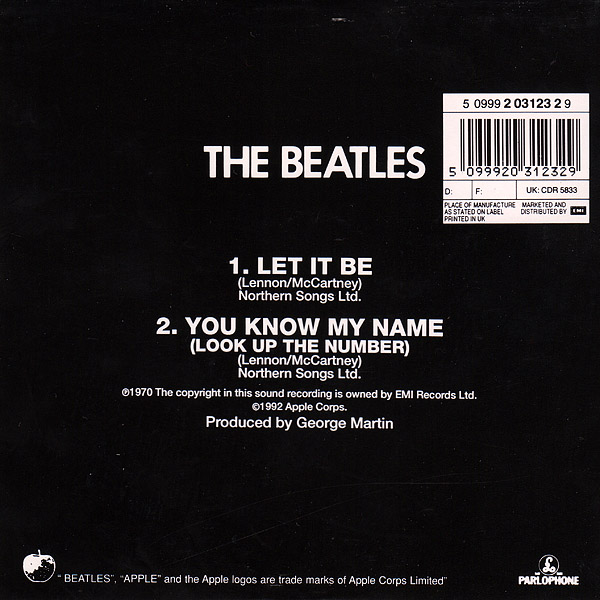
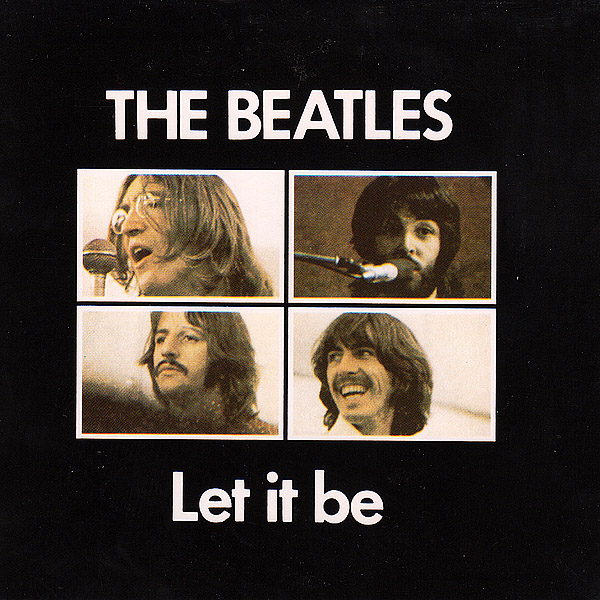
AlbumSome of the songs worked on during this session were first released on the "Let It Be / You Know My Name (Look Up The Number)" 7" Single

By The Beatles
On this day, at Olympic Studios, George Harrison re-recorded portions of his lead vocals for “For You Blue” (DDSI 25.47) during a session with engineer/producer Glyn Johns.
He also added a few playful ad-libbed lines over the instrumental solos. Over John Lennon’s guitar parts, George inserted lines like “Bop, cat, hop” and “Go, Johnny, go” — a nod to Chuck Berry’s “Johnny B. Goode“. Over Paul McCartney’s piano solo, he quipped, “Elmore James got nothin’ on this, baby, heh,” referencing Elmore James, the celebrated blues guitarist often hailed as the “King of the Slide Guitar.”
A new stereo mix of the track was then created and included in Glyn Johns’ 4th compilation of the “Get Back” LP. However, there remains a small mystery timing-wise:
Also, probably sometime during early January 1970, George recorded a new vocal for “For You Blue”. Mark Lewisohn indicates that this was probably 8 January (and subsequently, John Winn does, too). However, a mix including both vocals is featured on this fourth compilation (see details below). The tape box for this compilation clearly dates it as 5 January. Either, Glyn spliced an 8 January mix onto the 5 January reel or, since the new vocal was recorded at Olympic Studios (for which documentation is more sketchy than E.M.I.), perhaps the vocal was recorded prior to 5 January.
From beatlesource.com
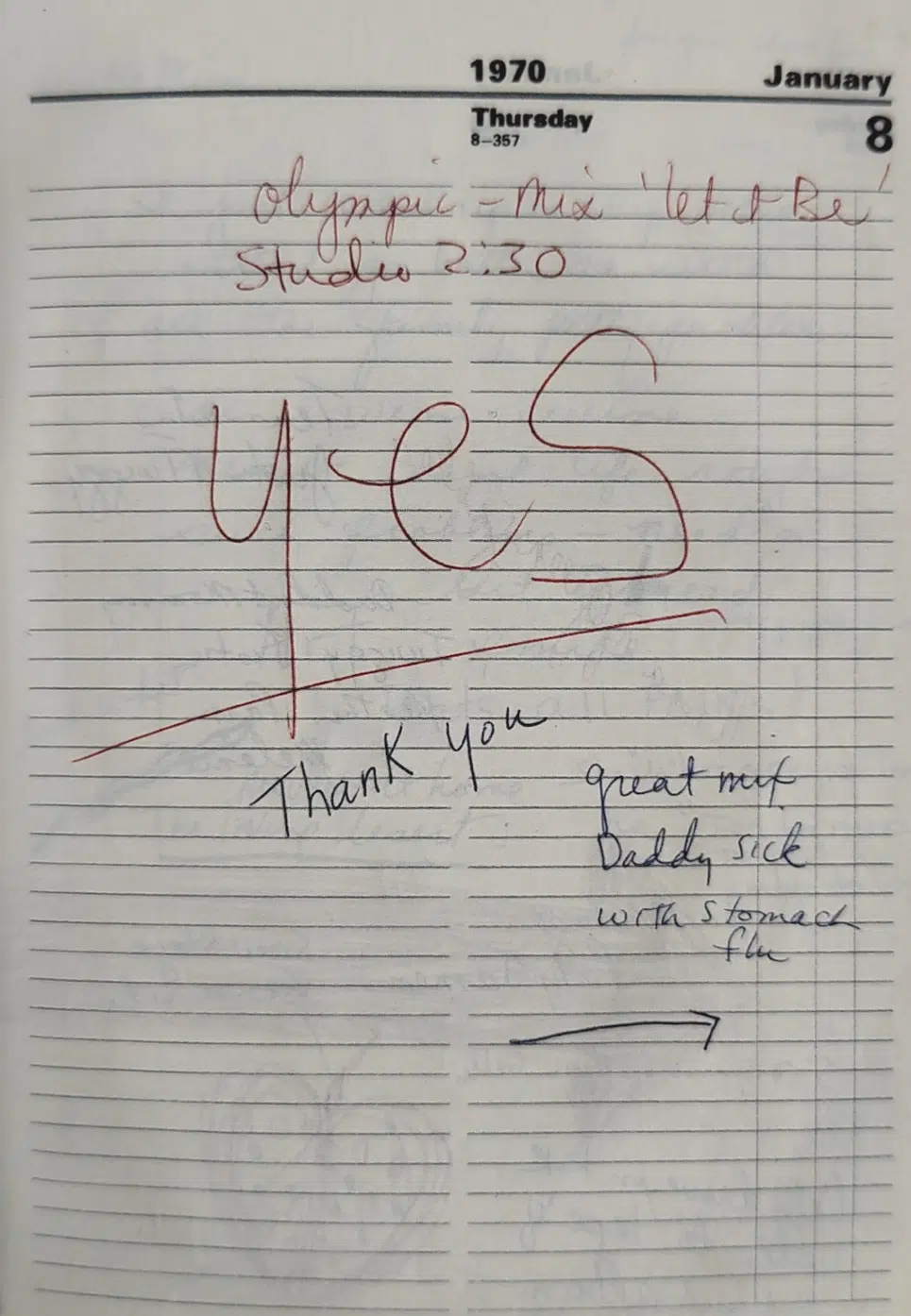
The accompanying book of the “Let It Be (50th anniversary boxset)“, released in 2021, includes a page from Paul McCartney’s diary dated January 8, noting his attendance at the mixing session at Olympic Studios for “Let It Be,” with the comment “great mix.” The same entry also includes the remark “with stomach flu” —apparently the result of a dinner the night before with model Twiggy and her manager and boyfriend, Justin de Villeneuve.
This suggests that the version of “Let It Be“ released as a single in March 1970 was likely mixed on this day by Glyn Johns, rather than on January 4 as previously assumed.
However, Glyn Johns chose not to include this version in his “Get Back” LP, likely because the overdubs added on January 4 clashed with the unembellished, live-in-the-studio aesthetic he envisioned for the project.
This January 8 session marked Glyn Johns’ final day working on the “Get Back” LP. Despite the considerable time and effort he had invested in compiling several versions of the album throughout 1969, The Beatles — or more likely Allen Klein — remained dissatisfied with the results.
In late January or early February 1970, American producer Phil Spector was brought in by Klein to take over the project with the approval of John Lennon. On March 23, 1970, Spector began reworking the tapes, ultimately shaping the version of the album released as “Let It Be” in May 1970.
We walked away from that LP. We didn’t really want to know. The best version of the album was before anyone got hold of it. Glyn Johns’s early mixes were great but they were very bare, very Spartan. It would be one of the hippest records going if they brought it out. That was one of the best Beatles albums because it was a bit avant-garde. I loved it. It was purely as we recorded it, down there in Apple or up on the roof. It had a good sound on it, from Glyn Johns, just a couple of mikes over the drums, it was very basic and I loved it.
Paul McCartney – From “The Beatles: Off the Record” by Keith Badman, 2008
A few months after the end of the “Get Back” sessions, engineer/producer Glyn Johns was given the task of compiling an actual album. Glyn made four different variants of the album, two of them having been considered for release at some point.
| Compilation 1 – January 1969 | Compilation 2 – Early May 1969 | Compilation 3 – Late May 1969 | Compilation 4 – January 1970 |
| Mixed: January 24, 1969 January 26, 1969 January 27, 1969 January 30, 1969 | Mixed: February 5, 1969 March-May, 1969 March 4, 1969 April 3, 1969 April 4, 1969 April 7, 1969 May 2, 1969 May 7, 1969 May 9, 1969 | Mixed: May 15, 1969 May 28, 1969 | Additional recording: January 3, 1970 January 8, 1970 Mixed: December 15, 1969 December 21, 1969 January 5, 1970 January 8, 1970 |
| Side one 1. Get Back (false start) — DDSI 23.78 2. Get Back — DDSI 23.79 3. I’ve Got a Feeling (fragment) — DDSI 23.80 4. Help! (fragment) — DDSI 23.81 5. Teddy Boy — DDSI 24.33 6. Two of Us (fragment – false start) — DDSI 24.48 7. Two of Us — DDSI 24.69 8. Dig a Pony — DDSI 23.66 9. I’ve Got a Feeling — DDSI 22.71 Side two 10. The Long and Winding Road — DDSI 26.91 11. Let It Be — DDSI 26.74 12. Don’t Let Me Down — DDSI 22.60 13. For You Blue — DDSI 25.46 14. Get Back — DDSI 27.63 15. The Walk — DDSI 27.83 | Side one 1. One After 909 2. Rocker 3. Save the Last Dance for Me 4. Don’t Let Me Down 5. Dig a Pony 6. I’ve Got a Feeling 7. Get Back Side two 8. For You Blue 9. Teddy Boy 10. Two of Us 11. Maggie Mae 12. Dig It 13. Let It Be 14. The Long and Winding Road 15. Get Back (reprise) | Side one 1. One After 909 — DDSI.30.08 2. Rocker — DDSI.22.58 3. Save the Last Dance for Me — DDSI.22.59 4. Don’t Let Me Down — DDSI.22.80 5. Dig a Pony — DDSI.23.70 6. I’ve Got a Feeling — DDSI.22.71 7. Get Back — DDSI.27.63 & 28.43 Side two 8. For You Blue — DDSI.25.47 9. Teddy Boy — DDSI.24.33 10. Two of Us — DDSI.24.69 11. Maggie Mae — DDSI.24.49 12. Dig It — Excerpt of DDSI.24.85 13. Let It Be — 31.64 + overdubbed guitar solo 14. The Long and Winding Road — DDSI.26.91 15. Get Back (reprise) — DDSI.28.43 | Side one 1. One After 909 2. Rocker 3. Save the Last Dance for Me 4. Don’t Let Me Down 5. Dig a Pony 6. I’ve Got a Feeling 7. Get Back 8. Let It Be Side two 9. For You Blue 10. Two of Us 11. Maggie Mae 12. Dig It 13. The Long and Winding Road 14. I Me Mine 15. Across the Universe 16. Get Back (reprise) |
| Bootlegged on “Kum Back“ | Bootlegged on “O.P.D.“ |
Written by George Harrison
Recording • DDSI.25.47 • Vocal overdubs
Mixing
Written by George Harrison
Mixing
The Complete Beatles Recording Sessions • Mark Lewisohn
The definitive guide for every Beatles recording sessions from 1962 to 1970. We owe a lot to Mark Lewisohn for the creation of those session pages, but you really have to buy this book to get all the details - the number of takes for each song, who contributed what, a description of the context and how each session went, various photographies... And an introductory interview with Paul McCartney!
The Beatles Recording Reference Manual: Volume 5: Let It Be through Abbey Road (1969 - 1970)

The fifth and final book of this critically acclaimed series, "The Beatles Recording Reference Manual: Volume 5: Let It Be through Abbey Road (1969 - 1970)" follows The Beatles as they "get back to where they once belonged...". Not once, but twice. With "Let It Be", they attempted to recapture the spontaneity of their early years and recordings, while "Abbey Road" was a different kind of return - to the complexity, finish and polish that they had applied to their work beginning with "Revolver" and through to "The Beatles".
If we modestly consider the Paul McCartney Project to be the premier online resource for all things Paul McCartney, it is undeniable that The Beatles Bible stands as the definitive online site dedicated to the Beatles. While there is some overlap in content between the two sites, they differ significantly in their approach.

Notice any inaccuracies on this page? Have additional insights or ideas for new content? Or just want to share your thoughts? We value your feedback! Please use the form below to get in touch with us.