
UK Release date : Nov 06, 1970
Let It Be (UK - 2nd pressing)
By The Beatles • LP • Part of the collection “The Beatles • The original UK LPs”
Last updated on October 27, 2025
UK Release date : Nov 06, 1970
By The Beatles • LP • Part of the collection “The Beatles • The original UK LPs”
Last updated on October 27, 2025
Previous album May 18, 1970 • "Let It Be (US version)" by The Beatles released in the US
Session Nov 05, 1970 • Recording "Monkberry Moon Delight", "Uncle Albert"
Session Nov 06, 1970 • Recording "Uncle Albert/Admiral Halsey"
Album Nov 06, 1970 • "Let It Be (UK - 2nd pressing)" by The Beatles released in the UK
Session Nov 10, 1970 • Recording "Too Many People"
Session Nov 13, 1970 • Recording "Little Woman Love"
Next album Dec 18, 1970 • "From Then To You (UK release)" by The Beatles released in the UK
This album was recorded during the following studio sessions:
3:37 • Studio version • A • Stereo
Paul McCartney : Acoustic guitar, Vocals, Whistling Ringo Starr : Drums John Lennon : Acoustic guitar, Vocals, Whistling George Harrison : Lead guitar George Martin : Producer Phil Spector : Producer Glyn Johns : Recording engineer
SessionRecording : Jan 31, 1969 • Studio : Apple Studios, 3 Savile Row, London
SessionSpoken intro : Jan 21, 1969 • Studio : Apple offices, 3 Savile Row • London • UK
SessionMixing : Mar 25, 1970 • Studio : EMI Studios, Room 4, Abbey Road
SessionMixing : Mar 27, 1970 • Studio : EMI Studios, Room 4, Abbey Road
3:55 • Studio version • A • Stereo
Paul McCartney : Bass, Harmony vocal Ringo Starr : Drums John Lennon : Lead vocal, Rhythm guitar George Harrison : Lead guitar George Martin : Producer Phil Spector : Producer Peter Bown : Engineer Glyn Johns : Recording engineer Billy Preston : Electric piano
Concert From "The rooftop concert" in London, UK on Jan 30, 1969
SessionMixing : Mar 23, 1970 • Studio : EMI Studios, Room 4, Abbey Road
3:48 • Studio version • B • Stereo
Paul McCartney : Acoustic guitar, Backing vocals, Piano Ringo Starr : Drums, Percussion, Svaramandal John Lennon : Acoustic rhythm guitar, Backing vocals, Electric guitar, Organ, Vocals George Harrison : Backing vocals, Electric guitar, Maracas, Tamboura George Martin : Hammond organ, Producer Phil Spector : Producer Phil McDonald : Assistant recording engineer Ken Scott : Recording engineer Peter Bown : Mixing engineer, Recording engineer Martin Benge : Recording engineer Lizzie Bravo : Backing vocals Gayleen Pease : Backing vocals Richard Lush : Assistant recording engineer Mike Sheady : Mixing engineer, Recording engineer Unknown : Eighteen violins, Four cellos, Four violas, Fourteen vocalists, Harp, Three trombones, Three trumpets Bill Parkinson : Guitar Martin Kershaw : Guitar
SessionRecording : Feb 04, 1968 • Studio : EMI Studios, Studio Three, Abbey Road
SessionOverdubs : Feb 08, 1968 • Studio : EMI Studios, Studio Two, Abbey Road
SessionOrchestral overdubs : Apr 01, 1970 • Studio : EMI Studios, Abbey Road
SessionMixing : Apr 02, 1970 • Studio : EMI Studios, Room 4, Abbey Road
Written by George Harrison
2:26 • Studio version • A • Stereo
Paul McCartney : Acoustic guitar, Bass, Electric piano, Hammond organ, Harmony vocals Ringo Starr : Drums George Harrison : Acoustic guitar, Electric guitar, Harmony vocals, Vocals George Martin : Producer Phil Spector : Producer Phil McDonald : Recording engineer Peter Bown : Recording engineer Unknown : Eighteen violins, Four cellos, Four violas, Fourteen vocalists, Harp, Three trombones, Three trumpets
SessionRecording : Jan 03, 1970 • Studio : EMI Studios, Studio Two, Abbey Road
SessionOverdubs : Apr 01, 1970 • Studio : EMI Studios, Abbey Road
SessionMixing : Apr 02, 1970 • Studio : EMI Studios, Room 4, Abbey Road
Written by Paul McCartney, Ringo Starr, John Lennon, George Harrison
0:51 • Studio version • A • Stereo
Paul McCartney : Piano Ringo Starr : Drums John Lennon : Six-string bass guitar, Vocals George Harrison : Lead guitar George Martin : Shaker Phil Spector : Producer Glyn Johns : Recording engineer Billy Preston : Hammond organ
SessionRecording : Jan 26, 1969 • Studio : Apple Studios, 3 Savile Row, London
SessionSpeech recording : Jan 24, 1969 • Studio : Apple Studios, 3 Savile Row, London
SessionMixing : Mar 27, 1970 • Studio : EMI Studios, Room 4, Abbey Road
4:03 • Studio version • B • Stereo
Paul McCartney : Backing vocals, Bass guitar, Electric piano, Maracas, Piano, Vocals Linda Eastman / McCartney : Backing vocals Ringo Starr : Drums George Harrison : Backing vocals, Lead guitar George Martin : Producer Phil Spector : Producer Phil McDonald : Recording engineer Jeff Jarratt : Recording engineer Glyn Johns : Recording engineer Billy Preston : Electric piano, Organ Unknown : Cellos, One baritone saxophone, Trombone, Two tenor saxophones, Two trumpets
SessionRecording : Jan 31, 1969 • Studio : Apple Studios, 3 Savile Row, London
SessionOverdubs : Jan 04, 1970 • Studio : EMI Studios, Studio Two, Abbey Road
SessionMixing : Mar 26, 1970 • Studio : EMI Studios, Room 4, Abbey Road
Written by Paul McCartney, Ringo Starr, John Lennon, George Harrison
0:40 • Studio version • A • Stereo
Paul McCartney : Acoustic guitar, Vocals Ringo Starr : Drums John Lennon : Acoustic guitar, Vocals George Harrison : Lead guitar Phil Spector : Producer Peter Bown : Engineer Glyn Johns : Recording engineer
SessionRecording : Jan 24, 1969 • Studio : Apple Studios, 3 Savile Row, London
SessionMixing : Mar 26, 1970 • Studio : EMI Studios, Room 4, Abbey Road
3:38 • Studio version • A • Stereo
Paul McCartney : Bass, Vocals Ringo Starr : Drums John Lennon : Rhythm guitar, Vocals George Harrison : Lead guitar, Vocals George Martin : Producer Glyn Johns : Recording engineer Billy Preston : Electric piano
Concert From "The rooftop concert" in London, UK on Jan 30, 1969
SessionMixing : Mar 23, 1970 • Studio : EMI Studios, Room 4, Abbey Road
2:54 • Studio version • A • Stereo
Paul McCartney : Bass, Vocals Ringo Starr : Drums John Lennon : Rhythm guitar, Vocals George Harrison : Lead guitar George Martin : Producer Phil Spector : Producer Peter Bown : Engineer Glyn Johns : Recording engineer Billy Preston : Electric piano
Concert From "The rooftop concert" in London, UK on Jan 30, 1969
SessionMixing : Mar 23, 1970 • Studio : EMI Studios, Room 4, Abbey Road
3:38 • Studio version • A • Stereo
Paul McCartney : Piano, Vocals Ringo Starr : Drums John Lennon : Bass George Harrison : Guitar Richard Hewson : Orchestra arrangement Phil Spector : Producer Peter Bown : Recording engineer Glyn Johns : Recording engineer Unknown : Eighteen violins, Four cellos, Four violas, Fourteen vocalists, Harp, Three trombones, Three trumpets
SessionRecording : Jan 26, 1969 • Studio : Apple Studios, 3 Savile Row, London
SessionOrchestra overdubs : Apr 01, 1970 • Studio : EMI Studios, Studio One, Abbey Road
SessionMixing : Apr 02, 1970 • Studio : EMI Studios, Room 4, Abbey Road
Written by George Harrison
2:32 • Studio version • A • Stereo
Paul McCartney : Piano Ringo Starr : Drums John Lennon : Electric lap steel slide guitar George Harrison : Acoustic guitar, Vocals George Martin : Producer Glyn Johns : Recording engineer
SessionRecording : Jan 25, 1969 • Studio : Apple Studios, 3 Savile Row, London
SessionJohn's spoken intro : Jan 08, 1969 • Studio : Twickenham Film Studios, London, UK
SessionOverdubs : Jan 08, 1970 • Studio : Olympic Sound Studios, London
SessionMixing : Mar 25, 1970 (intro, March 30) • Studio : EMI Studios, Room 4, Abbey Road
3:14 • Studio version • C • Stereo
Paul McCartney : Bass, Lead vocal Ringo Starr : Drums John Lennon : Backing vocal, Lead guitar George Harrison : Rhythm guitar George Martin : Producer Glyn Johns : Engineer Billy Preston : Electric piano Jerry Boys : Second engineer
Concert From "The rooftop concert" in London, UK on Jan 30, 1969
SessionRecording : January 27, 1969 • Studio : Apple Studios, 3 Savile Row, London
SessionMixing : Mar 26, 1970 • Studio : EMI Studios, Room 4, Abbey Road
In the UK, “Let It Be” was originally released in a box set that included a 164 page book, “The Beatles Get Back”.
The set’s deluxe presentation increased production costs by approximately 33%, making “Let It Be” the most expensive Beatles album at the time in terms of retail price. The high cost, along with issues with the book’s binding — many copies would later fall apart — led to the decision to discontinue the book for the second UK pressing in November 1970.
In the United States, United Artists — who distributed the album under the terms of the “Let It Be” film deal — declined to release the LP with the book, concerned that the elevated price would hurt sales. Instead, the U.S. edition featured a standard gatefold sleeve, which included a selection of photographs from the “Get Back” sessions.
BEATLES’ ALBUM
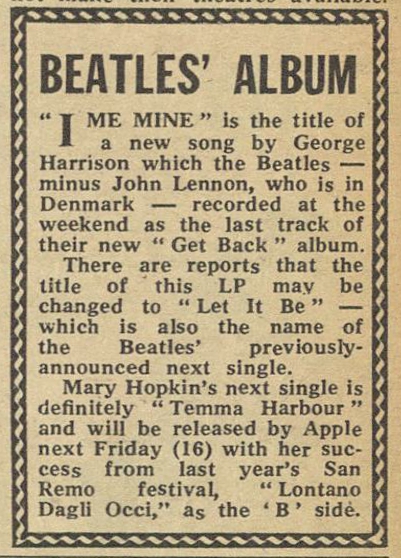
“I ME MINE” is the title of a new song by George Harrison which the Beatles — minus John Lennon, who is in Denmark — recorded at the weekend as the last track of their new “Get Back” album.
There are reports that the title of this LP may be changed to “Let It Be” — which is also the name of the Beatles’ previously-announced next single.
Mary Hopkin’s next single is definitely “Temma Harbour” and will be released by Apple next Friday (16) with her success from last year’s San Remo festival, “Lontano Dagli Occi,” as the ‘B’ side.
From Melody Maker – January 10, 1970
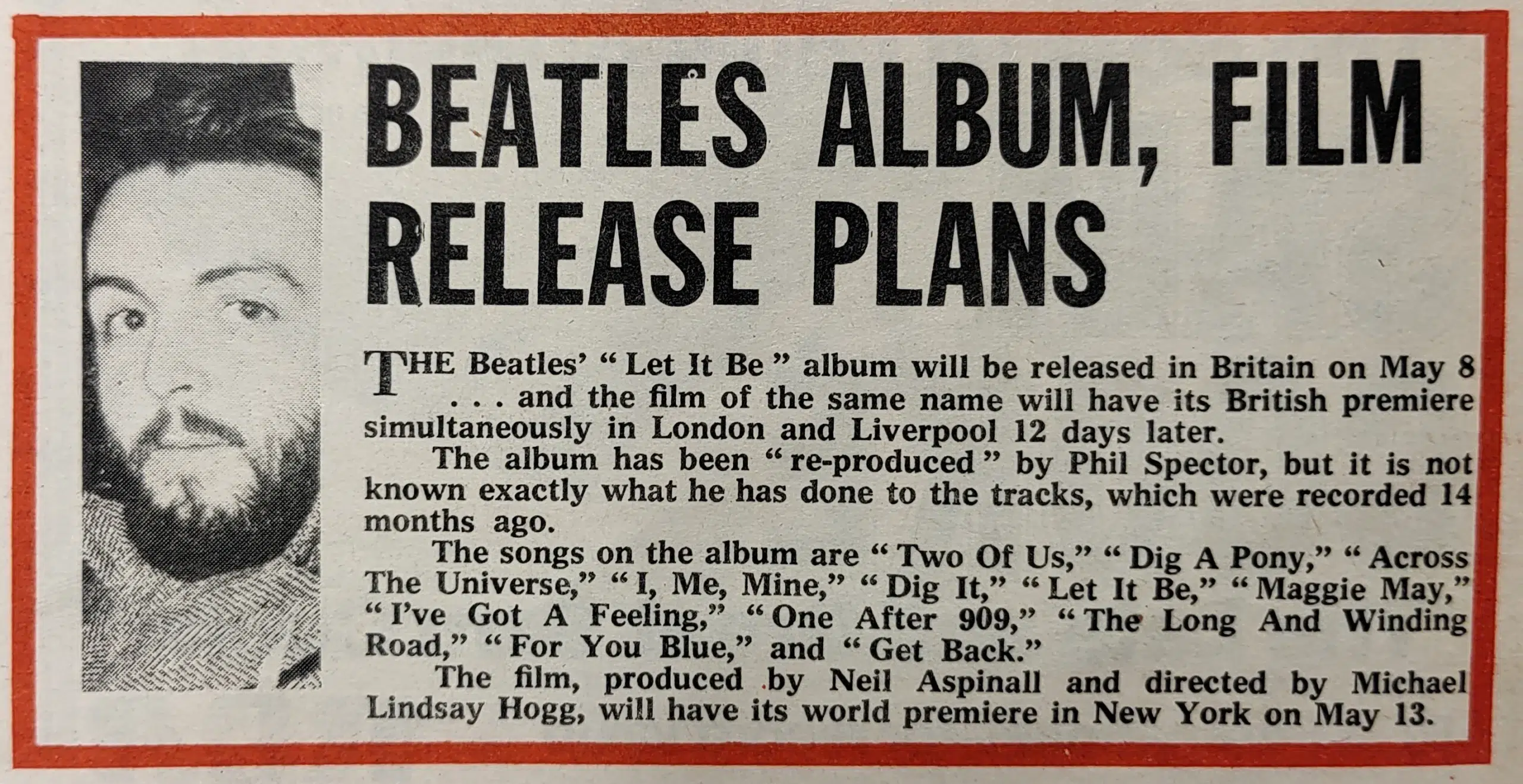
BEATLES ALBUM, FILM RELEASE PLANS
THE Beatles’ “Let It Be” album will be released in Britain on May 8 … and the film of the same name will have its British premiere simultaneously in London and Liverpool 12 days later.
The album has been “re-produced” by Phil Spector, but it is not known exactly what he has done to the tracks, which were recorded 14 months ago.
The songs on the album are “Two Of Us,” “Dig A Pony,” “Across The Universe,” “I, Me, Mine,” “Dig It,” “Let It Be,” “Maggie May,” “I’ve Got A Feeling,” “One After 909,” “The Long And Winding Road,” “For You Blue,” and “Get Back.”
The film, produced by Neil Aspinall and directed by Michael Lindsay Hogg, will have its world premiere in New York on May 13.
From Melody Maker – April 25, 1970
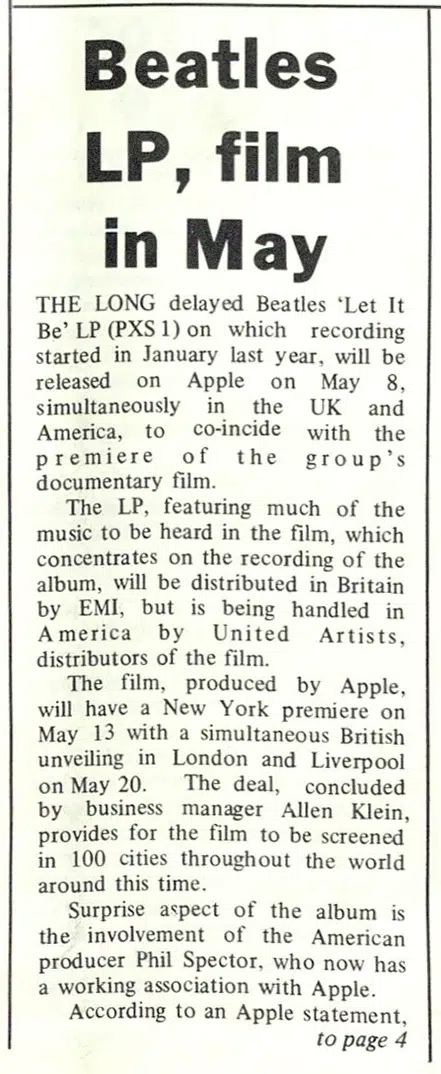
Beatles LP, film in May
THE LONG delayed Beatles ‘Let It Be’ LP (PXS 1) on which recording started in January last year, will be released on Apple on May 8, simultaneously in the UK and America, to co-incide with the premiere of the group’s documentary film.
The LP, featuring much of the music to be heard in the film, which concentrates on the recording of the album, will be distributed in Britain by EMI, but is being handled in America by United Artists, distributors of the film.
The film, produced by Apple, will have a New York premiere on May 13 with a simultaneous British unveiling in London and Liverpool on May 20. The deal, concluded by business manager Allen Klein, provides for the film to be screened in 100 cities throughout the world around this time.
Surprise aspect of the album is the involvement of the American producer Phil Spector, who now has a working association with Apple.
According to an Apple statement, ‘Let It Be’ is “a new phase Beatles album essential to the context of the film so that they perform live for many of the tracks. In comes the warmth, the freshness of the live performance as reproduced for disc by Phil Spector.”
In essence, this means that Spector has remixed some of the tracks and has also dubbed orchestrations and a choir at certain points.
Informed of the reference to Spector, George Martin, who was originally in control of the recording, expressed surprise that he had not been told directly. He added that he had heard the album in its new form.
Asked if he expected to be involved in any future Beatles recording, Martin replied: “In view of the fact that the Beatles don’t exist as the four young men I once knew, I don’t want to record them as a split group, but I would like to record them as they were.”
Martin said that as far as he was aware he was still the group’s official producer, under an agreement with EMI, but that he had never had a contract with the group themselves. He added apart from working with Ringo Starr and George Harrison, there had been no contact with the whole group since completion of the ‘Abbey Road’ album. On the LP itself Martin is given a “with thanks” credit.
Apple has also released a statement concerning the status of the Beatles and their representation following Paul McCartney’s recent remarks that Allen Klein “doesn’t represent me in any way.”
The statement points out that a 10-year partnership agreement was entered into between the Beatles as individuals and Apple Corps in April, 1967, in which Apple Corps is the majority partner in the Beatles and Company.
The agreement provides that with the exception of films and songwriting, the partnership is entitled to the services of the Beatles as a group throughout the world in respect of all branches of the entertainment industry.
The statement adds that no individual Beatle can “offer his services, appear alone and/or with any other person in any branch of the entertainment industry as to which the partnership has special rights, without the consent of Apple Corps and other Beatles. It is reiterated that no person, firm or corporation can act or negotiate for the Beatles or for the Apple group of companies other than ABKCO Industries, 1700 Broadway, New York City.”
From Record Retailer – April 25, 1970

BEATLES’ MOVIE OPENS MAY 20 – LP RELEASED IN A FORTNIGHT – McCartney live dates in America?
The Beatles’ long-awaited full-length feature film, the semi-documentary “Let It Be,” will have a double British premiere at London Pavilion and Liverpool Odeon on Wednesday, May 20. And invitations will be going out to all members of the Beatles to attend the star-studded screenings. In a week when Paul McCartney was reported as saying that “none of us wants to admit that the party is over,” Apple announced that the colour movie — described as a “bioscopic experience” — would have its world premiere in New York on May 13 and would be released in May in 100 major cities throughout the world, including saturation exposure across the United States.
The soundtrack album of the movie will be internationally released in two weeks’ time, on May 8. This is the LP which was recorded mainly at Apple in London.
Tracks on the “Let It Be” soundtrack album are “Two of Us,” “Dig A Pony,” “Across The Universe” (a John Lennon composition previously released on a wildlife charity LP, in another version); George Harrison’s “I Me Mine”; the joint composition “Dig It”; McCartney’s “Let It Be,” “Maggie May,” “I’ve Gotta Feeling,” “One After 909,” “The Long And Winding Road,” and “For You Blue” and “Get Back.”
As revealed in the NME last year, the “Let It Be” film is being distributed by United Artists under an early three-picture deal.
A statement was issued by business manager Allen Klein this week in which, on behalf of Apple Corps Ltd, it is pointed out that “… any individual Beatle cannot offer his services, appear alone, or with any other person in any branch of the entertainment industry — without the consent of Apple and the other Beatles.”
Presumably John Lennon’s Plastic Ono Band and George Harrison’s appearances with Delaney and Bonnie were cleared under this agreement, but in the present climate, there is uncertainty that Paul McCartney would be free to make personal appearances without considerable negotiation with Apple.
In spite of this there were reports from America this week — unconfirmed by Apple — that McCartney is to undertake appearances there.
From New Musical Express – April 25, 1970

Beatles ‘Dig It’ together on new album!
ALL FOUR Beatles combined to write a song on their new album out next month. And the long-awaited “Let It Be” film — “a bioscopic experience” — is to be simultaneously premiered in London and Liverpool on May 20.
John, Paul, George and Ringo together wrote “Dig It,” a number improvised as they recorded it. Explained Apple’s Derek Taylor: “They probably won’t share composing credits on the record, but this was definitely a track they all contributed to.”
The LP includes George Harrison’s “For You, Blue,” once considered by Herb Alpert as a single. George also wrote “I, Me, Mine.” Lennon’s “Across The Universe” — released on a charity album — and the oldie “Maggie May” are also included. Apart from “Let It Be,” Paul McCartney’s solo contribution is “The Long and Winding Road.”
Full tracks: Two Of Us; Dig A Pony; Across The Universe; I, Me, My; Dig It; Let It Be; Maggie May; I’ve Got A Feeling; One After 909; The Long And Winding Road; For You Blue; Get Back.
“Let It Be,” produced by Phil Spector, is described as a “new-phase” Beatles LP. It is essential to the context of the film in that John, Paul, George and Ringo performed “live” for many of the tracks, which reflect the warmth and freshness of their performance.
The album is in an attractive box with coloured photos of the four on the cover, and also includes a book of colour pictures taken during recording. Release date is Friday, May 8 — but no price has been set.
The “Let It Be” film — a semi-documentary colour movie lasting one hour and 20 minutes, showing the Beatles at work — will be first premiered in New York on May 13. It will be subsequently screened in 100 cities round the world. No theatres have been set.
ARETHA FRANKLIN’S next single on May 1 will be her version of “Let It Be,” originally planned for release in direct competition with the Beatles version.
From Disc And Music Echo – April 25, 1970

100-page book with Beatle album
A book titled “The Beatles Get Back” is included in the group’s new Apple album “Let It Be,” which, as previously reported, is released next Friday (8). It contains over 100 pages, mainly consisting of colour pictures of the group at Abbey Road and Twickenham studios. Recommended retail price of the album plus book is £2 19s 11d.
From New Musical Express – May 2, 1970

NEW LP SHOWS THEY COULDN’T CARE LESS – Have Beatles sold out? asks NME’s Alan Smith
If the new Beatles’ soundtrack album “Let It Be” is to be their last then it will stand as a cheapskate epitaph, a cardboard tombstone, a sad and tatty end to a musical fusion, which wiped clean and drew again the face of pop music. At £3 — bar a penny — can this mini-collection of new tracks, narcissistic pin-ups and chocolate box dressing really be the last will and testament of the once-respected and most-famous group in the world?
What kind of contempt for the intelligence of today’s record-buyer is it that foists upon them an album at this price with seven new tracks including several shorties — like the 40 seconds of “Dig It” and “Maggie May”; and the three previously-released numbers “Let It Be,” “Get Back” and “Across the Universe.”
I suspect, in fact, that almost £1 of the cost is to cover the accompanying book of fab glossy pix… and lump it or leave it, music lovers.
ON THE RECKONING OF THIS ALBUM THE BEATLES HAVE IN ANY EVENT LOST THEIR SELF-RESPECT AND SOLD OUT ALL THE PRINCIPLES FOR WHICH THEY EVER STOOD.
Remember all those quotes about “the men in suits,” and the contempt for candyfloss Hollywood chorales, and the earnest pride in their albums, and the fervent yearning to reject phonyness right along the line? Forget it… because with this LP, the philosophy seems to be exactly one of hype in a pretty packet.
The Beatles are, or were, about music — not the waffle surrounding and enclosed with “Let It Be.” And it pains me to see them go along, or accept, this load of old flannel and musical castration.THE TRAGEDY IS THAT WHAT LITTLE REMAINS OF THE ORIGINAL ALBUM (THIS SET TIES IN WITH THE SOUNDTRACK OF THE DOCUMENTARY FILM “LET IT BE”) IS SOME OF THE BEST STRAIGHT ROCK THE BEATLES HAVE RECORDED IN YEARS.
Almost all of the fun and raw feel has been taken away or polished up by Phil Spector, who was called in by Allen Klein to give a nice professional “re-production” to the LP, but he does leave in Lennon’s intro to the opener “Two of Us.”
“‘I Dig A Pygmy’ by Charles Hawtrey and the Deaf Aids,” bawls Lennon. “Phase One, in which Doris gets her oats.” Doris’ oats turn out to be a kind of honey-soft rocker about going home, sung by McCartney with, I think, Lennon harmonising. And if McCartney and Lennon ever get dark days of nostalgia about their past, then this is the one for the record-player.
Next is the short Lennon “Dig A Pony” (“you can penetrate any place you go,”); then Lennon’s ethereal and beautiful “Across The Universe,” in which he sings that “nothing’s gonna change my world.”
Following track is George’s Russian-flavoured “I Me Mine,” a strong ballad with a frantic centre; then it’s Lennon’s “Can You Dig It,” which is no more than a few seconds’ of a smile-raising chant about a number of items from the FBI to Matt Busby; then McCartney with a version of “Let It Be” — and then another few seconds of the old Liverpool ballad of “Maggie May.”
SIDE TWO starts with a good McCartney rocker, “I’ve Got A Feeling,” with cymbals, screams and Lennon coming in with a hushed-voice refrain about “having a good time and putting the floor down.” Both this and the follower, “One After 909,” are excellent stuff in which McCartney and Lennon really work together.
Next is a predictably beautiful ballad from McCartney, “The Long and Winding Road” — and can understand why he should object to the heavenly choir and other trimmings which were added without his permission. In its original form, this song had empty simplicity. Now it’s all obtrusive Mantovani-type strings and Cinemascope chorale… acceptable… but totally unnecessary.
The worst development in the fortunes of the Beatles is that whereas their finances may be one thing, interference in their individual work without their control — as in “Long and Winding Road” — is something else altogether.
Final tracks are another strong one from George, a whispery chunky rocker called “For You Blue” (“Elmore James,” he calls out at one point, “I got nothin’ on this baby!”); and then “Get Back.”
THE WORST THING ABOUT THE EXCELLENT LIVE NUMBERS ON THIS ALBUM IS THAT THERE ARE SO FEW OF THEM. THE NEXT WORST THING IS THAT THEY ARE DRESSED UP IN AN ABUNDANCE OF GLOSSY CARD AND PAPER AND PUSHED OUT AT £3 MINUS ONE PENNY.
The tragedy is that on the strength of the little new music there is on this LP, the Beatles were never informally better, never more with their feet on the ground. George Harrison believes the Beatles will work together again and, if only to restore the respect of those who admire, appreciate and love them, pray that he is right.
I have followed, vaunted and glowed with Merseyside pride at the achievements of the Beatles since the pre-“Love Me Do” days of the Blue Angel and New Brighton Tower. But in its overwrapped state, this glorified EP is a bad and sad mistake.
From New Musical Express – May 9, 1970

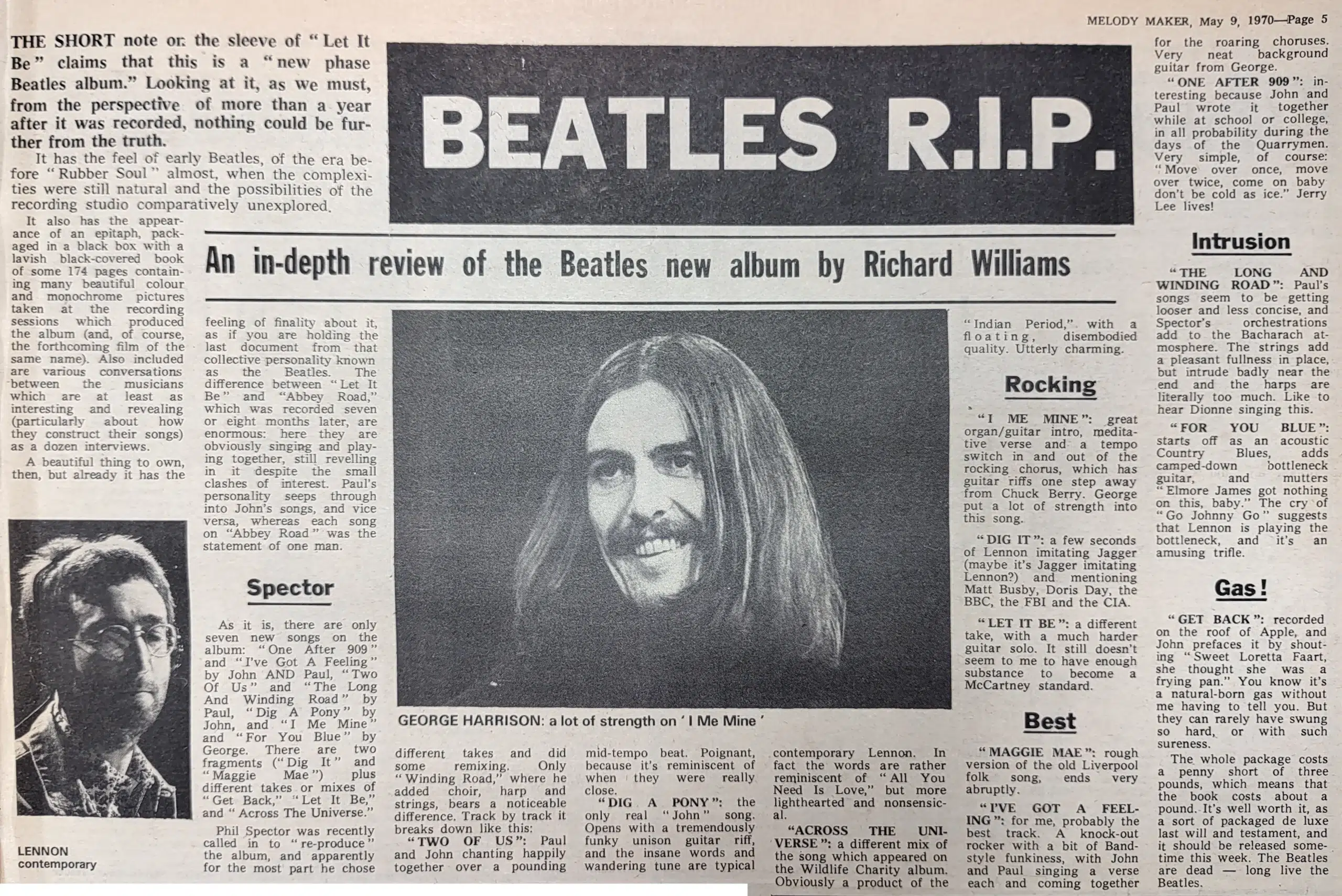
BEATLES R.I.P. An in-depth review of the Beatles new album by Richard Williams
THE SHORT note on the sleeve of “Let It Be” claims that this is a “new phase Beatles album.” Looking at it, as we must, from the perspective of more than a year after it was recorded, nothing could be further from the truth.
It has the feel of early Beatles, of the era before “Rubber Soul” almost, when the complexities were still natural and the possibilities of the recording studio comparatively unexplored.
It also has the appearance of an epitaph, packaged in a black box with a lavish black-covered book of some 174 pages containing many beautiful colour and monochrome pictures taken at the recording sessions which produced the album (and, of course, the forthcoming film of the same name). Also included are various conversations between the musicians which are at least as interesting and revealing (particularly about how they construct their songs) as a dozen interviews.
A beautiful thing to own, then, but already it has the feeling of finality about it, as if you are holding the last document from that collective personality known as the Beatles. The difference between “Let It Be” and “Abbey Road,” which was recorded seven or eight months later, are enormous: here they are obviously singing and playing together, still revelling in it despite the small clashes of interest. Paul’s personality seeps through into John’s songs, and vice versa, whereas each song on “Abbey Road” was the statement of one man.
As it is, there are only seven new songs on the album: “One After 909” and “I’ve Got A Feeling” by John AND Paul, “Two Of Us” and “The Long And Winding Road” by Paul, “Dig A Pony” by John, and “I Me Mine” and “For You Blue” by George. There are two fragments (“Dig It” and “Maggie Mae”) plus different takes or mixes of “Get Back,” “Let It Be,” and “Across The Universe.”
Phil Spector was recently called in to “re-produce” the album, and apparently for the most part he chose different takes and did some remixing. Only “Winding Road,” where he added choir, harp and strings, bears a noticeable difference. Track by track it breaks down like this:
“TWO OF US”: Paul and John chanting happily together over a pounding mid-tempo beat. Poignant, because it’s reminiscent of when they were really close.
“DIG A PONY”: the only real “John” song. Opens with a tremendously funky unison guitar riff, and the insane words and wandering tune are typical contemporary Lennon. In fact the words are rather reminiscent of “All You Need Is Love,” but more lighthearted and nonsensical.
“ACROSS THE UNIVERSE”: a different mix of the song which appeared on the Wildlife Charity album. Obviously a product of the “Indian Period,” with a floating, disembodied quality. Utterly charming.
“I ME MINE”: great organ/guitar intro, meditative verse and a tempo switch in and out of the rocking chorus, which has guitar riffs one step away from Chuck Berry. George put a lot of strength into this song.
“DIG IT”: a few seconds of Lennon imitating Jagger (maybe it’s Jagger imitating Lennon?) and mentioning Matt Busby, Doris Day, the BBC, the FBI and the CIA.
“LET IT BE”: a different take, with a much harder guitar solo. It still doesn’t seem to me to have enough substance to become a McCartney standard.
“MAGGIE MAE”: rough version of the old Liverpool folk song, ends very abruptly.
“I’VE GOT A FEELING”: for me, probably the best track. A knock-out rocker with a bit of Band-style funkiness, with John and Paul singing a verse each and coming together for the roaring choruses. Very neat background guitar from George.
“ONE AFTER 909”: interesting because John and Paul wrote it together while at school or college, in all probability during the days of the Quarrymen. Very simple, of course: “Move over once, move over twice, come on baby don’t be cold as ice.” Jerry Lee lives!
“THE LONG AND WINDING ROAD”: Paul’s songs seem to be getting looser and less concise, and Spector’s orchestrations add to the Bacharach atmosphere. The strings add a pleasant fullness in place, but intrude badly near the end and the harps are literally too much. Like to hear Dionne singing this.
“FOR YOU BLUE”: starts off as an acoustic Country Blues, adds camped-down bottleneck guitar, and mutters “Elmore James got nothing on this, baby.” The cry of “Go Johnny Go” suggests that Lennon is playing the bottleneck, and it’s an amusing trifle.
“GET BACK”: recorded on the roof of Apple, and John prefaces it by shouting “Sweet Loretta Faart, she thought she was a cleaner, but she was a frying pan.” You know it’s a natural-born gas without me having to tell you. But they can rarely have swung so hard, or with such sureness.
The whole package costs a penny short of three pounds, which means that the book costs about a pound. It’s well worth it, as a sort of packaged de luxe last will and testament, and it should be released sometime this week. The Beatles are dead — long live the Beatles.
From Melody Maker – May 9, 1970
An expensive memento of the Beatles…
“LET IT BE,” the latest (and last?) album from the Beatles, will long be remembered, either as the greatest-ever fan farewell gift, or the biggest disappointment ever! Disappointment is the album runs barely 15 minutes a side and sells at £2.19.11. That price includes of course the special packaging and the luxurious multi-coloured picture book that comes “free of charge.”
If you like looking at photographs of the Beatles as they were 12 months ago, then the book is unsurpassed. It’s 90 per cent pictures, and 90 per cent of those in colour, all taken at the Twickenham studios where the film “Let It Be” was largely made. The other 10 per cent is words, a curious, very Beatle-like string of dialogues which may or may not be part of the film script and which certainly read very disjointedly on their own (rather like a verbal Christmas record).
A McCartney quote worth recording, though is: “(The Beatles) haven’t been positive. That’s why all of us in turn have been ill of the group. There’s nothing positive in it. It’s a bit of a drag. The only way for it not to be a drag is for the four of us to say should we make it positive or should we forget it.” Right — then you realise Paul said that a full year ago.
That’s the book, plushly presented, and either a priceless treasure or a thorough waste of the extra £1.
This, track by track, is the music:
TWO OF US opens side one, a jogging acoustic piece with John and Paul harmonising and delicate guitar phrasing from George. An intimate charming song, with a hint of sadness.
DIG A PONY is a Lennon special, using words for sound rather than meaning. A very slow-paced song with a good harmony chorus.
ACROSS THE UNIVERSE is well known. This version lacks the technical refinements and voice echo, recorded (as were all the tracks) “live”, i.e. in just one take.
I ME MINE is a Harrison song with Billy Preston on organ and George’s guitar wailing. Paul sings the wistful refrain then it’s all-stops-out for the crashing chorus. Strings and brass added later, thanks to Phil Spector, and luckily they’re unobtrusive.
DIG IT is a 30-second nonsense “Rolling Stone” thing from John, going straight into LET IT BE. Again a different version, though detectable by George’s guitar solo. MAGGIE MAY is another 30-seconds throw-away of the traditional and ends the side.
I’VE GOT A FEELING opens side two and smacks of the songs Paul includes on “McCartney.” Wailing voice on a straight blues number.
ONE AFTER 909 is Chuck Berry stuff — a typical railway rocker taken at a fair old pace and lifted by more Preston organ.
THE LONG AND WINDING ROAD would have been “Michelle” or “Yesterday” of the album. Right in the McCartney tradition, but completely and utterly ruined by Phil Spector’s orchestral chorus. Yes, a female choir.
FOR YOU BLUE is George’s other contribution, a country blues thing with John “doing an Elmore James.” And a sudden-ending version of GET BACK is the closer.
Does it stand up on its own? Will it sound better having seen the film? Is it worth £3?
From Disc And Music Echo – May 9, 1970

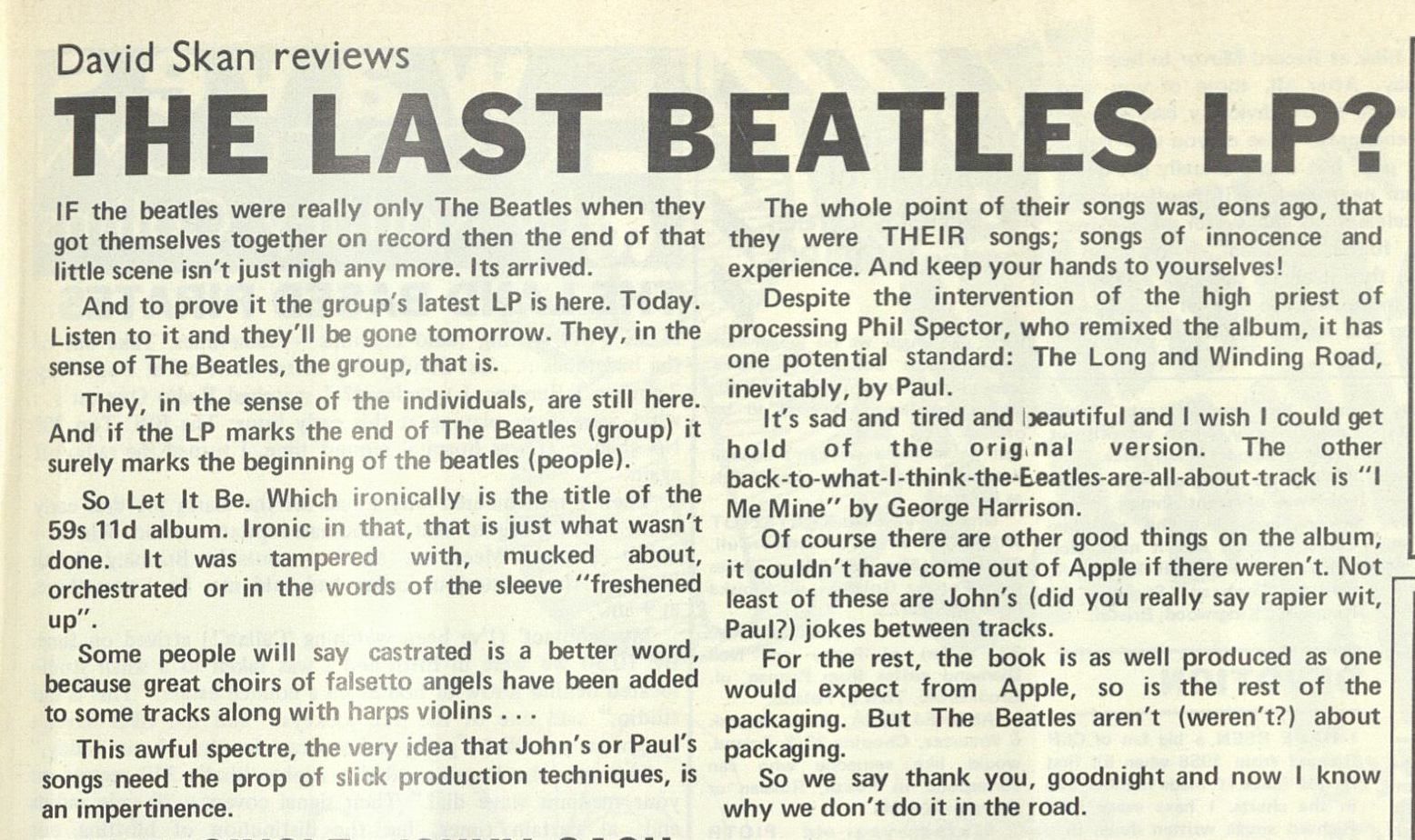
THE LAST BEATLES LP?
IF the Beatles were really only The Beatles when they got themselves together on record then the end of that little scene isn’t just nigh any more. It’s arrived. And to prove it the group’s latest LP is here. Today. Listen to it and they’ll be gone tomorrow. They, in the sense of The Beatles, the group, that is.
They, in the sense of the individuals, are still here. And if the LP marks the end of The Beatles (group) it surely marks the beginning of the beatles (people).
So Let It Be. Which ironically is the title of the 59s 11d album. Ironic in that, that is just what wasn’t done. It was tampered with, mucked about, orchestrated or in the words of the sleeve “freshened up”.
Some people will say castrated is a better word, because great choirs of falsetto angels have been added to some tracks along with harps violins… This awful spectre, the very idea that John’s or Paul’s songs need the prop of slick production techniques, is an impertinence. The whole point of their songs was, eons ago, that they were THEIR songs; songs of innocence and experience. And keep your hands to yourselves!
Despite the intervention of the high priest of processing Phil Spector, who remixed the album, it has one potential standard: The Long and Winding Road, inevitably, by Paul. It’s sad and tired and beautiful and I wish I could get hold of the original version. The other back-to-what-I-think-the-Beatles-are-all-about-track is I Me Mine by George Harrison.
Of course there are other good things on the album, it couldn’t have come out of Apple if there weren’t. Not least of these are John’s (did you really say rapier wit, Paul?) jokes between tracks.
For the rest, the book is as well produced as one would expect from Apple, so is the rest of the packaging. But The Beatles aren’t (weren’t?) about packaging. So we say thank you, goodnight and now I know why we don’t do it in the road.
From Record Mirror – May 9, 1970
BEATLES LP REVIEW – Let It Be – Apple PCS 7096/PXS 1
RELEASE OF this album has had the longest and largest buildup of any in pop music. Recorded in early 1969 and first expected to be issued last summer, the tracks were finally handed over to Phil Spector two months ago for some final first aid. None of the Beatles was particularly knocked out with the original production and mixing, and had lost interest.
Spector changed some of the takes, remixed most of them, and the sleeve Spector is given a credit for ‘re-producing’ the album. Gratitude is also extended to George Martin, but his contribution remains unspecified.
There is some confusion as to whether or not this is to be the last Beatles album. If the Beatles were to return to the studio as a group only to fulfil contractual commitments, it is unlikely that the new efforts would compare favourably with those of the past.
The presentation of the pack is superbly effective and beautifully executed. The accompanying book containing over 150 pages of mostly full-colour photographs and text is overwhelming in its flashy luxury. In many ways it is also highly irrelevant — the excitement of pop-star pin-ups is more attuned to the idolatry of five years ago. Even with the Beatles, consumers today are more into the music than the personalities.
Nevertheless, the design by John Kosh and the printing by Garrod and Lofthouse and [is] flawless in every respect.
Of the 12 tracks on the record, four are exceptional. And three of these have already been available to the public — the title track, Get Back and Across the Universe, the last dating back to the time Sergeant Pepper was recorded. The fourth standout is The Long and Winding Road, which seems the most likely candidate for cover versions.
Eight of the tunes are credited to ‘Lennon–McCartney’. I Me Mine and For You Blue are Harrison compositions of organic simplicity which fail to achieve the calibre of his earlier Something. Dig It and Maggie Mae are two jokey and brief throwaways credited to all four, the latter providing comic relief after the religious solemnity of Let It Be.
The deft hand of Spector is such that it is felt without really being noticed — Spectral effects, such as the merest hint of a full choir on Across the Universe and the reverberation of the cymbals in the early bars of Let It Be.
Even at 59s 11d, Let It Be cannot fail to be a massive seller. The price could scare away the customers only marginally interested in the Beatles, but the curiosity factor is high.
From Record Retailer – May 9, 1970

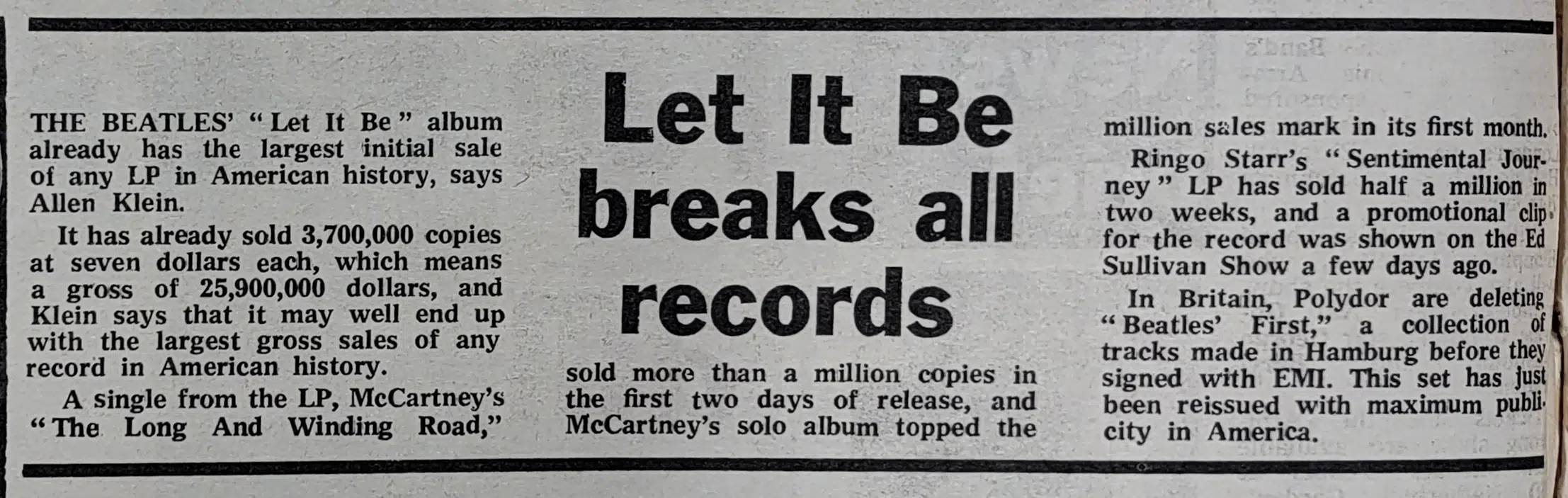
Let It Be breaks all records
THE BEATLES’ “Let It Be” album already has the largest initial sale of any LP in American history, says Allen Klein.
It has already sold 3,700,000 copies at seven dollars each, which means a gross of 25,900,000 dollars, and Klein says that it may well end up with the largest gross sales of any record in American history.
A single from the LP, McCartney’s “The Long And Winding Road,” sold more than a million copies in the first two days of release, and McCartney’s solo album topped the million sales mark in its first month.
Ringo Starr’s “Sentimental Journey” LP has sold half a million in two weeks, and a promotional clip for the record was shown on the Ed Sullivan Show a few days ago.
In Britain, Polydor are deleting “Beatles’ First,” a collection of tracks made in Hamburg before they signed with EMI. This set has just been reissued with maximum publicity in America.
From Melody Maker – May 23, 1970
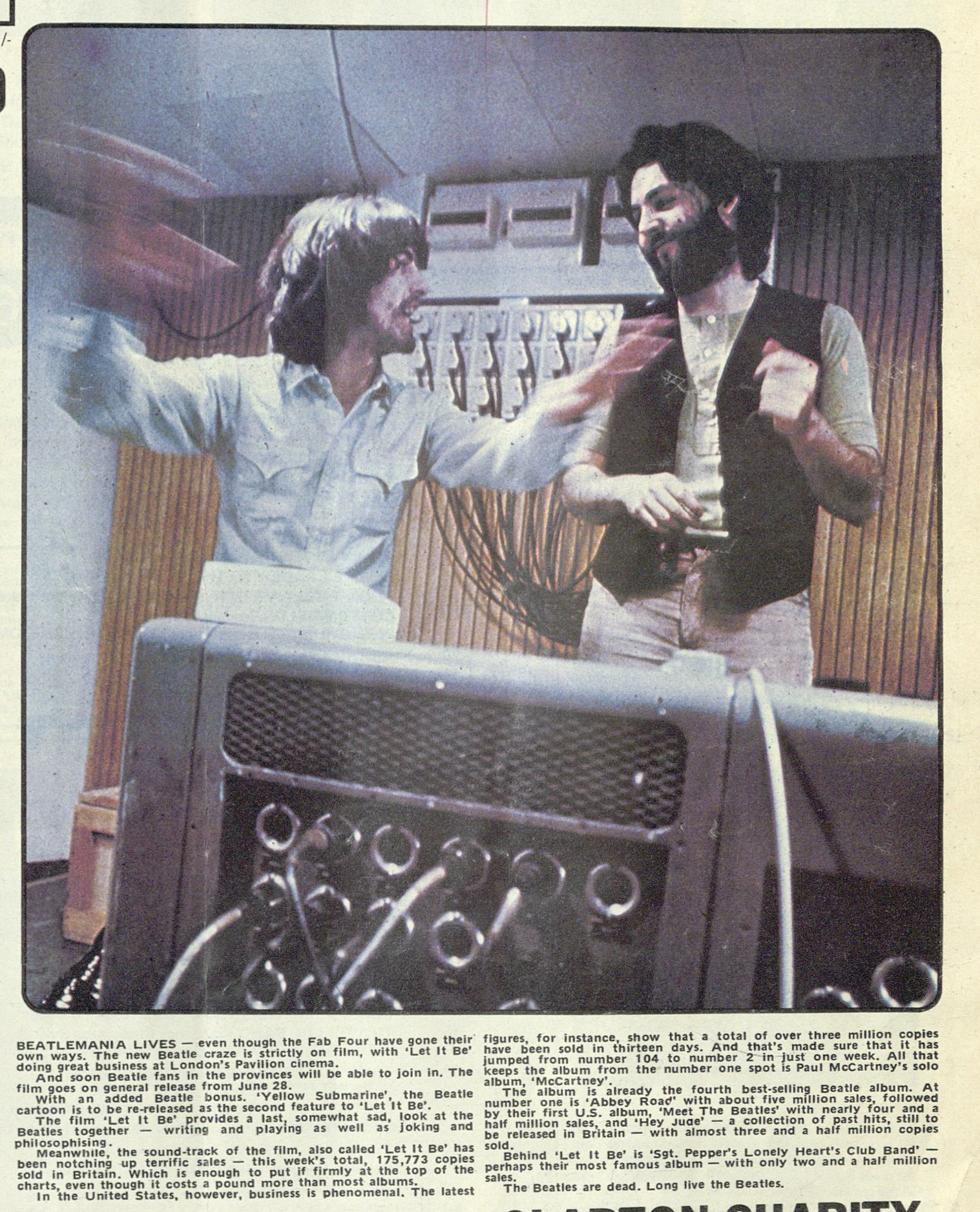
BEATLEMANIA LIVES
… even though the Fab Four have gone their own ways. The new Beatle craze is strictly on film, with ‘Let It Be’ doing great business at London’s Pavilion cinema. And soon Beatle fans in the provinces will be able to join in. The film goes on general release from June 28. With an added Beatle bonus. ‘Yellow Submarine’, the Beatle cartoon is to be re-released as the second feature to ‘Let It Be’.
The film ‘Let It Be’ provides a last, somewhat sad, look at the Beatles together — writing and playing as well as joking and philosophising.
Meanwhile, the sound-track of the film, also called ‘Let It Be’ has been notching up terrific sales — this week’s total, 175,773 copies sold in Britain. Which is enough to put if firmly at the top of the charts, even though it costs a pound more than most albums.
In the United States, however, business is phenomenal. The latest figures, for instance, show that a total of over three million copies have been sold in thirteen days. And that’s made sure that it has jumped from number 104 to number 2 in just one week. All that keeps the album from the number one spot is Paul McCartney’s solo album, ‘McCartney’.
The album is already the fourth best-selling Beatle album. At number one is ‘Abbey Road’ with about five million sales, followed by their first U.S. album, ‘Meet The Beatles’ with nearly four and a half million sales, and ‘Hey Jude’ — a collection of past hits, still to be released in Britain — with almost three and a half million copies sold.
Behind ‘Let It Be’ is ‘Sgt. Pepper’s Lonely Heart’s Club Band’ — perhaps their most famous album — with only two and a half million sales.
The Beatles are dead. Long live the Beatles.
From Record Mirror – June 6, 1970


Notice any inaccuracies on this page? Have additional insights or ideas for new content? Or just want to share your thoughts? We value your feedback! Please use the form below to get in touch with us.


